Showing posts with label Achaemenid Empire. Show all posts

Saturday, October 19, 2019

Apadana Staircase, a way to fabled Persian art

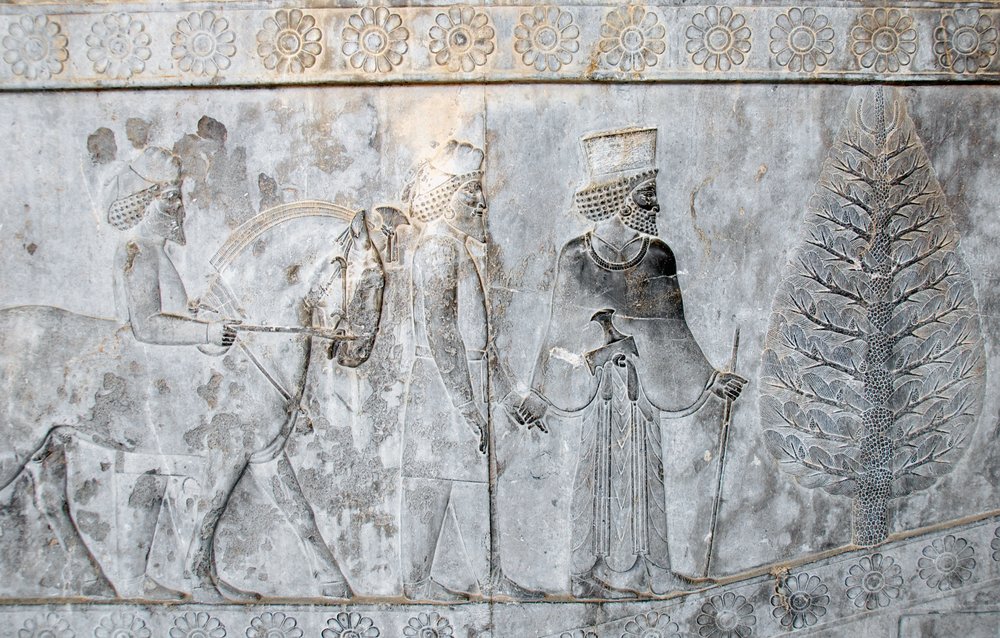
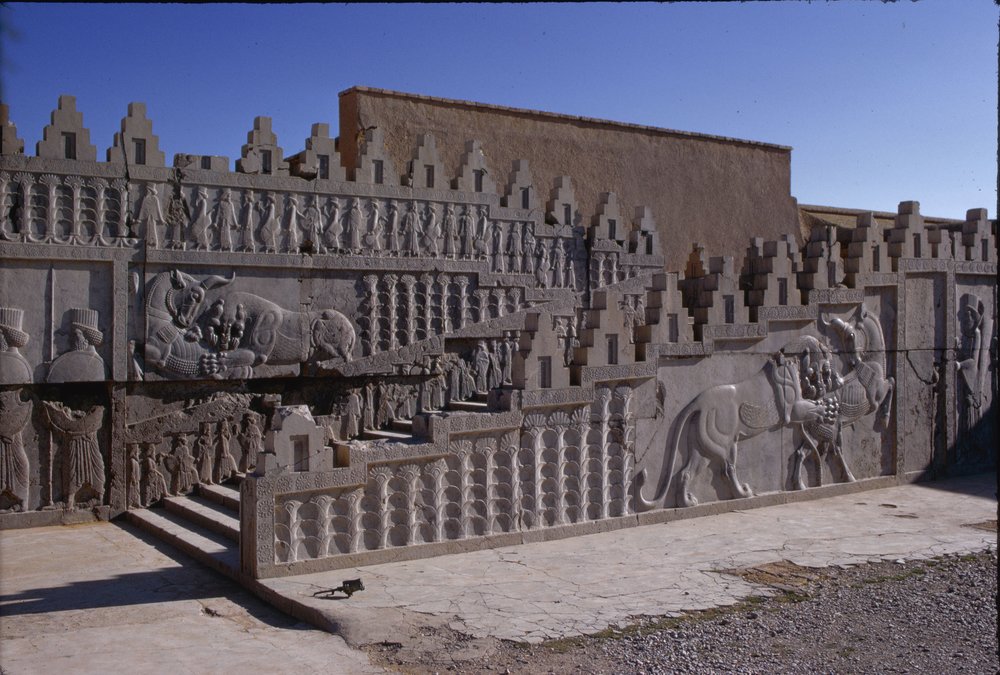
TEHRAN – The ruins of Apadana Staircase shows off and offers scenes of historic Persian arts to its domestic and foreign visitors.
The lavishly decorated monument stands within the UNESCO-registered Persepolis, which was once the ceremonial capital of Persian Achaemenid Empire (550 –330 BC).
The Staircase features finely crafted frieze in three major panels, each divided into several tiers depicting sovereigns, dignitaries and the then visitors to the city.
The northern panel itself is divided into three tiers of well-preserved bas-relief figures of Persian nobility including the Imperial Guard and the Immortals.
Detail depicts bas-relief carvings of some tribute bearers on the Apadana Staircase
According to the Lonely Planet, on the upper tier, the figures are followed by the royal procession, valets and horses of the king’s chariot; on the lower two tiers these figures precede Persians wearing feather headdresses and Medes in their round caps.
The central panel of the staircase is dominated by traditional symbol of Zoroastrianism which is flanked by two winged lions with human heads.
Elaborate panels at the southern end of the staircase depicts a record of nations, showing 23 delegations bringing their gifts to an Achaemenid king. The Ethiopians begin the frieze in the bottom left corner and are joined by Arabs, Thracians, Kasmiris, Parthians and Cappadocians. The Elamites, Egyptians and Medians occupy the panel at top right. Accompanying this pantheon of guests are an assortment of delicately carved sheep with ram’s horns and curled wool, two-humped Bactrian camels, oxen and mules.
A view of the Apadana Staircase in Persepolis
On the northern panel exists inscriptions with fairly stereotypical texts by king Xerxes; one in Old Persian and others in Elamite and Babylonian.
According to livius.org, a website on ancient history written and maintained since 1996 by the Dutch historian Jona Lendering, parts of the inscriptions read as:
“A great god is Ahuramazda, who created this earth, who created that heaven, who created man, who created happiness for man, who made Xerxes king: the king of many kings, one ruler of many rulers.”
“I am Xerxes, the great king, king of kings, king of all nations, having various kinds of people, king in this great earth far and wide, the son of king Darius, an Achaemenid.”
In 330 BC, the staircase was miraculously survived the sack of Persepolis by the soldiers of Alexander the Great. The staircase is currently protected by a permanent shelter.

Tuesday, August 06, 2019

Cruelty & stupidity are hallmarks of US moves

Martin Love
The quixotic US president, Donald Trump, and his idiotic administration have continued to commit blunder after blunder, both at home and abroad, especially against the Islamic Republic of Iran despite their policy of economic terrorism in violation of the UN charter and international law.
Stay with us for an article by Martin Love, editor of the British daily Observer, titled: “Cruelty & Stupidity are Hallmarks of US moves”.
One huge lie zipping around the Internet of late is the depiction of a map showing the extent of the Persian Empire in 300 BC, as it is labeled. It shows that the Achaemenid dynasty controlling lands stretching from a part of Europe west of the Bosporus across Anatolia to Bactria in Central Asia and what today is Pakistan and western India.
Captions seen with the map are suggesting this same extent of rule or control is exactly what Iran’s leaders are eyeing today, as if Iran is on some grand offensive to re-create the Achaemenid territorial reach. This propaganda in support of Western and particularly American hostilities towards Iran is sheer madness because it is false. Iran merely wants to grow and develop as it is now territorially.
But the propaganda map is a joke, too, because in 300 BC the Achaemenid empire of antiquity had broken by the Macedonian marauder, Alexander, and moreover by 300 BC Alexander had been dead for over a decade and various former generals and compatriots of his were squabbling over who was going to get what of the lands of the Persian Empire that he had conquered. A stupidity piled atop a stupidity is the map itself.
Indeed, the most glaring earmarks of this century so far are two: stupidity, which is bad enough, but also cruelty, which is much worse, especially when it is based on stupidity. And this foisted upon the world by leaders, and they can easily be named with Trump and Netanyahu in the top positions, who by any assessment of their mentalities by professional psychologists, must be declared deeply damaged if not insane. (One might suggest impairment also for outgoing Theresa May, Jair Bolsonaro of Brazil, Macron in France and a host of less visible “leaders” of US puppet countries around the world),
The cruelty factor seems to play out almost daily, which does a tag team routine with the stupidity factor. Take what happened in the past week in Wadi Hummus on the outskirts of East Bayt al-Moqaddas on land the Palestinians allegedly control and where they were building or already had mostly built up a handful of high-rise apartment buildings for several hundred Palestinian residents. So, one morning hundreds of Israeli troops and police show up suddenly with teams planting explosives and deploying various other implements of destruction like bulldozers, order the residents out of these buildings so fast they barely have time to take ANY of their belongings, and over the next few hours reduce the entire neighborhood to rubble. This was such “in your face” ethnic cleansing that it literally shocked the world.
Why, allegedly? Because these apartment building were supposedly too close to the illegal separation wall or barrier that the Zionists earlier placed like a long viper across parts of the West Bank. And then, when the UN Security Council attempted to condemn the destruction in Wadi Hummus, the US (the stupidity factor) objection to the measure killed it.
Events of the same low-calibre sense but high-level cruelty are occurring almost daily under the aegis, distant or far, of the Trump Administration. Like for example with Brazil’s refusal (no doubt on command of the Trump gang) to fuel two Iranian ships laden with Brazilian agricultural produce. Like for example at the behest of the US the authorities in Gibraltar changing their laws immediately this month to accommodate the piracy against and capture of an Iranian oil tanker allegedly taking fuel to Syria.
But perhaps the greatest stupidity and cruelty so far of late is Trump’s declaration that he could end the war in Afghanistan in a few days, and murder 10 million people, if he wanted. This is megalomaniacal cruelty. This is not something anyone in their right mind would even consider, much less speak about. And do not doubt he was speaking less to Afghanistan than he was to Iran, where sanctions have hurt the working and middle classes. It was a threat, pure and simple. In addition, the US and the British have been talking about some kind of naval armada to “escort” ships through the Persian Gulf and the Strait of Hormuz, as if transit has been endangered by Iran. This ploy really amounts to nothing more than a military blockade of Iran in the Persian Gulf and the Gulf of Oman.
Any analysis of these moves suggests that Trump, who claims he does not want a war, in fact really does because he ought to realize that he is not fomenting an uprising in Iran, but shoring up the determination of Iranians to resist and support their government. In fact, one can imagine that Trump does not know what he wants exactly except submission -- as if he’s playing some sort of crude hardball to get a business (rather than a necessary diplomatic) deal he likes. But he will never get his kind of deal, even while he believes he can have it with John Bolton nearby. Bolton’s eagerness to kill Iranians, Trump thinks, is a bargaining chip. It’s another “good cop, bad cop” routine…which is so shallow and lacking in smarts and sophistication and sensibility as any kind of pseudo “diplomatic” strategy, it has already failed.
So again, what’s Iran to do? It seems straightforward. Respond in kind but no more than in kind to aggression on Iran’s interests, make sure the craven Trumpists and allies realize Iran isn’t kidding about shutting down resource shipments through the Persian Gulf if it is attacked militarily, and above all remain cool headed and patient.
Iran is not rebuilding the Persian Empire, but the US Empire is beginning to implode.

Tuesday, January 29, 2019

History of Martial Music in Iran

By
 Hedieh Lahiji


It is said that the martial music in Iran dates back to Achaemenid period. Since then, military songs have been used to muster courage in the soldiers fighting in the battlefield to gain further victories against enemies.
Xenophon of Athens, an ancient Greek philosopher and historian is quoted as saying that just before his army’s confrontation with the Assyrian troops; Cyrus the Great, the founder of the Achaemenid Empire, the first Persian Empire, began to sing a song echoed loudly and respectfully by his military men. When the song came to an end, the army began to march resolutely towards the army of the enemy with long and regular strides.

During wars, the music band members used camels to relocate their heavy instruments. They also played exciting music in the battlefield to encourage the soldiers and improve their morale.
As a foreigner, who had lived for years in the historical city of Esfahan the capital city of Iran under Safavid dynasty four centuries ago, the French traveler Jean Chardin referred in his memoire to a number of Naqareh Khaneh in the city in which the music players began to play Naqareh and Dohol, an Iranian music instrument which is three times larger than European drum, on sunrise or sunset.
Alfred Jean Baptiste Lemaire
Jean-Baptiste Tavernier, a French merchant and traveler in 17th-century has also described a Naqareh Khaneh in Shah Square in Isfahan as a place for holding concerts beginning on sunset and sunrise with their music voices echoing across the city.
In the Naser al-Din Shah Qajar’s era, the music band of the court had to play during Eid holidays, his trips to the countryside, court formalities and Tazieh rituals held in Tekyeh Dowlat. Meanwhile, each day, the band began to play one hour before the sunset in the yard of Marble Throne. They also played music at the request of individuals for their marriage ceremony.
Years after the inauguration of Dar ul-Funun in 1851 as the first modern university and modern institution of higher learning in Iran, the then government established a new branch of the institution called Music Branch. A French musician called Alfred Jean Baptiste Lemaire was hired to teach music there. Lemaire trained many leading students in music area. So, gradually the world “music” referring to martial music bands began to replace the former Naqareh Khaneh in Iran.
Salar Mo’azez
Salar Mo’azez was one of Lemaire’s leading students who later became his deputy in Music Branch. He left Iran for Russia for supplementary studies in music. Having finished his education there, he returned to Iran replacing Lemaire. He also made a national song.
Years later, Turkish former President Mustafa Kemal Atatürk officially invited Iran’s ex-ruler Reza Shah in 1933 to visit Turkey. Upon protocol requirements, the Turkish side asked the Iranian government to send a copy of its national song’s musical note for playing during the official welcome ceremony for the Iranian king to Turkey.
Therefore, the Iranian army was asked by the government to prepare a note of a national song by the army’s music band. The created song was played as the national song of the country for the next 45 years.
After the victory of the Islamic Revolution in Iran in 1979, Iranian musicians made a large number of songs during the Sacred Defense era to encourage the Iranian soldiers in their fight against the Iraqi army under former dictator Saddam Hossein.
But, given the importance of creating epic music as well as brining up new players and musicians in the military music area, the government of Iran decided in 1994 to establish a music faculty in Tehran Art University. Sharif Lotfi played a key role in the establishment of the faculty.
Military music consists of three types of music: Percussion, wind and woodwind instruments.
Today, the martial music band of the Islamic Republic of Iran’s Army consists of various musicians and players who are specialists in their area of expertise.