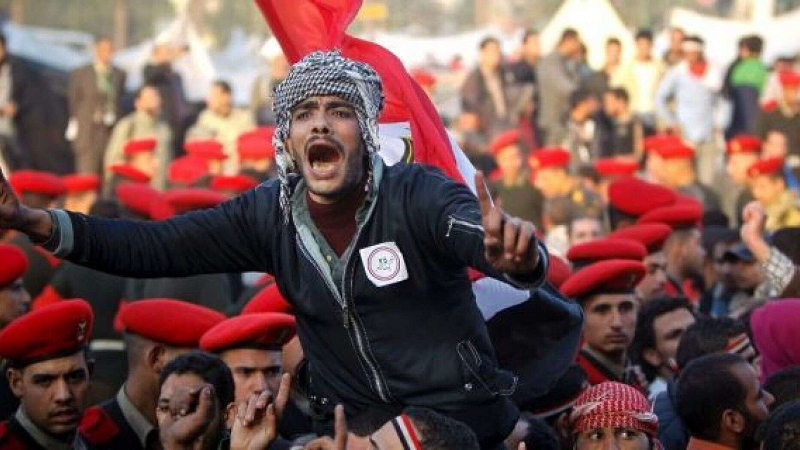
This month (December 2019) marks nine years since Islamic Awakening movements in Arabian countries erupted in the public square. Even though the demonstrations were spontaneous and organic, in the early stages they were mainly led and organized by Islamic organizations. Seeing these uprisings as a threat to neo-colonial interests, the Western corporate media and NATO regimes cunningly branded the uprisings as the “Arab Spring.” Unfortunately, it was not just the tag that was co-opted by Western powers but also the legitimate grievances of the oppressed people that had rebelled against Western-backed autocracies.
Last year, Crescent International had analyzed whether the process of the Islamic Awakening movement was worth it. Our analysis concluded that “it was absolutely necessary and it is a great blessing even in places where events went completely off-track… Post-2011 events, no regional dictator can afford to disregard the popular backlash. Violence is no longer the monopoly of corrupt and oppressive regimes. Of course, the elimination of monopoly on force by illegitimate regimes created its own problems, like ISIS and others, but these are short-term problems that are slowly but surely being eliminated.”
In this article, we would like to focus on the other side of the issue: where did the Islamic Awakening process go wrong? Naturally, there are numerous local reasons for each country where the popular uprising was co-opted and went off-track. Nevertheless, there are certain common denominators that can be observed in most places where the autocrats and their NATO backers managed to hijack the popular uprisings and subdue the masses.
During the uprisings, most of the Muslim world had big expectations of the Egyptian people finally taking their destiny into their own hands. However, within two years, Egypt was back in the clutches of the NATO backed autocratic system.
In a widely read column, ICIT’s director Zafar Bangash had looked at why one of the oldest Islamic socio-political movements — the Muslim Brotherhood — lasted in power for only one year, while the Islamic system in Iran has governed for 40 years and is only getting stronger. In the column titled, “Egypt and Iran: why different outcomes?” the ICIT Director stated, “The Ikhwan made the mistake of working within the system while Imam Khomeini understood that the existing system had to be demolished.” This author would add that the Ikhwan tried to work not only within the system, they tried to mold themselves into the system’s strategic architecture. Nothing manifested this better than the Ikhwan-backed government’s decision to shut down the Syrian embassy while keeping the Israeli embassy open, which is much more than an embassy. It is a state within a state in Egypt.
In August 2013, Foreign Affairs magazine pointed out that “security and intelligence cooperation between Israel and Egypt actually thrived during Mursi’s presidency.” During his short-lived presidency, as reported by Al-Monitor and others, “He [Mursi] appointed a new ambassador to Israel and sent a letter to President Shimon Peres, whom he addressed as, ‘My great and good friend.’ At the time, Peres said to me, ‘I would understand if he wrote, ‘Your Honor, my dear Mr. President,’ or something like that, but to write ‘My great and good friend,’ when he never actually met me is a bit over the top.’ In the letter, Mursi affirmed his commitment to maintaining good relations between Egypt and Israel.”
These missteps clearly reflect lack of clear thinking as well as self-confidence. Through such simplistic policies, the Ikhwan tried to show “pragmatism” but what it did was send a signal to the old guard that the movement lacks confidence to pursue its vision and can be confronted.
Another key malfunction of mass protest movements in the Arab world was the lack of God-consciousness among the leadership. To replace a corrupt governing system, one must possess competent and courageous human cadre. Since the protests were spontaneous and were not initially backed by any organized socio-political movement, it is understandable that in the initial stages, the masses would be leaderless. However, once the protests took off, the lack of cadre was evident. Even one of Arab world’s leading Islamic figures, Yusuf al-Qaradawi, was not able to see through the fog.
There are two fundamental reasons for the lack of identifiable leadership of the protest movements. It may even be a blessing in disguise. For, as soon as the leaders are known, the autocratic regimes would immediately go after them and throw them in prison. For decades, Western backed autocratic regimes have purged their societies of potential leaders to remain in power. Second, and this is the downside of it, most of the leaders of Islamic movements compromised themselves by latching on to Saudi sponsored or linked institutions.
The “Arab Spring” protests started with a lot of promise but ended up with promises of more of the same. One of the fatal mistakes was that the protest leaders failed to recognize the magnitude of the power they had in their hands. The power of the street was enough to overturn the whole system of corruption and abuse; however they chose to use their power to work through the corrupt system with the objective of reforming it — and at that moment, the system defeated them. The same thing happened with the Occupy Wall Street movement in the US.
While the first weakness is not in the hands of the leaders and local socio-political organizations in the Arab world, the second weakness is entirely of their own making. The primary reason for the second flaw — indeed a fatal weakness — is the absence of independent financial resources. Riyadh and other US allies masterfully utilize money to subtly subordinate Islamic leaders, often without their realization, to promote the policies of these regimes.
One of the primary reasons the Islamic movement in Iran succeeded in toppling the Western backed tyranny of the Shah was that the Islamic leadership in Iran had access to independent financing through the khums tax. This has not received adequate attention in contemporary Sunni Islamic jurisprudence even though it is also part and parcel of it. Perhaps it is time for Sunni scholars to broaden the definition of khums. Lack of ijtihad among Sunni ‘ulama’ on this crucial aspect has created practical weaknesses for Sunni Islamic organizations. It has forced many to ally themselves with wealthy monarchies of the Persian Gulf region compromising their position.
Another key weakness of Islamic Awakening was the media. Activists and socio-political organizations involved in mobilizing the masses analyzed the process through the prism of Western media. They did not create their own indigenous narrative of events.
The current ground reality is that in all locales where people staged uprisings against the Western backed autocrats there has been no change in governance except in Yemen. In Tunisia, the protest movement achieved some progress, albeit limited, primarily because the eruption of protests caught the imperialists by total surprise. Thus, they could not make adequate preparations to save the regime in its entirety. However, the main Islamic opposition force in Tunisia, al-Nahdah, has accepted to play within the rules set by remnants of the old guard. Thus, Tunisia remains within the French sphere of neo-colonial influence.
In Libya and Syria, NATO regimes completely manipulated the protest movements and utilized them as sledgehammers for their geopolitical objectives. However, the US-Israeli project in Syria was aborted due to Iran, Hizbullah, and Russia’s steadfast position. Another reason why NATO’s plans in Syria did not materialize is that they became victims of their own propaganda. They swallowed the fictitious narrative of the sectarian nature of the Syrian government.
Proof of how NATO regimes manipulated the legitimate grievances of the Islamic Awakening process is the fact that the unrests did not affect any of the regional monarchies. The Persian Gulf regimes are the primary pillars of NATO’s hard and soft influence in the Muslim world. American propaganda outlets even tried to sell this phenomenon as a model of governance for the Muslim world. Why wouldn’t they? When Washington says jump, these regimes say, “How high, sir!”
Overall, the Islamic Awakening process has been stalled. It is alive on the societal level and can reignite at any moment, but the process failed to topple the Western backed regimes. The nature of the problems in the Muslim world is such that societal problems can only be resolved when one possesses power and authority. NGOs and civil activist movements in the Muslim world will have limited effect without power.
People of the region must take control of their destiny by establishing governments that represent their aspirations and are accountable to Allah (swt). Such a government automatically means some form of Islamic governance. This is not a slogan but a societal demand. Although Islamic movements were frustrated in their desire to establish an alternative model of governance, all is not lost. In August 2017, the Muslim Brotherhood’s National Alliance for Reform in Jordan won most seats in municipal elections. This highlights the fact that Muslims generally rely on Islamic socio-political movements for solutions and there is nothing the NATO regimes can do about it. Their only recourse is to derail this phenomenon for a limited period of time.
Clown prince’s bread and circus keeping the people distracted
Yusuf Dhia-Allah
The Najdi Bedouins are not known for their humor. Their Wahhabi literalism does not allow for light talk. Their dour looks and furrowed foreheads betray their inner thoughts, limited as they are. Into this mix you throw in a clown prince and you get a clumsy mess that even Inspector Clouseau would not be able to match.
This is what is going on in “Saudi” Arabia, especially since Muhammad bin Salman (MbS) became crown prince in June 2017. With King Salman suffering from dementia, MbS is the de facto ruler of the medieval kingdom.
He has his finger in every Saudi pie. In addition to being the crown prince, meaning he will succeed his father to the throne, he is also the country’s defence minister, economic czar, head of Aramco, head of security, and his father’s court secretary. MbS also directs the Kingdom’s foreign policy.
And yes, he controls the Kingdom’s media both at home and abroad and is trying to acquire foreign media outlets as well. Despite this, he has not been able to sweep Jamal Khashoggi’s brutal murder in the Saudi Consulate in Istanbul last October under the rug. Khashoggi’s murder story refuses to die. Turkish President Recep Erdogan has made sure it does not. Even the United Nations has pointed the finger at MbS.
Is there anything that he does not control in the Kingdom? With so much power in his grubby hands, it would be reasonable to assume that he would have smooth sailing. Not so. Being the king’s son does not automatically confer intelligence or qualification to rule. There are numerous fault lines and competing interests in the Kingdom, even if he has managed to clamp down on them for now.
Whatever MbS touches turns to dust. Take the country’s oil wealth. Saudi Arabia has been described as America’s gas (petrol) station. Washington determines the price of oil and “Saudi” Arabia obeys, like a slave. Much of the Kingdom’s oil income is spent on buying weapons from the Americans to wage endless wars, and to finance the ruling family’s rapacious lifestyle.
As soon as Bin Salman was appointed defence minister when his father became king in January 2015, he launched the disastrous war against dirt-poor Yemen in March. It is still raging but has achieved few of the military or geo-strategic objectives. Instead, it has inflicted massive suffering on civilians where 22 million of the 24 million Yemenis are on the verge of starvation. More than a million children are afflicted by cholera — “the worst epidemic in history” — according to the UN.
Bin Salman’s other misadventures against Islamic Iran and tiny Qatar have been equally disastrous. The takfiri project — signature mark of the Bani Saud — is also on the rocks as Syrian forces backed by their allies have defeated the terrorist outfit. Perhaps MbS can claim some success in turning the Kingdom into a Zionist colony. It was already subservient to the US. At the same time, he is scurrying to hire mercenaries to protect the teetering kingdom even while being one of the largest importers of weapons in the world.
It is to the Saudi economy that we need to turn our attention to see where it is heading. The Saudis’ days of checkbook diplomacy are over. Oil income has sharply declined since 2014 eating into the regime’s reserves. One-third have been wiped out by budget deficits. At this rate, the Kingdom’s reserves that totaled $750 billion before the oil price crash will disappear in six years.
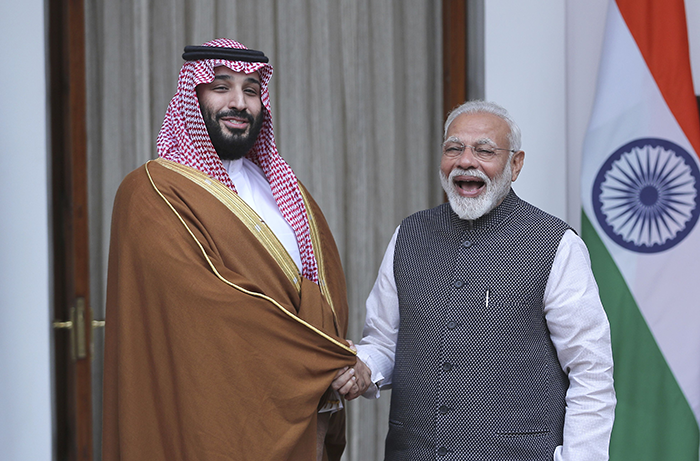
Two tyrants of a feather share a laugh together. Indian Prime Minister Narendra Modi, right, shakes hand with Saudi Crown Prince Muhammad bin Salman before the start of their meeting in New Delhi, 2-20-2019. Bin Salman said his visit to India will improve centuries-old ties, which he said are “in our DNA.” While promising Pakistan only $20 billion, he seeks to enter into contracts with India worth at least $100 billion. Bin Salman needs to achieve two strategic objectives out of his India visit: (1) to expand his security umbrella beyond the orbit of the currently volatile US political scene, and (2) to try to economically asphyxiate Islamic Iran as a deadline nears for India to comply with US sanctions against Iran, one of India’s main oil providers. Even though both of them spoke publicly about countering terrorism, don’t expect Modi to bring up the Khashoggi affair, especially with all those billions and oil on the table, and don’t expect Bin Salman to say anything about Kashmir: it’s all about the Benjamins, baby!
Bin Salman’s “Vision 2030” is already stumbling and is not likely to materialize into anything significant. He continues to harp on it but what else can he do? Similarly, the idea of floating Aramco on the international stock market has fallen apart. It was abandoned last September without offering any explanation.
On December 18, 2018, the king announced a 7% increase in state spending for the 2019 budget to spur the sluggish economy. Spending is projected to rise to 1.106 trillion riyals ($295 billion), from last year’s total of 1.030 trillion riyals ($275 billion). The economy shrank last year.
With government the biggest employer and most Saudis being bone lazy, the jobless rate has hit a record high of 30% among the youth (youth comprise 51% of the Saudi population). Hundreds of thousands of foreign workers (700,000 last year) have been dismissed and have left the Kingdom. They were not paid wages for many months for doing dirty menial work. The regime also imposed hefty visa fees on these poor workers making it impossible for them to continue to work in the Kingdom.
The Saudis are simply not ready or capable of doing the work the expatriates did. They cannot even boil an egg much less change a light bulb. The masakin from Pakistan, India, or Bangladesh did these chores in the past. Now they have been expelled from the Kingdom. Pity the poor Saudis, if they deserve any!
Far from addressing the deep structural faults in the Saudi economy, the regime — or more accurately Bin Salman — has embarked on gimmicks to divert people’s attention. One is the opening of cinemas; the other is holding open-air concerts where Saudi men and women indulge in vulgar behavior. There also plans to open a holiday resort on the Red Sea coast where “everything” will be allowed: gambling, drinking, and of course, the oldest of all professions: prostitution. Welcome to Bin Salman’s moderate, modern “Saudi” Arabia!
Another way to look at the troubled economy is that at the beginning of 2018, the regime imposed a 5% value-added-tax. This indirect method of taxation did not sit well with most Saudis who were used to subsidized services all their life. Fuel subsidies are being eliminated, adding to public angst.
Aware that people cannot be hoodwinked by gimmicks, the regime has embarked on the wholesale arrest of ‘ulama’. Even the mildest form of criticism is not tolerated. Hundreds of leading ‘ulama’ have been arrested and thrown in jail.
Similarly, members of the “royal” family were arrested in early November 2018 for a shakedown at the Ritz Carlton Hotel in Riyadh. Some of them were badly tortured and then forced to sign papers that they would not leave the Kingdom or divulge any information about their mistreatment.
Making too many enemies is never a good idea. Bin Salman is digging his own grave. Many informed observers have opined that he may not be able to succeed his father to the throne, and even if he does, his chances of survival are slim.
Few would shed any tears to the see the back of this horrible man from the desert.