Showing posts with label Najdi Bedouins. Show all posts

Wednesday, April 24, 2019

Bani Saud Reconfirm Barbaric Nature by Mass Executions and Crucifixion

Crescent International
Bani Saud and barbarism are synonymous. The Najdi Bedouins re-confirmed this by the mass execution of 37 people on April 23.
This is the second highest number of executions in a single day following the mass executions on January 3, 2016 when 47 people, including the respected scholar Shaykh Nimr al-Nimr, were executed.
In surpassing their previous barbaric nature, one of the prisoners was crucified after being beheaded. The headless body was left nailed to a pole for several hours to strike terror in the hearts of people.
The executions were carried out in the capital Riyadh and the two holy cities of Makkah and al-Madinah.
The Bani Saud from the backwaters of the Najdi desert have no regard for the sanctity of the two holy cities where bloodshed and warfare are forbidden.
Since their eruption from the desert and being planted as rulers in the Arabian Peninsula by British colonialists, the Najdi Bedouins have indulged in horrific crimes.
The 37 people executed were charged with “terrorism”. This is the standard allegation hurled at anyone that dares ask for basic rights.
The official statement said that the men were charged with “adopting terrorist extremist ideology, forming terrorist cells” and harming the “peace and security of society”.
Despite claiming that the kingdom is governed by the Qur’an and the Sunnah of the Prophet (pbuh), there is no codified law in the medieval kingdom.
Judges hand down sentences against the accused to please the rulers, not deliver justice.
Were Islamic law to be applied fairly, every member of the Bani Saud clan would lose not only both their hands—they are certified thieves—they will also be stoned to death.
They are mass murderers and adulterers.
One of the men executed was aged just 16 at the time of his arrest, according to Amnesty International. All the accused were arrested in 2011 and 2012. During their prolonged imprisonment, they were horribly tortured and forced to confess to their "crimes" in writing.
Such confessions are then presented in court as "evidence". When the prisoners tell the judge that these confessions were extracted under torture, they are accused of making allegations against government officials, itself a crime and subject to further punishment.
These are kangaroo courts whose sole purpose is to find a reason to punish those that have been accused by the regime of some alleged crime. They are not concerned about determining truth. How can anyone expect justice from such a flawed system?
The Bani Saud carry out executions in public, as a barbaric sport. People are invited to witness these horrific acts.
They are also meant to instill fear in people so they would not criticize the regime for its criminal conduct.
Among those executed, at least 14 were convicted of violent offences relating to their participation in anti-government demonstrations, Amnesty International reported. Ten others were accused of "spying for Iran", without providing any proof except their "signed confessions" extracted under torture.
Statistics compiled by Amnesty show that at least 104 people have so far been executed this year in the medieval kingdom.
At this rate, the number of executions in 2019 is likely to surpass last year’s total of 149 executions in the Bedouin-ruled kingdom.
The alarming rise in executions in reality reflects the regime’s nervousness.
It is afraid of increasing unease among people at the failed policies that are making life intolerable for them.
Demands for even basic rights are punished with death while the ruling family lives a life of rapacious extravagance.
All those executed in the recent wave of beheadings were from Qatif, the eastern province that is home to the Shi‘a population.
They are the most oppressed people in the kingdom. The region is underdeveloped and lacks even basic amenities.
Any calls by the population to be granted the same basic rights as other citizens are met with public executions.

Names of 27 out of the 37 people executed on April 23 are given below:

1: Ahmed Hassan Ali al-Rabi‘
2: Ahmed Hussein al-‘Aradi
3: Ahmed Faisal Hassan al-Darwish
4: Jabir Zuhair Jabir al Marhun
5: Hussein Hassan Ali al-Rabi‘
6: Hussein Ali Jasim al-Hamidi
7: Hussein Qasim Ali al-‘Abood
8: Hussein Muhammad Ali al-Muslim
9: Haider Muhammad Ibrahim al-Layf
10: Salman Amin al Salman al-Qurysh
11: Abbas Haji Ahmed al-Hassan
12: Abdul Aziz Hassan Ali al-Sahwi
13: Abdul Karim Muhammad al-Hawwaj
14: Abdullah Salman Saleh al-Asrih
15: Abdullah Adil Hassan al-‘Uoojan
16: Ali Hussein Ali al-‘Ashoor
17: Ali Hussein Ali al-Muhanna
18: Fadil Hassan Abdulkarim Libbad
19: Mujtaba Nadir Abdullah al-Suwaykat
20: Muhammad Hussain Ali al-‘Ashoor
21: Muhammad Saeed Abdrabb al-Rasool al-Khatim
22: Shaykh Muhammad Abdul Ghani Muhammad ‘Atiya
23: Muhammad Mansur Ahmed al-Nasir
24: Mustafa Ahmed Abdullatif Darwish
25: Muntazir Ali Saleh al-Subayti
26: Munir Abdullah Ahmed al-Adam
27: Hadi Yusuf Radhi al-Hazeem

Friday, March 01, 2019

Bin Salman: The Arabian Inspector Clouseau!

Clown prince’s bread and circus keeping the people distracted

Yusuf Dhia-Allah
 
The Najdi Bedouins are not known for their humor. Their Wahhabi literalism does not allow for light talk. Their dour looks and furrowed foreheads betray their inner thoughts, limited as they are. Into this mix you throw in a clown prince and you get a clumsy mess that even Inspector Clouseau would not be able to match.
This is what is going on in “Saudi” Arabia, especially since Muhammad bin Salman (MbS) became crown prince in June 2017. With King Salman suffering from dementia, MbS is the de facto ruler of the medieval kingdom.
He has his finger in every Saudi pie. In addition to being the crown prince, meaning he will succeed his father to the throne, he is also the country’s defence minister, economic czar, head of Aramco, head of security, and his father’s court secretary. MbS also directs the Kingdom’s foreign policy.
And yes, he controls the Kingdom’s media both at home and abroad and is trying to acquire foreign media outlets as well. Despite this, he has not been able to sweep Jamal Khashoggi’s brutal murder in the Saudi Consulate in Istanbul last October under the rug. Khashoggi’s murder story refuses to die. Turkish President Recep Erdogan has made sure it does not. Even the United Nations has pointed the finger at MbS.
Is there anything that he does not control in the Kingdom? With so much power in his grubby hands, it would be reasonable to assume that he would have smooth sailing. Not so. Being the king’s son does not automatically confer intelligence or qualification to rule. There are numerous fault lines and competing interests in the Kingdom, even if he has managed to clamp down on them for now.
Whatever MbS touches turns to dust. Take the country’s oil wealth. Saudi Arabia has been described as America’s gas (petrol) station. Washington determines the price of oil and “Saudi” Arabia obeys, like a slave. Much of the Kingdom’s oil income is spent on buying weapons from the Americans to wage endless wars, and to finance the ruling family’s rapacious lifestyle.
As soon as Bin Salman was appointed defence minister when his father became king in January 2015, he launched the disastrous war against dirt-poor Yemen in March. It is still raging but has achieved few of the military or geo-strategic objectives. Instead, it has inflicted massive suffering on civilians where 22 million of the 24 million Yemenis are on the verge of starvation. More than a million children are afflicted by cholera — “the worst epidemic in history” — according to the UN.
Bin Salman’s other misadventures against Islamic Iran and tiny Qatar have been equally disastrous. The takfiri project — signature mark of the Bani Saud — is also on the rocks as Syrian forces backed by their allies have defeated the terrorist outfit. Perhaps MbS can claim some success in turning the Kingdom into a Zionist colony. It was already subservient to the US. At the same time, he is scurrying to hire mercenaries to protect the teetering kingdom even while being one of the largest importers of weapons in the world.
It is to the Saudi economy that we need to turn our attention to see where it is heading. The Saudis’ days of checkbook diplomacy are over. Oil income has sharply declined since 2014 eating into the regime’s reserves. One-third have been wiped out by budget deficits. At this rate, the Kingdom’s reserves that totaled $750 billion before the oil price crash will disappear in six years.
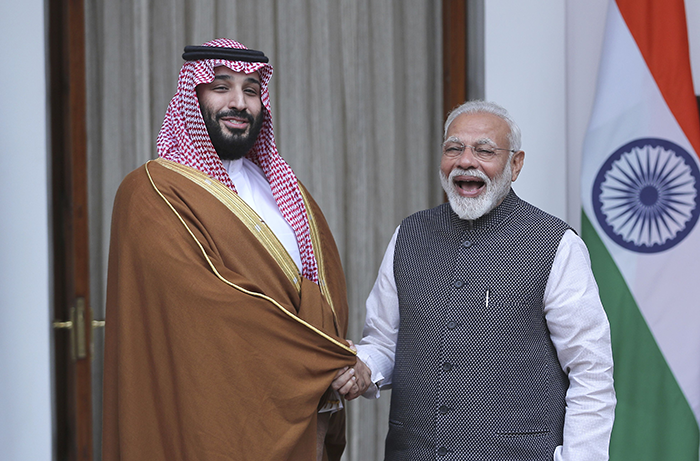
Two tyrants of a feather share a laugh together. Indian Prime Minister Narendra Modi, right, shakes hand with Saudi Crown Prince Muhammad bin Salman before the start of their meeting in New Delhi, 2-20-2019. Bin Salman said his visit to India will improve centuries-old ties, which he said are “in our DNA.” While promising Pakistan only $20 billion, he seeks to enter into contracts with India worth at least $100 billion. Bin Salman needs to achieve two strategic objectives out of his India visit: (1) to expand his security umbrella beyond the orbit of the currently volatile US political scene, and (2) to try to economically asphyxiate Islamic Iran as a deadline nears for India to comply with US sanctions against Iran, one of India’s main oil providers. Even though both of them spoke publicly about countering terrorism, don’t expect Modi to bring up the Khashoggi affair, especially with all those billions and oil on the table, and don’t expect Bin Salman to say anything about Kashmir: it’s all about the Benjamins, baby!
Bin Salman’s “Vision 2030” is already stumbling and is not likely to materialize into anything significant. He continues to harp on it but what else can he do? Similarly, the idea of floating Aramco on the international stock market has fallen apart. It was abandoned last September without offering any explanation.
On December 18, 2018, the king announced a 7% increase in state spending for the 2019 budget to spur the sluggish economy. Spending is projected to rise to 1.106 trillion riyals ($295 billion), from last year’s total of 1.030 trillion riyals ($275 billion). The economy shrank last year.
With government the biggest employer and most Saudis being bone lazy, the jobless rate has hit a record high of 30% among the youth (youth comprise 51% of the Saudi population). Hundreds of thousands of foreign workers (700,000 last year) have been dismissed and have left the Kingdom. They were not paid wages for many months for doing dirty menial work. The regime also imposed hefty visa fees on these poor workers making it impossible for them to continue to work in the Kingdom.
The Saudis are simply not ready or capable of doing the work the expatriates did. They cannot even boil an egg much less change a light bulb. The masakin from Pakistan, India, or Bangladesh did these chores in the past. Now they have been expelled from the Kingdom. Pity the poor Saudis, if they deserve any!
Far from addressing the deep structural faults in the Saudi economy, the regime — or more accurately Bin Salman — has embarked on gimmicks to divert people’s attention. One is the opening of cinemas; the other is holding open-air concerts where Saudi men and women indulge in vulgar behavior. There also plans to open a holiday resort on the Red Sea coast where “everything” will be allowed: gambling, drinking, and of course, the oldest of all professions: prostitution. Welcome to Bin Salman’s moderate, modern “Saudi” Arabia!
Another way to look at the troubled economy is that at the beginning of 2018, the regime imposed a 5% value-added-tax. This indirect method of taxation did not sit well with most Saudis who were used to subsidized services all their life. Fuel subsidies are being eliminated, adding to public angst.
Aware that people cannot be hoodwinked by gimmicks, the regime has embarked on the wholesale arrest of ‘ulama’. Even the mildest form of criticism is not tolerated. Hundreds of leading ‘ulama’ have been arrested and thrown in jail.
Similarly, members of the “royal” family were arrested in early November 2018 for a shakedown at the Ritz Carlton Hotel in Riyadh. Some of them were badly tortured and then forced to sign papers that they would not leave the Kingdom or divulge any information about their mistreatment.
Making too many enemies is never a good idea. Bin Salman is digging his own grave. Many informed observers have opined that he may not be able to succeed his father to the throne, and even if he does, his chances of survival are slim.
Few would shed any tears to the see the back of this horrible man from the desert.

Wednesday, January 02, 2019

Bani Saud’s Shameful Role in Yemen’s History

Yemen has resisted Saudi colonialism since the inception of the Kingdom


By Brecht Jonkers

Bani Saud’s role in the destruction of Yemen is by now well known. Since the start of the Saudi-led invasion in March 2015, at least 60,000 Yemenis have been killed, according to the Associated Press. Over half a million people are estimated to be suffering from cholera as a direct result of the destruction caused by the invasion, and over 10 million Yemeni civilians are either suffering from, or facing the prospect of, imminent starvation.
Yet for all the information that finally has started to seep through the mainstream media and the world’s collective consciousness, the bloody history of Saudi imperialism in Yemen remains largely unexplored.
Far from being a sad one-time event, the Saudi invasion of Yemen in March 2015 was but the latest in a long history of interventionism and aggression by Riyadh against the Yemeni people, a dark history that has been taking place ever since the Saudi kingdom’s inception in 1932.
By that time, the ancient realm of Yemen, ruled by elected Zaydi Imams since 897ce, had already suffered from a long series of invasions by both the Ottomans from the north and British colonialists from overseas. By 1874, most of southern Yemen had been colonized by the British, under the Aden Protectorate.
However, the Yemeni heartland in the north and west, incidentally the areas where the Saudis have consistently failed to make any military headway, were gradually reunited in the early-20th century under the rule of Imam Yahya Muhammad Hamid al-Din. He set out to modernize and stabilize the Yemeni state, and established close relations with other Arab and Muslim states.
However the concept of a united Yemen, refusing to accept foreign influence, was a thorn in the side of the British colonialists, especially since it was seen as a threat to their control over Aden. Efforts to exercise control over the Imamate — for example by British intelligence officer Gilbert Clayton, who was instrumental in the British orchestration of the “Arab Revolt” during World War I and worked as an attaché to ‘Abd al-‘Aziz Al Sa‘ud, repeatedly failed.
Moreover, Bani Saud also had their eyes on Yemen. The country had both a large population and large amounts of fertile soil. The promise of direct access to the Gulf of Aden and thus to the Arabian Sea, together with the extremely strategically located chokepoint of the Bab al-Mandab strait, made Yemen a very precious prize. Bab al-Mandab measures only 19 km in width, and connects the Gulf of Aden (gateway to the Arabian Sea and thus to the Indian Ocean) with the Red Sea and the Suez Canal.
Secondly, the ancient Yemeni Imamate, with its rich history of coexistence of religious communities and various Islamic schools of thought, was in direct contradiction to the myopic Wahhabi exclusivism that the new Saudi monarchy espoused. The Zaydi madhhab, to which Imam Hamid al-Din belonged and which held that any descendant of the Prophet (pbuh) could be elected to the position of imam, was a grave threat to the absolutist rule of Bani Saud that had erupted from the dark crevices of the Najdi desert. Having already driven the Hashimi clan out of power in the Hijaz, the British-backed self-declared monarchy saw Yemen as an existential threat to its power in the Arabian Peninsula.
A clear example of the reputation of Bani Saud can be found in Imam Hamid al-Din’s reply to ‘Abd al-‘Aziz Al Sa‘ud’s demands for control over Greater Yemen, “Who is this Bedouin, coming to challenge my family’s 900-year rule?”
In March 1934, the Najdi Bedouins now in control of much of the Arabian Peninsula declared war on Yemen, and advanced on the northern Yemeni border provinces of al-‘Asir, Jizan, Najran, and Baha. With British military support, and backed by Ikhwani (not associated with the Egyptian Muslim Brotherhood) militias, the Saudi forces advanced all the way to the port city of Hodeydah, forcing Imam Hamid al-Din to cede the four northern territories of Yemen to the Saudi occupiers.
A portrait of Imam Yahya Muhammad Hamid al-Din, who was assassinated along with his grandson on 8-17-1948, in what came to be known as the Waziri coup. During the coup attempt, some 5,000 Yemenis were killed and the Wazirs took control of the territory for only a limited number of weeks. Suspicion surrounding the assassination suggest Saudi and British involvement.
When mainstream media reports on the ongoing conflicts in Najran and Jizan, two areas in which the Yemeni Armed Forces have made significant gains fighting the Saudi invading forces, they often forget to mention that these territories are historical Yemeni lands that have been subjected to forced relocation of entire population groups since the 1930s.
Imam Hamid al-Din was assassinated under highly suspicious circumstances in 1948, after which his son Ahmad ibn Yahya took power. Not bothering with the traditional imam elections, Ahmad turned the country into a de facto monarchy. When he was succeeded by his similarly unelected son Muhammad al-Badr in 1962, a republican revolution broke out.
Saudi Arabia, along with the British and the United States, started sending large amounts of military support to the Royalists, hoping to curry favour with al-Badr and prevent republican sentiment from gaining a foothold in the Arabian Peninsula. In 1967, South Yemen became independent under a Communist-led government, putting even more fear in the hearts of the already terrified Bani-Saud rulers.
However, by 1970 it had become clear to the Saudis that the position of the Yemeni monarchy had become untenable. In a shock decision, Saudi Arabia recognized the Yemeni republic, in exchange for the reintegration of royalist officials into the new government. This made Yemen into the Arabian Peninsula’s first, and so far only, republic.
For the next several decades, Saudi influence increased gradually but significantly. In 1977, Saudi Arabia actively participated in the overthrow and assassination of Yemeni president Ibrahim al-Hamdi, a Pan-Arab Socialist who was negotiating with South Yemen about unification.
Ultimately, in 1978 the increased Saudi influence on Yemeni politics led to the rule of ‘Ali ‘Abdullah Salih, a military strongman of the country until 2012. As WikiLeaks documents have shown, Wahhabi infiltration of Yemen reached alarming proportions under Salih’s rule, with Riyadh bribing government officials and tribal leaders alike to facilitate this goal.
The most influential of these Wahhabi preachers was Muqbil ibn Hadi al-Wadi‘i, a Yemeni who studied in Saudi Arabia under the infamous Saudi cleric ‘Abd al-‘Aziz ibn Baz. In the 1980s, al-Wadi‘i established one of the world’s major Wahhabi training centers, right in the middle of the Yemeni heartland. Al-Wadi‘i enjoyed extensive protection from both Riyadh and Salih, especially due to his fanatical belief that Muslims should always obey their worldly rulers, regardless of how corrupt or removed from Islamic principles they may be. This tenet, which was also central in the philosophy of Ibn Taymiyah, is a direct antithesis of the Islamic command to “command the common good and forbid the evil” (3:104), and a complete denial of the Zaydi school’s command that unjust rulers should always be opposed, even if they are self-professed Muslims.
It was in resistance to all this that Sayyid Husayn al-Huthi founded Ansarullah in 1994. He was martyred in 2004 for making this bold move. From 2004 to 2010, the Salih regime waged six different wars against Ansarullah and by extension the Zaydi population of northern Yemen. Estimates of the number of people massacred run up to 25,000 in these bloody attacks, with direct support from the United States and Saudi Arabia. The bloodiest of these attacks was Operation Scorched Earth in 2010, when the Saudi army directly invaded Yemeni territory, resulting in around 8,000 deaths in just six months’ time.
American diplomats at the time described the Saudi position on Ansarullah as “dangerous and delusional” and expressed the fear that Saudi Arabia “will act irrationally.” This warning has turned out to be true but it has not prevented Washington from consistently supporting the Saudi regime.
The March 2015 Saudi-led invasion of Yemen is nothing new, at least not from the Yemeni perspective. It is a new, more open and extremely bloody chapter in the long and shameful history of the Saudi monarchy’s imperialist ambitions toward the land that was once called Arabia Felix: Blessed Arabia.
Brecht Jonkers specialises in the history of the Muslim East.

Wednesday, August 01, 2018

Banu Saud Impede Muslims’ Access to Hajj

A ritual devoid of meaning courtesy of the royals of Arabia


For the two billion Muslims, it is becoming increasingly difficult to perform Hajj, one of the fundamental pillars of Islam. This is due to both exorbitant prices the Najdi Bedouins charge pilgrims to perform Hajj when it should be completely free, and the arbitrary quota system they have imposed.
The occupiers of the Haramayn (the two holy cities of Makkah and Madinah) have imposed an arbitrary quota of 1% on each country. Given that there are approximately two billion Muslims, this means a person must live to an age of 1,000 years to get a chance to perform Hajj!
Let us consider the Qur’anic basis of Hajj. Allah (swt) says in the noble Qur’an that “…pilgrimage to the Bayt [al-Haram] is a duty owed to Allah by all people” (3:97).There is also a condition stipulated in this ayah: a Muslim must have the “means” to perform Hajj (3:97). In another ayah, the Qur’an clarifies that mushriks are prohibited from coming close to the Haram — the sacred House — because they are najis (impure) and the avowed enemies of Allah (9:17).
The “means” relate to financial as well as physical. The performance of this ‘ibadah requires undertaking a long journey away from one’s home, and spending several weeks or even months in the process. If a Muslim does not have the financial wherewithal to perform Hajj, he or she is exempt from it. Obviously, there are expenses along the way. In today’s terms, it would be the cost of airfare (or cost of land transportation including accommodation and food during the journey for those traveling by road).
In the early days of Islam including during the period of al-khilafah al-rashidah, Makkah’s residents provided food, water, and accommodation to pilgrims. The latter were not required to pay for anything since they were the guests of Allah (swt). Unfortunately, Bani Saud have turned Hajj into a money-making racket, despite the billions they have appropriated in stolen oil revenue.
Price gouging is the norm. Further, the Najdi Bedouins have created different classes of Hajj: five or even seven-star Hajj. Those with money can have the most luxurious accommodation in hotels and even pray there. Sound from the Haram is piped into the hotel where they can join in the five daily prayers without mixing with the masses on the Haram floor. Saudi court preachers have issued fatwas declaring such hotels as part of the Haram!
This defeats the very purpose of Hajj where Muslims from all over the world congregate in one of the biggest gatherings of humanity to get to know each other. Hajj is also a great leveler obliterating distinctions of class, wealth, or position. Ihram, the two pieces of unstitched cloth that pilgrims don is designed to eliminate distinction between the rich and poor.
While the Saudis and their court preachers have not been able to issue a fatwa to discard ihram for Hajj, they have introduced other deviations such as high-priced hotels and lavish meals. People with money would hardly feel the difference between performing Hajj and going on a holiday in Las Vegas or the French Riviera (nastaghfir-allah). Is this what the purpose of Hajj is or is this how the noble Messenger (pbuh) performed Hajj?
The Saudis have introduced other innovations (bid‘ahs) as well. Hajj is now restricted to 10–15 days and then the pilgrims are told to leave. The Qur’an declares, “Hajj is in the well-known months” (2:197).
Bani Saud have not only restricted Hajj to a few days, contrary to the teachings of the noble Qur’an, they have also reduced it to a set of rituals prohibiting Muslims from realizing or fulfilling the higher purpose of Hajj. The gathering of Muslims from all over the world is meant to enable them to discuss the serious issues confronting the Ummah and find solutions to these problems. Instead, pilgrims are prohibited from getting to know their brethren from other parts of the world.
They are parceled out according to nationality. Interaction is restricted lest Muslims become aware of the plight of fellow Muslims and start to think of solutions for their problems.
The ministry of Hajj and ‘Umrah will impose on pilgrims the wearing of e-bracelets that store personal information like nationality, port of entry, visa and passport number, address, phone number, etc. In order to forge an affinity for the device, Saudi PR personnel (that is, propagandists) have been extolling its indispensable qualities such as emergency medical responsiveness, translation assistance, location recognition, etc. What their PR campaign is keeping close to the vest is the true utility of the device for the Saudi/Israeli “security” apparatus: that it is a surveillance device to keep tabs on exactly what the bearer is doing and where he is going.

Discussion of such burning issues as the occupation of Muslims lands by the imperialists and Zionists, for instance, is expressly forbidden. Bringing up the continued occupation of Palestine, Kashmir, and Afghanistan or the Saudi war on Yemen are forbidden topics. Perish the thought if anyone were to dare raise the issue of the Najdi Bedouins’ illegal occupation of the Haramayn or their opulent lifestyle. They would soon find themselves at the chopping bloc and without a head.
So how did Muslims arrive at this sorry state and what can be done to rectify this intolerable situation? To understand the problem we must go to its root.
Bani Saud were installed by British colonialists nearly 100 years ago; they had their own agenda. Today, the Americans and Zionists have supplanted the British. Their agenda remains the same: to divest Hajj of its Qur’anic content. Bani Saud are happy to oblige, for their own survival as well as to serve their foreign masters’ designs to be allowed to stay in power! In his crude way, Donald Trump told French President Emmanuel Macron, “They [Saudi rulers] wouldn’t be there except for the United States. They wouldn’t last a week. We are protecting them…” Can it get any more blatant than that?
What does the noble Qur’an say about Hajj? “Hence, [O Prophet,] proclaim to all the people the [duty of] pilgrimage: they will come to you on foot and on every [kind of] fast mount, coming from every faraway point [on earth], so that they might experience much that shall be of benefit to them, and that they might extol the name of Allah on the days appointed [for sacrifice]…” (22:27).
Allah (swt) has extended an open invitation to all mankind to come to the House of Allah for Hajj. There is no requirement of visa or other man-made impediments. How can there be when the issue is the performance of one’s obligations required by Islam?
Yet surrendering to this un-Islamic practice of obtaining a visa to perform Hajj, Muslims have accepted the supremacy of the nation-state structure and occupation of the Arabian Peninsula by Bani Saud, and set aside the commands of Allah, even if inadvertently. This is not only a mega-bid‘ah that amounts to shirk — associating partners with Allah in power and authority — it is also the gravest of sins a person can commit (31:13).
Little or no attention is paid to the fact that the holy land and in particular the Hijaz, is not the private property of a family or clan. The Haramayn are the common heritage of the entire Muslim Ummah, hence the responsibility to protect them (Makkah and Madinah) also falls on the Muslims. This includes administration of the two holy cities that cannot be left in the hands of an incompetent, extremely arrogant, and morally bankrupt family that has illegally occupied the holy land.
Saudi occupation of the Haramayn actually means its annexation by the imperialists and Zionists. After all, Bani Saud are their agents. They no longer even try to hide this fact. This explains why there is little peace or security in a place that Allah (swt) has designated as a sanctuary (2:125–126).
Muslims must seriously consider how they can rectify this situation by bringing the Hajj back to its original divine purpose that is open to all people as commanded by Allah (swt).
Muslims, especially those endowed with knowledge and understanding, must seriously reflect on how Islamic practices have been emptied out of their true meaning and turned into meaningless rituals. If the Muslim world is suffering so much today, it is primarily because Muslims have abandoned their responsibility toward Allah (swt) and His Messenger (pbuh) and have neglected the true spirit of Hajj. It is time the committed Muslims take this responsibility seriously and bring an end to Bani Saud’s illegal occupation of the Haramayn and the Arabian Peninsula. So long as this immoral, greedy, and cruel family is in control of the most sacred places of Islam, Muslims are unlikely to see an end to their misery and suffering.