Showing posts with label U.S. foreign policy. Show all posts

Saturday, September 21, 2019

Pro-Israel sentiments are well entrenched in U.S. policy circles: Fitzpatrick

By Javad Heirannia

TEHRAN - Mark Fitzpatrick, Associate Fellow of International Institute for Strategic Studies says that the pro-Israel sentiments are well entrenched in U.S. policy circles. “Bolton's departure will not change this,” Fitzpatrick told the Tehran Times in an exclusive interview.
Following is the full text of the interview:
Q: What is your assessment of John Bolton's dismissal? Will the militant faction become a minority with this layoff?
A:  The Trump Administration has been divided between what might be called interventionists and isolationists.  John Bolton was the most senior and effective member of the interventionist wing of the Republican Party. But there are many others with a similar mindset, particularly in the Congress, such as Senator Tom Cotton.  It is too early to say whether they will become a minority with Bolton's departure. But we can say that his departure further consolidates power in the president himself.  So I expect that Trump's isolationist impulses will be strengthened.
Q: What effect will Bolton's dismissal have on U.S. foreign policy toward Iran?
A: Ever since Secretary of Defense Mattis left, there have been few differences within the Administration over Iran policy.  Secretary of State Mike Pompeo, among others, is a strong advocate of the maximum pressure policy.  But Bolton was inclined toward use of force, whereas Trump is wary about becoming bogged down in another war in the Middle East.  So with Bolton gone, it is somewhat less likely that the U.S. will attack Iran.
Q: With Bolton fired, it was speculated that Trump would be on a diplomatic course with Iran. On the other hand, Yemeni attacks on Aramco have prompted Washington to declare that it is ready to fight Iran. What is your assessment of this situation?
A: The attacks on Aramco make it politically impossible for Trump to pursue a diplomatic course right now.  Given that he seemed inclined to support French President Macron's proposal for a $15bn trade credit, the timing of the attacks is curious.  I wonder if it was conducted by a group that does not want to see Iran engaging with Trump.
Q: Since Pompeo has a Bolton-like approach, can Trump change Pompeo as well?
A: Although Pompeo has similar views about Iran, he is more willing to bend his views to align with those of President Trump.  Pompeo has been very successful at staying in Trump's good graces. I doubt he will leave.
Q: Given the change of person like Bolton, are Israeli policies in the U.S. State Department going to fade or shift?
A: The pro-Israel sentiments are well entrenched in U.S. policy circles.  Bolton's departure will not change this.

Thursday, August 08, 2019

Will Kushner become the Achilles' heel of the Republicans?

By Mohammad Ghaderi

TEHRAN - It seems that democrats are going to break their silence about the foreign policy mistakes of Jared Kushner, the senior advisor to the American President Donald Trump who is also his father-in-law. 
Kushner’s terrible mistakes in handing some of U.S. foreign policy issues is probably one of the main criticisms that democrats will address at Trump’s administration, especially if people like Joe Biden and Kamala Harris get to the final round of U.S. presidential elections. 
In fact, one of the main problems of Rex Tillerson, former U.S. Secretary of State with Trump was over Kushner’s interference in the country’s foreign policy; to the point that Tillerson was not even aware of some of meetings between Kushner and Saudi Arabia or Zionist officials.  
By the way, the story doesn’t end here! Kushner’s footprint can even be traced back to the murder of Jamal Khashoggi, the journalist who was an outspoken critic of Saudi Arabia’s regime. If this subject will finds its way into the presidential elections, Trump will be in very big trouble. 
Recently, Washington Post has requested Democrats of the congress (both members of the Senate and the House of Representatives) to investigate about the relationship between Kushner and Mohammad Bin Salman, the crown prince of Saudi Arabia.
According to Washington Post and New York Times, Kushner and Bin Salman had had a long, secret relationship that goes before the murder of Khashoggi. 
A relationship that led to very friendly relationships and following deals between the two sides. Some experts believe that Bin Salman had told Kushner that Saudi is planning to murder Jamal Khashoggi. 
Anyhow, leaking any information about Kushner’s involvement in the murder of Khashoggi has always been a serious red line for Trump’s administration. 
Undoubtedly in near future, more secret files and information will be accumulated and the media will expose many new security and political aspects of the relations between Bin Salman and Kushner. 
This information will be very useful to democrats for attacking Trump’s foreign policy in regard to Saudi Arabia. Many criticisms will also be addressed to Trump for giving his son-in-law the freedom to seriously meddle in the country’s foreign policies. In this case, Trump cannot possibly excuse himself. 

Wednesday, June 26, 2019

Trump’s new deal: exchanging Bolton and Pompeo with Esper

By Hanif Ghaffari

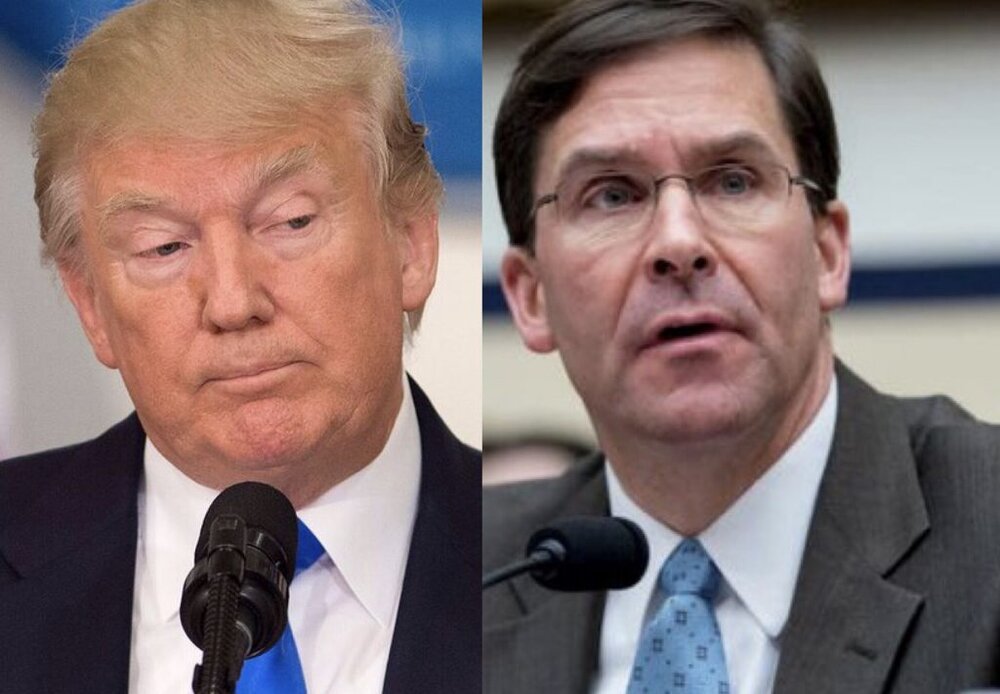
TEHRAN - It seems that the power game in White House has become more complicated than ever. The United States President Donald Trump has nominated Mark Esper as his next Defense Secretary. 
In a recent report, Foreign Policy news agency has pointed out that Mark Esper has a close relationship with hardliners of White House. The report goes on to say that Mark Esper has close relations with U.S. Secretary of State Mike Pompeo and National Security Advisor John Bolton and these relations will help Trump to keep his unstable administration moving. 
It seems that the nomination of Mark Esper has convinced American media that the position of John Bolton and Mike Pompeo on Trump’s team has been stabilized.   
Mark Esper has had close relationships with John Bolton since George W. Bush was in office; he was also classmates with Mike Pompeo in U.S. Military Academy at West Point. 
Despite their long history together, John Bolton and Mike Pompeo still don’t have good feelings about having Esper on board. Of course, Bolton and Pompeo don’t have any problem with Esper himself, but they are extremely worried about Trump’s intentions in appointing Esper as his Defense Secretary. 
According to reliable sources, as of March, Donald Trump has started clandestine meetings with some traditional republicans about removing Bolton and Pompeo from his cabinet. 
Obviously, Trump is mad at Bolton and Pompeo because their plans and suggestions have not solved any of U.S. foreign policy problems and have only reduced Trump’s popularity in key states. However, Trump might still have doubts about removing them, because by doing so he will almost certainly lose the support of Tea Party Movement and Neoliberals. 
Now with selecting Esper as the new head of Pentagon, Trump is trying to compensate for the future absence of Pompe and Bolton in his cabinet and send a message to Tea Party supporters and Neoliberals.
In this message, Trump is trying to tell these parties that even in the absence of Pompeo and Bolton, Pentagon will still be ruled by republicans and firing these two top hardline republic officials doesn’t mean that Trump is any less a supporter of hardline republic parties. 
Under this scenario, Trump can gain the votes of all three different parties of Neoliberals, Tea Party Movement supporters and traditional republicans in upcoming presidential elections. 
It seems that in near future, more details of this complicated game that Trump is playing behind the scenes will be revealed. A game in which Pentagon is used as a winning point. 

Monday, May 27, 2019

White House and Black Foreign Policy!

By Hanif Ghaffari

The criticisms of the foreign policy of the Trump government have increased. The presence of people such as Secretary of State Mike Pompeo and US National Security Advisor John Bolton have affected the process.
Many polls show that, even with economic satisfaction from the Trump in some U.S. states, criticisms of his foreign policy have raised the probability that the US president will likely be defeated in the 2020 presidential election.
The controversial results of polls conducted on Trump's popularity have been published in the United States. Some of these polls were conducted all over the United States, and since they were based on "public votes", their results can't be that much trusted. However, in some polls that were based on the US Electoral College structure, we can make a more accurate estimation of Donald Trump's condition. Business Insider has cited the NBC and Marist survey in one of its articles. The polls results indicate that in some important states such as Minnesota, Wisconsin, and Michigan, where Trump was able to win Hillary Clinton and thus found a way to the White House, there is no longer any chance of his re-election.
The continuation of this trend, while making the Democrats hopeful about winning the 2020 elections, could lead to in-party tensions among the Republican leaders. The Republicans are now actually in control of the White House and the Senate.
It should not be forgotten that the President of the United States has no choice but to retreat from his aggressive and brutal foreign policy to face this trend. In this regard, Trump may has to expel people like John Bolton and Mike Pompeo from the government. However, Tramp is worried about the loss of neoconservative votes in the case of Bolton's expulsion.
No doubt, the US foreign policy on foreign policy is not limited to the Trump government. This aggressive, brutal and interventionist foreign policy has led to many crises in the world. In order to reform this foreign policy, it is necessary to change US foreign policy strategies and lines. Something that did not even happen during Obama's presidency!

Thursday, May 16, 2019

The cost of Trump's behaviors for the United States

By Hanif Ghaffari

The US foreign policy in the world has been condemned by many international actors. Washington has, on one hand, promoted unilateralism during the presidency of Donald Trump, and on the other hand, has caused irreparable harm to the diplomatic relations of the world.
Polls in the United States indicate that most American voters are dissatisfied with Trump's foreign policy. A majority of Americans disapprove of the way President Donald Trump is handling U.S. foreign policy and about half think the country’s global standing will deteriorate during the next year, according to new poll that highlighted the nation’s partisan divide on foreign issues.
as The Associated Press  reported , Overall, the president receives low marks from the public for his job handling foreign policy — 35 percent approve, while 63 percent disapprove. Like other issues, the partisan divide is startling. While 76 percent of Republicans approve, just 8 percent of Democrats say the same.
“I just think that any time you buddy up with Russia or North Korea, it’s going to be bad business,” said Samantha Flowers, a 30-year-old third-grade teacher from Columbia, Missouri.
"Also, the way that he's handling our neighboring countries — Mexico in particular. I think it just goes against our American values in general. We've been a welcoming and compassionate country," she said before starting to recite words emblazoned on the Statue of Liberty, which reads in part: "Give me your tired, your poor, your huddled masses yearning to breathe free."
The fact of this is that one of the major points of the foreign policy of the Trump government is the issue of Iran. Undoubtedly, in the near future, Trump will see the consequences of his encounter with Iran over issues such as economic sanctions and withdrawal from the nuclear deal. On the other hand, it should not be forgotten that the United States President can not only have a strong presence in the White House by focusing on economic issues. Therefore, even if Trump will win the presidential election in 2020, he will not have a firm presence in the White House. Currently, in many public and state polls in the US, citizens of the country prefer people like Joe Biden and Bernie Sanders to Trump.
The conflict between the United States and the Iranian people is rooted in the hostility of Washington to the Iranian people. This hostility has long existed.sixty-five years ago, a CIA-backed coup toppled Mohammad Mosaddegh, Iran’s prime minister. The goal of the coup was to strengthen the West’s ally  Mohammad Reza Pahlavi.The last year,  U.S. Secretary of State Mike Pompeo announced the creation of a new Iran Action Group to coordinate U.S. policy toward the Islamic Republic in the wake of the U.S. withdrawal from the Joint Comprehensive Plan of Action (JCPOA).The formation of an action group against Iran by the U.S. Department of State can be analyzed and evaluated from different dimensions.The important point that should accordingly be taken into consideration is the "smart observation" of the United States policies by the Islamic Republic of Iran. If we take this approach, as we did in the past 40 years, we can make sure that Trump's failure costs will be above those of his predecessors! It should not be forgotten that the more severe the U.S. "action" against Iran, the stronger the "reaction" of Iran towards the United States. This is a rule that many American strategists have understood and have warned the White House about.
The Iranian nation has long been aware of the nature and identity of the United States.Neither the victory nor the failure of one of the two traditional American parties could change the American authorities' policies towards our country. The hostility of the U.S. Democrats and Republicans to our nation, and the vicious and extensive efforts of the two to confront the foundations of the Islamic Revolution of Iran, have been proven to all. In this equation, there's no difference between Jimmy Carter, Reagan, Bush, Clinton, George W. Bush, Obama, and Trump.
Anyway, today is a government in the United States, whose foreign policy is not approved by many American citizens!
As Usa Today reported, Venezuelan President Nicolas Maduro is deriding President Donald Trump as foolish for trying to oust him. Kim Jong Un is testing Trump’s “love” – and his resolve – in the North Korea negotiations. And Iran’s leaders are finding new ways to threaten the U.S. and to defy the president’s “maximum pressure” campaign.
In short, Trump’s foreign policy agenda is hitting the diplomatic rocks, with potentially disastrous results.
Some say it’s by design – Trump doesn't mind sowing chaos and confusion, and he has. Others say it’s a result of misguided policies and contradictory, undisciplined decision-making inside the White House.
Either way, the president has suffered a series of stunning foreign policy setbacks this week, raising fresh questions about his approach to military engagement and international affairs.
“What you see is a mismatch between means and ends across the board – whether it’s in Venezuela, whether it’s in North Korea, whether it’s in Iran – where the end’s always extremely ambitious and the diplomatic means tend to be quite de minimis,” said Robert Malley, a senior White House adviser on the Middle East, North Africa  in the Obama administration. “We’re courting danger where there’s no reason to.”
Finally, the United States has suffered a lot of disadvantages due to the controversial foreign policy of Donald Trump. These costs will increase exponentially in the future. Undoubtedly, the effects of the presence of Trump at the White House will not be limited to him and the current US government, and other US presidents will have to bear these harsh costs in the coming years.