Showing posts with label Shanghai Cooperation Organization. Show all posts

Friday, December 06, 2019

Trials and Tribulations of Central Asia Integration


The pros and cons of being the Heartland in the 21st century
Pepe ESCOBAR, Nur-Sultan, Kazakhstan
Crossing Tajikistan from west to northeast – Dushanbe to the Tajik-Kyrgyz border – and then Kyrgyzstan from south to north all the way to Bishkek via Osh, is one of the most extraordinary road trips on earth. Not only this is prime Ancient Silk Road territory but now is being propelled as a significant stretch of the 21st century New Silk Roads.
In addition to its cultural, historical and anthropological pull, this road trip also lays bare some of the key issues related to the development of Central Asia. It was particularly enlightening to hit the road as previously, at the 5th Astana Club meeting in Nur-Sultan, Kazakhstan, I had had the pleasure of moderating a panel titled Central Asia at the Intersection of Global Interests: pros and cons of being Heartland.
The Heartland in the 21st century could not but be a major draw. Any serious analyst knows that Central Asia is the privileged corridor for both Europe and Asia at the heart of the New Silk Roads, as the Chinese-led BRI converges with the Russia-led Eurasian Economic Union (EAEU).
And yet, less than 10% of trade in Central Asia happens within the region, while 60% is directed to the EU. Idiosyncratic practices among the five former Soviet “Stans” still somewhat prevail. At the same time, there’s a consensus that measures such as a proposed, online, unified Silk Visa plan are bound to boost tourism and trade connectivity.
Banking experts such as Jacob Frenkel, chairman of JP Morgan Chase International, insist that the path towards inclusive growth in Central Asia entails access for financial services and financial tech; Nur-Sultan, incidentally, happens to be the only financial center within a 3,000-mile radius. Only a few years ago it was basically a potato field.
So it will be up to Kazakhs to capitalize on the financial ramifications of their independent, multi-vector foreign policy. After all, aware that his young nation was a “child of complicated history,” First President Nursultan Nazabayev from the beginning, in the early 1990s, wanted to prevent a Balkans scenario in Central Asia – as proposed as a sort of self-fulfilling prophecy by Zbigniew Brzezinski in The Grand Chessboard. Recently Kazakhstan mediated quite successfully between Turkey and Russia. And then there’s the Kazakh hosting of the Astana process, which quickly evolved as the privileged road map for the pacification of Syria.
A link or a bridge?
Frederick Starr, chairman of the Central Asia-Caucasus Institute in Washington, made a crucial point in the sidelines of our debate: the UN recently passed a unanimous resolution recognizing Central Asia as a world region. And yet, there is no structure for cooperation inside Central Asia. Tricky national border issues between the Amu Darya and the Syr Darya rivers may have been solved. There are very few pending questions between, for instance, the Uzbeks and the Kyrgyz. Most “Stans” are SCO members, some are EAEU members and all want to profit from BRI.
But as I later saw for myself on the road as I crossed Tajikistan and then Kyrgyzstan, tariff barriers still apply. Industrial cooperation is developing very slowly. Corruption is rife. Distrust against “foreigners” is inbred. And on top of it, the fallout of the US-China trade war affects mostly developing nations – such as the Central Asians. A solution, Starr argues, would be to boost the work of an established commission, and aim towards setting up a single market by 2025.
At the Nur-Sultan debate, my friend Bruno Macaes, former Minister for Europe in Portugal and author of the excellent The Dawn of Eurasia, argued that the thrust for the New Silk Roads remains sea transportation, and investment in ports. As Central Asia is landlocked, the emphasis should be on soft infrastructure. Kazakhstan is uniquely positioned to understand differences between trading bocks. Macaes argues that Nur-Sultan should aim to replicate the role of Singapore as a bridge.
Peter Burian, the EU Special Representative for Central Asia, chose to stress the positives: how Central Asia has managed to survive its new Heartland incarnation without conflict, and how it’s engaged in institutional building from scratch. The Baltics should be taken as an example. Burian insists the EU does not want to impose ready-made concepts, and would rather work as a link, not as a bridge. More EU economic presence in Central Asia means, in practice, an investment commitment of $1.2 billion in seven years, which may not amount to much but targets very specific, practical-minded projects.
Evgeny Vinokurov, chief economist of the Eurasian Fund for Stabilization and Development, touched on a real success story: the 15 day-only transportation/connectivity rail between China’s central provinces, Central Asia and the EU – now running at 400,000 cargo containers a year, and rising, and used by anyone from BMW to all manner of Chinese manufacturers. Over 10 million tons of merchandise a year is already moving West while six million tons are moving East. Vinokurov is adamant that the next step for Central Asia is to build industrial parks.
Svante Cornell, from the Institute for Security and Development Policy, emphasized a voluntary process, possibly with six nations (Afghanistan also included), and well-coordinated in practice (way beyond mere political integration). Models should be result-oriented ASEAN and Mercosur (presumably before Bolsonaro’s disruptive practices). Key issues involve facilitating smoother border crossings and for Central Asia to position itself as not just a corridor.
Essentially, Central Asia should think eastwards – in an SCO/ASEAN symbiosis, keeping in mind the role Singapore developed for itself as a global hub.
What about tech transfer?
As I saw for myself days later, when for instance, visiting the University of Central Asia in Khorog, in the Pamir Highway in Tajikistan, set up by the Aga Khan foundation, there is a serious drive across Central Asia to invest in universities and techno centers. In terms of Chinese investment, for instance, the Asia Infrastructure Investment Bank (AIIB) is financing hydropower in Kyrgyzstan. The EU is engaged in what it defines as a “trilateral project” – supporting education for Afghan women and universities in both Kazakhstan and Uzbekistan.
This may all be discussed and deepened in an upcoming, first-time-ever summit of Central Asian presidents. Not bad as a first step.
Arguably the most intriguing intervention in the debate in Nur-Sultan was by former Kyrgyz Prime Minister Djoomart Otorbaev. He remarked that the GDP of four “Stans,” excluding Kazakhstan, is still smaller than Singapore’s. He insisted the road map ahead is to unite – mostly geoeconomically. He emphasized that both Russia and China “are officially complementary” and that’s “great for us.” Now it’s time to invest in human capital and thus generate more demand.
But once again, the inescapable factor is always China. Otorbaev, referring to BRI, insisted, “you must offer to us the highest technological solutions.” I asked him point-blank whether he could name a project with inbuilt, top technological transfer to Kyrgyzstan. He answered, “I didn’t see any added value so far.” Beijing better go back to the drawing board – seriously.

Thursday, November 08, 2018

Iran needs good ties with the East and West

Iran needs good ties with the East and West


(Persia Digest) - A university professor in the UK believes: “Iran must have closer ties with Europe for its economic development. But its security can be provided mostly by China and Russia. This requires a little subtlety in the ‘Neither East, Nor West’ slogan.”
Some experts in Iran believe that the world is on the threshold of a historic transfer of wealth and power from the West to the East. Furthermore, the attitude of the West towards Iran in general, and following Trump’s election in particular, strengthens the viewpoint that Iran must pursue the look to the East strategy more vigorously. Others believe that the East is still unable to stand up to the West. In Iran’s case, the East is not only thinking about its maximum interests, it is even taking advantage of Iran’s specific restrictions. This can be seen in Russia's decision to increase its oil production in the current situation or in China's conditions for settling Iranian oil money with Chinese goods.
Persia Digest (PD) has conducted an interview with Professor Anoush Ehteshami on the subject. He is a Professor of International Relations in the School of Government and International Affairs at Durham University. He has been publishing books and articles on Iranian foreign policy for nearly three decades.
You can read the interview here.
Can the strategy of looking to the East be in Iran’s interest under the circumstances?
The answer to this question needs an introduction. Iran’s foreign policy strategy was based on the “Neither East, Nor West” slogan. But after the end of the Cold War, it strengthened its ties with the East instead of the West and the slogan changed to “East-East”. Of course, China was not a world power at the time and Russia was a weak superpower. Even India did not have its economic power of today. Rising countries at the time were Japan, South Korea, and North Korea. Iran had ties with these countries before the 1979 revolution. Its military connections were strengthened with North Korea after the revolution and ties with South Korea also expanded significantly. As such, a gradual tendency towards the East grew in Iran after the Cold War.
Secondly, these global developments coincided with Iran's theory of an end to Western rule for the rising East. It was argued that Iran has an economic, cultural, geopolitical and ideological background that can strengthen the East and its relations with it in the medium-term so that it can shield Iran against America and the West.
Thirdly, international power has in practice shifted from the West to the East gradually over the past twenty years.
This gains momentum, however, only when the economic shift is tied to political issues. The East is rising beyond the shadow of a doubt. But there is no hegemony in the East and we must see what Iran is investing in by looking to the East. The East cannot yet meet the economic, military, and social needs of a relatively modern country like Iran. The question needs to be asked whether the East can respond to the needs of the Iranian middle class, which is stronger and more progressive than all the communities in the region, with combined spiritual and material aspirations.
A one-dimensional view of international relations is no longer viable, especially for a country like Iran which has a very strong industrial infrastructure and is highly specialized in terms of human resources, but with a weak economy and recovery stamina.
Iran needs good relations with both the East and West. Its primary industries date back to fifty years ago and are in need of new technologies and modernization. Iran’s main technological requirements are in the West. Countries like Japan and South Korea can help Iran, but are too afraid of the Unites States.
Iran exports most of its oil to eastern countries. This is also the case for its neighboring rival countries in the Persian Gulf whose main oil exports are also to the East. Iran’ economy is oil-based and it cannot afford to content itself with a look to the East. It must keep its oil and economic ties with the West as much as possible.
If Iran, for any reason, does not choose to change its relationship with the West, especially the United States, and follow the strategy of looking to the East, what would be the requirements of such a strategy?
The basis of Iran’s economic ties with the East is still unclear. How will this exchange take place? Except for South Korea and Japan, most of the economy in Eastern countries is run by governments. This is not a positive in the long-run, because state organizations are not competitive and these tend to pursue mainly tactical and political issues. Is Iran aware that economic relations with these countries are economically and technologically competitive or not? From the perspective of its partners, is this just in their favor, or is it a win-win situation?
Do countries such as China, Russia, India…change the quality of their relations with Iran to its detriment due to US sanctions, or are the sanctions a pretext to use Iran’s particular circumstances to their own benefit?
In my opinion, eastern countries like Russia, China, and India take advantage of Iran’s weak position. They are aware that Iran has no room for maneuver under the circumstances. Interestingly enough, Russia has announced it is willing to increase its oil production to replace Iranian oil on the market. These countries gave Iran a similar treatment under Mr Ahmadinejad’s presidency, because they knew Iran had no other options. I believe Iran’s strategy must be continued ties with Western Europe as leverage for its negotiations with the East. An Iran with alternatives cannot be taken advantage of.
Some in Iran call Russia a strategic partner and cite the two countries’ cooperation in the Syrian crisis as an example. Can the Iran-Russia relations be strategic?
This can be strategic insofar as their interests are identical. I do not believe this is a strategic relationship. History shows that Russia has always abandoned Iran in sensitive situations. Despite the fact that Iran and Russia are in synch over the Syrian crisis against the United States, Russia is not a strategically reliable partner for Iran. If Trump and Putin reach an agreement, Russia will simply prefer ties with the US to ties with Iran.
From an American perspective, China and Russia are among the most important threats to its national security. To the contrary, Iran is trying to establish a link with these two countries. Will such a link increase Iran's security? To what extent will the China-Russia-Iran triangle be a danger to the US?
I do not believe forming such a triangle will impact US opinion on Iran. Trump sees Iran as a rival for its interests in the region. The current administration does not seem to have the geopolitical perspective that such a triangle can pose a threat to its middle-term interests in the Middle East. Trump would be happy to pull out of the Middle East. Even if Russia and China replace the US in the ME, he will not consider this an issue for as long as they do not threaten the regional interests of the United States, Israel, and its allies. If such a triangle gives a new form to Iran's foreign policy, it may even be considered positive by the United States. Although China and Russia are considered serious threats to US National Security today, the United States seeks to contain it rather than confront it. For as long as the US has such a viewpoint, this triangle will not be a threat. But if India decides to join the triangle, then the US will have to worry.

Will the formation of this triangle or square increase Iran's security against the United States? Iran is currently trying to join the Shanghai Cooperation Organization (SCO). Is this a good policy for Iran?
Joining the Shanghai Cooperation Organization will benefit Iran who must stabilize its Asian identity. This is where its security in Asia is defined. In my opinion, Europe will never provide security for Iran. Neither will India, Japan, and South Korea under these conditions. Iran needs China, Russia, and the SCO. This is a good policy for Iran at this point. It has no other options.
Is this not contradictory with the view that Iran should keep its relationship with the West?
These are not mutually exclusive. Membership in the SCO will not turn Iran against Europe; because Europe sees the SCO as a regional security organization like NATO. Iran must have closer ties with Europe for its economic development. But its security can be provided mostly by China and Russia. This requires exercising a little subtlety in the “Neither East, Nor West” slogan.

Tuesday, October 30, 2018

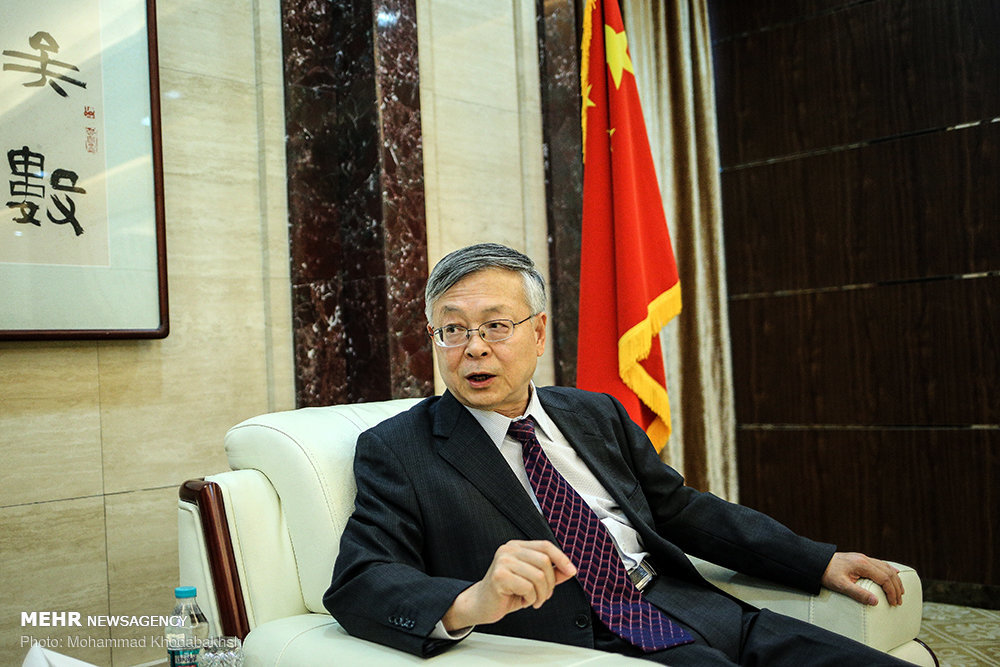
Beijing supports full membership of Iran in Shanghai Cooperation Organization: Ambassador

By Javad Heirannia & Maryam Khormaei


TEHRAN - China Ambassador to Tehran Pang Sen hailed the deeply-rooted relations between the two nations. But while expressing support for Iran's full membership in SCO, he underlined the need for more work to strengthen the comprehensive strategic partnership.
Following is the full text of his interview with Tehran Times and Mehr News Agency: 
Q: What are the areas of integration between China and Iran? The two countries believe in multilateralism and disagree with U.S. shift towards unilateralism. For example, Shanghai Cooperation Organization is a good example of multilateral policy. Where does china stand on Iran's permanent membership in SCO?
A: In June this year President Rouhani visited China to attend the Shanghai Cooperation Organization (SCO) summit held in Qingdao. The meeting was a great success. We made very good progress to map the direction of the future development of the organization. President Rouhani played there an active role and made positive contribution to the success of the summit. Two presidents also held a bilateral meeting on the sidelines of the summit. They discussed intense cooperation between 2 countries. I think that the relationships between our countries are mutually complementary. It is for the benefits of two countries as well as our nations. So there is a great potential for two countries to work together. We can build on the previous achievements to make further progress in political, economic, security, cultural areas and people to people exchange.
You mentioned about the possible membership of Iran in SCO. I would like to say that during president Xi’s visit to Tehran, two leaders issued a joint statement in which China made its position quite clear on this issue. China would be happy to see Iran play a greater role in SCO and we support Iran to be a full member of the organization.  We wish to emphasize the bilateral economic cooperation. The cooperation between two countries are in line with obligations that each of us undertake. The cooperation is transparent and legitimate.
f course we are facing some obstacles created by certain external factors among which are the U.S. sanctions against Iran. But I think that our relation is based on mutual respect and benefits which are deeply rooted in our longstanding friendship and civilization. So in the face of such difficulties we need to work together and consult on an equal footing to find ways to overcome the hardships caused by unilateral sanctions. Chinese position has always been clear. We are against such unilateral sanctions and so-called long arm jurisdiction because they are the manifestation of unilateralism and against the spirit of multilateralism. In the past two years, China and Iran have maintained close contact with each another. FM Zarif traveled to China and later the foreign ministers of remaining signatories of JCPOA met recently in New York to discuss ways how to overcome the difficulties in order to maintain the treaty because the JCPOA is an important multilateral deal and all signatories must fulfill their obligations. We are happy to see that Iran has been in full compliance with all its obligations under the deal. IAEA has issued 12 reports to certify that Iran is in full compliance with its obligations. The other partners including EU, France, Germany, UK, China and Russia have all expressed their readiness and willingness to support the continuation of the treaty. It shows that Iran is enjoying the support of the international community. I would like to mention the need to combat terrorism. Terrorism is a threat to all countries and the common enemy of the international community. There should not be any distinction between good and bad terrorism.  All of them should be seriously defeated. We need to address the issue of terrorism in its root causes for example by strengthening international cooperation, eliminating poverty and eradicating the extremist ideology. In our view, terrorism is not associated with any particular country, group of people or religion. Any form of terrorism should be fought with. There should be no double standards. China and Iran, both are victims of terrorism. We witnessed the recent terrorist attack in Ahvaz. China condemns such acts of atrocity. In the past time, we have had a very good cooperation in law enforcement and exchanging information to fight against drug trafficking, trans-boundary crime and etc. We will continue such cooperation because it is not only in the best interests of two countries and two nations but it is also for maintaining peace and stability of the region as a whole.  I also wish to say a few words about China-U.S. relations. There is an escalating trade friction between two countries. The root cause is not as we heard from the U.S. by the unilateral trade benefit gained by China because trading is beneficial for all involved parties. We are not seeking unilateral trade surplus. China wishes to set this issue through bilateral consultation and negotiation on an equal footing. Unfortunately the U.S. side is engaged in flip flopping. It rolled backed on our agreement and changed the mind. So this has made consultation between two countries very difficult. We made it clear from the beginning that China had no wish of engaging in trade war or conflict. This is not the case that China is afraid of but we don’t want such a war. But if the U.S. is determined to wage such a conflict, we are ready to fight back. China has sufficient confidence and capability to defend its interests, sovereignty, development and security. 
Recently U.S. vice president Mike pence delivered a speech at a think tank. The relevant speech made unwarranted accusations against China's domestic and foreign policies and slandered China by claiming that Beijing meddles in U.S. internal affairs and elections. This is nothing but speaking on hearsay evidence, confusing right and wrong and creating something out of thin air. The Chinese side is firmly opposed to it. 
China unswervingly pursues the path of peaceful development and commits itself to developing friendly and cooperative relations with all other countries on the basis of five principals of peaceful coexistence and forging a community with a shared future for mankind. China always follows the principle of non-interference in others' internal affairs and will by no means seek its own developments at the expense of other countries' interests. Meanwhile, we are determined to safeguard our sovereignty, security and development interests. It is very ridiculous for the U.S. side to stigmatize normal exchanges and cooperation with China. 
China's policy towards the U.S. is consistent and clear-cut. We are committed to joining hands with the U.S. to work for non-conflict, non-confrontation, mutual respect and win-win cooperation. We advise the U.S. to reflect on its own human rights issues and stop its unwarranted accusations and slander against China and take concrete actions to maintain the sound and steady development of China-U.S. relations. 
     
Q: On Nov. 4, the U.S. sanctions on Iranian oil come into effect. Do you think that China will comply with the U.S. demands or continue trade with Iran? Shall we expect them to reduce crude imports from Iran?
A: As for bilateral trade, I should make clear that the relations between two countries including our cooperation in energy and oil sectors is in full compliance with obligations we both have undertaken respectively. It is transparent and legitimate. We are firmly opposed to any unilateral sanctions. We know that the next round of sanctions are coming and will merely target on Iran’s' exports. Our position is to be opposed to U.S. sanctions. We will continue our cooperation with Iran. As for the specific modality of the cooperation, the two sides have been in contact over the past few months. We consult to make every efforts to make sure that our cooperation will continue. Of course over the past years, with or without sanctions there have been fluctuations in the exports and imports of the commodities including oil that is natural. So we don’t have to be surprised if there is an increase or a decrease in the import volume of oil by China from Iran.
Q: China seeks to revive the Silk Road via the Belt and Road Initiative. Where does Iran stand on China's Belt and Road and what are the mutual interests of the project? Which Iranian capabilities can help to secure mutual benefits?
A: First of all, I wish to emphasis the concept or initiative of one belt one road is open and transparent. Any country that wishes to join, they will be welcomed. So it is not a block limited to a few countries. We are happy to see that more and more countries are expressing their willingness and support to join this initiative. There are countries in Africa and Latin America and internal organizations also showed readiness to join the initiative. We have signed more than one hundred agreements with different countries about how to proceed the construction of one belt one road. This initiative is based on equality, openness, transparency and mutual benefits. We emphasis that one belt one road will be consulted and built collectively by all countries concerned so it is not for the self-interest of any particular country but for the joint benefits of all participating countries. Since ancient times, Iran has been a very important link on the Silk Road. More than two thousand years ago, the Silk Road existed along which China and Iran maintained very close links. The Silk Road is not limited to commercial activities but it has been a way for cultural, philosophical and religious exchange. So it is a pathway for friendship. Iran certainly has been playing a very important role form ancient times to present. We regard Iran as an important partner in the one belt one road initiative. In the past few years, we have conducted a very fruitful cooperation in a broad range of sectors. We have achieved grate progress and I think in the future, we can even work more closely for the benefits of the two countries and nations.
Q: A few years ago, Barak Obama claimed the U.S. had no idea to let China write the rules for 21st century trade. As you know the American order is based on liberalism. What is the difference between American order and Chinese order?
A: First of all, we firmly support a multilateral trading system based on WTO. Of course, in addition to WTO, there are many regional arrangements for example bilateral trade treaties or regional initiatives as you know there are different trading blocks and partners.
About this so-called TPP initiated by President Obama, they had some progress but as President Trump took office, he pulled away from this trade arrangement. Not only TPP, but under Trump administration, the U.S. withdrew from other international treaties. The same thing happened for Paris Climate Change pact and President Trump withdrew from it when it came to office. The one belt one road initiative is not aimed at or against any particular country. It is formulated for the benefits of all countries which are ready to join. That is why we see many countries such as Germany, France and UK also joined the Asian Infrastructure Investment Bank (AIIB).The one belt one road initiative is inclusive rather than exclusive. The TPP is to promote a certain group of countries in the cost of other ones and that is the main difference between TPP and one belt one road initiative. 
Q: Some experts believe that China doesn’t want to transform the SCO into an anti-western organization. As a result, it avoids giving a proper support to Iran's membership. What is your opinion on this matter?
 A: As I told you, President Xi visited Iran in 2016. The two presidents issued a joint statement in which China confirmed its position to support Iran to be a full member of SCO. During the recent visit to China by President Rouhani, China made it clear again its position to support Iran. There are some countries who are not happy to see the close friendship between China and Iran. They are trying to create division between the two countries by spreading rumors. For example, a couple of years ago, I read a piece of news by BBC. It claimed that China was opposing the full membership of Iran in SCO. I had to talk to Iranian Press to make clear that this ironic story was a sheer fabrication. As I told you, China fully support Iran's membership but the ultimate decision should be taken within SCO and by consensus. So, any decision has to go through consultation and that is why we suggested Iran should talk to other members to get a united support. As for the nature of SCO, I think that it mainly focuses on two areas: fighting terrorism and joint economic development. The membership expansion is a slow process. For example, recently, we received India and Pakistan as new members. The organization has initiated internal discussion about further expansion.  So, I wish to correct the impression and make clear that China is supportive of Iran's membership in SCO.
 Q: What are the areas of counter-terrorism cooperation? The Iranian Parliament Speaker's Special Aide Hossein Amir-Abdollahian said an international meeting would be held on issue of terrorism in Tehran. Will china attend the meeting? 
A: We have received invitation letter from Iranian Majlis Speaker Ali Larijani and sent it to Beijing. The matter is still under consideration.
Q: Iran and China have a common position on counter-terrorism. Have there been any moments of disagreement on this very important issue? 
A: First of all, we will focus on political area to form an international consensus in the UN and other forums. We have signaled opposition to the terrorism. For example, all agree that terrorism should be defeated. We also try to pull the international community together in order to fight terrorism in a collective way and avoid associating a particular country or religion with terrorism. China would also like to strengthen bilateral cooperation. For example, we can exchange information in regional formats such as SCO.
Q: Some experts believe that Iran and China aren’t yet strategic partners and their relationship is based on the principle of simple cooperation. How do you assess the relationship between two countries?
A: I have already mentioned that the comprehensive strategic partnership had been announced by presidents of China and Iran. Since then we have been making continuing efforts to strengthen bilateral cooperation in all areas. We have made very good progress and in June this year when President Rouhani visited China, they once again had in-depth discussion on how to enhance bilateral cooperation. There is always room for improvement and this is the same case for our bilateral cooperation. For example, in political area, we can have more frequent dialogues in different sectors and levels ranging from government departments to legislator and then people to people exchange as well as media exchange. Soon, the Chinese Xinhua News Agency will send a delegation to Iran in order to increase our media exchange. That will help to strengthen the mutual understanding between two countries. We need to take new approaches in order to overcome new challenges and keep up the level of our cooperation. We have more work to do in order to strengthen our comprehensive strategic partnership.
Q: The U.S. and China are on the brink of a trade war. How do you predict the future of this war? 
A: I can’t really speak on behalf the U.S. government but on behalf of Chinese government I should say that our position is clear. We don’t want such a war but aren’t afraid to fight back. We have full confidence and sufficient capability to defend our national interests, sovereignty, security and development. We hope that the two countries will be able to sit down and find a solution to the disputes. China and the U.S. have trade differences that is natural. The trade is not unilaterally beneficial for China but the U.S. also benefits a lot. We hope that the U.S. will understand that the best way to overcome the problem is trough consultation and negotiation rather than threat, coercion or sanction. Taking a different road will hurt both china and the U.S.
Q: As you know, low labor costs in China allows a reduction in the price of consumer goods and Trump is also critical of China's approach to cut tariffs on some goods. What’s your opinion on this matter? 
A: The fact is that there is a trade imbalance between two countries. China has a trade surplus but this is not intentional. It is the result of comparative advantage and international division of labor. On the other hand, China wish to buy more (for ex. high tech products) from the U.S. But they set up a lot of obstacles. I think that sanction is not the right way to solve the problem but we should do it through consultation and negotiation. China doesn’t build an unfair advantage against the U.S. There are trade policies and China is complying with the rules of WTO. So, the U.S. accusations against China are based on imagination and hearsay. 
Q: Is China seeking a mechanism to get rid of the U.S.-led monetary and financial order as well as dollar burden? If the answer is “Yes”, how will such a mechanism work?
A: We formally support multilateralism as well as the implantation of WTO rules. The U.S. practice to protect self-interests at the expense of others is wrong. We hope that all countries will oppose unilateralism and stick to the principals of multilateralism in order to protect our common interests.  
Q: The Realist theorists believe in the military aspect of the power and don’t pay much attention to other aspects. Talking about China, they bring up this argument that its economic power might be translated into military power. That's why they suggest that China will be the major threat to the U.S. in the future. What’s your opinion in this matter?
A: Over about forty years, China has adopted policy of reform and opening up. We have achieved tremendous progress. So China’s GDP has grown in a way that we stand as the world's No. 2 economy.  Living condition of Chinese people have been greatly improved. A lot of people have been lifted out of poverty. On the other hand, we are fully conscious that there is a big gap between Chinese level of development and the rest of the world. There are many countries which have a far higher level of GDP per capita income. If we take per capita GDP into account, China is lagging behind many countries. So in the future, we will still concentrate on our domestic economic development in order to improve living conditions furthermore of Chinese people. Meanwhile we will also have cross-sector development in all other areas such as science, technology, education and defense because China needs to upgrade our defense capability so that we will be able to safeguard our national security as well as sovereignty. I hope that our development will be balanced. China's growing economy and influence will bring more benefits to the world. We will make greater contribution to people's welfare and promote peace and stability all around the world. So China's growing influence is not for global dominance but to make a greater contribution to the common development of the entire world.
Q: China puts a great emphasis on the model of sustainable development. What are the major components of China's model of development and how much attention will be paid to political development in this model?
A: I think this is not only a goal of China but also a goal of the UN that the development should be sustainable and green. To bring benefits to our people, we need to safeguard our environment. Over the past two years, China has worked hard in this area to combat pollution. On the other hand, we need to pay attention to the political advancement of the country in order to improve the legal system and rule of law. The political satiability is also important because without it the society gets in trouble and all efforts for economic development will be damaged. So we should strive for good governance and improve our rule of law as well as economic development. So this is a two way approach. 

Saturday, August 25, 2018

Geopolitical, economic transitions are nothing but painful

By: Martin Love


TEHRAN, Aug. 25 (MNA) – Who knows what the real numbers are, but it’s been estimated that since the end of World War II the US has been responsible, one way or another, for the demise of some 25 million souls across the planet – many of them innocent, who were victimized by the overweening insistence that the US grab or maintain military or economic hegemony by damaging potential rivals.

There is nothing at all novel about this, for if one looks at history over the past centuries, there have been numerous governments and powers that sought to dominate their era and even, on occasion, managed to do some good. There are some peoples, polities and governments that quite literally have deserved reduction because on balance they have proven to be more destructive than constructive for humanity as a whole. Nazi Germany may be the prime example during the past century of a country that deserved the world’s enmity.

The US has long tried to fit the Islamic Republic into this category of polities that allegedly don’t deserve to survive for the SOLE REASON, in fact, that Iran refuses to ally itself with US and Zionist and Saudi attempts to control the Middle East and reap the benefits of its vast wealth. And even if the Islamic Republic, like any other country, sports aspects that can legitimately be criticized, Iran stacks up as a far more benign country today than severely undemocratic Saudi Arabia and Israel, the US’s chief “allies” in the region, despite all the Western and Zionist propaganda to the contrary.

I have, in any event, been depressed witnessing the US and Western failures of judgement, particularly with regard to Iran, and I have read that the suffering and confusion is immense within Iran, but at the same time I have tried to point out along the way that more than half the world’s population is moving within a painful transition, with leadership from Russia and China, to a new and much more promising paradigm than what the US has been trying to bully impose on the Mideast and Asia and even Europe. The US, in effect, may have been setting a trap for itself in recent decades that will eventually limit its impositions on other countries and force more cooperation.


Consider, for example, that a new bloc may be forming. It includes Russia, China, Iran and Turkey for starters, and may include India and Pakistan, too. Pakistan’s new leader, Imran Khan, has lately expressed disgust with his country’s allowing the US to have its way. The BRICS may be turning into the BRICS plus. This is good reason for Iranians to look ahead and try to understand that they, too, face a brighter future than they have known for decades.

Turkey has been offered membership in the “BRICS plus” and the Shanghai Cooperation Organization for starters, and Erdogan has allegedly shown interest in both. Thus, Turkey may leave NATO and cast its fate not with the West, but with Asian partners. Trade deals are on the table, too, and trade will increasingly be settled in local currencies, not the US dollar.


It’s all about the integration of Eurasia. Iran is already reportedly preparing to engage, by the start of 2020, into a comprehensive free trade agreement with the Eurasian Economic Union, and neighbor Turkey could well follow. 

Turkey, like Iran, is in the US doghouse because it plans to deploy Russian missile defense systems, has claimed it will continue to buy Iranian oil despite the sanctions, has apparently given up Western obsession with the deposition of Assad in Syria and will likely complete a gas pipeline across Turkey from Russia. (Why would Europe bother with far costlier LNG exports from the US?) And meanwhile, even one of the Persian Gulf states, Qatar, has offered a $15 billion loan to Turkey and restored better relations with Iran that includes energy collaboration in the shared South Pars gas field in the gulf, the largest on the planet.

All this can only benefit Iran eventually provided the US and Saudis and Zionists realize that further military aggressions in the Mideast will only deepen their worldwide isolation. In the US there is, for example, growing horror about the Saudi and UAE war on Yemen and the humanitarian crisis there with calls for the US by some in the US Congress to halt whatever support related to the war that the US military has been rendering to the Saudis.

I know for a fact that many “average” Americans are beginning to get a honest picture of just how relatively backward and corrupted and undemocratic the Saudis are. The possible beheading this month of a lovely Shia woman and human rights activist who lived in the Qatif oasis, a Shia enclave within largely Sunni Arabia, who simply expressed some opposition to the Saudi regime, has had an impact on transforming perceptions and I can say with certainty that in reading comments by many Americans attached to news articles about the Middle East that there is a strong revulsion against the Saudis, the Zionists, the Neocons in Washington and, in general, US foreign policy in the Middle East.

Iranians ought not to think most Americans with any knowledge of the Mideast do not rail against the Trump Administration. Some new war in the region sparked by the US or the Zionists will mark the end of the Trump presidency and the credibility of those who have supported its foreign policies, not to mention that the US would sink further into unsustainable financial debt.