Showing posts with label BRICS. Show all posts

Sunday, September 08, 2019

BRICS Needs a Unified Front Against US Intervention in Venezuela


Ramona WADI


Venezuela’s destabilisation by the US is understood best by the countries that have faced imperialist interference. Cuba’s revolutionary process, for example, has produced consistent political solidarity with Venezuela and is actively urging countries to reconsider their stance as regards the US sanctions which are creating severe humanitarian consequences.
The recent executive order signed by US President Donald Trump encompasses all entities that do business with Venezuela, thus creating an embargo that will further isolate the nation, even as the US moves to open a “Venezuela Affairs Unit” unit in its embassy in Bogota, Colombia. The unit would engage in diplomacy with the US-backed Juan Guaido, who is recognised by the Trump administration and its allies as the purported interim Venezuelan president. Its aim, according to US Special Representative to Venezuela Elliot Abrams, is in anticipation of “the day this regime falls”.
In a report titled “Economic Sanctions as Collective Punishment: The Case of Venezuela”, it is estimated that 40,000 people have died as a result of the US-imposed sanctions from 2017 to 2018. According to the US, Venezuela poses “an unusual and extraordinary threat” to its national security – unfounded claims as Trump continues with overt attempts to bring down Maduro’s democratically-elected presidency.
Political pressure against Venezuelan President Nicolas Maduro is instigated by the US, yet there is a backdrop of support from its allies in the region and, globally, from countries that spout the democracy line, even if there is nothing democratic about foreign interference.  While mostly in the background in comparison to the US, Canada has facilitated support for the Venezuelan opposition. In Europe, countries which have not explicitly backed Guaido have assumed an allegedly neutral stance which constitutes tacit agreement in terms of opposition support. The EU criticised US sanctions on Venezuela but has also threatened the country with similar punitive measures, as the European Parliament expressed its support for Guaido.
The international community is dominated by discourse that promotes foreign intervention according to the undemocratic agendas of the so-called democratic countries. Venezuela is urgently in need of a unified political strategy that stands in political solidarity against imperialist interests.
BRICS has positioned itself as one such alternative in terms of economic prospects, international security and stability. Russia and China have repeatedly affirmed their support for Maduro. South Africa and India have likewise followed suit. On the other hand, Brazil under President Jair Bolsonaro is preventing BRICS from promoting a political discourse that fully repudiates US interference in Venezuela.
Contrary to the rest of the BRICS countries, Brazil recognised Guaido as Venezuela’s interim president and it has expressed support for the international community to pay heed to “Venezuela’s cries for freedom”. Brazil has also adopting measures in line with the Lima Group, as well as prohibited Maduro and other senior Venezuelan officials from entering Brazil.
At the G20 summit in Japan, BRICS stated it supported dialogue between Maduro and the Venezuelan opposition to reach a solution. Yet the call is marred by the political divide between Brazil and the other BRICS members. This lack of consensus, including the divergence in terms of recognition of who is Venezuela’s legitimate leader, weakens its political diplomacy in the international arena. As Brazil aligns with the US, although reportedly holding back from endorsing military intervention in Venezuela, It is moving away from one of the organisation’s main aims, which is to establish itself in opposition to capitalist and imperialist exploitation.
In a recent interview, former Brazilian President Luis Ignacio Lula da Silva expressed his disappointment at BRICS not moving further politically. “BRICS was not created to be an instrument of defence, but to be an instrument of attack.” If this momentum is to be built, BRICS needs to find equilibrium in its politics, rather than allow itself to be swayed into a seemingly neutral position due to the US allegiances of Brazil under Bolsonaro. It is not enough to preach dialogue like the rest of the international community have done while weakening Venezuela’s autonomy. BRICS must evaluate its relevance, especially when it comes to one of its members demonstrating political opportunism that is contrary to the group’s aims.

Friday, October 19, 2018

Welcome to the G-20 from hell


World leaders wrestle with a maelstrom of complex, burning issues as they prepare for November 30 summit of the G-20 nations, says Brazilian investigative journalist Pepe Escobar.
Now we have more about his article titled Welcome to the G-20 from hellthat appeared in Asia Times.
The G-20 in Buenos Aires on November 30 could set the world on fire – perhaps literally. Let’s start with the US-China trade war. Washington won’t even start discussing trade with China at the G-20 unless Beijing comes up with a quite detailed list of potential concessions.
The word from Chinese negotiators is not at all bleak. Some sort of agreement could be reached on about a third of US demands. Debate on another third could ensue. But the last third is absolutely off-limits – due to Chinese national security imperatives, such as refusing to allow the opening of the domestic cloud computing market to foreign competition.
Beijing has appointed Vice-Premier Liu He and Vice-President Wang Qishan to supervise all negotiations with Washington. They face an uphill task: to pierce through President Donald Trump’s limited attention span.
On top of it, Beijing demands a “point person” with the authority to negotiate on behalf of Trump – considering the mixed-message traffic jam out of Washington.
Now compare this with the message coming from the research institute fabulously named Xi Jinping Thought on Socialism with Chinese Characteristics for a New Era under the Party School of the Central Committee of the Communist Party of China (CPC): the US has started the “trade friction” essentially “to hinder China’s industrial upgrading.”
That’s the consensus at the top. And the clash is bound to get worse.
US Vice President Mike Pence accused China of “meddling in American democracy,” “debt diplomacy,” “currency manipulation,” and “IP theft.” The Foreign Ministry in Beijing dismissed it all as “ridiculous.”
It’s enlightening to pay close attention to what Foreign Minister Wang Yi told the Council on Foreign Relations – as diplomatically as possible: “China will follow a path of development different from historical powers.” And China will not seek hegemony.
From the point of view of the US National Security Strategy, that’s irrelevant; China has been framed as a fierce competitor and even a threat. President Xi Jinping will not cave in to Washington’s trade demands. So expect a possible non-meeting between Xi and Trump in Buenos Aires.
Things look even hairier on the Russian front and unfortunately, the threat of a nuclear first strike from the US looms.
For all of Foreign Minister Sergey Lavrov’s Taoist patience, Moscow’s diplomatic circles are exasperated by serious American threats – as in the US Navy possibly enforcing a blockade to restrict Russia’s energy trade. Or worse: the ultimatum that Russia must stop developing a missile that according to Washington violates the Intermediate-Range Nuclear Forces (INF) Treaty, otherwise the Pentagon will destroy it.
This is as serious as it gets – because it amounts to committing to a US nuclear first strike.
In parallel, BP CEO Bob Dudley told the Oil & Money conference in London that any additional US sanctions against top Russian energy companies would be disastrous. “If sanctions were put on Rosneft or Gazprom or Lukoil like what happened with Rusal, you would virtually shut down the energy systems of Europe, it is a bit of an extreme thing to happen,” he said.
On the BRICS front, Russia and India deftly maneuvered on their own and managed to squash some US geostrategic planning against the three major poles of Eurasia integration: Russia, China and Iran.
The Quad – US, Japan, Australia, India – was conceived to box in China across the Indo-Pacific, in parallel to confining Russia’s margin of maneuver. The Quad is not exactly in sterling form after India decided to buy Russian S-400 missile systems. Trump has promised revenge.
On top of the S-400 deal, Russian companies will be building six additional nuclear reactors in India, at a cost of $20 billion each, over the next decade. Rosneft signed a 10-year deal to sell India 10 million tons of oil a year. And India will continue to buy oil from Iran, paying for it in rupees.
On the EU front, it’s all about Germany. There are few illusions in Berlin about the EU’s wobbly future. The export-centered German economy is focused on Asia. Germany is doubling down on solidifying an Asian-style model – a few large companies that are national champions able to turbo-charge exports. The US market – under protectionist winds – now is just an afterthought.
Then there’s the Brazilian tragedy. President Mauricio Macri ruined Argentina with a neoliberal shock. The nation is now a hostage of the International Monetary Fund (IMF).
A possible scenario is a G-20 in which Argentina will be learning how to deal with a fascist leading its close neighbor and top trade partner, Brazil.
Former paratrooper Jair Bolsonaro may be xenophobic and mysoginistic, but is certainly not a nationalist. The self-billed tropical “Messiah” routinely salutes the US flag. His economic hit man is a Chicago Boy bent on selling the country out – much to the delight of “investors” and “market” experts from New York and Zurich to Rio and Sao Paulo.
Forget about creating jobs or even attempting to solve Brazil’s immense social problems: acute social inequality, pressing investments in health and education, urban insecurity. Bolsonaro’s only “policy” is to weaponize the population in a Mad Max remix.
Everything under Bolsonaro should proceed under the unmitigated reign of a Hobbesian “free” market. Forget about any possibility of a moderating state intervention in the complex relations between Capital and Labor.
This is the apex of a complex process unleashed years ago in Brazil via think tanks such as the Atlas Network, loads of money and, last but not least, an evangelical/neo-pentecostal tsunami.
The pillars of the Brazilian carnage are powerful agro-business and mineral exploitation interests, toxic Brazilian mainstream media, evangelicals, a financial sector totally subservient to Wall Street, the weapons industry, the completely politicized judiciary, the police, intel services, and the armed forces.
And the stars of the show are of course the Beef-Bible-Bullet combo – with their scores of Congress members – overseen by the Goddess of the Market.
Neoliberalism never wins elections in Brazil. So the only way to implement “reforms” is via a sub-Pinochet. Expect widespread social-environmental havoc, indiscriminate killing of rural and native Brazilian leaders, an unmitigated bonanza for the weapons industry, banks celebrating Christmas every week, abysmal cultural repression, total denationalization of the economy, and workers and pensioners paying for all these “reforms.” Call it business as usual.
Bolsonaro’s fascist tendencies were normalized not only by the powers that be in Brazil. Argentina’s Foreign Minister Jorge Faurie qualified him as a “center-right” politician.
Beijing and Moscow – for BRICS reasons – and the EU in Brussels are appalled by Brazil’s descent into the maelstrom. Russia and China were counting on a strong Brazil contributing to a multipolar world as during the time of Lula, who was a major BRICS driving force.
For the EU, it is hard to stomach a fascist leading their top trading partner in Latin America, and the heart of Mercosur. For the Global South as a whole, the implosion of Brazil, one of its leaders, is an unmitigated tragedy.
Now picture Washington as a raging compendium of threats and sanctions. An EU fractured to the hilt – denouncing Asian illiberalism while impotent to fight the “rise of the deplorables” at home. BRICS in disarray, with two in a serious clash with Washington, one out of the game and one on the fence – among the top four. The House of Saud rotting from the inside. Iran not even at the G-20 table. Time to sing What a Wonderful World.

Wednesday, September 05, 2018

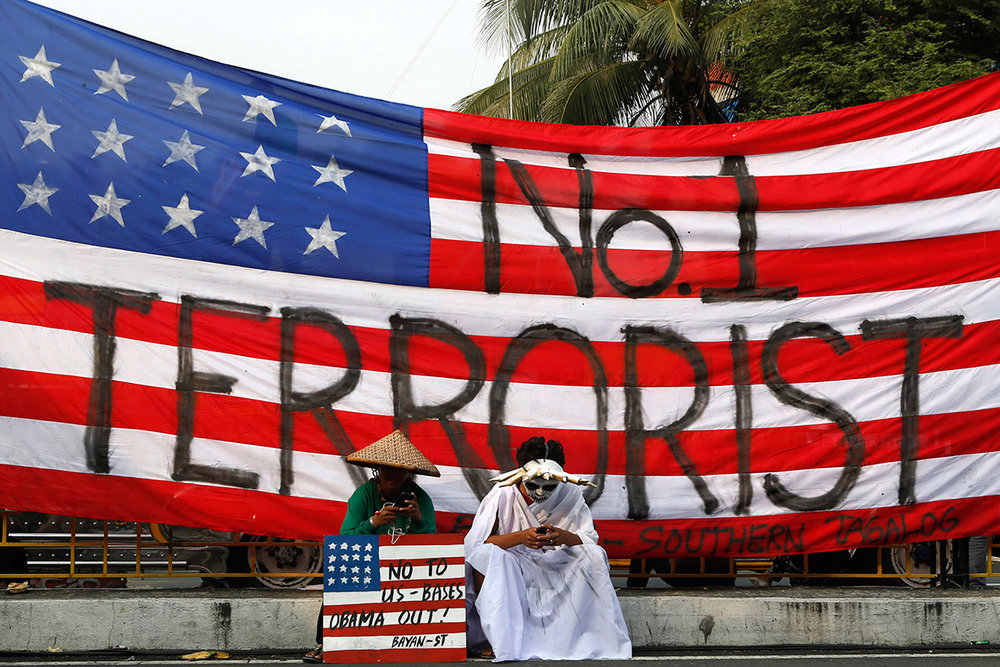
Iran’s key role in fight against America’s economic terrorism

By: Mudasir Sheikh


TEHRAN - The America’s economic terrorism against the Islamic Republic of Iran has assumed alarming proportions lately. But Iran stands unfazed. On August 20, 2018, Iran’s central bank-affiliated website took off U.S. dollar as a standard of measuring the average rate of Iran’s most tradable currencies. In February, Iran had switched from US dollar to Euro as the official reporting currency of the nation.
Recently President Hassan Rouhani announced a ‘secondary currency market’ and other comprehensive measures to tackle the devaluation of Rial. According to experts, Trump's hostile stance towards Iran is a major contributing factor for the devaluation of Rial, but President Rouhani’s recently announced policies are going to effectively counter this economic warfare.
The monopoly of US dollar in global trade has been effectively exploited by Washington to unleash its terror on sovereign states and to feed its unlimited deficits as beautifully explained by F. William Engdahl in his book ‘A Century of War: Anglo-American Oil Politics.’
It is easy to picture that Iran is not alone in this battle against American economic terrorism but it is on the forefront. China’s objective is also to push the global economy away from the slavery of petrodollar into the levers of real influence. This century has witnessed a ten-fold growth in Chinese economy thus claiming the status of world’s second-largest economy but Beijing is highly annoyed by dollar’s hegemony in the global financial system.
So China has now agreed on bilateral trade agreements with other victims of American economic terrorism like Pakistan, Turkey, Russia, and Iran. The People’s Bank of China and European Central Bank have agreed on a currency swap to facilitate bilateral trade between EU and China, thereby dumping about 500 million Euros worth of U.S. dollars to add Yuan in their reserves. China has also developed a Yuan-based oil future contract bypassing the U.S. Dollar dominated Brent and West Texas Intermediate benchmark.

Recently German foreign minister Heiko Maas proposed an alternative to the Society for Worldwide Interbank Financial Telecommunication system, aka the SWIFT code, in response to the unilateral withdrawal of U.S. from Iran nuclear deal and to facilitate the operations of EU companies into Iran as some companies such as Total and Maersk have suspended their Iranian operations due to the fear of reprisal from the U.S.

EU is not only challenging the SWIFT but back in 2017 Brussels proposed European Monetary Fund (EMF) in order to provide emergency financial assistance to member countries and to initiate a radical transformation into the financial institution of EU so that they can cope with the petrodollar hegemony.

According to a Wall Street Journal analyst, Gerald F. Seib, the use of petrodollar as a political weapon may cause its demise as obvious from the developments within Iran, Russia, and China, which are constantly exploring options to develop a parallel mechanism to facilitate global trade. Turkey’s changing stance and the establishment of New Development Bank (NDB) by BRICS member countries are also nails in the coffin of U.S. dollar standard.

According to a report by Forbes, Russia is also trying to develop an alternative to the SWIFT in an attempt to break the backbone of the western financial system. So Russia in consultation with China is about to introduce BRICS SWIFT. In addition to this BRICS countries have established their own bank by the name of New Development Bank (NDB), with similar functions as that of the World Bank.
China’s front to bring down the petrodollar has started with the launch of RMB priced crude oil Benchmark backed by gold which is a direct threat to current Brent and WTI benchmarks. Russia has also introduced its own payment gateway Mir to counter the U.S. based VISA and MasterCard companies. According to Russian National System of Payment Cards (NSPK), Mir has issued more than 13.9 million cards covering 10% of Russia in 2017.
Now as we have observed, Iran and a large number of other countries are facing the same problem of petrodollar hegemony and a lot of progress has been made to eliminate it. Iran has always been known for its consistent stand against the American hegemony and imperialism. Once again the world is looking at the leadership of Iran to consider the experience from monetary history and the cutting edge development into the field of technology like blockchain and hashgraph to design a much needed transparent and just economic system for the oppressed people across the world.
Technologies like blockchain and hashgraph based money, if fully redeemable in gold, can deliver a new global paradigm of financial freedom and a complete independence from U.S. dollar-based predatory international monetary system.  Blockchain and hashgraph are immune to manipulation and Gold is indestructible and resistant to inflation as obvious from the monetary history of last 5000 years. Additionally, blockchain based crypto currencies constitute the most efficient medium of exchange and gold is an unmatched commodity as for as the store of value is concerned and thus a combination of these two entities is a way forward for attaining the financial freedom.
Additionally BRICS, Iran, and other countries can develop a common financial institution that will look after the business transactions within these countries and with the rest of the world. A common crypto-currency redeemable in gold and a transparent financial institution can prevent concentration of power in a single entity so that the petrodollar like catastrophe can be avoided in the future.
Writer is a student and independent researcher based in Indian controlled Kashmir.

Saturday, August 25, 2018

Geopolitical, economic transitions are nothing but painful

By: Martin Love


TEHRAN, Aug. 25 (MNA) – Who knows what the real numbers are, but it’s been estimated that since the end of World War II the US has been responsible, one way or another, for the demise of some 25 million souls across the planet – many of them innocent, who were victimized by the overweening insistence that the US grab or maintain military or economic hegemony by damaging potential rivals.

There is nothing at all novel about this, for if one looks at history over the past centuries, there have been numerous governments and powers that sought to dominate their era and even, on occasion, managed to do some good. There are some peoples, polities and governments that quite literally have deserved reduction because on balance they have proven to be more destructive than constructive for humanity as a whole. Nazi Germany may be the prime example during the past century of a country that deserved the world’s enmity.

The US has long tried to fit the Islamic Republic into this category of polities that allegedly don’t deserve to survive for the SOLE REASON, in fact, that Iran refuses to ally itself with US and Zionist and Saudi attempts to control the Middle East and reap the benefits of its vast wealth. And even if the Islamic Republic, like any other country, sports aspects that can legitimately be criticized, Iran stacks up as a far more benign country today than severely undemocratic Saudi Arabia and Israel, the US’s chief “allies” in the region, despite all the Western and Zionist propaganda to the contrary.

I have, in any event, been depressed witnessing the US and Western failures of judgement, particularly with regard to Iran, and I have read that the suffering and confusion is immense within Iran, but at the same time I have tried to point out along the way that more than half the world’s population is moving within a painful transition, with leadership from Russia and China, to a new and much more promising paradigm than what the US has been trying to bully impose on the Mideast and Asia and even Europe. The US, in effect, may have been setting a trap for itself in recent decades that will eventually limit its impositions on other countries and force more cooperation.


Consider, for example, that a new bloc may be forming. It includes Russia, China, Iran and Turkey for starters, and may include India and Pakistan, too. Pakistan’s new leader, Imran Khan, has lately expressed disgust with his country’s allowing the US to have its way. The BRICS may be turning into the BRICS plus. This is good reason for Iranians to look ahead and try to understand that they, too, face a brighter future than they have known for decades.

Turkey has been offered membership in the “BRICS plus” and the Shanghai Cooperation Organization for starters, and Erdogan has allegedly shown interest in both. Thus, Turkey may leave NATO and cast its fate not with the West, but with Asian partners. Trade deals are on the table, too, and trade will increasingly be settled in local currencies, not the US dollar.


It’s all about the integration of Eurasia. Iran is already reportedly preparing to engage, by the start of 2020, into a comprehensive free trade agreement with the Eurasian Economic Union, and neighbor Turkey could well follow. 

Turkey, like Iran, is in the US doghouse because it plans to deploy Russian missile defense systems, has claimed it will continue to buy Iranian oil despite the sanctions, has apparently given up Western obsession with the deposition of Assad in Syria and will likely complete a gas pipeline across Turkey from Russia. (Why would Europe bother with far costlier LNG exports from the US?) And meanwhile, even one of the Persian Gulf states, Qatar, has offered a $15 billion loan to Turkey and restored better relations with Iran that includes energy collaboration in the shared South Pars gas field in the gulf, the largest on the planet.

All this can only benefit Iran eventually provided the US and Saudis and Zionists realize that further military aggressions in the Mideast will only deepen their worldwide isolation. In the US there is, for example, growing horror about the Saudi and UAE war on Yemen and the humanitarian crisis there with calls for the US by some in the US Congress to halt whatever support related to the war that the US military has been rendering to the Saudis.

I know for a fact that many “average” Americans are beginning to get a honest picture of just how relatively backward and corrupted and undemocratic the Saudis are. The possible beheading this month of a lovely Shia woman and human rights activist who lived in the Qatif oasis, a Shia enclave within largely Sunni Arabia, who simply expressed some opposition to the Saudi regime, has had an impact on transforming perceptions and I can say with certainty that in reading comments by many Americans attached to news articles about the Middle East that there is a strong revulsion against the Saudis, the Zionists, the Neocons in Washington and, in general, US foreign policy in the Middle East.

Iranians ought not to think most Americans with any knowledge of the Mideast do not rail against the Trump Administration. Some new war in the region sparked by the US or the Zionists will mark the end of the Trump presidency and the credibility of those who have supported its foreign policies, not to mention that the US would sink further into unsustainable financial debt.