Showing posts with label 'Peace Process'. Show all posts

Friday, November 29, 2019

How Western Media Bias Allows Israel to Get Away with Murder in Gaza

It is obvious that the Western media have maintained their blindspot on fairly reporting on Gaza and intentionally kept the truth from their readers.


An Israeli attack on Gaza was imminent, and not because of any provocations by Palestinian groups in the besieged, impoverished Gaza Strip. The Israeli military escalation was foreseeable because it factors neatly in Israel’s contentious political scene. The war was not a question of “if”, but “when”.
The answer came on November 12, when the Israeli military launched a major strike against Gaza, killing an Islamic Jihad Commander, Bahaa Abu al-Ata, along with his wife Asma.
More strikes followed, targeting what the Israeli military described as Islamic Jihad installations. However, the identities of the victims, along with damning social media footage, pictures, and eyewitness accounts indicate that civilians and civilian infrastructure were bombed and destroyed as well.
As of November 14, when a truce was announced, 32 Palestinians have been killed and over 80 wounded in the Israeli aggression.
What truly frustrates any meaningful discussion on the horrific situation in Gaza is the feeble response, whether by international organizations that exist with the sole purpose of ensuring world peace or by Western mainstream media, that ceaselessly celebrates its own accuracy and impartiality.
A most disappointing response to the Israeli violence was offered by Nickolay Mladenov, the United Nations Special Coordinator for the Middle East Peace Process.
Mladenov, whose job should have long been deemed pointless considering that no “peace process” actually exists, expressed his “concern” about the “ongoing and serious escalation between Palestinian Islamic Jihad and Israel”.
Not only Mladenov’s statement creates a moral equivalence between an occupying power, which instigated the war in the first place, and a small group of a few hundred armed men, it is also dishonest.
“The indiscriminate launching of rockets and mortars against population centres is absolutely unacceptable and must stop immediately,” Mladenov elaborated, putting great emphasis on the fact that “there can be no justification for any attacks against civilians”.
Shockingly, Mladenov was referring to Israeli, not Palestinian civilians. At the time that his statement was released to the media, there were already dozens of Palestinian civilians that had been killed and wounded, while Israeli media reports spoke of few Israelis who had been treated for “anxiety”.
The European Union did not fare any better. The EU parroted the same American knee-jerk response by condemning “the barrage of rocket attacks reaching deep into Israel”.
“The firing of rockets on civilian populations is totally unacceptable and must immediately stop,” a statement by the European bloc read.
Is it not possible that Mladenov and top EU foreign policymakers do not truly comprehend the political context of the latest Israeli onslaught—that embattled Israeli Prime Minister Benjamin Netanyahu is using military escalation as a way of fortifying his weakening grip on power.
Considering this, what is one to make of the poor media coverage, the inept analyses and the absence of balanced reports in major Western news media?
In a report published by the BBC on November 13, the British broadcaster referred to “cross-border violence between Israel and militants in Gaza”.
But Gaza is not an independent country and, per international law, it is still under Israeli occupation. Israel declared Gaza a “hostile territory” in September 2007, arbitrarily establishing a “border” between it and the besieged Palestinian territory. For some reason, the BBC finds this designation acceptable.
CNN, on the other hand, reported on November 13 that “Israel’s military campaign against Islamic Jihad” is entering its second day, while emphasizing the UN condemnation of the rocket attacks.
CNN, like most of its American mainstream counterparts, reports on Israeli military campaigns as a part and parcel of some imagined “war on terror”. Therefore, analyzing the language of US mainstream media with the purpose of underlining and emphasizing its failures and biases, is a useless exercise.
Sadly, US bias regarding Palestine has extended to mainstream media in European countries that were, to some degree, fairer, if not somewhat sympathetic, with the Palestinian peoples’ situation.
El Mundo of Spain, for example, spoke of a number of Palestinians—making sure to emphasize that they were “mostly militants”,—who “died” as opposed to “were killed” by the Israeli military.
“The escalation followed the death of Gaza’s armed branch leader,” El Mundo reported, failing once more to pinpoint the culprits in these seemingly mysterious deaths.
La Repubblica, which is perceived in Italy as a “leftist” outlet, sounded more like a rightwing Israeli newspaper, in its description of the events that led to the death and wounding of many Palestinians. The Italian newspaper used a fabricated timeline that only exists in the mind of Israeli military and decision-makers.
“Violence continued. Several rockets were thrown towards Israel by Gaza’s Islamic Jihad (militants), breaking the brief truce, according to (rightwing Israeli newspaper) The Jerusalem Post and to the Israeli army”.
It remains unclear what “truce” La Repubblica was referring to.
France’s Le Monde followed suit, reporting the same deceptive and cliched Israeli lines and emphasizing statements by the Israeli military and government. Interestingly, the death and wounding of many Palestinians in Gaza did not deserve a place on the French newspaper’s homepage. Instead, it chose to highlight a comparatively irrelevant news item where Israel denounced the labeling of illegal settlement products as “discriminatory”.
Maybe, one could have excused these across-the-board journalistic and moral failings if it were not for the fact that the Gaza story has been one of the most covered news topics anywhere in the world for over a decade.
It is obvious that the West’s “newspapers of record” have maintained their blindspot on fairly reporting on Gaza and intentionally kept the truth from their readers for many years so as not to offend the sensibilities of the Israeli government and its powerful allies and lobbies.
While one cannot help but bemoan the death of good journalism in the West, it is also important to acknowledge with much appreciation the courage and sacrifices of Gaza’s young journalists and bloggers who, at times, are targeted and killed by the Israeli army for conveying the truth on the plight of the besieged but tenacious Strip.
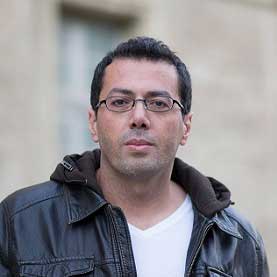
Ramzy Baroud

Ramzy Baroud is a journalist, author and editor of Palestine Chronicle. His latest book is The Last Earth: A Palestinian Story (Pluto Press, 2018). His latest book is The Last Earth: A Palestinian Story (Pluto Press, 2018). He earned a Ph.D. in Palestine Studies from the University of Exeter, and is a former Non-Resident Scholar at Orfalea Center for Global and International Studies, UCSB.

Wednesday, March 20, 2019

Chasing Mirages: What Are Palestinians Doing to Combat the ‘Deal of the Century’?

By Ramzy Baroud
US President Donald Trump and Palestinian Authority
President Mahmoud Abbas in the White House on
Wednesday, May 3, 2017
Save for a few symbolic ‘victories’ at the United Nations and UN-related bodies, Abbas has done little by way of a concrete and unified Palestinian action.


More US measures have been taken in recent weeks to further cement the Israeli position and isolate the Palestinian Authority (PA), before the official unveiling of President Donald Trump’s so-called ‘deal of the century’. But while attention is focused on spiteful US actions, little time has been spent discussing the PA’s own responses, options and strategies.
The last of Washington’s punitive measures came on March 3, when the US shut down its Consulate in Jerusalem, thus downgrading the status of its diplomatic mission in Palestine. The Consulate has long served as a de-facto American embassy to the Palestinians. Now, the Consulate’s staff will merge into the US embassy in Israel, which was officially moved to Jerusalem last May—in violation of international consensus regarding the status of the occupied city.
Robert Palladino, US State Department spokesperson, explained the move in a statement, sayingthat “this decision was driven by our global efforts to increase the efficiency and effectiveness of our diplomatic engagements and operations.”
Diplomatic hogwash aside, ‘efficiency and effectiveness’ have nothing to do with the shutting of the Consulate. The decision is but a continuation of successive US measures aimed at “taking Jerusalem off the table”—as per Trump’s own words—of any future negotiations.
International law, which recognizes East Jerusalem as an occupied Palestinian city, is of no relevance to the Trump administration, which has fully shed any semblance of balance as it is now wholly embracing the Israeli position on Jerusalem.
To bring Palestinians into line, and to force their leadership to accept whatever bizarre version of ‘peace’ Trump’s son-in-law, Jared Kushner, has in mind, the US has already taken several steps aimed at intimidating the PA. These steps include the cutting of $200 million in direct aid to Gaza and the West Bank, and the freezing of another $300 million dollars that were provided annually to the UN agency for Palestinian refugees (UNRWA).
That, and the shutting down of the Palestine Liberation Organization (PLO) office in Washington DC, on September 10, were all the signs needed to fully fathom the nature of the US ultimatum to the Palestinian leadership: accept our terms or face the consequences.
It is no secret that various US governments have served as the financial and even political backers of the PA in Ramallah. While the PA has not always seen eye-to-eye with US foreign policy, its survival remained, till recently, a top American priority.
The PA has helped Washington sustain its claim to being an ‘honest peace broker’, thus enjoying a position of political leadership throughout the Middle East region.
Moreover, by agreeing to take part in assisting the Israeli military in policing the Occupied Territories through joint US-funded ‘security coordination‘, the PA has proved its trustworthiness to its US benefactors.
While the PA remained committed to that arrangement, Washington reneged.
According to the far-right Israeli government coalition of Benjamin Netanyahu, PA leader, Mahmoud Abbas, is simply not doing enough.
‘Doing enough’, from an Israeli political perspective, is for Palestinians to drop any claims to occupied East Jerusalem as the future capital of Palestine, accept that illegal Jewish settlements in the West Bank would have to remain in place regardless of the nature of the future ‘peace agreement’, and to also drop any legal or moral claims pertaining to Palestinian refugees right of return.
While the PA has demonstrated its political and moral flexibility in the past, there are certain red lines that even Abbas himself cannot cross.
It remains to be seen how the PA position will evolve in the future as far as the soon-to-be announced ‘deal of the century’ is concerned.
Yet, considering that Trump’s blind support for Israel has been made quite clear over the course of the last two years, one is bewildered by the fact that Abbas and his government have done little by way of counteracting Washington’s new aggressive strategy targeting the Palestinians.
Save for a few symbolic ‘victories’ at the United Nations and UN-related bodies, Abbas has done little by way of a concrete and unified Palestinian action.
Frankly, recognizing a Palestinian state on paper is not a strategy, per se. The push for greater recognition has been in the making since the PLO Algiers conference in 1988, when the Palestine National Council declared a Palestinian state to the jubilation of millions around the world. Many countries, especially in the global south, quickly recognized the State of Palestine.
Yet, instead of using such a symbolic declaration as a component of a larger strategy aimed at realizing this independence on the ground, the PA simply saw the act of recognizing Palestine as an end in itself. Now, there are 137 countries that recognize the State of Palestine. Sadly, however, much more Palestinian land has been stolen by Israel to expand on or build new Jewish-only colonies on the land designated to be part of that future state.
It should have been clear, by now, that placing a Palestinian flag on a table at some international conference, or even having a Palestine chair at the G77 UN coalition of developing countries, is not a substitute for a real strategy of national liberation.
The two main Palestinian factions, Abbas’ own Fatah party and Hamas, are still as diverged as ever. In fact, Abbas seems to focus more energy on weakening his political rivals in Palestine than on combating the Israeli Occupation. In recent weeks, Abbas has taken yet more punitive financial measures targeting various sectors of Gaza society. The collective punishment is even reaching families of prisoners and those killed by the Israeli army.
Without a united front, a true strategy or any form of tangible resistance, Abbas is now vulnerable to more US pressure and manipulation. Yet, instead of moving quickly to solidify the Palestinian front, and to reach out to genuine allies in the Middle East and worldwide to counter the bitter US campaign, Abbas has done little.
Instead, the Palestinian leader continues to chase political mirages, taking every opportunity to declare more symbolic victories that he needs to sustain his legitimacy among Palestinians for a while longer.
The painful truth, however, is this: it is not just US bullying that has pushed the PA into this unenviable position, but, sadly, the self-serving nature and political bankruptcy of the Palestinian leadership itself.


Ramzy Baroud is a journalist, author and editor of Palestine Chronicle. His latest book is The Last Earth: A Palestinian Story (Pluto Press, 2018). His latest book is The Last Earth: A Palestinian Story (Pluto Press, 2018). He earned a Ph.D. in Palestine Studies from the University of Exeter, and is a former Non-Resident Scholar at Orfalea Center for Global and International Studies, UCSB.