
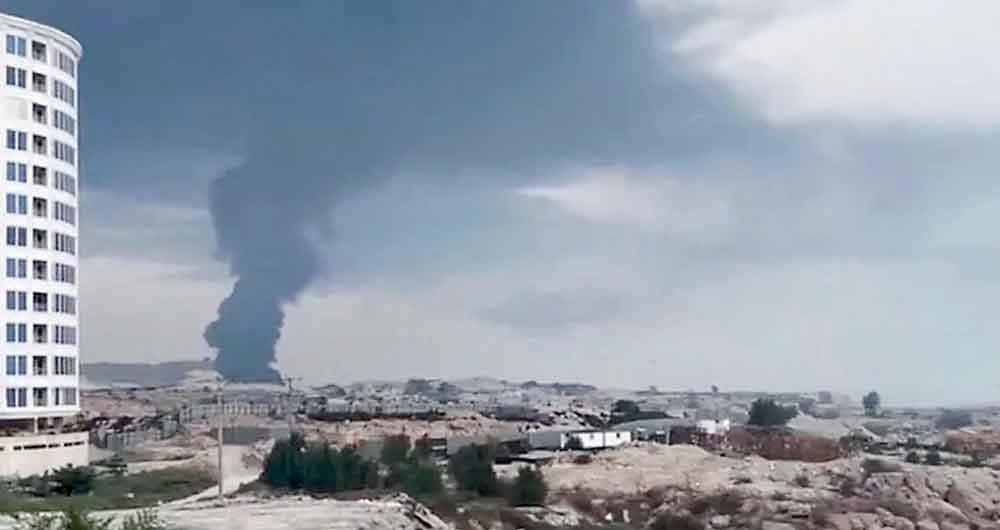
Plumes rise into the sky after a US attack on an Iranian facility in southern Iran

Yet another round of escalation, and yet another cycle of hope and despair. Now in its sixth month, the US war on Iran is hitting the poor the hardest. From transport to daily bread, they pay more than they did for essentials before the US‑Israeli war of aggression on Iran began on February 28.
To end the war—even if only temporarily—the warring parties attempted mediation, but only half‑heartedly. The outcome was a vaguely worded memorandum of understanding, which lasted only three weeks before collapsing, triggering the current round of what some critics call Donald Trump’s “forever war.”
The trust deficit, instead of being bridged, keeps widening. It is now as unbridgeable as the contrast between the two countries’ ideologies: one rooted in Shiite Islamic principles, the other in neo‑Western civilizational values. Together, they risk igniting Samuel Huntington’s much‑criticized “clash of civilizations.”
Also widening in tandem with the trust deficit are the war’s geographic contours. Saudi Arabia, Yemen, and Iraq have all become theatres where scores are being settled. Adding to the complexity, Ukraine last Saturday attacked an Iranian ship in the Caspian Sea, claiming it was carrying military cargo to Russia. Iran warned Ukraine that the attack would not go unpunished.
A three‑day pause in the fighting raised hopes for peace this week. But it was not to be. Iran launched what the US now calls a “surprise attack” on American military targets in Jordan. An angry Trump vowed a fitting response, saying: “We are going to beat the f**king sh*t out of them. We’ll be hitting them hard. They’re going to get a beating.”
Hours after the Iranian attack—which signalled a new strategy in Tehran’s approach to the war—the US and Saudi militaries jointly struck pro‑Iranian militias in several Iraqi cities, including the Shiite holy city of Karbala. US Central Command described the attacks as a response to more than 30 drone attacks against US forces and Saudi energy infrastructure over the previous 72 hours. Meanwhile, the hostilities between Saudi Arabia and Yemen’s Houthi militia also intensifying.
On Wednesday night, several Iranian islands and towns in the south were hit hard. The attacks were described as the retaliation for Iran’s surprise strike on US bases in Jordan. They coincided with Trump’s meeting with Benjamin Netanyahu, the Israeli prime minister and architect of the Iran war. Few details of what the two leaders discussed are known. But it is no secret that Israel is pleased with the way the US is pummeling Iran while turning a blind eye to the Zionist state’s atrocities in Lebanon and Gaza, despite US‑brokered ceasefires in both theatres.
Outside the war zone, the battered poor ask when this war of attrition will end. America’s playboy octogenarian president, Donald Trump—a billionaire to boot—is not known to have experienced hunger. He slashes funding for poverty‑alleviation programmes yet calls on Congress to approve US$1.5 trillion, money enough to eradicate global hunger five times over.
To the dismay of the world’s poor, Iran is also matching US unwillingness to compromise in kind. It unleashes its limited military resources against US targets and ships that defy its orders, drawing more American attacks, in a strategy seen as an attempt to exhaust US missile and drone stocks. Recent US media reports indicated that US ammunition reserves were fast depleting. Such reports have given Iranians reason to be cautious about any lull in attacks and to doubt US intentions. They theorise that Washington’s peace offers are merely a ruse to replenish its stocks and strike even harder at Iranian targets.
No wonder both the US and Iran say this war is not an eye for an eye but a head for an eye.
Behind the rhetoric, however, Trump is desperately seeking a face‑saving exit—one that is becoming increasingly elusive when both countries embrace a strategy of escalation aimed at de‑escalation. Mediators Pakistan, Qatar, and Oman have tried as hard as they could, but diplomacy, when its pushers are handicapped, is bound to fail.
What is required now is diplomacy at a global level, since those affected by Washington’s illegal war are not only Iran and the Gulf states but also the wider world—particularly developing nations that depend on oil imports, tourism, and markets for their meagre exports. Britain’s recent proposal for an international conference to discuss safeguarding ships in the Strait of Hormuz attracted only a few takers.
China, however, could assume leadership in convening an international peace conference aimed at finding a diplomatic solution to the conflict, even though it had earlier indicated that it did not wish to be a guarantor of peace in any ceasefire deal. After all, didn’t China spring a diplomatic surprise by mediating an end to hostilities between Saudi Arabia and Iran in 2023?
Such a China-led international diplomatic effort would be in consonance with President Xi Jinping’s Global Governance Initiative (GGI), built on new pancha seela or five core concepts: sovereign equality, the international rule of law, multilateralism, a people‑centred approach, and real action.
According to the latest white paper released by China’s State Council, the GGI was proposed to respond to the “severe and complex” challenges of the time. The challenges include intensifying geopolitical tensions and armed conflicts, the resurgence of militarism and nuclear proliferation, as well as global economic fragmentation, food and energy insecurity, and the widening wealth gap.
The Iran war offers China an opportunity to address the concerns stipulated in the white paper through the GGI. In line with this vision, China has already established the International Organisation for Mediation (IOMed) in Hong Kong to help resolve disputes between states.
Peace in the Gulf region, needless to say, serves China’s national interest. Stability would ensure low energy prices and the free flow of oil from West Asia to energy‑dependent China and other countries, especially in Asia.
Some analysts, however, contend that the war also serves China’s interests, since it keeps the US distracted from the Indo‑Pacific, particularly the South China Sea, China’s backyard. With Washington shifting its THAAD missile systems from South Korea to West Asia and relocating thousands of military personnel from Japan to the region, China can only be pleased to see the United States’ Pivot to Asia defence doctrine crumbling.
Since the peace dividends far outweigh whatever leverage the war may bring, can China accept the peace challenge and join Pakistan, Qatar, and Oman to end the conflict as early as possible? Such a role is imperative, given that the war fires now engulf the vital Bab al‑Mandeb region and are spreading to other countries.
The war now hinges on one thorny issue—Iran’s claim to control the Strait of Hormuz.
The Trump administration and US warmongers must also learn to relish peace and realise that America’s victory in this war lies not in defeating Iran but in reviving the Memorandum of Understanding and implementing Clause 5, which allows Iran and regional countries to work out a mechanism to ensure freedom of navigation in the Strait of Hormuz.
That is a way forward and may be a starting point for peacemakers. Allowing Iran to charge a reasonable levy on ships may be worth the price for peace—one that would bring far greater dividends to the globe.

No comments:
Post a Comment