Showing posts with label Gibraltar. Show all posts

Tuesday, August 20, 2019

Iranian victory in Gibraltar 45-day battle

Iranian victory in Gibraltar 45-day battle

Tehran, Aug 19, IRNA – The case of Adrian Darya tanker (Grace 1) ended Sunday night in Gibraltar, where many experts consider the ship's release a legal and diplomatic victory for the Islamic Republic of Iran.
They believe that Tehran has shown once again that in dealing with these issues by using defense-political authority can defend its own interests and at the same time apply the policy of resolving bilateral and multilateral disputes.
The case of "Grace 1 or Adrian Darya" oil tanker incident began just 45 days ago, when news of the launch of a special financial mechanism called INSTEX came to light, and news of the seizure of the ship carrying Iranian oil by British Navy got media attention.
What was the matter?
The Gibraltar government announced on July 4 that authorities in the area and the British Navy had seized a 300,000-ton supertanker called Grace I. Subsequently, the UK claimed that the tanker was headed for the Baniyas Refinery in northwestern Syria.
Fabian Picardo, the Chief Minister of autonomous region of Gibraltar, claimed at that time that the refinery was owned by a company subject to EU sanctions against Syria.
Gibraltar is a strategic region in the Iberian Peninsula in southern Spain, with Madrid and London claiming sovereignty. Gibraltar is in fact a peninsula that is connected by land to Spain, but is a British overseas territory.
Reactions to Grace's seizure
This was not the end of the story, and after the tanker carrying Iranian oil was seized, Foreign Ministry officials, and in particular Foreign Minister Mohammad Javad Zarif, announced that some sort of "piracy" had taken place and had begun their political and legal action.
Iran's first reaction to this was to summon the British ambassador. Foreign Ministry spokesman Seyyed Abbas Mousavi wrote on Twitter that the British ambassador to Tehran was summoned to the Foreign Office following the illegal seizure of a tanker carrying Iranian oil in the Gibraltar Strait.
The then British Foreign Secretary Jeremy Hunt had a phone conversation with the Iranian Foreign Minister. The British Foreign Office had said the condition for Grace 1 release would be a guarantee by Iran that the next destination of the tanker was not to be Syria, but Iranian Foreign Ministry officials responded that the request had no legal basis.
Hours after the announcement by the Gibraltar government, US National Security Adviser John Bolton while welcoming the development tweeted that the United States and its allies would continue to prevent Tehran and Damascus to make benefits from this illegal trade.
Russia's diplomatic apparatus, however, condemned the British seizure of the tanker, announcing the evident was suggesting that the move was a pre-designed plan by the US and Britain.
The statement by the Russian Foreign Ministry emphasized that remarks by US and British officials after the incident indicated that the measure had been planned in advance and that several intelligence agencies had contributed.
Legal Battle in Gibraltar
The past developments in the case of the oil tanker were as complex as the seizure of the ship. The seizure of the British oil tanker Stena Impero and the British attempt to build a maritime alliance in the Persian Gulf, has signs of a complicated political-security and legal process.
But to what extent the Gibraltar government's legal perceptions for the seizure of the ship were correct, the British Navy's action is not considered to be right in the light of the principles governing international relations (seizure in international waters).
The interpretation that the British had of the status of the ship and acted within it was a unilateral perception of the Syrian sanction.
Examination of the EU sanctions document against Syria shows that the British government's claim to seize the oil tanker "Grace 1" carrying Iranian crude oil has no legal basis for even moving to Syria.
According to the annexed document to the European Union's restrictive measures against Syria, European countries are only required to inspect cargoes destined for Syria on suspicion of carrying military weapons to Syria.
In fact, 28 EU member states can only seize ships and aircraft passing through EU territory carrying weapons and "equipment related to domestic crack down" only for compelling reasons.
According to the EU sanctions document, the import of crude oil and petrochemical products from Syria to EU member states is banned and there is no mention of restrictions on crude exports to the country. So British action is, in every way, contrary to the principles of international law.
The Times of London, on the other hand, wrote that the local government of Gibraltar 36 hours before the oil tanker (Grace 1) passed through the area, amended the rules and regulations on sanctions under British pressure so that the British Marines to be able to occupy and seize it.
According to jurists, the changes in the laws of the local government of Gibraltar pretended in a way that the seizure of the Grease was legal.
The Gibraltar Local Government Sanctions Regulations 2019, which became the law of the territory on July 3, gives the officials the authority to identify and seize ships if the local government chief minister is suspected of the ships are used to violate EU sanctions.
Happy ending to Adrian Sea case
But after 45 days of political and legal battle last Thursday evening, August 15, local newspapers in Gibraltar reported that a British-ruled district court had granted the release of Iranian supertanker "Grace 1" and the British government finally after five weeks released the tanker.
Adrian Darya’s seizure was lifted as the Trump administration attempted twice to seize the ship and its cargo by pressuring the supreme court of the Gibraltar region and imposing unilateral sanctions on the ship and its crew.
The Gibraltar government issued a statement on Sunday saying the United States is seeking to seize the tanker for reasons that are in essence related to US sanctions on Iran. The Gibraltar government issued a statement rejecting the US request, stressing that the EU sanctions regime against Iran is fundamentally different from the US sanctions regime against Iran.
But a strategic understanding and experience can be apprehended from the case of the oil carrier; although there appears to be signs of British involvement in American political, legal, and economic processes towards the Islamic Republic of Iran, but basically such a situation indicates that American strategy, policy and action is vincible, and Iran's political and legal diplomacy, in the light of the JCPOA political-legal basis, can help pursue national interests and achieve national goals.

Monday, August 19, 2019

Why Iran and Britain are heading for a crash

Mahan Abedin
Warship belonging to British Navy, allegedly sent to the Strait 
of Hormuz is seen passing through the Bosphorus in Istanbul, 
Turkey on July 12, 2019. 

The decision by the Gibraltar authorities to release supertanker Grace 1 will slightly ease tensions between Britain and Iran, but not for long.
Relations between the two states have been steadily deteriorating for the past eight months and the fear is that they will collapse altogether, as they have done repeatedly in the past.
The steady drift to the break down in Anglo-Iranian relations comes at a sensitive time and unfolds against a backdrop of a sharp escalation of tensions between Iran and the United States across the Middle East.
One reason why the capture of Grace 1 by British Royal Marines so infuriated the Iranians – and prompted the seizure of the British-flagged tanker Stena Impero in the Strait of Hormuz two weeks later – was because the British action had been carried out at the behest of the Americans.
Whilst the tanker issue appears to be on the point of resolution, wider disputes and tensions in the fraught Anglo-Iranian relationship are likely to sharpen in the months ahead as Iran adopts an increasingly strident posture in the face of pressure by the US, UK and Israel.
In view of the emotions invested in the volatile Anglo-Iranian relationship, the breakdown this time could be more dramatic and long-lasting.

An old story


The British-Iranian relationship is one of the most intriguing and enigmatic in international relations. It is highly emotive primarily because of the UK’s former quasi-colonial role in Iran. Whilst Iran could never be colonised, nevertheless a prolonged period of national decline for the better part of the 19th century made the country uniquely vulnerable to the so-called “Great Game”  
As Britain and Russia intensified their rivalry in the last quarter of the 19th century for influence and control over Central Asia and its periphery, Iran’s embattled Qajar rulers surrendered much of their sovereignty to the encroaching superpowers of the day.
The fact that the British were far more successful than their Russian rivals at penetrating Iranian society – and manipulating Iran’s sclerotic elites – has left a lasting impression on the Iranian psyche. The former British foreign secretary, Jack Straw, has aptly captured this enduring Iranian impression of British power in his book, “The English Job: Understanding Iran and Why It Distrusts Britain.
Since the Iranian revolution of 1979, Tehran has been trying to reset its international relations across the board. The key foreign policy priority has been to rebalance relations with the core Western powers, notably the US and the UK.
To that end, Iran has scored major successes in the past four decades. A brief glance at the Middle East’s geopolitical map in 2019 demonstrates just to what extent Iran has emerged as the region’s dominant power, undermining, and in some cases displacing, American influence.
The struggle against British influence has been no less intense, but much of it has been hidden and thus the resulting shift in the balance of power has been harder to detect. Iran’s main contemporary grievances against Britain revolve around London’s outreach to Iran’s adversaries in the Gulf, in addition to the hopeless British quest of re-establishing a semblance of influence within Iran.

The big breakdown?


Anglo-Iranian relations have been inherently volatile for two centuries, but they became more fraught and unpredictable following the Iranian revolution in 1979. Most importantly, the contemporary relationship has unfolded against a backdrop of a steady, but consistent, shift in the balance of power.
Today, Iran is much stronger than 40 years ago. By contrast, Britain continues to decline, at least in geopolitical terms, as evidenced by the shrunken size of the Royal Navy and broader depletion of military strength.   
Broader indices of national power have shifted too. Iran is a remarkably cohesive society led by an ideologically-driven state determined to not only transform the international balance of power, but equally important to displace the normative values in international relations which have guaranteed Western hegemony for two centuries.
By contrast, Britain is a divided society led by elites who are increasingly unsure of their place in the world. The divisions and polarisation and, by extension, the decline of the British establishment, is set to intensify following Britain’s disorderly exit from the European Union in just over two months.
The bottom line is that Iran seeks to redefine the relationship with Britain, not so much to the point of placing it on an equal footing, but building up sufficient leverage to deter the UK from working closely with Iran’s regional adversaries to Tehran’s disadvantage.
Britain’s whole-hearted support for the Bahraini dictatorship and London’s continuing involvement in the Yemen conflict are two of the most important examples.
But the shift in the balance of power – with Iran now stronger than the UK in some key aspects – does not mean that the British will sit on their hands as Iran continues to redefine the relationship by continually defying and challenging Britain.
Indeed, post-Brexit, some elements of the British establishment may try to soften the political and economic blows by taking sanctuary in the old colonial delusions.
Anglo-Iranian relations have collapsed in a big way on at least two occasions since 1979. The first breakdown occurred in 1989 in the wake of the late Ayatollah Khomeini’s Fatwa against the British-Indian novelist Salman Rushdie.
The late Ayatollah Khomeini’s intervention galvanised the British Muslim community in an unprecedented manner and it may be considered as Iran’s first major interference in Britain’s internal affairs.
The second breakdown occurred in November 2011 after Iranian students stormed the British embassy in Tehran following Britain’s lead role in imposing nuclear-related sanctions on Iran.
The third major breakdown is an inevitability, and may occur sooner rather than later owing to the new British Tory government’s ideological and political proximity to the Trump administration in the US.
But this time around expect the breakdown to be deeper, longer and much harder to resolve.

Friday, August 16, 2019

Gibraltar releases Iran-operated tanker despite US pressure


Press TV – Gibraltar’s government has released an Iranian-operated supertanker, which was seized by British marines in the Strait of Gibraltar on July 4, despite pressure from the United States for the vessel’s continued detainment.
“Authorities in Gibraltar have released the Iranian supertanker Grace 1, which was seized on July 4 on suspicion it was shipping 2.1 million barrels of crude oil to Syria in breach of EU sanctions,” Reuters quoted the Gibraltar Chronicle as reporting on Thursday.
According to the report, the chief justice of Gibraltar’s supreme court, Anthony Dudley, said there was no US application currently before the court.
Chief Justice Anthony Dudley said that since Iran had guaranteed in writing that the destination of the Grace 1 would not be a country “subject to European Union sanctions… there are no longer reasonable grounds to suspect that the detention of the Vessel is required.”
Spain’s Foreign Ministry reported after the incident that the UK had seized the vessel at the request of the US, which has been trying to trouble Iran’s international oil vessels as part of its campaign of economic pressure against the Islamic Republic.
Earlier on Thursday, Gibraltar said that the US had applied to seize the Iranian-operated oil tanker after British media reported that the vessel’s release was imminent following a set of diplomatic exchanges between Tehran and London.
“The US Department of Justice has applied to seize the Grace 1 on a number of allegations which are now being considered,” the Gibraltar government said in a statement.
It added that the “matter will return to the Supreme Court of Gibraltar at 4 p.m. (1400 GMT) today.”
A diplomatic dispute broke out between Iran and the UK on July 4, when Britain’s naval forces unlawfully seized Grace 1 and its cargo of 2.1 million barrels of oil in the Strait of Gibraltar under the pretext that the supertanker had been suspected of carrying crude to Syria in violation of the European Union’s unilateral sanctions against the Arab country.
However, reports show the confiscation took place upon a call by the US.
Tehran rejected London’s claim that the tanker was heading to Syria, slamming the seizure as “maritime piracy.”
Iran’s Ports and Maritime Organization said Tuesday that Britain was expected to soon free Grace 1, after the two sides exchanged certain documents to pave the way for the supertanker’s release.
Iran’s FM: Trump’s piracy attempt indicates his contempt for law
Soon after the report emerged about the release of the Iranian-operated tanker, Iran’s Foreign Minister Mohammad Javad Zarif took to Twitter noting that the seizure of the tanker proved the Trump administration’s contempt for the law.
“This piracy attempt is indicative of Trump admin’s contempt for the law,” Iran’s top diplomat said.
Zarif added that the US effort to prevent release of the Iranian tanker was aimed at abusing “the legal system to steal our property on the high seas.”
He said this vain attempt followed the US failure in achieving its anti-Iranian goals through economic terrorism.
‘US faced humiliating defeat in its effort to prevent tanker’s release’
Following the decision by the Gibraltar court, Iran’s Ambassador to UK Hamid Baeidinejad said in a tweet on his official Twitter page that the decision by the officials of Gibraltar put an end to 40 days of illegal seizure of the tanker, which carries the Iranian oil.
“Up to the last minute, the United States tried in vain to prevent the release of the tanker, but was faced with a humiliating defeat,” Iran’s UK envoy added.
Baeidinejad stated that all preliminary steps have been taken to ensure the tanker’s movement toward free waters and “the vessel will soon leave the Gibraltar region.”

Monday, July 22, 2019

Hubris Before the Fall


Hubris is usually a forewarning of impending calamity. Extreme arrogance blinds the hubristic person to the limits of their power. So, blindly, they push on with reckless excess, leading to potentially disastrous results.
The US and Britain are exemplars of this kind of mad hubris in the present mounting tensions with Iran.
After Iran seized a British cargo ship this week in the Persian Gulf, Britain’s foreign secretary Jeremy Hunt condemned the Iranian action as “unacceptable” and warned that Tehran is “choosing a dangerous path”.
American President Donald Trump also rebuked Iran. “We have the greatest ships – the most deadly ships, we don’t want to have to use them,” he said to reporters Friday at the White House. “We hope for their [Iran’s] sake they don’t do anything foolish. If they do, they will pay a price like nobody’s ever paid.”
Britain is claiming that Iran’s impounding of a British-operated ship is unlawful and violates “freedom of navigation”. Iran said it seized the vessel after it collided with an Iranian fishing boat and disobeyed safety regulations for passing through the narrow Strait of Hormuz.
Whatever the exact circumstance are, London has very little legal or moral authority to remonstrate with Iran. Tehran says it is carrying out an investigation into the alleged infringement by the British ship. Iran has the sovereign right to do so.
As for the official British reaction, it smacks of downright hypocrisy. An Iranian oil tankeris currently detained in the British overseas territory of Gibraltar after Royal Marines boarded the vessel on July 4 and took it into custody over claims it was transporting oil to Syria – allegedly in breach of European Union sanctions on Damascus.
Iran slammed that British seizure as “piracy” and disputes the legality of Britain’s motives. There are good grounds to believe that Britain’s actions were conducted in league with Washington to deliberately aggravate Iran.
What’s good for the goose is good for the gander. If the British apply “laws” on alleged shipping transgressions by Iran, then Tehran has every right to do likewise on suspected British ships in or near its territorial waters in the Persian Gulf.
The arrogance of Britain and the US is astounding. Hypocrisy and double standards are tumbling over themselves.
Washington and London’s accusations that Iran is “escalating” tensions are an absurd inversion of reality. Iran’s foreign minister Mohammad Javad Zarif just this week requested the US to enter negotiations to resolve the stand-off – if Trump reciprocated by lifting harsh sanctions off Iran. You can’t get fairer than that.
The Stena Bulk oil tanker unloads oil
© AP PHOTO / DAMIAN DOVARGANES
The Stena Bulk oil tanker unloads oil
Let’s recall the bigger picture. The dangerous situation has been created by Washington’s reprehensible tearing up last year of the international nuclear accord with Iran. Then in April, Trump reimposed crippling sanctions on Tehran driving the Iranian economy into even further turmoil. Such economic warfare is illegal under international law. It’s “economic terrorism”, as Iranian-American writer Soraya Sepahpour-Ulrich aptly puts it.
In May, the Trump administration shifted gear and embarked on a policy of what can only be called military aggression by sending warships and B-52 nuclear-capable bombers to the Persian Gulf, purportedly to “defend” against alleged – though unsubstantiated – Iranian security threats.
For the past two months there have been a series of sabotage incidents against commercial shipping which the US has blamed on Iran. Iran denies any involvement and has instead speculated that the incidents are being orchestrated by malign forces to incriminate Tehran.
The seizure of the Iranian oil tanker off Gibraltar earlier this month by British commandoes fits into the same pattern of deliberate provocation.
So when Britain’s Jeremy Hunt gets on his high horse of legal probity and righteousness, the hubris is way too much to stomach.
Washington and London have said in public that they don’t want a war with Iran. But all other signs suggest that war is something they are prepared to wage. Maybe they expect that the display of military power and bragging about it will be enough to make Iran cower and beg for mercy. That, in short, is state terrorism.
But Iran is nobody’s fool nor play thing, as its leaders have time and again warned. Tehran says that the US and Britain may start a war, but it will be Iran that “finishes it”.
There is no doubt Iran’s military defenses are formidable and its missiles could dispatch American and British warships to a watery grave.
Then we are in extremely red-alert geopolitical territory where military conflict could explode into a regional war and even world war. With the Americans and their British bulldog getting a bloody nose, the truly worrying thing is that their extreme arrogance will tempt them to salvage their disaster with the unthinkable – nuclear weapons.
Hubris before the fall could be a fall involving just the corrupt American and British rogue regimes. But awful to contemplate is the fall might also include vast numbers of innocent people, or even the planet as we know it.
One things seems irrefutable, however. The American and British criminal bullying towards Iran and the rest of the world has to stop. The world can no longer afford to tolerate their extreme lawlessness.

Monday, July 08, 2019

British Piracy Against Iran Oil Tanker On The High Seas

Crescent International
Iran has reacted angrily to Britain’s seizure of it oil tanker in the early hours of July 4 near Gibraltar.
British commandos seized the supertanker Grace 1 as it sailed through the Strait of Gibraltar. It was carrying 2 million barrels of oil, reportedly destined for Syria.
What credibility can there be to the British claim that they carried out the act of piracy at the request of Gibraltar, which is a disputed British colony with a total population of 300,000?
Spain rejects British claims to Gibraltar and demands its return. Madrid insists Gibraltar is part of its territory.
On Friday (July 5), Iran’s foreign ministry summoned British ambassador Rob Macaire to explain the “illegal seizure” of its oil tanker.
It also demanded “the immediate release of the oil tanker, given that it has been seized at the request of the US, based on the information currently available,” the foreign ministry statement said.
Iran dismissed Britain’s excuse that it seized the Iranian oil tanker at the request of the “Gibraltarian authorities to enforce [European] sanctions against the regime of Bashar al-Assad.”
Spain’s acting Foreign Minister, Josep Borrell, confirmed Iran’s position saying Gibraltar had seized Grace 1 in response to a request from the US to Britain. The Spanish paper El Pais reported that Borrell said the US intelligence implied that the supertanker was in British territorial waters.
Madrid will now formally complain of a British incursion into Spanish waters, with Borrell, the EU’s nominee for High Representative for Foreign Affairs and Security Policy, stating, “We are analysing the circumstances and seeing how they affect our sovereignty.”
The Washington war hawk and paid agent for the terrorist outfit, Mujahideen-e Khalq Organization, better known as munafiqeen (hypocrites), John Bolton was elated at the news.
He tweeted, “Excellent news: UK has detained the supertanker Grace I laden with Iranian oil bound for Syria in violation of EU sanctions. America & our allies will continue to prevent regimes in Tehran & Damascus from profiting off this illicit trade.”
Tehran’s reaction, however, was not confined to diplomatic protests only.
Mohsen Rezai, former head of Iran’s Revolutionary Guard Corps and member of the Supreme National Security Council said Iran would respond to bullies “without hesitation.”
He warned in a tweet, “If Britain does not release the Iranian oil tanker, it is the authorities’ duty to seize a British oil tanker.”
Britain as usual is acting as America’s poodle while the US is behaving as an outlaw regime. There is nothing new about US misconduct.
Washington warlords are playing with fire. The Trump regime has imposed illegal sanctions on Iran since walking away from the multilateral agreement in May 2018.
While European states Britain, France and Germany—all signatories to the July 2015 nuclear accord with Iran known as JCPOA—say that they want to preserve the multilateral accord they have done little to uphold it.
They keep telling Iran not to breach the accord by suspending adherence to some of its provisions but they fail to fulfill their own obligations.
As Iran’s Foreign Minister Dr Javad Zarif told the New York Times in an interview published on July 4 that since it is a multilateral accord, it cannot be imposed unilaterally.
Iran alone is not responsible for adhering to it. He pointed out that Trump says it is a bad deal and wants to renegotiate it. Iran has rejected this demand since the deal was negotiated over several years and it is a multilateral, not a bilateral agreement.
It was also affirmed through UN Security Council resolution 2231 on July 20, 2015.
Dr Zarif said Iran “will remain committed to the deal as long as the remaining participants (EU, France, Germany, UK, Russia and China) observe the deal.”
“Survival or collapse of the JCPOA depends on the ability and willingness of all parties to invest in this undertaking. In a nutshell, a multilateral agreement cannot be implemented unilaterally,” Zarif said.
He also said that Iran’s decision to reduce its commitments was taken in line with its legal rights under paragraphs 26 and 36 of the nuclear deal, saying, “Paragraph 36 of JCPOA is a clear example that we negotiated this deal with the full understanding that we could not trust the commitment of the West.
The JCPOA obliges the European signatories to prove their commitment to the nuclear deal in action, Dr. Zarif said, adding that the Islamic Republic would commit to the agreement in exactly the same way as those countries would.
Britain’s illegal seizure of the Iranian oil tanker clearly shows the Europeans’ evil intentions. The West cannot be trusted to adhere to even a signed agreement.
Crescent International

Saturday, July 06, 2019

Royal Marines seize Iranian tanker under orders from US

A detachment of nearly 30 British troops including Marines from 42 Commando raided the tanker, Grace 1, together with police from Gibraltar, the rocky outcrop seized by Britain following the War of the Spanish Succession under the 1713 Peace of Utrecht that is strategically placed to control access to the Mediterranean Sea.
The UK said it had seized the ship to prevent Iran breaching sanctions against Syria.
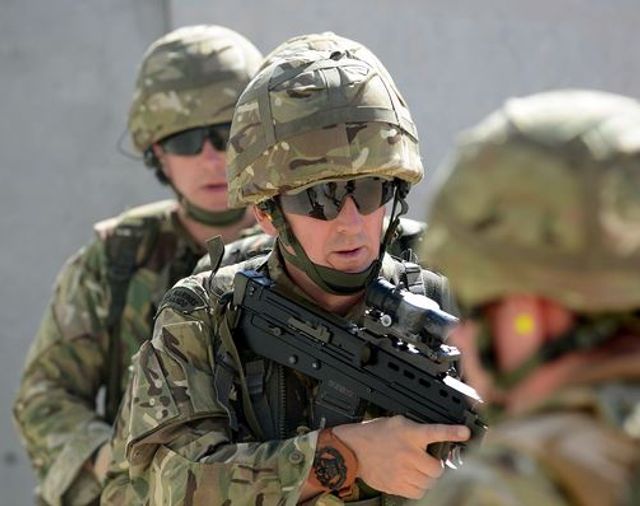
Royal Marines during live fire drills in 2012 [Credit: LA(Phot) Jason Ballard/MOD]

The military operation in the early hours of Thursday morning involved a descent by ropes from a Wildcat helicopter and boarding from a speedboat. Grace 1 was travelling through the strait of Gibraltar. It was identified by Lloyd’s List as having begun its journey from Iran and was controlled by Russian Titan Shipping, a subsidiary of TNC Gulf in Dubai. Iran has since declared ownership.
The 28 crew members were mostly Indian nationals.
Lloyds List says it is the first tanker carrying Iranian oil to head for Europe this year. It represents a significant loss to a country hit by comprehensive US sanctions and more targeted economic penalties by the European Union. In April 2018, Iran shipped 2.5 million barrels per day, which fell to around 300,000 barrels per day in June this year, according to Al Jazeera. Other sources claim that Iran is now exporting only 200,000 bpd and needs to ship at least 600,000 to avoid economic meltdown.
Tehran responded by summoning Britain’s ambassador to its foreign ministry to explain what it described as an “illegal seizure.” An Iranian statement “called for the immediate release of the oil tanker, given that it has been seized at the request of the US, based on the information currently available.”
The most significant comment came from Mohsen Rezai, a former head of Iran’s Revolutionary Guard and a member of a council that advises the Supreme Leader, Ayatollah Khamenei. He said Iran would respond to bullies “without hesitation.” He warned in a tweet, “If Britain does not release the Iranian oil tanker, it is the authorities’ duty to seize a British oil tanker.”
UK Ambassador Rob Macaire reiterated the British position that the vessel had been seized at the request of the “Gibraltarian authorities to enforce sanctions against the regime of Bashar al-Assad.” The Ministry of Defence also insisted that British troops acted under the direction of the Gibraltar police.
Fabian Picardo, Gibraltar’s chief minister, added that “we have reason to believe that the Grace 1 was carrying its shipment of crude oil to the Banyas refinery in Syria … the property of an entity that is subject to European Union sanctions against Syria.”
This is both a transparent and stupid lie. Gibraltar, population 30,000 plus, is as capable of acting independently as a mouse in a cage.
Spain’s acting foreign minister, Josep Borrell, said Gibraltar had seized Grace 1 in response to a request from the US to Britain. El Pais reported that Borrell, from the Socialist Party (PSOE) said the US intelligence implied that the supertanker was in British territorial waters. Madrid will now formally complain of a British incursion into Spanish waters, with Borrell, the EU’s nominee for High Representative for Foreign Affairs and Security Policy, stating, “We are analysing the circumstances and seeing how they affect our sovereignty.”
Donald Trump’s national security adviser, John Bolton, tweeted, “Excellent news: UK has detained the supertanker Grace I laden with Iranian oil bound for Syria in violation of EU sanctions. America & our allies will continue to prevent regimes in Tehran & Damascus from profiting off this illicit trade.”
It is difficult to gauge how significant the UK/Spanish row is, given the constant tensions over Gibraltar and the degree to which Spain would ever wish to clash with the US. Moreover, a Spanish diplomatic source said, “Spain didn’t want to interfere because the issue was compliance with European Union sanctions.”
Nevertheless, Britain is acting in its chosen role as America’s most loyal imperialist military ally—a stance made more imperative by the deadline for the UK exiting the EU in October.
This is certainly the first time that any EU member state has seized an Iranian tanker at sea and the EU has thus far been seeking to keep alive the 2015 Joint Comprehensive Plan of Action (JCPOA), reached between Tehran, the US, China, Russia, Britain, France and Germany, limiting the country’s uranium stockpile to 300 kilograms, after Trump withdrew US backing last year.
The deal is in grave difficulties, with Iranian President Hassan Rouhani warning Wednesday that Tehran would respond to US aggression pushing the Middle East to the brink of war by boosting its uranium enrichment to “any amount that we want” after July 7.
Rouhani said that Iran had removed the core of the Arak reactor and filled it with cement in January 2016, but if the remaining signatories to the 2015 accord did not defy the US and operate according to “the programme and timeframe of all the commitments you’ve given us, we will return the Arak reactor to its previous condition.”
Iran would reduce its stockpile of enriched uranium only if Britain, France, Germany, Russia and China honoured their pledges.
The UK is clearly seeking to stiffen EU resolve to confront Iran on behalf of Washington. Gibraltar’s Picardo stated that he had “written this morning to the Presidents of the European Commission and Council, setting out the details of the sanctions which we have enforced,” while British diplomatic sources told El Pais that they are convinced Madrid and London are working towards the same goal of ensuring that EU sanctions against Syria are respected: “It was done in observance of international law, and we have no doubt whatsoever that the government of Spain also supports the sanctions regime, even though we admit that both governments still have a pending dispute over the territory of Gibraltar.”
The EU’s executive declined to comment Thursday, saying that implementing sanctions was a matter for the member states.
Whatever the level of disagreements between the US and Europe, the danger of war continues to grow. And no imperialist power can be entrusted with the task of opposing it. Europe’s “caution” is nothing more than a reflection of its military weakness against the US and fear that it will be side-lined in the oil-rich Middle East. But its response will be to seek to strengthen its hand against Washington and Wall Street—ultimately by rearmament and the creation of an EU army. A catastrophic war in the Middle East brings with it the danger of world war. It can be stopped only by the independent social and political intervention of the working class.