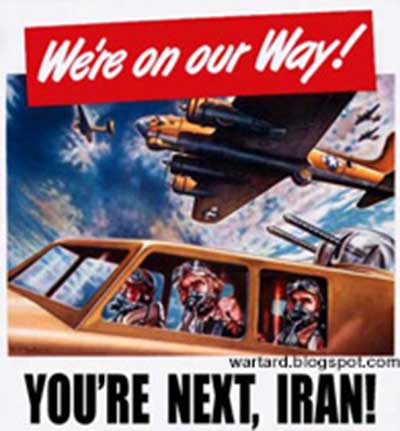
Although the Trump administration has given many reasons for its aggressive attitude toward the Islamic Republic of Iran, the more prominent reasons emerge from Iran failure to assure (1) it will never pursue nuclear weapons, (2) will not supply weapons to Hezbollah and Hamas, and, (3) will not threaten Israel.
Only Iranian pursuit of nuclear weapons can affect the security of the mighty United States (US), and that pursuit cannot occur until expiration of The Joint Comprehensive Plan of Action (JCPOA) allows additional enrichment, which, unless the JCPOA is terminated before it expires, is not until, about 2030. Seems the US can wait to see how events progress, talk with Iran as that date nears, and postpone action for at least a decade. With those considerations, why the US aggressive behavior toward Iran? Maybe, because Iran is “The Last Nation Standing.”
What does this mean? Well, there is a common thread in US actions of aggressive behavior toward certain nations that have not actually threatened the security of the United. The common thread is Israel, and after the decline of all of these nations that have not threatened the security of the United States, Iran is the Last Nation Standing.
Sudan
Not a nation to be recommended to any citizen — having been corrupt, intolerant, and ruled by a despot — once wealthy with minerals and gushing oil, Sudan had possibility of becoming a strong and vibrant African nation, US policies of countering terrorism, assisting South Sudan rebels, and Interfering in the Darfur civil war contributed to preventing that outcome.
Link of a car bomb at the World Trade Center in New York to Osama bin Laden, who had residence in Sudan, prompted the US State Department to add Sudan to its list of state sponsors of terrorism. Afterwards, the United States accused Sudan of harboring members of several terrorist organizations, and, In October 1997, imposed economic, trade and financial sanctions. These sanctions occurred despite Sudan, starting in 1995, offering extradition or interviews of arrested al-Qaeda operatives, as well as allowing access to the extensive files of Sudanese intelligence. According to a CIA source, as reported in the Guardian, Sept 30, 2001, “This represents the worst single intelligence failure in this whole terrible business. It is the key to the whole thing right now. It is reasonable to say that had we had this data we may have had a better chance of preventing the attacks.”
The US congress heightened the insurrection in Sudan’s Darfur province by passing an amendment, H.Con.Res.467 — 108th Congress (2003-2004), amended 07/22/2004, which “States that Congress declares that the atrocities unfolding in Darfur, Sudan, are genocide, and urges the Administration to refer to such atrocities as genocide.” The amendment gathered world opinion against the Sudanese government. Not clarified were that, although the public accepted the figure of 400,000 killings of people in Darfur, this genocide had no verification of the number of killings, no displayed mass graves, and no images of a great number of bodies.
Before he left the U.S. State department, former US Deputy Secretary of State Robert Zoellick stated, “It’s a tribal war. And frankly I don’t think foreign forces want to get in the middle of a tribal war of Sudanese.”(ABC News on-line, November 9, 2005)
A peace agreement, which ended the second Sudanese civil war in 2005 and restored southern autonomy, moved the United States, on September 9, 2009, to ease the sanctions on Sudan. On July 9, 2011, South Sudan became independent and reduced Sudan to a pipeline for South Sudan oil. After Sudan became a diminished state, barely able to survive, the United States lifted economic and trade sanctions. Independent South Sudan fared worse — involved in its own civil war, human rights violations, and social and economic turmoil.
“According to James Mulla, the director of Voices of Sudan, a coalition of U.S.-based Sudanese-interest organizations, Israel’s support proved pivotal to the Anyana’s success during the first Sudanese civil war, which ended in 1972.
Over the years, there have been reports of the Israelis continuing to aid South Sudanese rebels during Sudan’s second civil war, which lasted from 1983 to 2005 and resulted in an estimated 1.5 million to 2.5 million deaths.”
Libya
Due to Libya Leader Moammar Gadhafi’s support for radical revolutions, the United States found reason to have strained relations with Libya. Sanctions soon followed. In March 1982, the U.S. Government prohibited imports of Libyan crude oil into the United States and expanded the controls on US origin goods intended for export to Libya. Licenses were required for all transactions, except food and medicine. In April 1985, all Export-Import Bank financing was prohibited.
On April 14, 1986, the United States launched air strikes against Libya in retaliation for “Libyan sponsorship of terrorism against American troops and citizens.” Five military targets and “terrorism centers” were hit, including Gadhafi’s headquarters.
After Libya halted its nuclear program, renounced terrorism, accepted responsibility for inappropriate actions by its officials, and paid appropriate compensation to the victims’ families for the bombing of a US commercial airplane over Lockerbie, Scotland, the United Nations (UN) lifted sanctions, the US terminated the applicability of the Iran and Libya Sanctions Act to Libya, and President Bush signed an Executive Order terminating the national emergency with respect to Libya, which ended economic sanctions. All was going well until 2011.
Despite the lack of clarity of the 2011 rebellion against Gadhafi and specious reasons for NATO and US roles to defend the rebels, the U.S. government cut ties with the Gadhafi regime, sanctioned senior regime members, and, together with several European and Arab nations, managed to have the UN authorize military intervention in the conflict. The intervention demolished the Gadhafi regime, an outspoken antagonist of Israel, and enabled the rebels to obtain victory, another fallen nation and, still, in 2019, an embattled nation.
Egypt
Prime Minister of Egypt, Anwar Sadat, signing of a peace treaty with Israel stimulated the US to normalize relations with combative Egypt. The most populous and leading nation of the Arab world, principal defender of Arab rights, which had waged several wars with Israel, became a weakened observer to the hostilities affecting the Middle East.
Syria
The US never favored the Assad regimes, cut relations, and wished them to go away. Nevertheless, after the September 11, 2001 attacks on US soil, the Syrian Government tried limited cooperation with the US War on Terror. Syrian intelligence alerted the US of an Al-Qaeda plan, which was to fly a hang glider loaded with explosives into the US Navy’s Fifth Fleet headquarters in Bahrain. Syria was also a destination for US captives outside of its borders in its rendition program. According to US officials, as reported by Nicholas Blanford, in a Special to The Christian Science Monitor, May 14, 2002, Syrian information was instrumental in catching militant Islamists around the world.
Syria’s opposition to the Iraq War deteriorated relations. Serious contention arose because of a US claim that the Syrian Government permitted foreign fighters to cross the Syrian border and enter Iraq. In May 2004, the Bush administration enacted the Syria Accountability and Lebanese Sovereignty Restoration Act, which imposed sanctions on Syria, banned the majority of exports to Syria except food and medicine, and prohibited the export of most goods containing more than 10 percent US manufactured component parts
Syria’s descent into near oblivion started with its civil wars, in which foreign fighters (ISIS and al-Nusra) entered Syria from NATO’s Turkey (no retribution to Turkey for allowing ISIS to enter Syria), and a multitude of insurgents fought with and against one another until Assad, with assistance from Russia, Iran and Hezbollah, overcame the insurgencies. WikiLeaks, in 2011, released diplomatic cables between the US embassy in Damascus and the State Department, which revealed that the US had given financial support to political opposition groups and their related projects through September 2010.
In December 2012, President Barack Obama announced the US would formally recognize the Syrian Opposition Coalition as the legitimate representative of the Syrian people.
With ISIS defeated and a limping Assad government barely managing to have the nearly destroyed nation survive, United States Ambassador to the United Nations. Nikki Haley. affirmed that “the priority of the United States policy concerning Bashar al-Assad is to no longer to force him out of power.” Bombed almost daily by Israeli missiles and planes, the hopelessly weak Syria cannot retaliate.
Iraq
insufficient for US strategists that a decade of sanctions had only crippled Iraq, the US administration, citing strong intelligence reports that proved Saddam Hussein was developing weapons of mass destruction, invaded and destroyed Iraq. Anyone examining the reports could ascertain their falseness and show that Iraq was no more dangerous to the security of the United States than Venezuela. The already severely weakened Iraq, which always had the possibility of becoming a strong and vibrant nation, and was no threat to the US, suffered the mightiest of blows and fell with hardly a whimper.
Haaretz, Apr 03, 2003
“The war in Iraq was conceived by 25 neoconservative intellectuals, most of them Jewish (ED: Avid Israel supporters), who are pushing President Bush to change the course of history.”
Iran
No matter what Iran does, the US perceives Iran as an enemy and a threat to not only the Middle East, but to world order. All this hostility, despite the facts that (1) the Iranians showed willingness to create a new Afghanistan by pledging $560 million worth of assistance, almost equal to the amount that the United States pledged at the Tokyo donors’ conference in January 2002, (2) according to the U.S. envoy to Afghanistan, Richard Dobbins, Iran played a “decisive role in persuading the Northern Alliance delegation to compromise its demands of wanting 60 percent of the portfolios in an interim government,” (3) Iran arrested Al-Qaeda agents on its territory and, because Al-Qaeda linked the Shiite Muslims, represented by Iran and Hezbollah, with Crusaders, Zionists, and Jews as its most bitter enemies, had ample reason to combat terrorist organizations, and (4) Iran has no reason for or capability of attacking the US or its western allies.
What do all these defeated nations, which have suffered from US aggressive tactics, have in common — they were no threat to the US and each was a severe antagonist of Israel — Sudan. Libya, Egypt, Syria and Iraq — each capable of achieving power, and now powerless. The US sacrificed its soldiers in battles, spent excessive sums of money, gained animosities from other nations for its aggressive efforts, and for one principal reason — to protect Israel.
Why does the US protect Israel?
Some believe the US protects Israel to have a western footprint in the Middle East, similar to that of using South Korea to have a footprint in Asia. Others speak of the foothold enabling oil control.
These arguments have contradictions. The US can acquire support from almost all Middle East nations by not supporting Israel, no longer is dependent on Middle East oil, and can actually lower oil prices and have more access to petroleum by encouraging Iran oil production.
Let’s talk real. The destructions visited upon the described nations have done little to advance US security and economy. Therefore, the reason for the actions and US support of Israel must be political — politicians are coopted by catering to the religious right community and other Israel defenders. US administrations are willing to sacrifice American lives and give exorbitant financial assistance to Israel in trade for electoral support from Israel’s backers. All this despite Israel making decisions counter to US interests, such as allowing a Chinese firm, in which the Chinese government has a major stake, to run the Israeli port of Haifa, which hosts joint U.S.-Israeli naval drills and visits from American vessels.
Due to US aggressive tactics, the antagonists to Israel have fallen, and Iran is the last nation standing.
Dan Lieberman edits Alternative Insight, a commentary on foreign policy, economics, and politics. He is author of a nonfiction book, A Third Party Can Succeed in America, a Kindle, The Artistry of a Dog, and a novel, The Victory (under a pen name, David McWellan).