Showing posts with label British oil tanker. Show all posts

Friday, August 09, 2019

Pressure tactics in the Persian Gulf

JOHN CHERIAN

Tension escalates in the Persian Gulf as Britain impounds an Iranian oil tanker. But Iran’s strategy of “equal response” against any aggression from the U.S. and its allies makes the Trump administration settle for a “fair deal”.
As almost all military experts and commentators have been warning, the standoff in the Persian Gulf triggered by the United States could ignite a military confrontation that could engulf the entire region and have repercussions around the world. A new sequence of events started when the Royal Navy impounded an Iran-owned 30,000-tonne supertanker carrying two million barrels of oil in the Strait of Gibraltar in the first week of July. The British government claimed that the ship was impounded on the request of the authorities in Gibraltar, a British territory on the tip of the Iberian Peninsula.
Britain said the ship was carrying oil to be delivered at a Syrian port, contravening the European Union (E.U.) sanctions on trade with Syria. It was clear at the outset that the ship was impounded under the orders of the U.S. administration, that too at a time when Britain, France and Germany, which are signatories to the Joint Comprehensive Plan of Action (JCPOA), or the U.S.-Iran nuclear deal, were supposed to be doing their best to ease the effects of the draconian sanctions imposed on Iran by the U.S. Iran had requested the E.U. countries to initiate action to counteract the adverse impact of the sanctions on its people. The European leaders, while advising Iran to exercise patience, looked the other way as the Donald Trump administration began tightening the economic noose around Tehran.
At a time when Iran is desperately trying to export its oil to customers who are willing to buy it, Britain has gone ahead and precipitated another crisis by seizing the Iranian tanker. Iran maintained that the ship was not heading to Syria and that the oil was supposed to be delivered to another country. Britain is aware that no Syrian port is capable of receiving a big ship. Besides, the British authorities know that the E.U. sanctions on trade with Syria do not apply to Iran.

Calling the seizure of the ship “an act of piracy”, Iran urged Britain to release the tanker and its crew, which included Indians. The Iranian Foreign Ministry warned Britain “against entering a dangerous game with no end in sight under the influence of the Americans”. Iranian President Hassan Rouhani was quick to warn Britain of the “consequences” of the move.
Within days of Tehran’s warning, a British ship proceeding to collect oil from Basra was accosted by an Iranian naval patrol in the Strait of Hormuz. The ship had to turn back under British naval escort. The incident was meant to sound a warning, but the British government tried to portray it as an act of aggression by Iran. Iran pointed out that the incident happened in an area in the Strait of Hormuz over which it had territorial sovereignty.

Trump’s threats

United Nations Secretary-General Antonio Guterres issued a call for “maximum restraint” in the Persian Gulf region at a time when the Trump administration was exerting “maximum pressure” on Iran.
Trump has been making threats to obliterate Iran and has openly admitted to the waging of an economic warfare against Iran and its people. He said that the U.S. would cobble up an anti-Iran naval coalition in the Persian Gulf. In the third week of July, the U.S. announced that it was sending its troops to Saudi Arabia. Iran is already surrounded by a string of U.S. military bases.
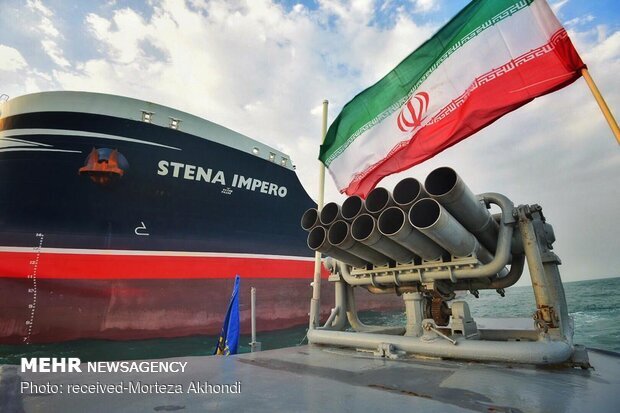
On July 19, two weeks after the impounding of the Iranian ship by the British, Iran announced that it had taken into custody a British oil tanker, “Stenna Impero”, on charges of “breaching international maritime law”. On the same day, the Gibraltar Supreme Court ruled that the ship impounded by Britain would not be released any time soon. The ruling on the extension of the ship’s detention came after a meeting between Gibraltar Chief Minister Gabriel Pinalto and British Prime Minister Theresa May. British Foreign Secretary Jeremy Hunt made it clear that the decision on the ship was made in London.
A statement from the Islamic Revolutionary Guard Corps (IRGC) of Iran said that the British oil tanker was detained at the “request of the Hormuzgan Ports and Maritime Organisation for failing to recognise international maritime rules”. According to the IRGC, the ship violated “three international naval regulations”, including turning off the GPS, breaking the traffic pattern in the Strait of Hormuz and polluting the water by dumping crude oil residue. The tanker was shifted to Iran’s Bandar Abbas port, and all the 23 members of the crew, 18 of them Indians, including the captain, were kept on board the ship pending investigations. India has called on Iran for the early repatriation of the Indian sailors. The IRGC detained a second British tanker temporarily. Iranian authorities let it go after warning it to abide by international environmental regulations.
Iran’s influential Guardian Council, which has a say in foreign policy matters, stated that the seizure of the British ship was “a reciprocal action” in retaliation for the British seizure of the Iranian ship. “The rule of reciprocal action is well known in international law,” a spokesman for the IRGC said.

Justifying the seizure of the Iranian ship on the grounds that it was contravening E.U. sanctions, Foreign Secretary Hunt said that Iran had violated international law. Iranian Foreign Minister Mohammad Javad Zarif tried to convince his British counterpart to release the ship. Hunt, who is engaged in a losing contest for the Prime Minister’s post in Britain, preferred to take a tough line, at the behest of the U.S.
The U.S. and the U.K. have always acted in tandem on Iran. Their despicable role in the overthrow of Iran’s first democratically elected leader, Mohammed Mossadegh in the 1950s, is well documented. That incident is embedded in the national psyche of Iran. Trump was quick to condemn Iran’s seizure of the British ship. Germany and France, too, joined the chorus of criticism. The three countries had no words of criticism for the British interception and capture of the Iranian ship in international waters.

The actions of the European countries reinforce the Iranian view that they are not serious about salvaging the JCPOA. Britain had ostensibly joined France and Germany in preserving the deal by trying to set up an alternative trading platform through which Iran could evade U.S. sanctions. The British government accepted that Iran was largely justified in increasing its uranium enrichment levels as a response to the Trump administration abrogating the JCPOA. Britain insists that it is committed to the U.S.-Iran nuclear deal. Recent events have shown that the commitment is skin deep at the most.
The seizure of the British ship came just a day after Trump announced the shooting down of an Iranian drone by a U.S. warship. However, the spokesman for the Iranian army, Gen. Abolfazi Shekarchi, said that it was a “false claim rooted in Trump’s illusions”. After Trump’s initial claims, the U.S. military stopped talking about the alleged downing of an Iranian drone. It seems that the Pentagon is keen to settle scores with Tehran for the loss of its drone over Iranian territorial waters in June.
A cat-and-mouse game seems to be on in the Persian Gulf. Iran has taken care to ensure that the actions it has taken so far were carried out inside its territorial waters. During the last days of the Iran-Iraq war (1980-88), the U.S. Navy shot down an Iranian civilian plane, with 290 people on board, over the Persian Gulf. The U.S. claims that it was an accident, but many Iranians still have suspicions about the 1988 downing of the Iran Air Airbus 300. Accident or not, incidents such as that one are waiting to occur if tensions in the Persian Gulf are not resolved soon.
After the shooting down of the U.S. drone in June, there was a real threat of war breaking out. Trump claimed at the time that he had called off a U.S. missile strike on Iran just 10 minutes before it was due to be launched. Iran as well as the military leadership had stated at the time that they would not have stood aside if the U.S. had launched an attack. After waiting for 15 months for the European signatories to the JCPOA to act and provide sanctions relief, Iran has given up its policy of “maximum patience”.
President Rouhani has adopted a strategy of “equal response” against any aggression from the U.S. or its allies. Iran has built a vast network of underground military facilities along its coastline in anticipation of a U.S. attack. Iran and its allies have developed formidable asymmetrical military capabilities across the region. The Hizbollah chief, Sheikh Hassan Nasrallah, warned that his forces would spring to Iran’s aid if the Trump administration carried out its military threats.

U.S. sanctions

The Trump administration imposed more sanctions on Iran after the downing of the U.S. drone. Iran’s Supreme Leader, Ayatollah Ali Khamenei, and Foreign Minister Zarif were among the top officials against whom sanctions have been imposed. Zarif, who spent many years studying in the U.S. and was the key Iranian interlocutor in the nuclear deal, was confined to the U.N. building in New York and the Iranian embassy compound during his recent visit there. The new U.S. sanctions barred him from even travelling within New York City.

Zarif’s visit to New York in the third week of July coincided with signals from the Trump administration that it was willing to start talking to Iran. The last thing Trump wants is a full-scale war before he is up for re-election. He is now saying that all he wants is “a fair deal” with Iran. There has been talk that Trump is going to appoint the anti-war Republican Senator Rand Paul as an emissary to Iran. Iran has always said that it is ready for talks provided the unilateral U.S. sanctions are lifted immediately. During his visit, Zarif reiterated that Iran would never give up its defensive missile programme, a key demand of the Trump administration, as long as the U.S. supplied sophisticated missiles and armaments to its adversaries in the Gulf. Zarif also said that Iran could “reverse” its uranium enrichment if sanctions were lifted.
The U.S. Secretary of State, Mike Pompeo, however, is on record stating that U.S. sanctions will be lifted only after Iran permanently ends its production of nuclear fuel, gives up its medium-range missiles and ends its support for terrorist groups. The U.S. deems Hamas and Hizbollah, which Iran supports, as “terrorist” groups.
No self-respecting Iranian government will accept the conditions laid down by the Trump administration. As Zarif stated in New York, Iran signed a historic agreement with the U.S. government and not with individuals. The only way out of the impasse and to keep war from breaking out at this juncture was to keep channels of communication open and hopefully wait for the demise of the Trump administration in 2020. “We will survive, we will prosper long after President Trump is gone,” Zarif told the media in New York, pointing out that Iran had a glorious history that was 7,000 years old. “Our time slots are in millennia,” he said.

Friday, July 26, 2019

The different reactions of Arab governments and nations toward the seizure UK tanker

By Fatemeh Salehi
TEHRAN - On Friday, a British oil tanker was seized in the Strait of Hormuz by the Islamic Revolution Guards Corps (IRGC). The tanker was seized due to violation of maritime laws, causing marine pollution and endangering other vessels. 
The interesting point here is the huge gap between the Arab government and Arab nations in their reaction to this incident. This gap can also be seen in other important issues in the Middle East, such as the fate of Palestine. 
Arab nations have always proved that they are wide aware of foreign issues and their opinions are far more progressive than those of their governments. Up to now, they have held several protests to announce their opposition toward government policies especially toward Palestine and have voiced their disagreement toward plans to normalize relationships with the Zionist regime. 
Over the years, Arab governments and the media that are linked to them have launched extensive advertisements to defend governmental policies; a very good example is Al Arabiya news that is attached to Saudi Arabia government; however, despite all these advertisements, Arab nations have never been influenced by these propagandas and have showed their opposition. 
For instance, Arab nations have showed their opposition toward the American plan for displacement of Palestinians called “the deal of the century” or efforts to normalize relations between Arab countries and the Zionist regime. 
A new example is the seizure of British oil tanker in the Persian Gulf. 
In reaction to the seizure, Most Arab governments have expressed their concerns about rising tensions in the Persian Gulf and have said that Iran’s act was “hostile.” 
Adel al-Jubeir, Saudi Minister of State for Foreign Affairs said in Twitter: “attack on the freedom of maritime navigation is a violation of international law".
Bahrain Ministry of Foreign Affairs also said that it “strongly condemned” Iran’s seizure of the British oil tanker and urged Iran to stop its “irresponsible” acts. 
Some other Arab countries also voiced similar concerns. 
However, tweets of these countries’ residents show an opposite view about the subject.  
One of the tweets says: “whatever happens in the Strait of Hormuz is planned by American and Israeli intelligence services. They just want to drag Arab countries into the conflict under the pretext of protecting oil tankers and water channels, so that they [the west] can take control over the region and swindle money out of the Arab oil-exporting countries.” 
In response to Al Arabiya, another twitter user said, “Did you respect international laws when you seized the Iranian oil tanker in Gibraltar? So this is just about bullying other countries, not about respecting the law.” 
Another user wrote: “they keep accusing Iran for every incident in the Middle East or attacking Saudi Arabia facilities, in order to push Arab countries into a war with Iran.” 
“Europe was trying to be the good cup after the United States abandoned the nuclear deal with Iran, but the emergence of Iranian oil tanker in Gibraltar was a smart move; Europe was checkmated and had to reveal its true colors and everyone saw that it was the bad cup after all,” says another user.  
Another user published a picture of Sayyed Hassan Nasrallah the Secretary-General of Hezbollah and wrote: “the resistance struck the evil side twice over the last few days. Seizure of the British oil tanker put a smile on Sayyed’s face.” 
In conclusion, we should not assume that Arab Nations have the same view as their government toward issues in the region, especially those in concern with Iran.
 Arab nations have always admired Iran’s military power and its active role in the region and regretted that their own governments are firmly dependent on Western countries and are getting more attached to them every day. 

Wednesday, July 24, 2019

Ways for Britain to deal with the seizure of its oil tanker by Iran

An expert on international law in Tehran believes: “The seizure of the British oil tanker for failure to observe the Law of the Sea is perfectly legal and London must go to competent courts instead of political encounters.”
IRGC forces seized the British-flagged Stena Impero oil tanker on Friday for navigating in the wrong direction in the Strait of Hormuz, turning off its positioning system and ignoring warnings by the IR of Iran. In a letter to the UN Security Council, Britain called the Iran move as illegal.
Dr Massoud Akhavanfard, professor of international law, told Persia Digest (PD) in an interview: “The Law of the Sea was drawn up about a hundred years ago. In 1982, the 3rd UN Conference on the Law of the Sea (UNCLOS III) compiled the regulations for the right of navigation in international waters. These pertain to national security and the IR of Iran is also concerned with its national security in seizing the British tanker.”
He added: “According to the articles of the 1982 Law of the Sea, the powers of the host country are broad. Therefore, the Iranian judiciary is also empowered to respond accordingly when the rules of the convention are not observed.”
The professor of international law emphasized: “The British vessel incident is a legal matter and this country’s government must pursue it according to international law rather than with diplomatic and psychological encounters. It must submit all its evidence to competent courts. Turning off the positioning system of a ship endangers navigation routes. Changing direction, creating environmental pollution, and disregarding the warnings issued by the armed forces of Iran in charge of its security provide the Islamic Republic with adequate grounds to seize the oil tanker.”
Akhavanfard reiterated: “The IRGC played its role as part of the ruling system in Iran to seize the tanker and deliver it to the Ports and Maritime Organization of Hormozgan Province. This is not a political issue and the oil tanker is in the hands of the IR of Iran judicial authorities. If Britain intends to respond accordingly, it must begin by contacting this authority in Iran, because they have jurisdiction to investigate the issue according to the 1982 Convention.”
He continued: “Another strategy is to resort to international arbitration. The British government can also go to the International Court of Justice with optional jurisdiction. If its evidence is not satisfactory, this country will be responsible for damages according to the 1982 Convention.”

Britain confused on policies toward Tehran: easing the tension or increasing them

By Hamid Bayati

Britain has had a rough week after Iran seized British oil tanker in the strait of Hormoz. It seems that the British are confused what policy to adopt; first, British Secretary of State for Defense described the capture “hostile” and then, the British Foreign Secretary announced that they want to ease the tensions with Iran.  
British government second emergency meeting
The British officials made the remarks after their second emergency meeting on Saturday.  After the meeting, British Foreign Secretary Jeremy Hunt wrote on Twitter that they want to reduce the tensions; however, he claimed that the capture of Stena Impero ship in Oman waters was in breach of international laws. 
According to Hunt, the British government emergency meeting has discussed the safety of shipping in the Strait of Hormoz and it will submit the results to the Parliament on Monday. 
On the other hand, Penny Mordaunt, the British Secretary of State has described the seizure a “hostile action.” Mordaunt has also claimed that while the British ship was being captured, another British ship which was sent to the Persian Gulf was at a 60 minute distance from them. 
Tension between Iran and Britain escalated after Britain seized an Iranian oil supertanker called Grace 1 in Gibraltar on July 4th. 
Britain and Gibraltar claimed that the supertanker was carrying oil to Syria, but the Iranian government announced that the tanker was heading another destination. 
After the illegal seizure of Grace 1 oil tanker, Iranian officials decided to resolve the issue through diplomacy and they had a meeting with Gibraltar officials but some other entities interfered in the matter and Gibraltar announced that the oil tanker will not be released. 
After this, the Leader of the Islamic Revolution Ayatollah Ali Khamenei announced that the British government’s illegal seizure of the Iranian supertanker was an act of “piracy” and will not go “unanswered”.
Testing a failed plan

Hardliners in Britain are now saying that more pressure must be placed on Iran and some are even proposing the renewal of sanctions; however, this is a poor strategy that has been already tested by their closest ally, the United States, and has never come to any success.
Britain is proposing that the European Union puts more pressure on Iran; however, London and Brussels are not at their best relationship right now as they have disagreements over a variety of subjects including Brexit. 
Relying on U.S. empty promises 
Britain and Gibraltar who seized Grace 1 for satisfying U.S., are now in a conundrum. Washington, who first encouraged Britain to capture the Iranian oil tanker, has now bailed on Britain and is not having any intensions to support Britain in releasing its tanker that has been seized by Iran.  
Now, London has resorted to the United Nations Security Council to release its ship. Obviously, if the western countries take on a hostile stand toward Iran in this situation, it will only exacerbate the security of the Persian Gulf region and will be to the benefit of no one. 
The only strategy that can take Britain out of this crisis is to stay away from U.S. and try to resolve the issues with Iran directly. 
Anyway, right now, Britain’s internal situation is also unsteady as the country will have a new Prime Minister in few days, so whatever the British officials say now cannot be trusted, because the country’s cabinet is changing and the new cabinet may have new members who have other opinions.  
The West and the Middle-Eastern countries must be patient
What is interesting now is that some countries like Bahrain are now acting like the seized ship belonged to them! 
Taking such a firm and aggressive stance is very strange because the Arab countries around the Persian Gulf don’t have a steady situation themselves and are in constant conflict with one another, each trying to topple the others. 
Europe is now struggling to save the Joint Comprehensive Plan of Action, but the hardliners such as the hawkish B-team (comprised of US National Security Adviser John Bolton, Israeli Prime Minister Benjamin Netanyahu, Saudi Crown Prince Mohammed bin Salman and Abu Dhabi Crown Prince Mohammed bin Zayed Al Nahyan) may try to exaggerate the seizure of this ship by Iran and take it as an advantage to incite Britain and Europe into taking a more aggressive position toward Iran. 
Now, Britain and Europe have only two options. First is to join U.S. who is now alone in its battles with Iran, or to be patient and try to resolve the issue through diplomacy. 
Following U.S. is obviously the wrong decision as U.S. has taken this path before and leads to nowhere but failure. 

Sunday, July 14, 2019

Iran Keeps Calm While U.S. And Britain Continue Their Provocations

undefined
Great Britain has joined the U.S. pressure and provocation campaign against Iran. It is creating incidents to put Iran into a defensive position and to provoke into a violent reaction.


Early today 'two U.S. officials' spread a scare story about Iran which lead to this CNN headline: Iranian boats attempted to seize a British tanker in the Strait of Hormuz
Armed Iranian boats unsuccessfully tried to seize a British oil tanker in the Persian Gulf Wednesday, according to two US officials with direct knowledge of the incident.The British Heritage tanker was sailing out of the Persian Gulf and was crossing into the Strait of Hormuz area when it was approached by boats from the Iranian Islamic Revolutionary Guard Corps.
The Iranians ordered the tanker to change course and stop in nearby Iranian territorial waters, according to the officials.
The same 'two U.S. officials' briefed ABCNews:
A British warship prevented an apparent attempt by five Iranian small boats to direct a British oil tanker towards Iranian waters on Wednesday, according to two U.S. officials.
Remarkably the official British report came later than the U.S. officials briefing. It showed significant differences:
The UK defence ministry said that "three Iranian vessels attempted to impede the passage of a commercial vessel, British Heritage, through the Strait of Hormuz.""HMS Montrose was forced to position herself between the Iranian vessels and British Heritage and issue verbal warnings to the Iranian vessels, which then turned away," the ministry statement said.
...
"There has been no confrontation in the last 24 hours with any foreign vessels, including British ones," the Revolutionary Guards said in a statement.
The U.S. officials claimed 5, not 3 boats. They claimed the boats tried to seize the ship, while the Brits just say they probably were getting in the way of the ship. The U.S. officials 'direct knowledge of the incident' seems to be lacking. Iran says that nothing happened at all.
There are reasons to believe that the Iranian statement is the most truthful one.
The BRITISH HERITAGE is a crude oil carrier with an overall length of 274 m, a beam of 49 m and a maximum draft of 17.8 m. How three of the typical 20 feet long fiberglass speedboats of the IRGC could try to 'seize' or even 'impede' such a huge ships is not conceivable.
According to CNN the ship came from Basra, Iraq, had stopped at the Saudi coast and then left the Persian Gulf. It was not carrying any cargo at the time of the incident. That is quite curious as a crude oil carrier is typical loading and not delivering crude to Persian Gulf countries.
Here is a Marine Traffic chart of the last course of the British Heritage.

bigger
Of interest is also that the ship turned off its AIS signal, see the dotted line, during its passage through the Hormuz Strait.
CNN also noted that:
On July 10, the ship turned off its transponders for almost 24 hours, making it undetectable by radars. When it switched on its transponders at around 1pm Eastern Time, it appeared to have sailed through the Persian Gulf escorted by the HMS Montrose.
Turning of the AIS in a high traffic area and especially at night is quite dangerous. The AIS signals a ships type, speed and course and other ships use that data to plan their own course. But even without AIS the ship will still be visible on the Iranian surveillance radars that control the Hormuz Strait. A ship on the radar screen without AIS information would be suspicious.
So why would the British ship do that? Was that an attempt to draw special attention to it from the Iranian coast guard or military?
To me it seems that the empty British crude carrier, which was shadowed by a British frigate, was used as bait. There were probably Royal Marines on board waiting for an Iranian attempt to seize the ship. Iran did not fall for it.
On July 4 the British military in Gibraltar hijacked the tanker GRACE 1 which was carrying Iranian crude oilallegedly to Syria. The ship had planned to receive provisions in Gibraltar. The British controlled enclave changed its local regulations only a day before the ship arrived:
The new regulation, introduced on July 3, allows Gibraltar to designate and detain ‘specified ships’ for up to 72 hours if the chief minister has reasonable grounds to suspect a breach of EU regulations.Crucially, Grace 1 can be held until any other legal proceedings in other jurisdictions against the owners of the cargo or tanker are settled. The seizure has triggered a diplomatic row between the UK and Iran, amid claims the detention was done at the behest of the US.
Tomasz Wlostowski, a lawyer specialized in EU regulatory affairs, found that there is no legal base in EU sanctions law and regulations to nab the tanker.
Today the police of Gibraltar arrested the captain of the ship:
Gibraltar Chronicle @GibChronicle - 14:45 UTC - 11 Jul 2019Police in #Gibraltar have arrested the captain and chief officer of the supertanker Grace 1 on suspicion of breaching EU sanctions on Syria, a spokesman for the Royal Gibraltar Police has confirmed.
The spokesman confirmed too that documents and electronic devices have been seized from the ship.
Both men were arrested on Thursday afternoon interviewed under caution. Neither has been charged at this stage and investigations continue.
On July 3 a U.S. military spy plane crossed into Iranian airspace, twice, likely to provoke an reaction. The pirating of the GRACE 1 on July 4 was a U.S. planned provocation of Iran but carried out by the Brits. The passage of the empty BRITISH HERITAGE without AIS but with a military shadow seems to have been an attempt to lure Iran into a revenge action. When that did not work John Bolton strew the scare story about a failed attempt to 'seize' the ship. The Brits say the incident was less serious, and Iran says it never happened. The arrest of the captain of the GRACE 1 is another step on the provocation ladder.
The people who planned these provocation do not understand how Iran acts and reacts. Its military forces are obviously under orders not to react to provocations as such could allow the John Bolton's of this world to escalate towards a war.

Iran will react to these provocations and especially the British seizure of its tanker. But, as we noted in an earlier piece, its responses to such incidents are nearly always asymmetrical and come at an unexpected place and time.