Showing posts with label Benny Gantz. Show all posts

Tuesday, December 03, 2019

Israel’s Unfinished ‘Coup’


Photograph Source: zeevveez – CC BY 2.0
This time, nothing seems to work. Israeli Prime Minister, Benjamin Netanyahu, has tried every trick in the book to save his political career and to avoid possible prison time. But for Israel’s longest-serving leader, the honeymoon is certainly almost over.
It is an “attempted coup”, is how Netanyahu described his indictment on charges of fraud, bribery and breach of trust by Israeli Attorney General, Avichai Mandelblit, on November 21. Netanyahu’s loyalists agree. On November 26, a few thousand Likud party supporters gathered in Tel Aviv, under the title “Stop the coup”, to express their anger at what they see as a massive conspiracy involving Mandelblit, the media, various state institutions, and “disloyal” Likud party members.
Netanyahu’s main Likud party rival, Gideon Sa’ar, received much of the verbal abuse. Sa’ar, who almost faded into oblivion after leaving the Knesset in 2014, emerged once more on Israel’s political scene following the April 2019 elections. Netanyahu’s failure to form a government then was compounded by a similar failure to cobble up a government coalition after the second general elections, held within a few months in September.
Since 2014, no one dared challenge Netanyahu’s reign over the Likud. “There was no need to do so,” wrote Yossi Verter in Haaretz on November 29. Netanyahu “brought them to power, time after time. But few things happened since then.”
It is because of these “few things” that Sa’ar dared to challenge Netanyahu once more. What is significant about Sa’ar’s leadership challenge is not the possibility of him unseating Netanyahu, but the fact that the “king of Israel” no longer commands the type of fear and respect that he has painstakingly espoused over a decade of nearly uncontested rule.
As soon as Sa’ar called for new Likud primaries, Netanyahu’s political minions, such as Foreign Minister, Yisrael Katz, and other heavyweight politicians – Nir Barkat, Miri Regev, among others – pounced on Sa’ar, describing him as “disloyal”. The Tel Aviv protesters had far more demeaning words for the rebel Likud member. However, despite the deafening screams and the name-calling, Netanyahu conceded, promising on November 23, that he would set up and face a party leadership challenge within weeks.
Embattled Netanyahu has no other options. Although he may still come out in the lead should the primaries be held on time, he cannot afford deepening existing doubts within his party. If he fails to ensure his legitimacy within his own Likud party, he could hardly make the case of being able to lead all of Israel following a possible third general election in March.
However, Sa’ar is not Netanyahu’s biggest problem.
The picture for Netanyahu – in fact, for all of Israel – is getting more complicated by the day. The Israeli leader has successfully managed to coalesce his own political and family interests within the collective interests of all Israelis. “I’m doing everything required to ensure the government’s and cabinet’s work is getting done in all the ways required to ensure the safety of Israel’s citizens,” he told a reporter on November 23, insisting that he is still carrying out his duties as a Prime Minister “in the best possible way, out of supreme devotion to Israel’s security.”
Desperate to hang on to power for as long as possible, Netanyahu still employs the same political discourse that helped him unify many sectors of Israeli society for over ten years. But that ploy is no longer reaping the intended result. For one, Netanyahu’s main rival in the Blue and White (Kahol Lavan) Party, Benny Gantz, has neutralized the Prime Minister’s success in manipulating the term “security”, for he, too, is an advocate of war, whenever and wherever war is possible.
Netanyahu’s last war on Gaza on November 12, where the Israeli army killed 34 Palestinians, including women and children, is a case in point. During the short-lived destructive war, Gantz was busy trying to form a government, as Netanyahu had already failed that task. Resorting to war, Netanyahu tried to send three messages, all intended for Israeli audiences: one to Mandelblit, to postpone the indictment; the second to Gantz, to reconsider his decision to block him from taking part in a future government, and the final one to the Israeli public, to remind them of his own supposed ability to reign in “terror”.
But all has failed: Gantz announced his inability to form a government on November 20, preferring failure overextending a lifeline to Netanyahu, whose indictment was imminent. Indeed, the Attorney General’s decision arrived on November 21, making it the first time in the history of the country that a Prime Minister is indicted while in office. Worse, Blue and White widened its lead significantly over the Likud, according to a public opinion poll commissioned by Israel’s Channel 12 television, which was published on November 26.
But what other languages, aside from that of war – in the name of security – and haphazard accusations of political conspiracies, can Netanyahu possibly employ during this period? Such tactics often worked in the past. In fact, they worked so well that the entire Netanyahu political doctrine was designed around them. Now, the Israeli leader has run out of ideas, and is quickly running out of allies as well, not only from without, such as his former ally and the head of Yisrael Beiteinu party, Avigdor Lieberman, but from within his own party as well.
The reason that Netanyahu is still in power after all the setbacks and outright failures is the fact that his rivals are yet to mobilize the necessary votes and public support to oust him for good. It will certainly take more than Gantz alone to dislodge stubborn Netanyahu from office, for the latter has consolidated and entrenched his rule through an intricate system of political patronage that runs deep through many facets of Israeli society.
With this in mind, it seems that the end of the Netanyahu era is finally upon us, but it is likely to be longer and uglier than expected. While it remains true that a fundamental change in Israel’s political system will neither deliver peace and justice to Palestinians – or stability to the region – it could potentially constitute the equivalent of a political earthquake within Israel itself, the consequences of which are yet to be seen.

Monday, December 02, 2019

Is Netanyahu Ready to Inflame War to Escape His Legal Troubles?


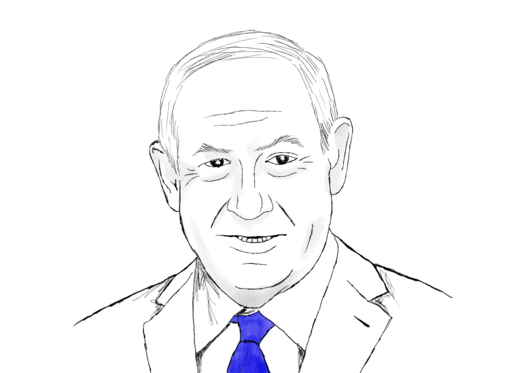
Drawing by Nathaniel St. Clair
The decision to indict Israeli Prime Minister Benjamin Netanyahu on three separate criminal counts pushes the country’s already unprecedented electoral stalemate into the entirely uncharted territory of a constitutional crisis.
There is no legal precedent for a sitting prime minister facing a trial – in Netanyahu’s case, for bribery, fraud and breach of trust. Former Israeli prime minister Ehud Olmert was charged with corruption in 2009 but only after he had resigned from office.
Israeli commentators are already warning of the possibility of civil war if, as seems likely, Netanyahu decides to whip up his far-right supporters into a frenzy of outrage. After a decade in power, he has developed an almost cult-like status among sections of the public.
He called for mass protests in Tel Aviv by supporters on Tuesday night under the banner “Stop the coup”.
The honorable thing would be for Netanyahu to step down quickly, given that the two elections he fought this year ended in deadlock. Both were seen primarily as plebiscites on his continuing rule.
He is now the country’s caretaker prime minister, in place until either a new government can be formed or an unprecedented third election is held.
His departure would end months of governmental near-paralysis. The path would then be clear for a successor from his Likud party to negotiate a deal on a right-wing unity government with rival Benny Gantz, a former army general.
Gantz’s Blue and White party has made it a point of principle not to forge an alliance with Netanyahu.
Previous experience, however, suggests that Netanyahu might prefer to tear the house down rather than go quietly. If he is allowed to press ahead with another election in March, he is likely to stoke new levels of incitement against his supposed enemies.
Until now, the main target of his venom has been a predictable one.
During the April and September campaigns, he railed relentlessly against the fifth of Israel’s citizenry who are Palestinian as well as their elected representatives in the Joint List, the third largest faction in the Knesset.
Shortly before last Thursday’s indictment was announced, Netanyahu was at it again, holding an “emergency conference”. He told supporters that a minority government led by Gantz and propped up from outside by the Joint List would be a “historic national attack on Israel”. The Palestinian minority’s MPs, he said, “want to destroy the country”.
Such a government, he added, would be an outcome “they will celebrate in Tehran, in Ramallah and in Gaza, as they do after every terror attack”.
This repeated scaremongering had an obvious goal: rallying the Jewish public to vote for his far-right, now overtly anti-Arab coalition. The hope was that he would win an outright majority and could then force through legislation conferring on him immunity from prosecution.
Now he appears to have run out of time. After three years of investigations and much foot-dragging, the attorney general, Avichai Mandelblit, has finally charged him.
According to the Israeli media, Netanyahu turned down opportunities for a plea bargain that would have seen him resign in return for avoiding jail time.
According to the most serious allegation, he is accused of granting media tycoon Shaul Elovich benefits worth $500 million in exchange for favourable coverage.
Weighed against the crimes he and other Israeli leaders have perpetrated over many decades against the Palestinians in the occupied territories, the offences he is indicted for seem relatively minor.
Nonetheless, if found guilty, Netanyahu faces a substantial prison sentence of up to 10 years. That makes the stakes high.
All the signs now are that he will switch his main target from Israel’s Palestinian minority to the legal authorities pursuing him.
His first response to the indictment was to accuse the police and state prosecutors of an “attempted coup”, claiming they had fabricated the evidence to “frame” him. “The time has come to investigate the investigators,” he urged.
As one Blue and White official told the veteran Israeli reporter Ben Caspit: “Netanyahu will not hesitate to sic [unleash] his supporters on those institutions of government that represent the rule of law. He has no inhibitions.”
Technically the law allows a prime minister to continue serving while under indictment and before a trial, which is still many months away. Assuming Netanyahu refuses to resign, the courts will have to rule on whether this privilege extends to a caretaker leader unable to form a new government.
Netanyahu is therefore likely to focus his attention on intimidating the supreme court, already cowed by a decade of tongue-lashing from the Israeli right. Critics unfairly accuse the court of being a bastion of liberalism.
But bigger dangers may lie ahead. Netanyahu needs to keep his own Likud party in line. If its members sense he is finished, there could be a rapid collapse of support and moves towards an attempt to overthrow him.
The first hints of trouble emerged on Saturday when Gideon Saar, Netanyahu’s most likely challenger in Likud, accused him of “creating an atmosphere of chaos” by denigrating the legal authorities. On Tuesday he went further calling on Netanyahu to quit.
After the failure by both Gantz and Netanyahu to put together a coalition, the task was passed last week to parliament. Its members have just over a fortnight left to see whether one of their number can rally a majority of MPs.
This brief window could provide an opportunity for Saar to move against Netanyahu. On Sunday he submitted an official request for the Likud party to hold a snap leadership race.
Observers fear that to allay this danger, Netanyahu might consider not only inflaming his base but also setting the region alight with a conflict to rally the rest of the public to his side and make his removal impossible.
In fact, the Israeli media reported that shortly before September’s election, he had tried to pull precisely such a stunt, preparing a war on Gaza to justify postponing the ballot.
He was stopped at the last minute by Mandelblit, who realised that the cabinet had been misled into approving military action. Netanyahu had reportedly concealed from them the fact that the military command was opposed.
In recent weeks, Netanyahu has stoked severe tensions with Gaza by assassinating Palestinian Islamic Jihad leader Baha Abu Al Atta. Last week he launched airstrikes on Iranian positions in Syria.
When Olmert was being investigated for corruption in 2008, Netanyahu sagely warned of the dangerous confusion of interests that might result. “He will make decisions based on his own interests of political survivability rather than the national interest,” he said.
And that is precisely the reason why many in Israel are keen to see the back of Netanyahu – in case his instinct for political survival trumps the interests of stability in the region.
Jonathan Cook won the Martha Gellhorn Special Prize for Journalism. His latest books are “Israel and the Clash of Civilisations: Iraq, Iran and the Plan to Remake the Middle East” (Pluto Press) and “Disappearing Palestine: Israel’s Experiments in Human Despair” (Zed Books).

Saturday, September 28, 2019

Netanyahu or Gantz: The tragic dilemma facing Israel's Palestinian citizens

Orly Noy

The Joint List's recommendation of Gantz as prime minister dramatically alters the traditional political stance of Arabs in Israel


Members of the Joint List party sit next to Israeli President Reuven Rivlin as he began cross-party talks on 22 September over who should form a new government (Reuters)
Many people were hoping that the mid-September election in Israel would resolve the political mess that followed the previous election in April when neither of the two leading candidates for prime minister - Benny Gantz of the Blue and White alliance and Benjamin Netanyahu of Likud - garnered enough votes to form a government.
But that hope was quickly dashed within a few days when the votes were counted. The political blocs headed by both candidates fell short of securing the 61 seats required for a parliamentary majority.

Chaotic landscape 

On the right, the bloc headed by Netanyahu won 55 seats. It included Likud, Shas and the ultra-Orthodox Torah Judaism party as well as the far-right Yamina party headed by Ayelet Shaked. The centre-left bloc, headed by Benny Gantz, which includes Blue and White, the Joint List, Labor and the Democratic Union, secured 57 seats.
The degree of chaos in the Israeli political landscape today is indicated by the status of Yisrael Beiteinu, headed by Avigdor Lieberman, who has proposed among other things the “transfer” of Arab citizens out of Israel entirely. Lieberman is one of the most extreme far-right politicians the country has ever seen.
The degree of chaos in the Israeli political landscape today is indicated by the status of Yisrael Beiteinu, headed by Avigdor Lieberman
Yisrael Beiteinu won eight seats but has joined neither the rightist bloc nor the centre-left bloc. Thus far Lieberman has refused to express support for either Gantz or Netanyahu, and is calling for a national unity government with the two major parties, Likud and Blue and White.
In the absence of a clear majority for either of them, both Gantz and Netanyahu have begun their quest to round up the required minimum of 61 Knesset seats to form a government. The first stop is the office of the Israeli president, where the heads of all political parties represented in the next Knesset must come to recommend their preferred candidate for the prime minister position.
Following those discussions, the president in turn recommends which of the candidates he believes has the best prospects to succeed in forming a government and formally tasks him with the job. If, within the legally mandated time period, that candidate fails to muster 61 seats, his rival is given an opportunity to assemble his own coalition. 

The highest priority

The decision as to which of the two candidates - Gantz or Netanyahu - to recommend to the president, or whether even to make a recommendation at all, has posed the first major challenge to the (mostly Arab) Joint List since it reassembled itself on the eve of the election.
The Arab parties have historically refrained from recommending Jewish candidates for prime minister, from either the right or the left
On the one hand, the Arab parties have historically refrained from recommending Jewish candidates for prime minister, from either the right or the left, because all of them lead Zionist parties that seek to preserve Jewish supremacy in Israel.
On the other hand, this latest electoral victory was - to a great extent - a referendum on the question of Netanyahu’s continued leadership, the end of which is sought more eagerly by Arab citizens in Israel than by any other constituency. And given Netanyahu’s increasingly unbridled incitement against Arab citizens over the course of his tenure in office, the yearning to put an end to his rule became the highest political priority. 

Dethroning Netanyahu

This dilemma sparked some trenchant discussion among the four parties comprising the Joint List, each with its own distinct political ideology. Ultimately (five days after the election, on 22 September), the Joint List recommended to the president that Gantz be named to form a government.
But the move was made with a heavy heart, based on the overriding need to do whatever was necessary to dethrone Netanyahu.
The Joint List's recommendation of Gantz as prime minister was made with a heavy heart, based on the overriding need to do whatever was necessary to dethrone Netanyahu
Balad, the Palestinian National Democratic party, remained opposed because of Gantz's bloody military record of Gantz when he served as Israeli army Chief of Staff between 2011 and 2015, and because of the likelihood that ultimately he will opt for a unity government that includes Likud and the far-right Lieberman. 
The decision by the Joint List was termed “historic” and duly applauded by many on the Jewish left in Israel. Bear in mind, however, that no such truly “democratic” celebration is possible in Israel, nor is there cause for such rejoicing.
The decision proves only one thing: The depth of the tragedy of Palestinian citizens of Israel, whose default choice was the man whose election campaign included boasting of having "returned Gaza to the Stone Age" during the Cast Lead war on Gaza (2008-09), who bragged about the massive numbers of Palestinians killed in that war and whose pronouncements show that he will not hesitate to do likewise again.
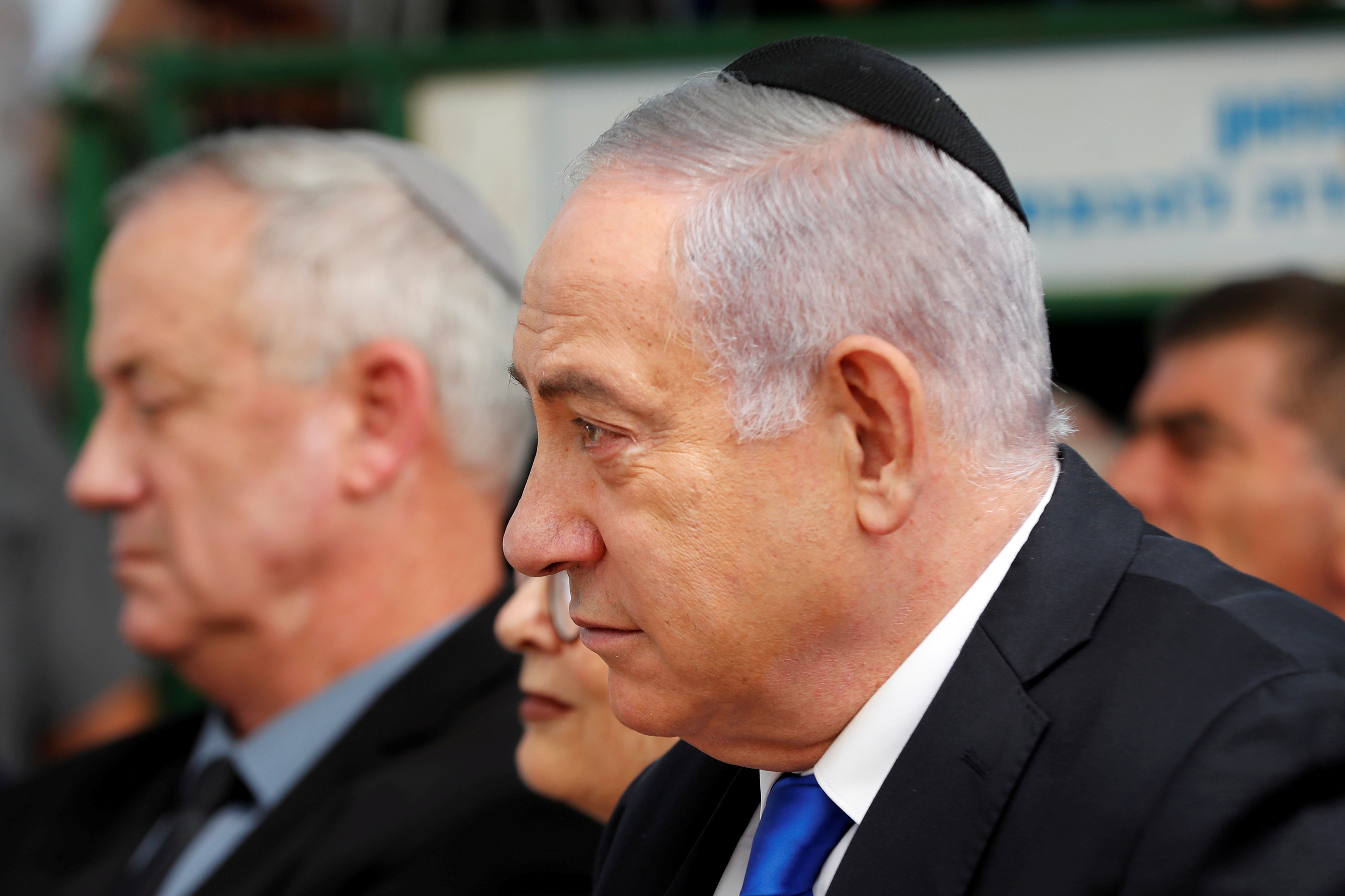
Israeli Prime Minister Benjamin Netanyahu sits next to Benny Gantz, leader of the Blue and White party on 22 September (Reuters)
Israeli Prime Minister Benjamin Netanyahu sits next to Benny Gantz, leader of the Blue and White party, on 22 September (Reuters)
The Joint List representatives also presented the president with a list of their demands, including among other things the annulment of the Nation State Law, an end to the demolition of the homes of Arab citizens and official status for villages without it, an end to the occupation, etc. – but in practice, the gesture is merely a formality.
The list of demands needs to be presented not to the president but to Gantz, who not only did not promise anything to the Arab members of Knesset in exchange for their recommendation, but continues to dodge any suggestion of negotiating or partnering with them. Gantz has trouble even pronouncing the word “Arabs”, preferring during the campaign to talk about "Jews and non-Jews".

No government participation

Meanwhile, we should note that a recommendation in favour of this or that candidate to be tasked to form a government does not reflect willingness to join that government. Certainly no one is contemplating such a possibility vis-à-vis Arab members of Knesset.
The Arab parties are voicing a historic refusal to join an Israeli government as a matter of principle
But to assist in bringing down Netanyahu's regime in favour of a government headed by Gantz, the Joint List is not required to join Gantz’s coalition. Besides their recommendation of Gantz to the president, the Joint List can theoretically be part of the Knesset's voting bloc on which Gantz’s government relies, without themselves being part of the government.
There is a precedent from 1993 when Shas left the Rabin government after Israel signed the Oslo Accords and the five Arab Knesset members, without actually joining the government themselves, were part of a voting bloc that enabled the government to remain in power. 
If this question comes up, there will naturally also be a question as to the price Gantz is willing to pay for such support by the Arab parties from outside his coalition. But this is not entirely about a quid pro quo; the Arab parties are voicing a historic refusal to join an the Israeli government as a matter of principle, and not merely because in any case a government with Arab ministers would be considered illegitimate by a substantial majority of the Jewish public in Israel.

Between fire and brimstone

The Arab Knesset members know that their presence in the Knesset lends legitimacy to a government that engages in institutionalised discrimination against them, but the implied liability in actually joining the government is another thing entirely.
In the Knesset, they can fight for the rights of the Arab minority and can oppose government policies whereas once they join the government, they are no longer the opposition, and the responsibility for Israeli policies falls on all members of the governing coalition.
Again, the question of Arab Knesset members’ inclusion in the government is not on the agenda, but nonetheless the Joint List has taken a dramatic step that alters the traditional political stance of Arab citizens of Israel. Arabs and Jews seeking greater political involvement on the part of Arab citizens lauded the decision and called it "historic".
And so it may be; but the hand of every Arab  legislator who voted for that decision must have trembled at the thought of its significance and of the responsibility thereby laid upon them when the day comes that Gantz, this time as prime minister, orchestrates another hellish massacre against the residents of Gaza.
In such an eventuality, those who applauded the decision today will presumably find it hard to live with their role - a not inconsiderable one - in having brought Gantz to power. The same dilemma naturally exists with regards to a Netanyahu regime, of course.
That’s how it is when you have to choose between fire and brimstone.
Orly Noy
Orly Noy is a political activist who has worked through frameworks including the Coalition of Women for Peace and the Mizrahi Democratic Rainbow Coalition.

Tuesday, September 24, 2019

Netanyahu Rejoices as 3 Arab Leaders Retract Gantz Endorsements

A combination picture shows Blue and White party leader Benny Gantz and Israeli Prime Minister Benjamin Netanyahu.

    A combination picture shows Blue and White party leader Benny 

    Gantz and Israeli Prime Minister Benjamin Netanyahu. | Photo: Reuters

Israeli President Reuven Rivlin said Monday that now the recommendations from the Joint List will account for 10 endorsements, giving Netanyahu a lead by one recommendation.

Benjamin Netanyahu went ahead of Benny Gantz by one recommendation Monday after three Israeli-Palestinian politicians abstained from endorsing Gantz. 

The Joint List won 13 sears in Tuesday making it Knesset’s third-largest bloc. Their support gave Gantz 57 recommendations. However, three Arab politicians from Palestinian nationalist Balad party abstained. The Joint List, an alliance of Palestinian-Israeli parties announced Sunday they would endorse Blue and White’s Gantz. 
Israeli President Reuven Rivlin said Monday that now the recommendations from the Joint List will account for 10 endorsements, giving Netanyahu a lead by one recommendation. 
Rivlin also said he called both leaders Monday for a closed-door talk to break the impasse. The president has to choose a prime minister by Oct. 2 who will then have six weeks to form a government. 
He is not obliged to pick Netanyahu but can choose whoever he thinks has the best chance to command a majority and form a government. Usually, it goes to the leader of the largest party but the close election result formed a deadlock. 
Rivlin suggested that Netanyahu and Gantz should form a unity government. However, when Netanyahu offered coalition last Thursday, Gantz rebuffed it
The Palestinian leaders said that they were not backing Gantz but rather attempting to topple Netanyahu, the longest-serving far-right prime minister of Israel who is facing three corruption charges. 
“We have become illegitimate in Israeli politics in the Netanyahu era,” the leader of the Joint List, Ayman Odeh, told Rivlin. “We are this time recommending Benny Gantz to form the next government.”
Ahmad Tibi, another Arab lawmaker said, “History is done: we’ll do what is needed to bring down Netanyahu.”

Sunday, September 22, 2019

Israeli election spells no change for Palestinians

Journalist Robert Inlakesh says it makes no difference who becomes the next Israeli Prime Minister, Palestinians will lose either way.

As Benjamin Netanyahu suffered a major blow to the benefit of opposition leader Benny Gantz in the Israeli snap elections, Israel is now being perceived to have voted for change.
But what sort of change will be coming to Israel, given a Benny Gantz led coalition, and will Netanyahu actually be ousted or will Israel head into a third round of elections due to the current deadlock?
Many will already know a little about the longest-serving Israeli Prime Minister, Benjamin Netanyahu, with his corruption scandals, war-waging and racist rhetoric towards Palestinians and Africans, being just a few of the many dynamics of his infamous career.
For the Palestinian people, Netanyahu is a man who describes peoples of neigbouring countries and territories as “wild beasts”, says that Israel has to build walls to protect itself, and is evidently not a good man to see in a position of power.
But unfortunately for peace and stability in the region, the record of Benny Gantz is not very different.
Who is Benny Gantz?
Benny Gantz could be Israel’s next Prime Minister and is an ex-Chief of Staff for the IDF, having served between 2011 and 2015. He is most infamous for his roles in the killing of 167 Palestinians in 2012 and the Gaza massacre of 2014, resulting in the murder of 2,202 Palestinians.
The Kahol Lavan (Blue and White) Party front man is not in favour of a two-state solution, he does not support any Palestinian state. Rather, he believes in maintaining Israel’s occupation of the West Bank and East Jerusalem; he believes in making Israel’s illegal blockade of Gaza even tighter; he believes in complete Israeli domination of Jerusalem; and he believes that Israel must maintain its illegal annexation of Syria’s Golan region, as well as annexed Lebanese land in the North.
So Benny Gantz’s foreign policy is essentially the same as Netanyahu’s and if asked to form a coalition government, he will likely carry on exactly where the last Prime Minister left off.
In short, Gantz carries on in a similar fashion to Netanyahu, minus the pictures, diagrams and pointer pen, proclaiming that Israel must never allow Iran to have a nuclear weapon and that Israel must crush Hezbollah and Hamas.
Benny Gantz
Speaking at AIPAC earlier this year, his speech could have been an exact double of Netanyhau’s when it came to his rhetoric on Iran, Syria, Lebanon and the Palestinians.
Gantz is not only a former Chief of Staff for Israel’s military – his career highlight being the 51 days of destruction in Gaza during “Operation Protective Edge” in 2014 – but he used his past during his campaign in order to garner the votes necessary to challenge Netanyahu.
Gantz even released an ad campaign video in which he brags about killing thousands of Palestinians sending parts of Gaza “back to the stone age”. Interestingly, the very day of the Israeli election there was a Dutch court hearing for a war crimes case against the Israeli ex-general for his participation in the murder of 7 Palestinians killed in a specific airstrike.
Netanyahu’s downfall
Benjamin Netanyahu ran his election campaign on racism against Arabs and specifically Palestinians, inside of Israel and outside of it. He also ran his campaign on whether Israel was wishing to be a more religious or secular society.
A third notable point in his campaign was his “security” component, in which he stirred up tensions with Iraq, Syria, Gaza and Lebanon in order to make himself appear strong.
However, despite his attempt to play to the Israeli public’s racist sentiments and his attempts to divide and scare the Israeli population into submission, he failed.
His racism against Israeli Arabs produced an unprecedented 60% voter turnout from that community, making the “Arab Joint List” the third largest party inside of the Knesset. This is because roughly 20% of Israel’s citizens are Palestinian Arabs. The turnout is understood to be a reaction to Netanyahu in order to combat him.
Israeli Prime Minister Benjamin Netanyahu
His promise of security to Israelis was also not good enough, in part because of his embarrassing losses and inability to deal with armed factions inside of Gaza.
But perhaps the biggest factor in Netanyahu’s downfall was his own former Defence Minister, Avigdor Lieberman, who still has the power to maintain or break the current PM. Netanyahu would have formed a coalition government earlier this year, however, the former Defence Minister prevented him from doing so by rejecting an offer to join the coalition.
At the time of the last election, the move by Lieberman was taken due to a disagreement over mandatory conscription of the Ultra-Orthodox into the military. The bad blood however, began with a flare up between the Israeli military and armed factions in Gaza in November of 2018, when Gazan resistance factions dealt an embarrassing blow to Israel, resulting in the resignation of Lieberman after Netanyahu refused to start an all-out war.
What next for Palestinians?
If Benjamin Netanyahu wins, he may follow through with his campaign promise to annex the Jordan Valley – which officially constitutes 30% of the West Bank. However, due to the situation on the ground it’s closer to 40% – meaning that close to 100,000 Palestinians could be ethnically cleansed from their villages and towns.
Netanyahu may also want revenge on Gaza for the resistance daring to fight back, possibly initiating a new massacre of the Gazan population.
If Benny Gantz wins, he has vowed to be tougher on Gaza, which may mean more executions of unarmed demonstrators at Gaza’s Great Return March, as well as a possible tightening of the blockade and a new war. \
Gantz is also a lot less experienced as a politician and could make reckless moves in the region.
One positive to a Gantz Prime Minister win, could be a decline in Israel’s hold over Washington, as nobody has the connections of Netanyahu in the U.S. However if the ex-general is asked to form a coalition by the Israeli President, Netanyahu may try to initiate a war in order to get a third election.
Ultimately, it does not matter whether Gantz or Netanyahu wins the position of Prime Minister, the Palestinians lose either way.

Friday, April 26, 2019

War Versus Peace: Israel Has Decided and So Should We

By Ramzy Baroud

Prime Minister of Israel Benjamin Netanyahu
Israelis are divided on some issues, but resolutely unified around the continued subjugation of the Palestinian people.

So, what have we learned from the Israeli legislative elections on April 9?


A whole lot.
To start with, don’t let such references as the “tight race” between Israeli Prime Minister Benjamin Netanyahu, and his main rival, Benny Gantz, fool you.
Yes, Israelis are divided on some issues that are particular to their social and economic makeup. But they are also resolutely unified around the issue that should concern us most: the continued subjugation of the Palestinian people.
Indeed, ‘tight race’, or not, Israel has voted to cement Apartheid, support the ongoing annexation of the Occupied West Bank, and carry on with the Gaza siege.
In the aftermath of the elections, Netanyahu emerged even more powerful; his Likud party has won the elections with 36 seats, followed by Gantz’s Kahol Lavan (Blue and White) with 35 seats.
Gantz, the rising star in Israeli politics was branded throughout the campaign as a centrist politician, a designation that tossed a lifeline to the vanquished Israeli ‘left’—of which not much is left anyway.
This branding helped sustain a short-lived illusion that there is an Israeli alternative to Netanyahu’s extremist right-wing camp.
But there was never any evidence to suggest that Gantz would have been any better as far as ending the Israeli occupation, dismantling the Apartheid regime and parting ways with the country’s predominantly racist discourse.
In fact, the opposite is true.
Gantz has repeatedly criticized Netanyahu for supposedly being too soft on Gaza, promising to rain yet more death and destruction on a region that, according to the United Nations, will be unlivable by 2020.
A series of videos, dubbed “Only the Strong Survives”, were issued by the Gantz campaign in the run up to the elections. In the footage, Gantz was portrayed as the national savior, who had killed many Palestinians while serving as the army’s chief of staff between 2011 and 2015.
Gantz is particularly proud of being partly responsible for bombing Gaza “back to the stone age.”
It apparently mattered little to Israeli centrists and the remnants of the left that in the 2014 Israeli war on Gaza, dubbed Operation “Protective Edge”, over 2,200 Palestinians were killed and over 11,000 were injured. In that most tragic war, over 500 Palestinian children were killed, and much of Gaza’s already ailing infrastructure was destroyed.
But then again, why vote for Gantz when Netanyahu and his right-wing extremist camp are getting the job done?
Sadly, Netanyahu’s future coalition is likely to be even more extreme than the previous one.
Moreover, thanks to new possible alliances, Netanyahu will most likely free himself of burdensome allies, the likes of former Israeli Defense Minister, Avigdor Lieberman.
One significant change in the likely makeup of the Israeli right is the absence of such domineering figures, who, aside from Lieberman also include former Education Minister, Naftali Bennett and former Justice Minister Ayelet Shaked.
All the grandstanding from Bennett and Shaked, who had recently established a new party called “The New Right”, didn’t even garner them enough votes to reach the threshold required to win a single seat in the Israeli Parliament, the Knesset. They needed 3.25 percent of the vote, but only achieved 3.22 percent. They are both out.
The defeat of the infamous duo is quite revealing: the symbols of Israel’s extreme right no longer meet the expectations of Israel’s extremist constituencies.
Now the stage is wide open for the ultra-orthodox parties, Shas, which now has eight seats, and United Torah Judaism, with seven seats to help define the new normal in Israel.
The Israeli left—if it was ever deserving of the name—received a final blow; the once prominent Labor Party, won merely six seats.
On the other hand, Arab parties that ran in the 2015 elections under the united banner of the “Joint List”, fragmented once more, to collectively achieve only 10 seats.
Their loss of three seats, compared to the previous elections, can be partly blamed on factional and personal agendas. But, that is hardly enough to explain the massive drop in Arab voter participation in the elections: 48 percent compared to 68 percent in 2015.
This record low participation can only be explained through the racist ‘Nation State Law”, which was passed by the right wing-dominated Knesset on July 19, 2018. The new Basic Law, declaredIsrael as the “nation state of the Jewish people” everywhere, relegating the rights of the Palestinian people, their history, culture and language, while elevating everything Jewish, making self-determination in the state an exclusive right for Jews only.
This trend is likely to continue, as Israel’s political institutions no longer offer even a symbolic margin for true democracy and fair representation.
But perhaps the most important lesson that we can learn in the aftermath of these elections is that in today’s Israel, military occupation and apartheid have been internalized and normalized as uncontested realities, unworthy of national debate. This in particular should summon our immediate attention.
During election campaigns, no major party spoke about peace, let alone provided a comprehensive vision for achieving it. No leading politician called for the dismantling of the illegal Jewish settlements that have been erected on Palestinian land in violation of international law.
More importantly and tellingly, no one spoke of a two-state solution.
As far as Israelis are concerned, the two-state solution is dead. While this is also true for many Palestinians, the Israeli alternative is hardly co-existence in one democratic secular state. The Israeli alternative is Apartheid.
Netanyahu and his future government coalition of like-minded extremists are now armed with an unmistakably popular mandate to fulfill all of their electoral promises, including the annexation of the West Bank.
Moreover, with an emboldened and empowered right-wing coalition, we are also likely to witness a major escalation in violence against Gaza this coming summer.
Considering all of this, we must understand that Israel’s illegal policies in Palestine cannot and will not be challenged from within Israeli society.
Challenging and ending the Israeli occupation and dismantling Apartheid can only happen through internal Palestinian resistance and external pressure that is centered around the strategy of Boycott, Divestment and Sanctions (BDS).
It is now incumbent on the international community to break this vicious Israeli cycle and support the Palestinian people in their ongoing struggle against Israeli occupation, racism and apartheid.

Ramzy Baroud

Ramzy Baroud is a journalist, author and editor of Palestine Chronicle. His latest book is The Last Earth: A Palestinian Story (Pluto Press, 2018). His latest book is The Last Earth: A Palestinian Story (Pluto Press, 2018). He earned a Ph.D. in Palestine Studies from the University of Exeter, and is a former Non-Resident Scholar at Orfalea Center for Global and International Studies, UCSB.