
By Benay Blend
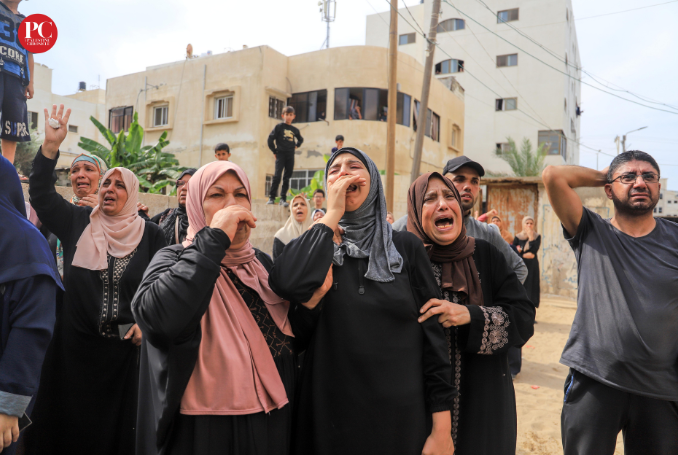 Palestinian women bear the brunt of Israel’s war on Gaza.(Photo: Mahmoud Ajjour, Palestine Chronicle)
Instead of recognizing that Palestinian women have historically been brutalized by the Occupation, Western feminists often chose to focus on Orientalist views of women in Islamic society.
March 8, 2026, marks the annual International Women’s Day (IWD), this year coded “Give To Gain,” a topic that “encourages a mindset of generosity and collaboration.”
“When people, organizations, and communities give generously, opportunities and support for women increase,” the call continues. “Whether through donations, knowledge, resources, infrastructure, visibility, advocacy, education, training, mentoring, or time, contributing to women’s advancement helps create a more supportive and interconnected world.”
By focusing on individual achievement, how does this include other forms of feminisms, such as Arab and Black, that are centered on communal uplift, often including men? Given recent criticism of liberal institutions, do such non-profits go beyond acknowledging violence and inequality while failing to call out the structures that produce it?
Writing shortly before IWD 2024, Samreen Mushtag asks: “What speeches and silences mark the women’s day? Which women, whose oppression, and whose resistances comprise the conversations in global feminist revolutions and their definition of worthwhile lives?”
When Palestinian women are invoked, they are most often portrayed as victims; very seldom are they celebrated by Western Feminists as active in the resistance, perhaps because women’s politics in Occupied Palestine do not fit into neat categories recognized by mainstream feminism.
According to Sophie Richter-Devroe, such women’s activism takes the form of daily efforts to resist Israel’s intrusions into the everyday lives of individuals, families and communities (Women’s Political Activism and Peacebuilding, Resistance and Survival, 2018, p. 3).
In the diaspora, women have also been at the forefront of the struggle, from grassroots organizing to academia to important legal work, as well as in mainstream and independent media (Nada Elia, Greater Than the Sum of Our Parts: Feminism, Inter-Nationalism, and Feminism, 2023, p. 2.)
“The repeated invocation of Palestinian women and children (as victims) evokes widespread condemnation,” Mushtag notes, “even though it does nothing to the system that enables a violent force to continue with unimaginable terror.”
Instead of recognizing that Palestinian women have historically been brutalized by the Occupation, Western feminists often chose to focus on Orientalist views of women in Islamic society who are allegedly maltreated by their own culture.
“As far as the mainstream discourse in the West is concerned,” Nadia Elia claims, “Palestinian women and queers either do not exist or are oppressed by ‘Islamic fundamentalism,’ with little recognition of Israel’s violence, much of which is gendered.”
In the homeland, as well as the diaspora, women have long resisted Western imperialism and Israel’s ongoing ethnic cleansing. In masculinist discourse, Elia notes, struggle equates solely to armed resistance, despite all forms of resistance that Palestinians have chosen over the years.
“Another, more comprehensive understanding of ‘resistance’,” she concludes, “would take into consideration all the ways we persevere against the odds—that is, our sumoud (steadfastness) when Zionists are intent on erasing our very existence.”
Women have always been the “political spine” of the Palestinian struggle, Dr. M. Reza Behnam writes. In Gaza, they serve as doctors, lawyers, journalists, mothers, and chefs in communal kitchens, a testament to their “strength, resilience and fearlessness that [has] kept the resistance alive.”
For these reasons, Israel targets them on purpose, knowing that they are the “pillar that sustains Palestinian life.”
This focus on everyday survival, particularly now in Gaza, where healthcare, reproductive rights, and resources are under attack, means that the pursuit of individualized, feminist agendas, such as those highlighted by IWD 2026, is not part of life under siege by Israelis.
Unlike Western feminism, as exemplified by IWD 2026, Palestinian women frequently privilege collective survival and communal/intersectional solidarity over individual rights. This perspective means that personal narratives might be used to express individual experience, but at the same time, the individual is placed within the collective struggle for liberation.
While there might be more economic opportunities in the diaspora, most Palestinian women are tied to the homeland where a culture of mutuality persists.
In Palestine and Feminist Liberation (2025), Nada Elia refers to what she calls “faux feminism,” the “imperialist and colonialist” variety that “aspires for a bigger piece of the pie without considering how unhealthy that pie is” (p. 62). In her version, feminists search for an alternate pie recipe, one that involves an “in-depth social and political transformation” (p. 62).
In their lead-up to March 8th, organizers ask that participants donate to a woman-centered non-profit of their choice. “As individuals, giving support means calling out stereotypes, challenging discrimination, questioning bias, celebrating women’s success, and more.”
At the present time, there are questions about the effectiveness of liberal non-profits in challenging Israel’s genocide of Palestinians. “Liberal institutions are designed to recognize the violence that structures Palestinian life without destabilizing the systems that produce it,” A Kayum Ahmed warns.
In this way, such non-profits might acknowledge the genocide in Gaza without calling for the dismantling of Zionism itself. Because donors are the driving force behind such institutions, Ahmed notes, liberal institutions “have never been the engines of liberation. They measure injustice; they do not rupture it.”
On the website for IWD 2026, there are photos of women, along with a few men, striking the “give to gain pose”: hands out, palms up, symbolizing the receipt of monetary contributions.
While there is one photo of a Muslim woman with a head scarf, one disabled woman in a wheelchair, there does not seem to be a recognition of other forms of feminism besides that which relies on movement up the economic ladder.
The sole center of attention seems to be on “gender equality” with no mention of liberation from racialized colonial oppression. Despite the claim that “IWD is a truly inclusive, diverse, and eclectic moment of impact worldwide,” such a narrow focus proves to be an issue.
Elaborating on “conventional women’s studies approaches that attribute any victimization of women” to gender inequality, Professor Rabab Adhulhadi prefers, instead, an analysis of gender oppression in “relationship to collective engagements with racial oppression” (Arab and Arab American Feminisms: Gender, Violence, and Belonging, edited by Rabab Abdhulhadi, Et al., p. xxi). While Palestinian feminists believe that there can be no liberated Palestine without women, the focus remains on decolonization and dismantling the Zionist regime.
For these reasons, Abdulhadi and her co-contributors do not endorse the postcolonial feminist critiques of the “sisterhood is global” model that permeates IWD 2026. Because there is no universal women’s experience, Abdulhadi favors a variety of feminisms that are often “overlaid on top of one another” (p. xxv).
Focusing on another International Day, this time calling for the Elimination of Violence Against Women, journalist Romana Rubeo notes the same reluctance “to focus on the bigger picture, to truly analyze the issues, to consider the deep conflicts of Western society.” Thus, organizers arrive at a singular brand of feminism that excludes violence against Palestinian women, particularly in this case, women prisoners.
In contrast, International Working Women’s Day (IWWD), held in Chicago in March of 2024, provided a venue for anticolonial feminists to call out the genocide supported by colonial “feminist” propaganda.
In her coverage of the event, Noor H. stressed that all participants emphasized the importance of grounding feminism in working-class, anticolonial principles. As one organizer put it: “Palestinian feminism extends beyond the struggles that white liberal feminists typically campaign for. It is anticapitalist, anti-imperialist, and seeks to decolonize.”
Speakers also emphasized the interconnectedness of liberation struggles worldwide. While focusing on anticolonial feminism as a framework for speaking about Palestinian feminism, participants called for moving from theory to praxis, thus encouraging attendees to continue mobilizing after leaving the event.
These principles are missing from IWD 2026, an event that encourages individual donations rather than continued mobilizing on behalf of Palestinian liberation, along with other global movements.
Perhaps even more insidious, “white savior” feminists have reemerged in the weeks before the US-Israel unprovoked attack on Iran. On January 17, 2026, Ms. Magazine published a call for international feminists to stand with Iranian women against their current government. Included was a photo of an anti-regime protestor burning a picture of Ali Khamenei outside the US consulate in Milan.
Now, a few months later, the US has bombed Iran in an effort to “save” the people, and in the process, hit an Iranian girls’ elementary school, thereby killing over 80 children.
“Not only has liberal white feminism harmed Muslim women,” Yousra Sasmir Imran writes, “but it has excluded them from feminist spaces. White feminists have the habit of dominating all spaces and platforms and ‘whitesplaining’ lived realities that they actually have no lived experience of.”
In the end, this omission demonstrates that narrow definitions of feminism remain dominant in mainstream organizations, in the process excluding the self-determined theories of feminisms encouraged by Palestinian, Arab, Black, Indigenous, and Third World feminist thought and praxis.
– Benay Blend earned her doctorate in American Studies from the University of New Mexico. Her scholarly works include Douglas Vakoch and Sam Mickey, Eds. (2017), “’Neither Homeland Nor Exile are Words’: ‘Situated Knowledge’ in the Works of Palestinian and Native American Writers”. She contributed this article to The Palestine Chronicle.

No comments:
Post a Comment