
By Palestine Chronicle Staff
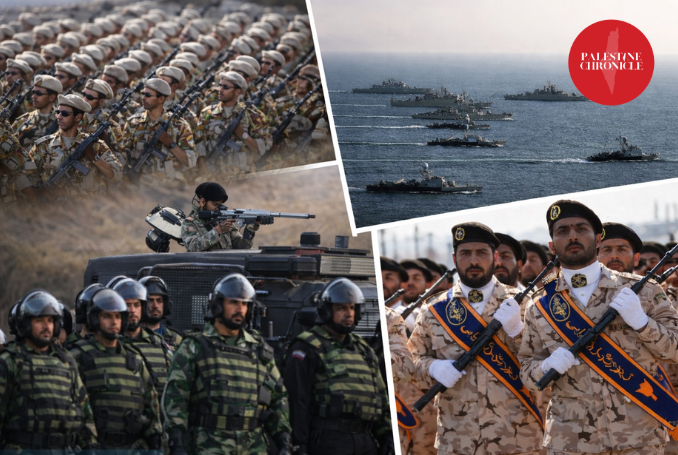 Branches of Iran’s military—including ground forces, naval units, and security formations—during exercises and official parades. (Design: Palestine Chronicle)
Iran’s military power relies on missiles, drones, naval deterrence, and large mobilization forces supporting the IRGC-led strategy.
What missiles form the backbone of Iran’s arsenal?
Ballistic missiles are widely considered the central pillar of Iran’s military doctrine. Over the past two decades, Tehran has invested heavily in developing a large and diverse missile inventory capable of striking targets across the region.
US military assessments have suggested that Iran possesses more than 3,000 ballistic missiles (a commonly cited estimate, though analysts stress that the exact size of the stockpile is unknown).
Other defense research groups and regional intelligence estimates place the number closer to around 2,500 missiles before the current war, again noting that such figures are approximations rather than confirmed totals.
The arsenal includes multiple families of medium-range ballistic missiles such as Emad, Ghadr, Sejjil, Kheibar, and Khorramshahr, many of which are designed to reach targets 1,000 to 2,000 kilometers away.
Iranian doctrine emphasizes missiles partly because of the country’s limited modern combat aircraft fleet. Instead of relying heavily on airpower, Tehran has focused on developing mobile launch platforms, underground missile bases, and large salvo capabilities.
Among the newest additions to the arsenal is the Fattah hypersonic missile, which Iranian officials say can travel at speeds above Mach 10.
Heavier systems such as the Khorramshahr missile are designed to carry larger warheads, with payload capacities estimated at over one ton (figures vary depending on the missile variant and reporting source).
Together, these missile systems create a layered strike capability combining range, payload, and speed.
How important are drones to Iran’s strategy?
Drones have become the second major pillar of Iran’s military doctrine. In recent years, Iran has developed a wide range of unmanned aerial vehicles designed for reconnaissance, strike missions, and long-range attacks.
The most widely known system is the Shahed-136 loitering munition, a drone designed to travel long distances before striking a target.
Estimates of its operational range vary but often fall between 1,500 and 2,500 kilometers (figures vary depending on payload, flight profile, and reporting source).
Iran’s drone industry has expanded significantly in recent years. Analysts say the country may be capable of producing thousands of drones per year.
Some coordinated drone attacks in recent conflicts have reportedly involved hundreds of drones launched in a single wave.
Iran also operates larger drones capable of reconnaissance and precision strike missions. These include the Shahed-129, Shahed-191, and Mohajer families, which can remain airborne for extended periods while conducting surveillance or guiding attacks.
Because drones are relatively inexpensive compared to ballistic missiles, they allow Iran to sustain pressure during prolonged conflicts.
In practice, drones and missiles often operate together: drones can distract or exhaust air defenses while missiles deliver heavier payloads.
What role does the IRGC play in Iran’s war strategy?
The Islamic Revolutionary Guard Corps (IRGC) occupies a central position in Iran’s military structure and is widely seen as the institution responsible for managing the country’s strategic weapons.
Iran’s armed forces include approximately 600,000 active personnel, a figure that includes both the regular military and the IRGC (numbers vary depending on how reserve and paramilitary forces are counted).
Within the IRGC, the Aerospace Force oversees Iran’s ballistic missile and advanced drone programs. This branch manages missile production, testing, and launch operations.
The IRGC also operates its own ground forces, naval forces, and intelligence networks separate from the regular military, allowing it to conduct specialized operations and coordinate strategic strikes.
Because the missile and drone programs fall under IRGC authority, the organization plays a leading role in Iran’s deterrence and retaliatory strategy.
What capabilities does Iran’s regular army provide?
Iran’s conventional armed forces, known as the Artesh, include the army, air force, and navy.
Together with the IRGC, Iran’s military totals roughly 600,000 active troops (again an approximate figure based on multiple defense estimates rather than an officially confirmed number).
The regular army provides large-scale ground forces responsible for territorial defense and border security.
Iran’s air force operates a mix of older aircraft, many dating back to the pre-1979 era, but it still contributes to national defense through air patrols, logistics, and air defense coordination.
Iran has also invested heavily in air defense systems, including domestically produced missile defense platforms designed to protect strategic infrastructure and military bases.
How significant is Iran’s naval power?
Iran’s naval doctrine focuses on asymmetric maritime warfare rather than conventional fleets.
Two naval forces operate in parallel: the Iranian Navy and the IRGC Navy.
The IRGC Navy operates hundreds of fast attack boats (exact fleet numbers are uncertain and fluctuate over time) along with coastal missile batteries and naval drones.
Iran has also developed long-range anti-ship missiles capable of striking targets hundreds of kilometers away, creating a defensive barrier around key maritime routes.
These capabilities are designed to allow Iran to threaten shipping lanes or naval vessels in nearby waters if a wider conflict develops.
Could volunteers and reserves play a role?
Beyond its regular armed forces, Iran possesses a large paramilitary reserve known as the Basij.
The Basij operates under the authority of the IRGC and functions as a mass mobilization network capable of supporting the military during national emergencies.
Although precise figures vary, analysts estimate the Basij includes hundreds of thousands of active members and potentially millions of registered volunteers.
These forces are typically used for internal security, logistical support, and civil defense rather than operating advanced weapons systems.
However, their size provides Iran with significant manpower reserves in the event of a prolonged conflict.
(FARS, MEHR, Al Mayadeen, Reuters, AJA, Anadolu, PC)

No comments:
Post a Comment