
By Palestine Chronicle Staff
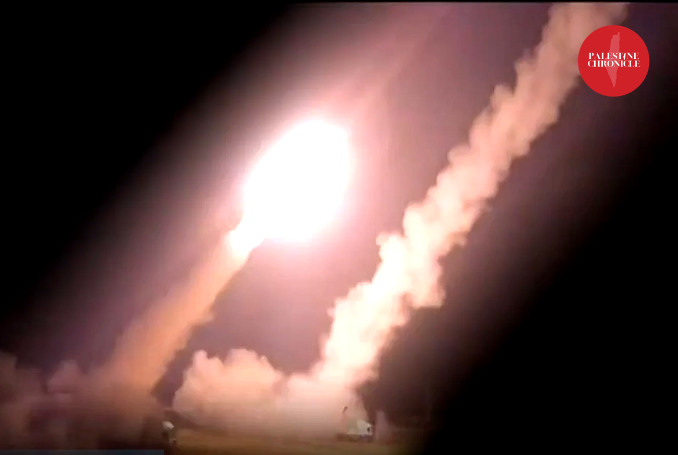 Iranian missiles launched at night in footage circulating on social media. (Photo: Social Media)
Iran says Wave 37 of “True Promise 4” unleashed its heaviest missile barrage yet, lasting three hours.
Key Developments
- Iran says Wave 37 of “True Promise 4” unleashed its heaviest missile barrage yet, lasting three hours.
- Iran’s Revolutionary Guard announced the launch of Wave 37 of Operation “True Promise 4.”
- The Guard described the assault as the most intense operation since the war began.
- Iran said the attack lasted at least three hours and targeted Israeli and US-linked positions.
- Heavy missiles, including Khorramshahr, Kheibar, and Qader were reportedly used in the operation.
- Israeli media reported sirens and explosions in Tel Aviv and central Israel following the launches.
Most Intense Attack
Iran’s Islamic Revolutionary Guard Corps (IRGC) announced shortly after midnight Tuesday–Wednesday that it had launched Wave 37 of Operation “True Promise 4,” describing it as the most intense strike carried out since the beginning of the war.
According to the IRGC statement, the new wave targeted Israeli military sites as well as US-linked positions across the region, marking a continuation of the escalating confrontation between Iran, Israel, and the United States that began on February 28.
The Guard said the operation included strikes on targets in Tel Aviv and other locations inside Israel, in addition to positions associated with the United States, including the headquarters of the US Fifth Fleet and sites in Erbil.
Iranian officials framed the operation as part of a broader campaign responding to a joint US-Israeli war targeting Iranian territory and infrastructure.
The IRGC said the latest assault represents a major step in the ongoing military campaign, signaling that Iran intends to continue expanding the scale and intensity of its missile strikes.
Heavy Missile Barrage
In its statement, the IRGC said the operation relied heavily on long-range ballistic missiles and heavy warheads, some weighing approximately one ton.
Among the weapons reportedly used were Kheibar and Qader missiles equipped with multiple warheads, as well as the Khorramshahr heavy ballistic missile, one of Iran’s most powerful long-range systems.
The Guard said Khorramshahr missiles were launched in multiple salvos targeting US and Israeli positions, emphasizing the missile’s heavy payload and destructive capability.
Two days before the attack, Brigadier General Majid Mousavi, commander of the IRGC Aerospace Force, announced that Iran had changed its operational policy and would no longer launch missiles carrying warheads weighing less than one ton.
The statement suggested that future strikes would rely increasingly on heavier payloads and more destructive systems, indicating a shift in Iran’s operational doctrine as the conflict continues.
Iranian officials say the use of heavier warheads reflects the growing scale of the confrontation, which has increasingly expanded beyond direct strikes on Iranian territory to include attacks on regional bases and military infrastructure.
Three-Hour Assault
According to the IRGC, Wave 37 continued for at least three hours, making it one of the longest sustained missile operations carried out since the beginning of the war.
During that period, Iranian forces reportedly launched multiple phases of missiles toward targets in Israel and elsewhere in the region.
Israeli media reported that air raid sirens sounded across central Israel, including the Tel Aviv area, following the detection of incoming Iranian missiles.
Reports also indicated powerful explosions in the Tel Aviv region, although the extent of damage remained unclear due to strict military censorship imposed by Israeli authorities during wartime.
Israel’s Home Front Command reportedly instructed residents in several areas to immediately enter shelters after missile launches were detected.
Iran’s statement suggested that the prolonged duration of the attack reflected a coordinated multi-stage operation, with missiles launched in successive waves over several hours.
The IRGC emphasized that the attacks are continuing and that Iranian forces remain engaged in what it described as a determined campaign aimed at achieving “complete victory.”
Expanding Regional Front
Meanwhile, other regional groups have also reported escalating operations.
The Islamic Resistance in Iraq announced a large-scale campaign targeting US bases and positions in the region using drones and missiles.
In Lebanon, the Islamic Resistance reported additional rocket attacks targeting Israeli troop concentrations near the southern town of Khiam and other border areas.
At the same time, new incidents have raised concerns about the vulnerability of US diplomatic and military infrastructure.
According to a report by the Washington Post, a drone strike hit the US diplomatic support center in Baghdad, a major logistical facility used by American diplomats near Iraqi military installations and Baghdad International Airport.
Elsewhere in the Gulf region, a recent internal assessment cited by US officials reportedly concluded that parts of the US embassy complex in Riyadh, damaged by a suspected drone strike, may be “beyond repair.”
The escalating attacks come as tensions continue to rise around key strategic locations such as the Strait of Hormuz, one of the world’s most critical oil transit routes.
Iranian officials have warned that vessels linked to countries involved in the war may not be allowed to pass through the strait, raising fears of wider disruptions to global energy markets.
(Al Mayadeen, Israeli Media, Reuters, Washington Post, PC)

No comments:
Post a Comment