Sunday, December 31, 2023

Turkey at 100: Will Ankara move closer to Russia or the US?

From the East to the West, Turkey's balanced transactional relationships will most likely continue in the months and years ahead

Sahar Khamis

Turkish President Recep Tayyip Erdogan speaks in Ankara on 29 November 2023 (AFP)
As Turkey marks its centenary as a republic, it is important to explore the historical and contemporary factors shaping its future foreign policy - especially its mixed relationship with the West, which has been characterised by both tensions and mutual pragmatic interests. 

President Recep Tayyip Erdogan’s recent electoral victory has many implications for modern Turkey and its relationship with the West, especially the United States and the European Union. His new term could redefine these relationships and shape the country’s future trajectory.  

Historically, there have been ups and downs in the popular and political receptions and perceptions of Turkey in the West, dating back to Ottoman times. As the Ottoman Empire consolidated power, it was looked upon with fear and bitterness in the West. These sentiments deteriorated further after the end of the First World War. 

More recently, a series of events have complicated Turkey’s relationship with the West, especially the US. Turkey began to distance itself from the US when it refused the passage of American troops to Iraq in 2003. In 2011, it destroyed the US-Israel-Turkey axis by severing ties with Tel Aviv, and implemented a policy in Syria that ran counter to US interests. When the July 2016 coup was attempted, Turkey blamed the US.  

Some of these factors have changed over time. For example, Turkey restored its strategic relationship with Israel due to mutual economic interests. It even welcomed Israel’s president to Ankara in March 2022, marking the highest-level meeting between the countries in 14 years. This was received favourably by western nations, especially the US.

But Turkey’s position on Syria, which aligns with the positions adopted by Russia and Iran, remains a point of contention and unease between Turkey and the West. Tensions between Turkey and Greece, both Nato members, also continue to strain Turkey’s relations with its western allies.

Turkey blames the US for hosting Turkish cleric Fethullah Gulen, who has been living in self-exile in Pennsylvania since 1999. Turkey designated his global Hizmet movement as a terrorist organisation and blamed it for instigating the 2016 coup attempt. Repeated calls by Erdogan for the US to hand over Gulen never succeeded, further fuelling tensions. 

Points of contention

More points of contention have emerged in recent years, including Turkey’s rapprochement with Russia. The pair have cooperated on oil and gas pipelines; Russia has sold weapons, such as the S-400 missile system, to Turkey, and provided technical assistance in the construction of Turkey’s nuclear plants; and the two nations have collaborated on trade. 

Turkey is the only Nato member that didn’t support the imposition of sanctions against Russia over the Ukraine war. It even transported Russian fuel to China and Iran, bypassing the internationally imposed sanctions on Moscow. 

Turkey’s power stems in part from its role within Nato as a bridge between the East and the West, thanks to its unique geographic location, which spans Europe and Asia. Turkey played a key role in backing Finland’s bid to join Nato, and after initial opposition, it also accepted Sweden - a move rewarded by Washington’s approval of a deal for F-16 fighter jets. 

Turkey’s attempt to link its approval of Sweden’s Nato membership to the approval of its own long-sought accession to the EU did not work out, creating another source of tension between Ankara and the West. But despite such tensions, Turkey’s fast-growing economy, rich natural resources, unique geographic location and strategic alliances explain why it remains important for both the West and its fiercest rivals, Russia and China. 

Erdogan has distanced himself from being perceived as a puppet of the West, especially of the US, through building viable relationships with other strong countries

Turkey’s latest elections showed the faultiness of predictions about Erdogan’s dwindling power and sliding popularity. Hopes for an end to his rule turned out to be wishful thinking. Despite the small margin by which he won, he will continue to lead Turkey for a third term, earning the title of “Turkey’s strongman” for securing 25 years in power. 

While Erdogan’s victory is very consequential for Turkey and its foreign policy, however, predictions are mixed when it comes to the country’s path forward vis-a-vis the West. Some expect Turkey to distance itself from the West and to lean more towards Russia, while others expect the opposite. 

Those who adopt the first position argue that Turkey’s relations with the US and European countries will remain at best transactional, and vulnerable to circumstantial crises. Turkey is under US sanctions for purchasing the Russian S-400 system, Washington is concerned about Ankara’s deepening ties with Moscow, and US President Joe Biden has kept Erdogan at arm’s length due to a decline in democratic standards. 

Turkey, in turn, is outraged over US support for armed fighters in Syria affiliated with the outlawed Kurdistan Workers’ Party (PKK), and it is wary of deepening political and defence cooperation between its arch-rival Greece and the US.

Maneuvering power

Those who adopt the second position, meanwhile, cite Russia’s increased international isolation and diminished military reputation as a result of the attempted mutiny by the Wagner Group and the prolonged war in Ukraine. 

These perceived weaknesses on Russia’s part could strengthen Turkey’s maneuvering power as the only Nato country that didn’t back sanctions on Russia. They also stress the importance of Turkey’s continued relationship with the US and its western allies. 

Between these two contradictory positions, there is a balanced middle ground that acknowledges the challenges in Turkey’s relationships with its western allies, while also stressing the value of successful engagement to overcome these challenges. While acknowledging that Turkey will be a thorn in the West’s side for years to come, this position also takes into account Turkey’s G20-sized economy, diplomatic expertise, military strength and location, which make it absolutely essential to the West.

Those who adopt this middle position argue that through direct engagement between the leaders of Turkey and its western allies, especially the US, important wins have been achieved, including Nato accession for Sweden, F-16 sales, a ceasefire with the PKK (or at least continued Turkish restraint in northeastern Syria), calm with the Greeks, and progress on Armenian-Azeri rapprochement.

This position maintains that a smart revival in Turkey’s relationship with the West is not just essential; it is the only way to achieve both parties’ goals and to serve their mutual interests. It may also be the best way to pragmatically contain what has been described by some critics as the “storm of Erdoganism”. 

Building ties

Erdogan has distanced himself from being perceived as a puppet of the West, especially of the US, through building viable relationships with other strong countries, including Russia and China. He has also gotten closer to Iran in recent years. This policy is based on the necessity of solidifying and diversifying Turkey’s strategic partnerships and alliances to safeguard its interests in the political, economic and military spheres. 

Significantly, Erdogan has successfully remained relevant in the global arena by keeping Russia close and stressing his commitment to Nato, while extracting maximum concessions from both sides - a delicate balancing act. Although some of his recent tactics, especially his position on Sweden’s Nato membership, have angered Russia, it is unlikely that such moves would erode the foundations of their transactional relationship. 

In a multipolar world, the winners will be those who can navigate these new realities and negotiate with more than one strategic power

Likewise, it is unlikely that Turkey’s policy on Syria and its increasing closeness with Russia, China and Iran would erode Turkey’s transactional relationship with the West. 

Moving forward, Turkey can choose between three scenarios: favouring its western allies at the expense of its relations with Russia and China; favouring the latter at the expense of the former; or continuing to skillfully balance these relationships. The third scenario seems more realistic. In a multipolar world, the winners will be those who can navigate these new realities and negotiate with more than one strategic power to safeguard their interests.  

Turkey has been successfully doing just that through its balanced transactional relationships with the East and the West, and it will most likely continue on the same path during Erdogan’s third term and in the post-Erdogan era. 

Another balancing act that is equally vital for Turkey’s future foreign relations is its ability to keep its position of regional influence in the Middle East, while maintaining its geostrategic relationship with Israel. This seems to be more challenging than ever in the midst of the Gaza crisis which started unfolding on 7 October 2023.

Turkey has been criticised for taking a primarily rhetorical position on this grave humanitarian tragedy which condemned Israel’s attacks on innocent civilians in Gaza and criticised the West for backing Israel, without taking more decisive practical steps, such as cutting diplomatic ties with Israel, for example, or even threatening to do so.

Turkey’s ability to skilfully walk these tight ropes and juggle these diplomatic balls will determine its success or failure as a regional and international power to be reckoned with.

Sahar Khamis
is an Associate Professor in the Department of Communication at the University of Maryland, College Park. She holds a Ph.D. in Mass Media and Cultural Studies from the University of Manchester in England. She is the co-author of the books Islam Dot Com: Contemporary Islamic Discourses in Cyberspace and Egyptian Revolution 2.0: Political Blogging, Civic Engagement and Citizen Journalism, and the co-editor of the book Arab Women’s Activism and Socio-Political Transformation: Unfinished Gendered Revolutions.

Qassem Soleimani, Minority groups

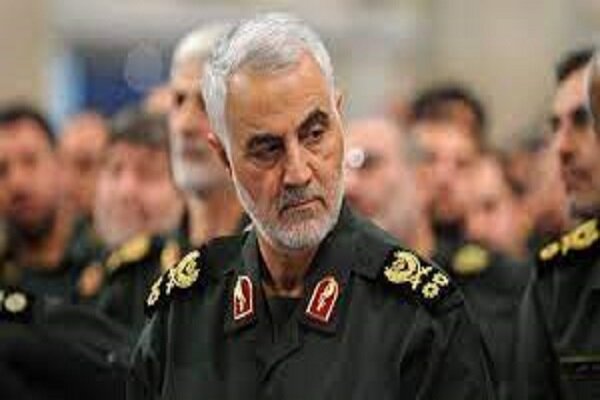
General Qassem Soleimani was legendary in his lifetime and after his martyrdom for his achievements in defeating both the Zionist entity and Takfiri terrorist groups like Daesh.

But a less known aspect of his life is the work he did in working with other religious groups to protect their rights and their lives, working with Christians, Sunnis and other minorities in their struggles in the West Asia region.

In this episode, we will explore these contributions he made and dispel myths and slanders put forth by his enemies who rage that he frustrated all of their agendas in the region.

Access the Link for the interview:

https://www.presstv.ir/Detail/2023/12/30/717292/Qassem-Solaimani,-Minority-groups

Failure of Europe’s Sanctions Policy against Hamas

Strategic Council Online - Interview: An expert on West Asia affairs stressed that Europe’s turning to threadbare plans such as boycotting Hamas, which has been tried many times over the past century to solve the Palestinian problem, is doomed to failure. Until the main problem of Palestine, i.e., the occupation is not resolved, there will be no opening, and the resistance will continue.

In an interview with the website of the Strategic Council on Foreign Relations, Mehdi Shakibaei referred to the letter of the foreign ministers of the three countries of France, Italy, and Germany to the European Union’s foreign policy officials to intensify sanctions against Hamas and its supporters, stated: Western countries, by discrediting Hamas intends to separate the Resistance groups from the body of Palestine and then sanction them with the stigma of terrorism. At the same time, the entire people of the Gaza Strip are part of the Resistance and Hamas.

While pointing to the failure of the efforts to relocate the residents of the Gaza Strip and transfer them to other areas, including the Sinai desert, he added: Western countries even hoped that by creating discontent, the residents of the Gaza Strip would turn against the Resistance groups and hold protests, but have failed in those measures and after more than two months since the crimes of the Zionist regime, the people of Gaza refused to show favor to their policies; because the Resistance in Palestine is popular and its Mujahidin are the members of Palestinian families.

The Deputy of the International Union of Non-Governmental Organizations Supporting Palestine emphasizes that the Zionist regime has not been successful in either of its two designs, i.e., expelling Palestinians and creating protests and riots against Resistance groups. Therefore, the West, under the pressure of Zionist lobbies and cartels, has undertaken a diplomatic and media campaign on behalf of the Israeli regime in order to increase the pressure against the Resistance, said Such measures are carried out. At the same time, Europe ignores all its human rights slogans and remains silent in the face of the tragedies of Gaza and the crimes of the Israeli regime and puts forward plans such as boycotting Hamas.

Saying that the issue of the current war between the Gaza Strip and the Zionist regime should be looked at in the framework of the theory of the war of civilizations, Shakibaei said that it is a war between the Western world and the Palestinian Muslim nation and reminded that they want to discredit the Hamas movement. At the same time, Hamas represents a part of the Palestinian nation, and the results of the last elections in that region also showed it. However, European countries want to see it in the context of a terrorist organization in order to pursue their goals through it.

Referring to Europe’s displeasure with the reduction of US attention towards the war in Ukraine, he added: In the past days, we have seen that the European authorities ignored the right of the Palestinian people to determine their own destiny and continued to create space against the Palestinian Resistance, stating that Hamas has no place in the future and political horizon of Gaza. Now, they are trying to take another step towards imposing their will on the Palestinian people by trying to sanction Hamas.

The analyst of West Asia affairs, while emphasizing the need for European countries to pay attention to the consequences of their policies towards Palestine, noted: The Palestinian issue is not a new issue, but a crisis that has been around for over a century. In 1917, when British colonialism pledged to the Jews of the world to create a national homeland for them in Palestine, the Palestinian crisis began. It has been 76 years since 1948, when the regime was established inside Palestine and occupied started in open collusion with the United States, Britain, and France. In fact, for about 76 years of this one century, the main problem has been the occupation. Until the main problem and difficulty, that is, the occupation of Palestine, is not solved, no plan or initiative will achieve the desired result.

The Deputy of the International Union of Non-Governmental Organizations Supporting Palestine continued: Western sanctions in the form of the policies of the United States, Europe, and the United Nations against Hamas intensified since 2006 and with the victory of Hamas in the elections of the Palestinian Legislative Assembly and especially since 2009 with the success of this group in the 22-day war against the Israeli regime. However, even if they want to impose new sanctions and supposedly isolate and destroy Hamas, the idea of resistance will not disappear.

He stated: We should not forget that Hamas was formed in the past four decades, and the Palestinians were resisting in the years before that. At that time, when there was no Hamas, the Palestinian people would rise up. Therefore, with such measures, they will be unable to eliminate the idea of resistance, and the problem of Palestine will remain.

Saying that turning to the threadbare plans that have been tried many times during the last century to solve the Palestinian problem is doomed to failure, Shakibaei noted that none of those plans pay attention to the central issue of Palestine, which is the issue of occupation. As long as the Palestinian occupation issue is not resolved, there will be no opening regarding the Palestinian issue, and the resistance will continue. Even if, by no possibility, they manage to destroy Hamas, the people will still resist because their land has been usurped, and their identity has been questioned.

He reminded that this is the fifth or sixth generation of Palestinians after the occupation, and all Mujahidin elements who fight in the field against the regime, both in the Gaza Strip and in the West Bank, are young people who basically did not see the beginning of the occupation and are about 18 to 30 years old. Therefore, it is clear that they cannot destroy the idea of resistance even by destroying a Resistance organization.

Martyr Soleimani defeated Israel's geographic development

Martyr of Quds/3

Martyr Soleimani defeated Israel's geographic development

TEHRAN, (MNA) – General Qassem Soleimani played a direct role in the Zionist regime's war with the Resistance groups including the 2006 Lebanon war which led to the great defeat of this regime and stopped its occupation of Islamic countries.

Martyr Soleimani plays important role in failure of Israel's geographical development project

One of the most important strategies of the Zionist regime in the field of foreign policy is the development of the occupied geography. After the victory of the Islamic Revolution, the Zionist regime was only able to occupy more of Palestine by building settlements and failed to occupy more lands in other Islamic countries.

Although this failure had various reasons, the command of Lieutenant General Qassem Soleimani in the Axis of Resistance and fighting against the occupation regime was one of the main reasons, which is briefly examined in this article.

Martyr Soleimani strengthens inhibitory power of Resistance

The most important priority of Martyr Soleimani at the beginning of his assignment as the commander of IRGC's Quds Force was to strengthen the infrastructure of the Resistance Axis which led to important victories against the Zionist regime. 

The Zionist regime has withdrawn several times from the occupied territory. The Sinai desert, southern Lebanon, and Gaza are the three points from which the Zionist regime retreated. The withdrawal from the Sinai desert was done through an agreement with Egypt, but the withdrawal from southern Lebanon and the Gaza Strip occurred as a result of the military defeats of the Zionist regime. 

 In 2000, after the commanders of the Zionist regime sent field reports to the leaders of this regime, announcing that the war in southern Lebanon had become erosive and there was no chance for victory in this region against Hezbollah fighters, the order to withdraw from south Lebanon was exported.

The Zionist army occupied southern Lebanon in 1978 and entered Beirut in 1982, but later withdrew from this area and remained in southern Lebanon until 2000. The operation to liberate South Lebanon started on May 21st of the same year from the Ghandouriyeh region towards Qantara, including other areas in the south. This process continued until May 25th, and with the departure of the last Zionist soldier, Salim al-Huss, the prime minister of Lebanon at the time announced the liberation of South Lebanon on this day.

Two days after the withdrawal of the Zionists from southern Lebanon, one of the high-ranking officers of the Zionist regime said in a conversation with the Maariv newspaper that 1,580 of our forces were killed and 6,485 were wounded in Lebanon in a very difficult and tragic experience of 22 years. This amount is much more than the casualties of the June 1967 war, during which the lands of three Arab countries were captured by us. Now, if we judge correctly, we see that we did not leave Lebanon, but fled unilaterally without having a trump card in hand".

This great victory happened only two years after the assignment of General Soleimani as the commander of the Quds Force of the Islamic Revolutionary Guard Corps.

Nabil Qawouq, a member of the executive council of the Lebanese Hezbollah movement, stated that Martyr Soleimani took command of the Quds Force before the liberation of southern Lebanon in 2000, and he was an essential partner in this historic achievement, adding that after the liberation of southern Lebanon, the Resistance turned the region from the period of defeats to the period of victories which created a fundamental change in equations and awakenings.

Gaza is another important point that the Zionist regime had to leave in 2005 after 38 years of occupation. The second intifada was from 2000 until 2005. The continuation and escalation of the Palestinian intifada in different areas of Palestine, the withdrawal of the Zionist regime from the Gaza Strip, and the liberation of Gaza are among the most important developments of the era of Martyr Soleimani's command.

General Soleimani inflicts repeated defeats on Zionist regime in numerous wars

Another important action taken by Lieutenant General Qasem Soleimani, the commander of the IRGC's Quds Force was to play a direct role in the war between the Zionist regime and the Resistance groups.

The liberation of southern Lebanon, the second Palestinian intifada, the 33-day war in 2006, the 22-day war in 2008, the 8-day war in 2012, the 51-day war in 2014, and the war with Takfiri terrorists and their supporters in Syria and Iraq from 2011 until his martyrdom in The year 2020 was one of the most important battles in which Lieutenant General Qassem Soleimani played a role in the field and operationally.

In the first 6 wars, the Zionist regime was a direct side of the war and was also the initiator in all these wars. Although the Zionist regime caused a lot of human casualties and material damage to the Palestinians and Lebanon (in 2006) in these wars, this regime could not achieve its military goals in any of these wars. for instance, the 2006 war started with the aim of destroying Lebanon's Hezbollah, but not only did Hezbollah not disappear, but after this war it became one of the most important and influential players in the political-security system of the West Asian region.

Nasser Qandil, a leading Lebanese analyst, described Haj Qassem's role in the 33-day war. Haj Qassem insisted on being in the central operation room in the city of "Beirut" next to the martyred commander "Haj Imad Mughniyeh" his friend and constant companion and also next to Seyyed Hassan Nasrallah, the Secretary General of Lebanon's Hezbollah. During the 33-day war, Haj Qasim was constantly moving between the battlefields and the central operations room. During this time, he did his best to provide everything that the Resistance men in Lebanon needed.

Undoubtedly, the victory of the Zionist regime in the 33-day war could lead to the occupation of this regime in the geography of the Islamic world, but the great defeat of the Zionist regime played an important role in stopping its occupation in the geography of Islamic countries.

The war in Syria since 2011 and the war in Iraq since 2014 were not imposed by the Zionists, but the defeat of the governments of Syria and Iraq meant the victory of the Zionist regime in these wars which could lead to the formation of anti-Resistance governments in these two countries.

US open support of terrorist groups and the division of terrorists into good and bad can be analyzed in this regard. Martyr Soleimani played a role in the battle against Takfiri terrorists. From 2011 onwards, the enemies of the Resistance had taken the approach of spreading terrorism in countries close to the Resistance, including Syria and Iraq, to hit this Axis. While the enemies expected the Syrian regime to change or ISIL to form an Islamic caliphate in Iraq, the Syrian regime remained and ISIL disappeared in Iraq.

Nasser Qandil reminds us that without a doubt if it was not for Haj Qassem Soleimani and his strategic role in the battlefields, the realization of the final victory over the Takfiri terrorism of ISIL in Syria, Iraq, and the region would not have been possible.
 

Conclusion

Occupation is the most important characteristic of the Zionist regime, as it occupied the land of Islamic countries, established a government, and also had a desire to occupy more geography in the Islamic world, which, except Palestine, was not successful in other Islamic countries.

The role of Martyr Soleimani in deterring the geographical expansion of the Zionist regime was prominent because he succeeded in invalidating the myth of the invincibility of the regime's army and seriously hindering the geographical expansion of the Zionist regime by creating military infrastructure and improving the deterrence power of the Resistance Axis in the West Asian region.

One of the main reasons for the assassination of Lieutenant General Qassem Soleimani was the same issue.

Reported by Mehr News Agency

US Concern about Possible Engagement in Conflict with Yemen’s Ansarollah

Strategic Council Online - Opinion: Yemen is the most important front that has been opened against the Zionist regime parallel with the Gaza war and has been able to inflict strategic and important blows on that regime in field and non-field dimensions. Barsam Mohammadi – Expert on regional affairs

The activism of this front, which has seriously overshadowed “calculations” of the war against Gaza, will gradually have more effects on the “balance of power” and the field, political, and security equations of this war. This issue has worried the leaders of the Zionist regime and the US administration.

It is noteworthy that the Zionist regime basically cannot confront Ansarollah; therefore, it is organizing the so-called aggressive policies and measures against Yemen through the United States.

Recently, the American media “Semafor” claimed in a report that Washington is considering a direct attack on Yemen’s Houthis in response to the increase in attacks on commercial ships in the Red Sea.

The “Washington Post” newspaper also wrote in a report that the United States is expanding a multinational military unit in the Red Sea to prevent the expansion of Israel’s war against the Gaza Strip in the region, and the purpose of this action is to prevent attacks on commercial ships that are passing close to Yemen.

Although the US and the Israeli regime have repeatedly made several statements regarding the threats to their interests from Yemen’s Ansarollah and have even threatened to counter Yemen’s measures, they are in a situation where they are entering into any conflict with the Yemenis. At the same time, they dominate the important areas of the Red Sea, which will definitely be more painful for the US and the Zionist regime. However, this issue faces important obstacles, the most important of which are mentioned below:

One, the performance and experience of Yemen’s Ansarollah in the 8-year war with the Saudi coalition are in the eyes of the United States. This issue has caused the White House to be very cautious in dealing with Ansarollah, which has reached good levels of “hard and soft deterrence” today.

Two, Ansarollah’s positions, which have shown that they follow every word they say, have added to the “intensity of concern’ of the Americans about the conflict with Ansarollah and its regional consequences, which will definitely confront this country with many problems.

The White House is confident that any aggression against Ansarollah, which has a significant number of ballistic missiles, advanced long-range drones, and sea mines, will be immediately met with a heavy attack on US bases in Saudi Arabia, the United Arab Emirates, Qatar, and Bahrain, where thousands of US troops are stationed.

“Ali al-Qhoom,” a member of the political bureau of Yemen’s Ansarollah, in an interview with Al-Mayadeen network, warned: Any hostile action against Yemen will have dire consequences and high costs. Therefore, the US is not willing to target Yemeni missile and drone systems due to the fear of Yemen’s retaliatory measures.

Three; despite the extensive military equipment that the Zionist regime has sent to the very small Gaza area with the help and support of the United States, they are currently trapped in the Gaza swamp. From this point of view, conflict with a front that is ten times more powerful than the Palestinian Resistance is definitely a “difficult and dangerous” issue for the United States. That is why several present and former US defense officials have warned the country’s administration that if Ansarollah and other Resistance groups are attacked, the US and its allies will face great risks.

Four; the consequences of the direct conflict with Yemen’s Ansarollah have caused the US to form a naval military and security coalition known as the “Guardian of Welfare” against Ansarollah and leave the confrontation with the Yemenis to this coalition, which will be directed and led by itself.

In fact, the US seeks to divide the responsibility of the conflict with Yemen in a “stepping” manner and among the countries of the region! But forming this coalition, which is currently on paper, is not an easy task.

There is this point of view among some Arab countries: why should they participate against Ansarollah and a country that does not threaten their interests and whose account party is only the Zionist regime? As Cairo has clearly stated, considering that there is no threat from Yemen towards it. Therefore, they will never enter into any security or military alliance to confront the armed forces of Yemen.

At the same time, Riyadh did not want to participate in the White House coalition and pressured Washington to “show restraint” in its responses to Ansarollah. On the other hand, some of the US Western allies, such as France, Italy, and Spain, have also announced their non-participation in this coalition led by the United States and have emphasized that they will participate only in the form of alliances under the leadership of NATO or the European Union.

The fact that the American, Zionist, and Western circles claim that Ansarollah has endangered the safety of navigation is only a claim. Based on specific religious and political principles that Ansarollah adheres to in the issue of Palestine and Gaza, it has announced that it only targets the interests of the Zionist regime and the foreign trade of the ships related to it.

Considering that the White House is aware of the consequences of any adventure against the Yemenis, therefore, it intends to pay the political, security, etc., costs of the conflict with Yemen from the pockets of the Arab, European, and even the Security Council! Of course, it is quite clear that the US entry into the war with Yemen and Ansarollah, in any form and by any means, is a “dangerous action” for regional and international peace and security, and the United States must take the “responsibility” for its consequences. Therefore, the US must have a correct assessment of the strategic situation in the region. If it seeks to prevent the spread of war and the escalation of regional tensions, it must form a military coalition to curb the military crimes of the Zionist regime in Gaza.

Instead of looking for the cause of the threat in Yemen and the Red Sea, the US should see it in Gaza and occupied Palestine. Yemen’s position is also quite clear; as long as the siege of Gaza is not lifted and the crimes of the Zionists in it are not stopped; the attack on the ships bound for the ports of the Zionist regime will not be stopped.

Shadow of Gaza War over US Presidential Election

Strategic Council Online - Interview: An expert on US affairs believes Biden has gambled the most on the war in Gaza and Ukraine and will pay a huge price in this regard in the upcoming presidential elections.

Hamidreza Gholamzadeh, in an interview with the website of the Strategic Council on Foreign Relations, said: In their slogans, the American Democrats attach more importance to such issues as human rights, freedom, and equality, but now Biden is acting against those slogans in the most explicit and naked way possible; to such as extent that the American vetoes in the Security Council and the support of the Zionist regime in the Gaza war are against the declared positions and policies of the Democrats.

He added that opposition to Donald Trump’s policies made Biden become the president of the United States, but now Biden has lost his social base with the voters to some extent. For example, the youth spectrum in the United States believes that the country should not support the Zionist regime and does not care about such a link and connection.

Gholamzadeh also described the fear of Trump coming to power as one of the strategies of Biden’s campaign for the upcoming presidential elections in the United States and noted: For example, Biden’s campaign will start publishing video ads about not giving visas to Muslims in case of Trump’s victory and is trying to highlight this issue. This shows that he feels threatened by his position among Muslim voters and is now trying to improve or upgrade his position among public opinion, including Muslims, by pursuing a negative campaign against Biden.

Referring to Biden’s approach to the war in Ukraine, he added: The US has stopped supporting Ukraine in the war with Russia to some extent due to economic reasons. It can be said that Biden gambled the most on the war in Gaza and Ukraine and will pay a massive price for this issue.

Gholamzadeh stated: The war in Gaza has cost more to Biden than the war in Ukraine. The war in Gaza has become a concern of the people, and based on this, there is a possibility that the outcome will be detrimental to Joe Biden.

The analyst, answering the question that if Biden does not get the necessary votes, it is possible that the next American president will not support the Zionist regime, said: As the most famous and powerful Zionist lobby, the AIPAC lobby is influential in American politics and the election process. That’s why American politicians have to cooperate with the Zionist regime.

He continued: In my opinion, Netanyahu’s fate will change until the 2024 elections, and it is unlikely that he will remain in power. However, whoever replaces Netanyahu will not harm the US support for the Zionist regime because, according to Biden, if there was no Zionist regime, a Zionist regime should have been built for the national interests of the United States.

Two Iranian artists’ works on show at Arts Club Dubai

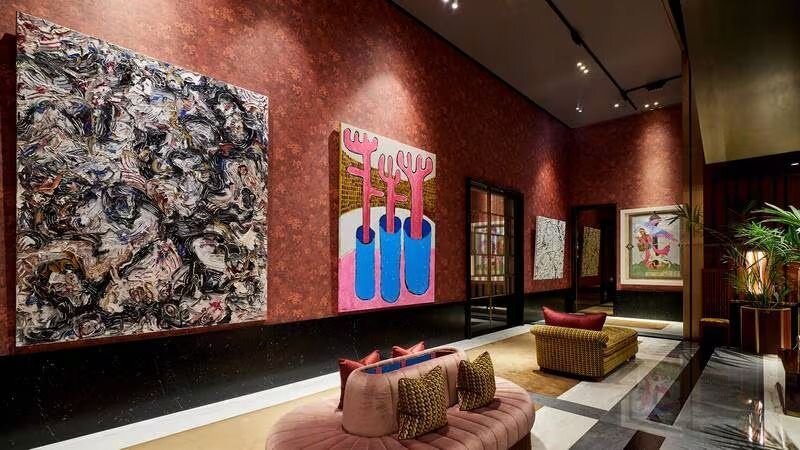
TEHRAN-The 8th Stairway Exhibition is underway at the Arts Club Dubai with works by renowned artists from the region selected from a collection by the Farjam Foundation, a private, non-profit, non-governmental organization.

Titled “Contemporary Middle East,” the exhibition showcases pieces by Middle Eastern artists whose works fall across a spectrum of styles, techniques, and aesthetics, Iran Art reported.

The Farjam Foundation is founded by Iranian art collector Farhad Farjam. Its collection encompasses Islamic, Middle Eastern, and Western art, including works that span from pre-Islamic times to contemporary pieces.

The selected pieces display the breadth of contemporary artists who have significantly contributed to the cultural dialogue and artistic landscape.

The exhibition features eight works spread across two floors alongside the stairway wall, two of which are by Iranian artists Farhad Moshiri and Siamak Filizadeh.

The conceptually rich work by internationally esteemed artist Moshiri, which has its roots in the pop art movement, subtly explores displacement, transformation, and socio-political commentary. The other Iranian artist Filizadeh combines traditional motifs with contemporary elements.

Born in Shiraz, the capital of Fars Province, Moshiri, 60, is currently based in Tehran. In his works, he addresses contemporary Iranian norms and traditions and simultaneously reflects on recent cultural developments in his homeland.

His artwork is rooted in pop art dialect with a subtle, subversive socio-political commentary. Moshiri’s richly embellished paintings and sculptures explore the intersection of Eastern and Western popular culture, the tension between traditional craft and contemporary art practice, and the malleable nature of identity.

His interest in pop art and kitsch resonates throughout his work. Many of his visuals are pulled from cartoons, films, comic strips, children’s books, and advertisements, while phrases appropriated from classical poetry, soap operas, and pop songs blur the lines between art and cliché.

By selecting ambiguous source images that reference both American and Iranian popular culture, Moshiri takes a complex look at how cultural identity is defined.

Born in Tehran, Filizadeh, 53, holds a BA degree in graphic design. In 1988, he started his career as a graphic designer, working in different fields of design, advertising, branding, and visual arts. He has been appointed as the art director and graphic designer for several large institutions and international festivals and has been awarded numerous prizes for the design of posters and books. 

He has held five solo exhibitions in Tehran and has been featured in group exhibitions in Tehran, Texas, Arkansas, Los Angeles, Chicago, New York, Rio de Janeiro, London, Dubai, Ogaki, and Yokohama.

Moreover, two Emirati artists are featured in the show; Ibrahim, considered an innovator of conceptual art in the Middle East since the 1980s, and painter Al Rais, known for his abstract aesthetic where he combines geometric shapes and Arabic calligraphy.

Tunisian-born artist Nadia Kaabi-Linke, who delves into her personal history of migration across cultures to create conceptual pieces, has one of the biggest pieces in the exhibition, 

Other artists in the exhibition include Lebanese painter and sculptor Marwan Sahmarani, known for his techniques using thick and expressive brushstrokes; and the Palestinian-American abstract artist Samia Halaby, who is recognized for her play with bold colors and geometric shapes.

The Arts Club was founded in London in 1863 to provide a haven for those with a professional or amateur relationship with the arts, literature, or sciences, and it has continued to welcome a community of discerning thinkers and thought leaders ever since.

The Arts Club Dubai is the first international outpost of the historic London private members’ club. Unveiled in 2020, the Club stands in Dubai International Financial Center, the heart of the city’s financial center.

“The Stairway Exhibition: Contemporary Middle East” will be on display at The Arts Club Dubai until February 25, 2024.


TAGS