Sunday, December 31, 2023

Top Iran, UK diplomats discuss Red Sea developments

Top Iran, UK diplomats discuss Red Sea developments

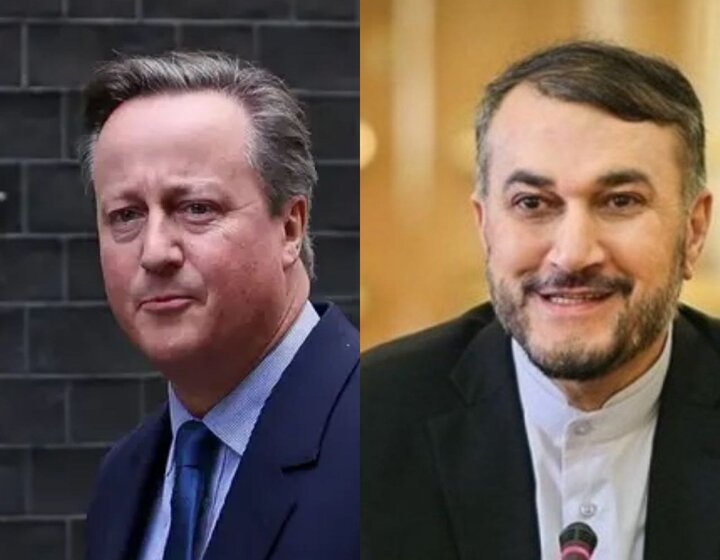
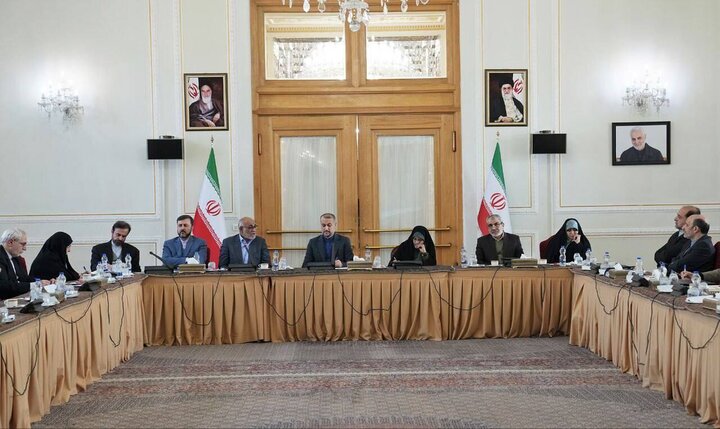
TEHRAN, (MNA) – British Foreign Secretary David Cameron announced that he has discussed the developments in the Red Sea with Iranian top diplomat Hossein Amir-Abdollahian on Sunday.

"I spoke to @Amirabdolahian today about Houthi attacks in the Red Sea, which threaten innocent lives and the global economy. I made clear that Iran shares responsibility for preventing these attacks given their long-standing support to the Houthis," Cameron wrote on his X account.

Earlier the British Secretary of State for Defence had alleged Iran of supporting the Yemeni armed forces and tried to link Iran with the recent developments in the Red Sea that occurred after the Gaza war.

Following the escalation of tensions in the Gaza Strip, the Yemeni armed forces announced that they would carry out attacks against the Zionist regime until the aggression against Gaza is stopped, and they will not allow any Israeli ships to travel in the waters of the Red Sea and the Bab al-Mandeb Strait.

Claims against Iran's role regarding the actions of the Yemeni armed forces come as the Resistance groups in the region act completely independently based on their own decision about the security of their countries or to support the oppressed Palestinian nation.

Honoring the Martyrdom Anniv. of Abu Mahdi Al-Muhandis, Hajj Qassem Soleimani and Their Companions

By Hashim Reza

Honoring the Martyrdom Anniv. of Abu Mahdi Al-Muhandis, Hajj Qassem Soleimani and Their Companions

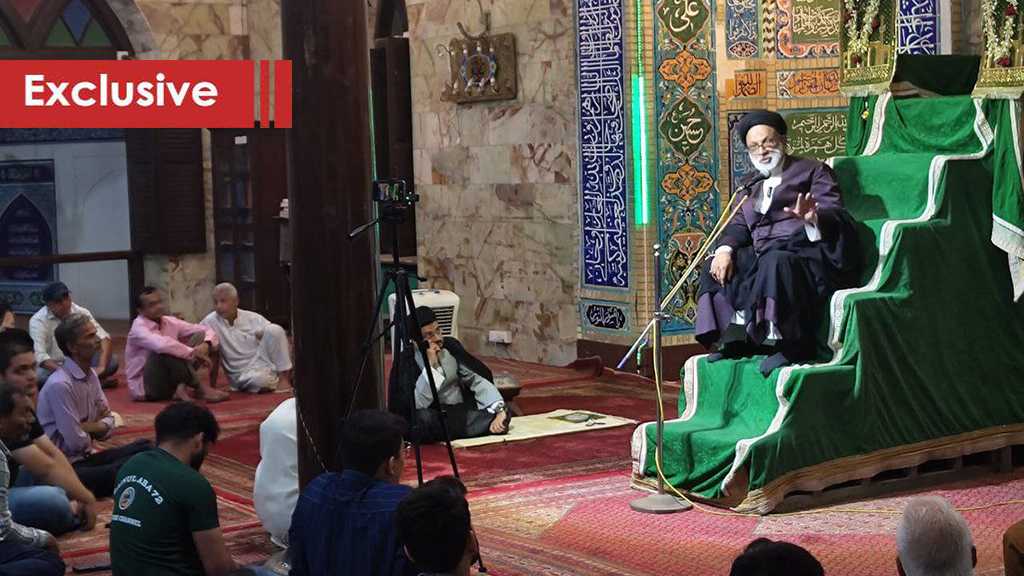
Mumbai, India – Held in various locations throughout Mumbai from December 29, 2023, to January 7, 2024, the Yaad e Shohada Program marked the martyrdom anniversary of Martyr Qassem Soleimani, Martyr Abu Mahdi al-Muhandis and their companions in a solemn manner. The purpose of the event, which was organized by a number of dedicated Mumbai organizations, was to commemorate the sacrifices that these respected individuals made in the name of justice and peace.

The program took place throughout a broad range of Mumbai's neighborhoods, in places including Andheri, Dongri, Jogeshwari, Navi Mumbai, Kalyan, Bhiwandi, Ambivali, Mira Road, Mumbra, and Kurla. These venues ensured that the message of reflection and remembering was felt throughout the city by providing a wide platform for the event.

Prominent speakers graced the occasion, offering wisdom and insights that deepened the remembrance. Maulana Syed Mohammed Askari of Delhi, Maulana Hasnain Rizvi Kararvi of Mira Road, Maulana Najeeb ul Hasan of Mumbai, Maulana Abid Rizvi of Jogeshwari, and Maulana Kamaal Ahmed Khan of Mumbra comprised the esteemed panel of speakers. Every speaker contributed a distinct viewpoint, enhancing the occasion with their extensive expertise and sincere contemplations on the selfless acts of the martyrs.

Through the successful fostering of unity and remembering, the program brought together individuals from many backgrounds. Participants in the events engaged in prayers, dialogues, and memorials, highlighting the significance of group commemoration and the martyrs' ongoing legacy.

As an honorable memorial to Martyr Qassem Soleimani, Martyr Abu Mahdi al-Muhandis and their comrades, the Yaad e Shohada Program concluded. The success of the event was determined by the community's significant participation and engagement as well as the variety of sites it covered. All of those present were imbued with a sense of fortitude and dedication to justice by the martyrs' legacy, which never stops inspiring and uniting people.

Why martyr Soleimani called martyr of Quds?

Martyr of Quds /4

Why martyr Soleimani called martyr of Quds?

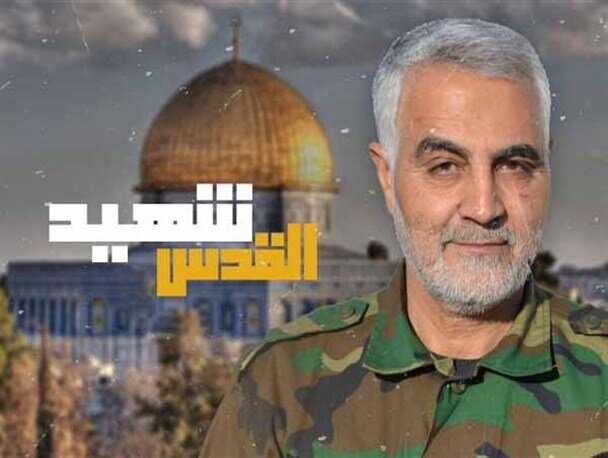
TEHRAN, (MNA) – It can be explained that the title "Martyr of Quds" was an indication of the priority of confronting the Zionist regime and is synonymous with "Quds Freedom" in the opinions of Martyr Soleimani.

Martyr Soleimani ; martyr of Quds

The importance of the role of Martyr Soleimani can be examined in different dimensions. As Iran's senior international commander, he has dealt with regional threats such as various crises in Iran's neighboring countries and terrorist threats that affected Iran's eastern and western borders after September 11, 2001. One of the most important roles of this commander is in confronting the occupation of the Zionist regime and liberating Quds. Ismail Haniyeh, the head of Hamas’s political office stated at the martyr's funeral, " Commander Martyr Soleimani gave his whole life in support of Palestine, and I declare that he is the great commander of Quds".
Apart from these words, it seems that the goals and actions of Martyr Soleimani were the most indicative of his status as Martyr of Quds.
 

Martyr Soleimani had revolutionary spirit in fight against occupation

A look at the principles and goals of the Islamic Revolution shows that confronting the Zionist regime was one of its main goals from the beginning. The principle of supporting the oppressed is considered an addendum to anti-arrogance and anti-tyranny. Based on this, the Islamic Republic, in parallel with the fight against arrogance and colonialism, considers itself obliged to support the oppressed of the world who are fighting against the arrogant. Imam Khomeini (RA)also stated that "we are in favor of the oppressed. whoever is oppressed in any pole, we are in favor of it".
Martyr Soleimani's revolutionary spirit in defending Quds is according to the statement of the leader of the revolution.

Martyr Soleimani considered fighting against the Zionist regime as the only solution to the Palestinian issue. At the ceremony of the 40th day of Martyrdom of Martyr Morteza Hosseinpour in 2017, referring to the need to resist the Zionist regime, he said "Palestine has no choice but to resist; It has no choice but to stand. There is no other way except sacrifice".
He also said at the martyrdom ceremony of Imad Mughniyeh in February 2018 "Today, Gaza and Lebanon are constant sources of anxiety for Israel, and every missile fired from Palestine can be seen with Imad Mughniyeh's fingerprints."

In a statement addressed to the commander of the Qassam forces, Soleimani wrote "Assure everyone that Islamic Iran, no matter how much the pressures increase and its siege tightens, will not leave Palestine alone".
"Defending Palestine is a matter of honor and we will never give up this religious duty in exchange for the luxuriance of this world. Defending Palestine is a real example of defending Islam and the Quran", he noted.
 

Martyr Soleimani perceives Quds as main conflict between Islam, West

Another feature that depends on the role of Martyr Soleimani as Martyr of Quds is the importance of the Palestine issue for him. Martyr Soleimani was the commander of the Quds Force as part of the foreign policy of the Islamic Republic, but he considered the issue of Quds and Palestine not a foreign policy issue, but a religious issue related to the entire Islamic world.

The Islamic Jihad Secretary General Ziad Al-Nakhale, says that the occupied city of Quds was always in the heart of General Soleimani, and in all the battles in which Martyr Soleimani was present in the region, the compass was the Quds War; Because the goal was to maintain resistance.

Martyr Soleimani said in a speech "All our fights in the Islamic world with the West are over a mosque. All our unity in the Islamic world is based on one mosque. All this war is over Al-Aqsa Mosque. All these conspiracies around the Islamic world are based on this mosque, and everything that could and can unite the Islamic world is a mosque."

Martyr Soleimani leads mission of Quds Force towards issue of Palestine

Martyr Soleimani fulfilled the goals of the Quds Force in the form of the orders of Imam Khomeini (RA) and the leadership of the revolution in line with the main goal of confronting the Zionist regime as the main threat against the Islamic Republic and the Islamic world from the beginning of his activity as the commander of the Quds Force in 1997 until his martyrdom on January 3, 2020.

The purpose of the Quds Force before his command was more focused on directly confronting concentrated threats. While during the period of General Soleimani, these actions gradually led to overlap with the goals of the Resistance. Since Soleimani's martyrdom, his actions in the Palestine issue at the beginning of his tenure in the Quds Force received more attention.

General Hassan Ravandeh considers devoting to Quds Day and being in the front line of the resistance as the two most important actions of the martyr. He says that the first important action of Martyr Soleimani was to pay special attention to the celebration of International Quds Day, noting that during his 23 years as a commander in the Quds Force, he paid special attention to the celebration of International Quds Day and personally followed the programs of the Quds Day in all parts of the world. 
The second action was to be on the front line of the fight against the Zionist regime, he stated, pointing out that before the presence of General Soleimani in the Quds Force, they did not have any serious military work, and all actions were defensive and security, but with the arrival of General Soleimani as the commander of the Quds Force, the shape and image of the work changed and with an extensive visit to the resistance area, he checked the facilities personally.

Equipping Palestinians

"Filling the hands of the Palestinians", is an interpretation by the Leader of the Islamic Revolution and is the most telling proposition for the actions of of Martyr Soleimani in the Palestinian issue.
One aspect of this proposition is military support for the Palestinian Resistance. The result of Martyr Soleimani's support for Palestine and Quds is that Hamas has access to conventional weapons such as kornet missiles, suicide drones, and remote control equipment.

In the Al-Aqsa Storm Operation, the equipping tunnels and missile launch systems failed the Zionist regime in many attacks on these targets.

After the martyrdom of General Soleimani, the Secretary General of Islamic Jihad said "This issue was like a miracle and it was very difficult in terms of technical, security, and feasibility, but in the end, the weapons sent by General Soleimani to the Gaza Strip, with the same missiles, opened the way for the bombing of Tel Aviv".

Another aspect of this "filling the hands of the Palestinians" includes the unity of the power of the Resistance groups around the issue of Palestine and Gaza. Soleimani not only upgraded the operational capacity of the Palestinian forces from stone to modern weapons, including the ability to build rockets but also used the entire geography of the Resistance to defend Al-Quds.

The Resistance groups, which were separate parts until a decade ago, in recent years have become a coalition with specific goals, the result of which was to establish a balance of terror against the Zionist regime. It is in this direction that the Al-Aqsa Storm Operation has faced the support of Iraqi groups, Lebanese Hezbollah, and the Yemeni National Army.

Conclusion

In general, it should be said that the title "Martyr of Quds" was an indication of the priority of confronting the Zionist regime and is synonymous with "Quds Freedom" in the opinions of Martyr Soleimani. Martyr Soleimani put confronting the regime's occupation at the top of his agenda with the spirit born from the Islamic Revolution. Also, within the framework of the general goals of the decision-makers of the Islamic Republic's establishment, the mission of the Quds Force was focused on providing weapons support to the Palestinian groups Hamas and Islamic Jihad.

Reported by Mehr News Agency

Martyr Soleimani revived Resistance Front in region: Leader

Martyr Soleimani revived Resistance Front in region: Leader

TEHRAN, (MNA) – The Leader of the Islamic Revolution Ayatollah Seyyed Ali Khamenei says the revival of the Resistance Front was the most important service of Martyr Soleimani in the region.

Ahead of the fourth anniversary of the martyrdom of Lt. General Qassem Soleimani and Abu Mahdi al-Muhandis, Leader of the Islamic Revolution Ayatollah Seyyed Ali Khamenei met with the family of Martyr Soleimani.

Revival of the Resistance front in the region was the most important role and service of Martyr Soleimani, the Leader of the Islamic Revolution said in this meeting.

Hailing the struggles of the Resistance forces in recent months, the Leader said, "Martyr Soleimani made a lot of efforts to revive the Resistance Front and he carried out this work with the same sincerity and wisdom and ethics."

Ayatollah Khamenei praised and appreciated the efforts of the IRGC Quds Force commander, Brigadier General  Esmail Qaani, and said, " The path of strengthening the Resistance Front should be continued."

In this meeting, Zainab Soleimani briefed the Leader on the measures taken regarding the transfer of thoughts of Martyr Soleimani to the young generation.

Harming Resistance to cost US, Israel dearly: Ghalibaf

Harming Resistance to cost US, Israel dearly: Ghalibaf

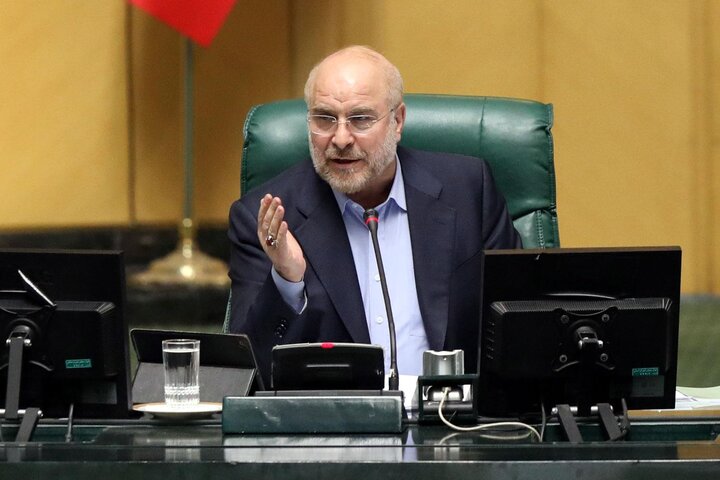
TEHRAN, (MNA) – The speaker of Iran’s Parliament warned the US and the Zionist regime that inflicting any harm on the resistance front will come at a price.

Addressing a parliamentary session on Sunday, Mohammad Bagher Ghalibaf offered his condolences on the loss of General Seyed Razi Mousavi, an Iranian anti-terror adviser who was martyred in an Israeli missile strike in the suburbs of Damascus on December 26.

“I should emphasize that any act of aggression against the commanders or the physical infrastructures of the resistance (front) will cost the US and the Zionists dearly,” he warned.

Denouncing the Israeli onslaught on Gaza, Ghalibaf said the more the Zionist regime commits crimes, the closer it will get to defeat.

He also echoed the stances of the “courageous leaders of the Palestinian resistance” that no ceasefire will be acceptable unless the Israeli strikes come to a complete halt and all Palestinian prisoners are freed in exchange for the release of Zionist captives.

Nearly 22,000 people have been killed and over 56,000 injured in Israeli attacks on Gaza since October 7.

The Israeli bombardments have destroyed 70 percent of homes in Gaza, where 1.5 million people have been left homeless.

Iran's FM urges ending West's use of UNHRC as instrument

Iran's FM urges ending West's use of UNHRC as instrument

TEHRAN, (MNA) – Iran’s Foreign Minister Hossein Amir-Abdollahian has called for the cessation of instrumental use of the United Nations Human Rights Council by some Western countries.

Amir-Abdollahian said on Sunday that the human rights claims by some Western countries against the Islamic Republic of Iran lack any legal and moral validity.

He said that the mechanisms imposed by human rights institutions and under the pressure of a few Western countries against the Islamic Republic of Iran have no legal justification and legitimacy.

He referred to the ongoing genocide in Gaza, the violation of Palestinians' rights over the last 8 decades, and the comprehensive support of the United States and the West for the occupation and apartheid of the Zionist regime.

At 100 years, the Treaty of Lausanne still provides a powerful lesson

A century later, the peace treaty is still in force and continues to have a profound impact on Turkey and beyond

Hamza Karcic

Republican People's Party members participate in the Great Youth March at the mausoleum of Mustafa Kemal Ataturk on Ataturk, Youth and Sports Day, an annual national holiday commemorating the Turkish War of Independence, in Ankara, on 19 May 2022 (AFP)

Monday, 24 July, marks 100 years since Turkish representatives of the Ankara government and the Allied Powers signed a treaty in Lausanne, Switzerland. A century later, the treaty is still in force and continues to have a profound impact on Turkey and beyond.

As the First World War came to a close in late 1918, European powers sought to deal a final, fatal blow to the "sick man on the Bosphorus" - as the Ottoman Empire had been referred to in its waning days.

The armistice signed at Mudros on the island of Lemnos on 30 October 1918 provided for an Ottoman surrender and set the stage for Allied occupation and partition of Ottoman lands.

For the first time since Sultan Mehmed II conquered Constantinople in 1453, the city came under foreign occupation. BritishFrench and Italian troops marched into Istanbul.

Sparking a resistance

The Mudros Armistice, signed on 30 October 1918, achieved Ottoman surrender and paved the way for worse to come. It further sparked Turkish national resistance to the Allied occupation which continued through the establishment of the Republic of Turkey.

The approach of the Allied Powers was to carve up what remained of the Ottoman Empire through a humiliating treaty. The infamous Treaty of Sevres, signed on 10 August 1920 by an Ottoman delegation and the Allied Powers, imposed exceptionally punitive measures.

Apart from achieving Allied interests, which included occupying any part of the Ottoman Empire, Sevres aimed to do away with Turkish sovereignty and allocated large parts of the Turkish homeland for GreekArmenian and Kurdish territorial ambitions.

The detailed treaty comprising 433 articles stands as a shameful document that sought to partition, subjugate and dispossess the Ottoman territories.

While the Istanbul government signed the Treaty of Sevres, the Turkish national liberation movement led by Mustafa Kemal Pasha (later Ataturk) rejected it. The Grand National Assembly, which was established on 23 April 1920 with its seat in Ankara and played a crucial role in the Turkish War of Independence, rejected Sevres in August 1920 and it was never ratified.

The Istanbul government issued what became known as the Istanbul Fatwa, declaring the nationalist forces in Anatolia as "rebels" who threatened the Caliphate and must be fought. Islamic scholars and officials who were supportive of the nationalist forces, however, issued a fatwa of their own. Known as the Ankara Fatwa, the mufti of Ankara, Rifat Borekci, who had been an early supporter of the national resistance, responded on religious terms, claiming that the capital had been under foreign occupation by "enemies of Muslims" and that the caliph's judgement had been compromised.

Much earlier, Mustafa Kemal Pasha had seen the writing on the wall. He set sail from Istanbul for the Black Sea town of Samsun in May 1919 to lead the national resistance movement.

In Anatolia, he provided leadership, organisation and strategic vision to the various resistance organisations that emerged.

A lasting legacy

The War of Independence, which lasted from May 1919 to October 1922 marked a key event in Turkey's history. By rejecting Sevres, nationalist forces embarked on a liberation struggle to rid their land of occupying forces. The result was an armistice signed at Mudanya in the Marmara region in October 1922, which paved the way for a new peace treaty the following year.

'Sevres Syndrome' has become a popular belief in Turkey to describe the practice of western powers imposing double standards on the country and meddling in its affairs

Mustafa Kemal Pasha appointed Ismet Inonu, his top military commander and future successor, as the head of the Turkish delegation at Lausanne. The conference began in late November 1922 and lasted intermittently through July of the next year. Ankara's primary objective was Turkish independence and sovereignty. In other words, it sought the abrogation of Sevres.

During the conference, Turkey and Greece came to an agreement with far-reaching consequences.

The population exchange agreement stipulated in Article 1: "As from the 1st May 1923, there shall take place a compulsory exchange of Turkish nationals of the Greek Orthodox religion established in Turkish territory, and of Greek nationals of the Moslem religion established in Greek territory." The exceptions, as stated in Article 2, were "the Greek inhabitants of Constantinople" and "the Moslem inhabitants of Western Thrace". It is estimated that around two million people left their homelands to resettle in new ones as a result of this agreement.

The Lausanne Treaty marked the culmination of the Turkish War of Independence. With the Ottoman Empire on the losing side in World War I, the Allied Powers resorted to partition and occupation.

Sevres became a symbol which, more than 100 years later, is present in public discourse in Turkey and beyond. In fact, "Sevres Syndrome" has become a popular belief in Turkey to describe the practice of western powers imposing double standards on Turkey and attempting to meddle in the country's affairs.

It was only after the Turkish national resistance movement achieved military victories on the ground from 1919 to 1922 that a repeal of Sevres came about. This is the enduring lesson of 100 years ago. Lausanne is equally significant for what the late BBC journalist Andrew Mango noted in his book, From Sultan to Ataturk: "Of all the treaties concluded after the Great War, the Lausanne Treaty alone has survived."

A century later, Lausanne offers a simple but powerful lesson. It is not principles or norms that determine the outcomes of diplomatic negotiations and the substance of peace agreements, but facts on the ground. That was the case in 1923 and remains so today. 

Hamza Karcic
is an associate professor at the Faculty of Political Science, University of Sarajevo.