Showing posts with label siezing the Grace 1 vessel in Gibraltar. Show all posts

Friday, August 02, 2019

WHY DID THE UK COMMANDER OF HM MONTROSE REFRAIN FROM FIRING ON THE IRGC? WHO IN IRAN GAVE ORDERS TO CAPTURE THE “STENA IMPERO”?

Iranian IRGC Naval unit onboard of the British-flag tanker
“Stena Impero
“.
By Elijah J. Magnier
The US officially asked Europe, in particular the UK, France, Germany and Italy, to provide a naval force to patrol and protect ships sailing in the Straits of Hormuz, even if the command and control is handled by the Europeans and not the US. Washington wants to drag the old continent into the front line in case of a military confrontation with Iran. It is well known that the US is behind the existing tension in the Middle East today following its unlawful unilateral withdrawal from the Joint Comprehensive Plan of Action (JCPOA), known as the nuclear deal. However, to the dismay of the US, Europe has up to now refused to follow the US path. The US would like to see Europe more involved. Although the Trump administration is not looking for war, despite the fact that Iran turned its missiles against the UK Royal Navy HMS Montrose and the US destroyers (when the Iranian Revolutionary Guard Corps confiscated the British-flag tanker Stena Impero). This is the reason that the British command chose to avoid a military confrontation and decided against a military intervention to protect the tanker.
“I order you not to intervene in my operation. The tanker is under my control. Do not put your life in danger”. This is exactly what the Iranian IRGC naval officer told the commander of the Foxtrot 236 when Iranian special forces were about to board the tanker Stena Impero. But why would he warn the British Navy “not to risk their lives”?
The British Navy’s radar sweeps had discovered active mode missiles radar tracking them by means of their semi-radar homing from different launch platforms- main radars which could easily create a saturation attack designed to put the ship in a helpless position and eventually destroy it. The Iranian missiles were ready to firehad the commander of the UK vessel decided to engage with the Iranian fast boats.
Iranian missile platform launchers spread all along the Iranian coast overlooking the Straits of Hormuz had the four US vessels and the one UK naval ship in their sights, ready to engage. Other Iranian armed drones were in the air, also ready to engage, waiting for orders to dive on their selected targets. Iran has not revealed, to date, other more sophisticated missiles that it has manufactured and could put in service in case of war.
The UK commander of the Foxtrot 236 Royal Navy decided to let go of Stena Impero and allow the diplomacy of his government to take over, to avoid the potentially serious casualties inevitable in the case of a military confrontation.
However, the British government is insisting on saving face. It therefore has to reject any exchange of tankers. The Royal Navy had already confiscated an Iranian supertanker, Grace 1, in Gibraltar. London pushed even further the conflict with Iran when the Gibraltar court extended by one additional month the arrest of the Iranian supertanker following a US request.
The only plausible solution is for the Gibraltar court to refrain from adding more fuel to the ongoing crisis and to end the detention of Grace 1, once the period of one month is reached.This will enable Iran to release Stena Impero from Bandar Abbas harbour and end the crisis.
Why did the IRGC officer order the British commander to keep away even if the HMS Montrose was within a reachable distance, along with another four US frigates, well-armed and potentially ready to engage?
When the British authority decided to extend the arrest of “Grace 1”, it basically ended the initiative of Emanuel Bonne (the French presidential envoy) to obtain the release of the Iranian super tanker. The UK’s decision to undermine its European partner’s initiative and abide by US policy showed the vulnerability of Europe’s fragile unity. London agreed to be an instrument of Trump’s policy.
This is when the Iranian Leader Sayyed Ali Khamenei ordered the commander of the IRGC Hussein Salameh to stop the first British ship and retaliate with a tit-for-tat. Following a meticulous overview of all ships navigating in the area, Salameh was informed about the Stena Impero, but also about the five western military ships in the vicinity. The IRGC commander informed Sayyed Khamenei who responded, according to a well-informed source: “Go with God’s blessing and have no fear. They will not dare to attack us”. 
This is how the decision was taken, at the highest level of the Iranian leadership where the spiritual, military and political leadership were involved under the flag of “protecting the national interest and security of the country.” 
Notwithstanding the UK position, Europe will not accept the US trap and become a shield for a war Washington would like to impose on the continent. British oil companies are changing the registrations of their ships and removing the British flag so as to sail safely through the Straits of Hormuz. BP, the giant British oil company which was the first to follow this procedure, is avoiding sending ships to the region, relying instead on proxies. This is a flagrant manifestation of its lack of trust in its own government’s decision, which is not in the interests of the UK but instead reflects a servile devotion to Trump administration policy. 
There is a war risk premium that tanker owners pay when navigating in the Persian Gulf. They now have to pay an additional $185,000 for supertankers, in the wake of the attacks of recent months.
The IRGC has sent many messages by shooting down a US drone, by sabotaging tankers and by capturing another. They come down to a single message: if Iran does not export its oil, no country will. The arrival of a new UK Royal Navy ship, the HMS Duncan, will change nothing: it will add to the bank of objectives and list of Iranian targets available in the Persian Gulf in case of war. The US decision to revoke the nuclear deal not only made the Middle East less safe, but also has brought Russia further into the warm waters of the region: Iran has announced a joint naval exercise with Russia in the next months. Iran is bringing the Russians into what used to be the US’s “water playground”. Obviously, Washington’s “maximum pressure” is failing to produce the results the Americans predicted.
As long as Trump is in power, the situation in the Middle East will not stabilise. Not many people in the world believed the Secretary of State Mike Pompeo when he said the US sanctions are crippling Iran by up to 95%, and that Iran’s Middle Eastern influence is seriously affected by the US measures.
Iran is defying US hegemony and is ready for war, openly challenging the US and the UK. Tehran is welcoming Chinese and Russian support and is developing its missile capability to compensate for its lack of superiority in the sea and the air.
Iran counts on its missiles to impose its Rules of Engagement and is challenging both the US superpower and the UK with its imperial tradition.
The US is no longer in a position to dictate to Iran and “cut its nails”. Tehran is developing further its missile technology and nuclear capability. It is ready for the next step, which involves further partial withdrawal from the nuclear deal despite France and Germany’s efforts to proclaim their distance from the US attitude. The world will continue to focus on this part of the world, watching with anxiety how the US-Iran confrontation will unfold.

Friday, July 26, 2019

Iran – Seizure of a British Tanker – more than Tit for Tat

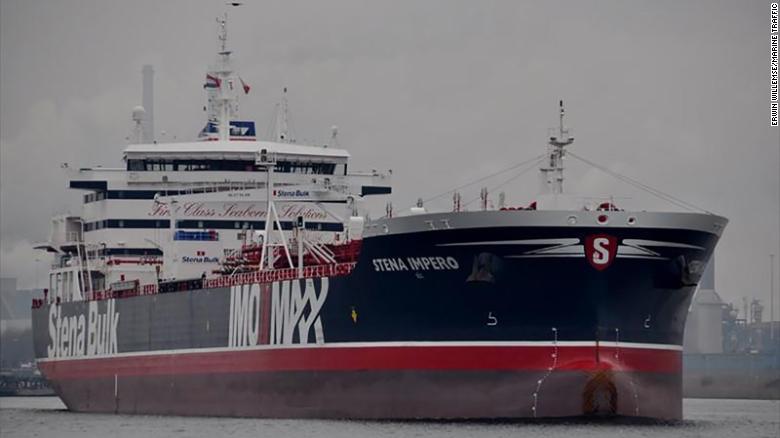
The British-flagged tanker “Steno Impero”, heading for Saudi Arabia, was seized on Friday, 19 July 2019, by the Islamic Revolutionary Guard Corps (IRGC), in the Strait of Hormuz, after it rammed an Iranian fishing boat, whose distress call it ignored.
The tanker was taken to an Iranian port, because it was not complying with “international maritime laws and regulations,” Iran’s Revolutionary Guard said. Most importantly, the ship did not respond to several warnings from helicopters and Iranian boats, as apparently it turned off its transponder. How could that happen under control of professional sailors, other than as an open provocation.
Shipping safety in the Strait of Hormuz is crucial. Between 20% and 30% of the world’s hydrocarbons are shipped through this narrow passage of international water way before entering the Gulf of Oman. The strait is closely watched by Iran, as it is of utmost security concern for Iran.If this passage were to be closed due to conflict, it could bring down the world economy.
Do those that play these provocations, the UK as a handler dancing to the strings pulled by of Washington, realize what’s at stake? – Do they want to bring the Middle East to the brink of war? A regional war that could easily convert into a world war? – That may well be the longer-term intention. In the short-run, though it looks like pushing the escalation to a point where US ‘Client Europe’ may be discouraged from insisting on maintaining their part of the Iran Nuclear deal, or the Joint Comprehensive Plan of Action (JCPOA), and to blackmail Iran into a bilateral negotiation with the US on Iran’s nuclear program.
The first objective may be achieved; the second – no way. Iran is not falling for such fraud, especially with the country that pulled unilaterally out of the deal that was negotiated for two years (since November 2013) before it was signed in Vienna, Austria on 14 July 2015, by the 5+1 (the five permanent members of the UN Security Council – China, France, Russia, UK and US – plus Germany  – and the European Union, and of course Iran).
Not only did President Trump, guided by his buddy, Israel’s Netanyahu, tear up the agreement unilaterally, but he also reinstated one of the most severe economic sanctions programs on Iran, plus all the western lies and smear propaganda launched against Iran. It is sheer insanity to believe that Iran would under these circumstances go to the negotiating table with her hangman. That will not happen. But war tensions are being further raised which is fully in the direction of the war criminal-in-chief, John Bolton’s dream, ever since the invasion in 2003 of Iraq which he also helped to engineer. It is like this sick man’s raison d’ĂȘtre. Mass killing by war and conflict is in his genes. The world can only hope that Trump, or those who pull the strings behind Trump, will eventually dismiss Bolton.

Iran has already said that they will launch a full investigation into the British tanker’s, Steno Impero’s, sailing off course and ramming a fishing boat – and that the UK is invited to participate in the investigation.

Backtracking to 4 July, when the British Royal Marines seized the Iranian tanker Grace 1 in Spanish waters, off the coast of Gibraltar, under the pretext that the super tanker was carrying oil destined for Syria which was under the EU’s sanction program. Iran’s Foreign Minister Javad Zarif, denied that the oil was destined for Syria; did however not elaborate further.
Spanish Foreign Minister, Mr. Josep Borrell, said that Washington informed Spain about the impending capture by the UK of the Iranian tanker in Spanish territorial waters. Spain could have said ‘no’ – but didn’t. Why not? Afraid of sanctions?
The UK did the bidding of Washington against her own interests, because the UK was one of three EU countries – Germany, France and UK – who at least made appear as if they wanted to preserve their part of the Iran Nuclear Deal. Mind you, this is not for love of Iran, but pure business interest. Iran should be aware of that – meaning, Iran could be shot in the back at any time by the EU, by the very countries that try – or make appear they try – to circumvent the US sanctions.
What happened on 4 July was an act of sheer piracy, nothing less. A crime on high seas which the west just tolerated. The vessel is still under British control, while the arrested crew has since been liberated. Aside from the fact that Iran’s capture of the British oil tanker may look like tit for tat – Iran acted fully legitimate, as it’s Revolutionary Guard is policing the Strait of Hormus for security of other ships sailing through the narrow passage.
In one of his typical outbreaks of a madman, President Trump warned in a televised ‘fire and fury’ speech at the white House on Friday 19 July, “We have the greatest ships – the most deadly ships, we don’t want to have to use them. We hope for [Iran’s] sake they don’t do anything foolish. If they do, they will pay a price like nobody’s ever paid.”

Why would Trump not use the same language to warn the Brits for their pirating an Iranian vessel in Spanish waters? – well, we know this is the crazy, unbalanced and off-kilter world we live in. Its so normal, people in the west take this imbalance and injustice, this double-talk and hypocrisy as the gospel.

All indications are however, while building up a war scene, the US are seeking justification for what they had already called out – an alliance of the willing to send war ships to the Straight of Hormus to assure safe passage for ‘everybody’. Well, this would certainly not fly with Iran. But important to know is what’s behind this idea. Imagine the US navy and her puppet allies controlling the sea passage through which almost a third of all the world’s hydrocarbon sails every day – Washington would have one more tool to sanction, strangle countries they feel do not bend enough to Washington’s dictate. Their oil shipment would be withheld, to bring their economy down – this might be the most effective weapon yet.
World beware! Even those who are in favors with the self-declared hegemon, you never know when the pendulum may swing the other way, simply because the Israel-driven US of A may be on a whim aggression course against an imaginary enemy, or corporate interests are shifting — in conclusion nobody would be safe – and, the world economy could come crashing down, like a house of cards, making 2008 look like a walk in the park.
Peter Koenig is an economist and geopolitical analyst. He is also a water resources and environmental specialist. He worked for over 30 years with the World Bank and the World Health Organization around the world in the fields of environment and water. He lectures at universities in the US, Europe and South America. He writes regularly for Global Research; ICH; RT; Sputnik; PressTV; The 21st Century; TeleSUR; The Saker Blog, the New Eastern Outlook (NEO); and other internet sites. He is the author of Implosion – An Economic Thriller about War, Environmental Destruction and Corporate Greed – fiction based on facts and on 30 years of World Bank experience around the globe. He is also a co-author of The World Order and Revolution! – Essays from the Resistance

Peter Koenig is a Research Associate of the Centre for Research on Globalization.

Monday, July 15, 2019

Iran vs. Spineless Europe. How far will US-western Threats Go?

By Peter Koenig
July 14, 2019 "Information Clearing House" -  Iran’s Foreign Minister, Javad Zarif, tweeted that
“All such steps are reversible only through E3 compliance. Having failed to implement their obligations under JCPOA – including after the US withdrawal – EU/E3 should at a minimum politically support Iran’s remedial measures under Para 36 [of the JCPOA], including at the International Atomic Energy Agency (IAEA).” Mr.Zarif added, “E3 have no pretexts to avoid a firm political stance to preserve JCPOA and counter U.S unilateralism.”
IAEA’s Director General, Yukiya Amano has informed the Board of Governors that the Agency verified on 1 July that Iran’s total enriched uranium stockpile exceeded the deal’s limit, and that Iran was in breach of the agreement.

But that is not true. There is no breach. Foreign Minister Zarif, rightly pointed out that Iran’s amassing more enriched uranium than permitted under the deal, was not a violation. Iran was exercising its right to respond to the US unilateral withdrawal from the pact a year ago, to the E3 not honoring their part of the deal, and to Washington’s imposed totally illegal and unjustified punishing sanctions on Tehran.

Zarif confirmed Iran’s action and why, by tweeting,
“We triggered and exhausted para 36 after US withdrawal. Para 36 of the accord illustrates why. We gave E3+2 [also including Russia and China] a few weeks, while reserving our right. We finally took action after 60 weeks. As soon as E3 abide by their obligations, we’ll reverse.”
Mr. Zarif is absolutely right. Here is what the famous para 36 of the JCPOA says:
Disputed Resolution Mechanism
36. If Iran believed that any or all of the E3/EU+3 were not meeting their commitments under this JCPOA, Iran could refer the issue to the Joint Commission for resolution; similarly, if any of the E3/EU+3 believed that Iran was not meeting its commitments under this JCPOA, any of the E3/EU+3 could do the same. The Joint Commission would have 15 days to resolve the issue, unless the time period was extended by consensus. After Joint Commission consideration, any participant could refer the issue to Ministers of Foreign Affairs, if it believed the compliance issue had not been resolved. Ministers would have 15 days to resolve the issue, unless the time period was extended by consensus. After Joint Commission consideration – in parallel with (or in lieu of) review at the Ministerial level – either the complaining participant or the participant whose performance is in question could request that the issue be considered by an Advisory Board, which would consist of three members (one each appointed by the participants in the dispute and a third independent member). The Advisory Board should provide a non-binding opinion on the compliance issue within 15 days. If, after this 30-day process the issue is not resolved, the Joint Commission would consider the opinion of the Advisory Board for no more than 5 days in order to resolve the issue. If the issue still has not been resolved to the satisfaction of the complaining participant, and if the complaining participant deems the issue to constitute significant nonperformance, then that participant could treat the unresolved issue as grounds to cease performing its commitments under this JCPOA in whole or in part and/or notify the UN Security Council that it believes the issue constitutes significant non-performance.
The provocations by the west seem to be inexhaustible. On Thursday, 4 July, the UK, ordered by Washington, has seized an Iranian oil tanker which they suspected of carrying oil for Syria. Al Jazeera reports:

“British Royal Marines, police and customs agents on Thursday [4 July] stopped and seized the Grace 1 vessel in Gibraltar on suspicion it carried Iranian crude oil to Syria in breach of European union sanctions against President Bashar al-Assad’s government.”
Foreign Minister Zarif tweeted that UK’s unlawful seizure of a tanker with Iranian oil is piracy, pure and simple. Iran denied that the tanker was bound for Syria’s Baniyas refinery – which does not even have the capacity for such a super tanker to dock, says Iran’s deputy foreign minister, Abbas Araghchi. He did not elaborate on the final destination of the super tanker.

It is clear, the UK, in connivance with its transatlantic empire, does the bidding for Trump’s warrior team, Bolton and Pompeo. – How much farther will they go, the provocateurs? Do they want to incite war with Iran, a retaliatory action, like Iran seizing a UK tanker in return – so as to ‘justify’ a western, possibly Israeli, aggression on Iran, with a counter attack by Iran, triggering a direct intervention by Washington – of course, in defense of Israel – and a major conflict, possibly nuclear, might erupt?
Iran most likely will not fall into this trap. But the question must be asked, how far will the US-western threats, sanctions and physical aggressions go?
This morning, 10 July, RT reports,
“The latest out of Washington is that the US is looking to put together a “coalition” that would “ensure freedom of navigation both in the Straits of Hormuz and Bab al-Mandeb,” as Chairman of the Joint Chiefs of Staff General Joseph Dunford said on Tuesday. These are the waterways connecting the Persian Gulf to the Gulf of Oman, and the Red Sea to the Gulf of Aden, respectively.”
What this “freedom of navigation” means, is outsourcing naval blockade and wester piracy of Iranian oil tankers. And that in the 21st Century. How deep can you, WEST, fall to go for this kind of high sea crime practiced centuries ago? Your moral and ethical deterioration is accelerating rapidly into a bottomless black hole from where there is no return.

There is no question, that Iran does not seek to become a nuclear power, that was never the intention in the first place as was attested already almost ten years ago by the American 16 foremost intelligence agencies, but Iran wants to use its nuclear power generation capacity more efficiently – and that is their full right, especially if the Nuclear Deal is broken. The saber rattling, fear mongering and sanctions are meant to intimidate and punish Iran for not bending to the tyranny of Washington – mainly changing regime and hand over Iran’s riches to the US-western corporatocracy.

What it boils down to is whether the E3 – Germany, France and the UK – have sufficient backbone to go ahead on their own, honoring the JCPOA accord, and whether they and the European Union as a whole, would be willing and sovereignly capable of defending their companies from US sanctions, if they start trading with Iran. This is the question that many European corporations are already asking, especially European oil corporations.

At one point, there seems to have been political will by Europe to circumvent the US sanctions regime by introducing a special payment method, called the Instrument in Support of Trade Exchanges (INSTEX) which would allow companies in Europe to do business with Iran outside the US-and dollar-dominated SWIFT payment system.However, this works only, if the EU stands up for their companies defending them from US sanctions. Otherwise, as Pompeo already hinted,
“We will simply sanction all companies that use INSTEX.”
In the long run there are three realities to keep in mind.
First, US sanctions will not go away, unless the rest of the world stands up to the US and sanctions them back, in other words stops trading with the US and uses different payment modes than SWIFT and the US-dollar, for example, local currencies, or yuan and ruble through the Chinese International Payment System (CIPS), or the Russian MIR system (MIR – meaning, world, or peace), introduced by the Bank of Russia in 2015 and which is also opening up to worldwide use.

Second, it is only a matter of time until the Europeans, either as a union or as individual countries will realize that trading with the East – Russia, China and all of the huge mega-Continent of Eurasia which also includes the Middle East, is the most natural trading that can be. It has existed for thousands of years, before the ascent of the AngloZionist empire, some 300 years ago. There is no division of seas. It is a contiguous landmass. And everybody from other continents is welcome to join, peacefully, without the intention of domination and ransacking natural resources.

Third, this second reality will be enhanced and accelerated by China’s Belt and Road Initiative (BRI), also called the New Silk Road – which makes already significant inroads with peoples connecting infrastructure – roads, railways, maritime routes – plus industry, education, research and cultural connections and bridges along the BRI-routes. BRI will very likely become the future for connecting humanity with equitable socioeconomic development for decades to come.

Therefore, Iran may seriously consider dropping for now her ambition to trade with the west – the west is a sinking ship. And instead look to the East for the future. It may mean temporary losses – yes, but so what – the future is not composed of a pyramid of fake dollar-based instant profit – but of foresight and vision. Iran is on the right track by aspiring and most likely shortly entering the Shanghai Cooperation Organization (SCO) as a full-fledged member. But, yes, it means dropping the west for now – until the west sees the light on her own.

 Peter Koenig is an economist and geopolitical analyst. He is also a water resources and environmental specialist. He worked for over 30 years with the World Bank and the World Health Organization around the world in the fields of environment and water. He lectures at universities in the US, Europe and South America. He writes regularly for Global Research; ICH; RT; Sputnik; PressTV; The 21stCentury; TeleSUR; The Saker Blog, the New Eastern Outlook (NEO); and other internet sites. He is the author of Implosion – An Economic Thriller about War, Environmental Destruction and Corporate Greed – fiction based on facts and on 30 years of World Bank experience around the globe. He is also a co-author of The World Order and Revolution! – Essays from the Resistance. He is a Research Associate of the Centre for Research on Globalization.