Showing posts with label karbala. Show all posts

Sunday, October 20, 2019

Despite media bias, Western people have right to authentic information on Arbaeen

By Afshin Majlesi

Mass media outlets, including news agencies, radio, television, the Internet and mobile platforms, have undoubtedly become the primary source of information for the majority of, if not all, individuals in modern societies.
Thus, they can gain a weighty influence to shape a dominant culture, perception or belief in a society by pursuing hidden agenda, which is left implicit in their discourse.
Monitoring Western media, in particular the British and the U.S. ones, in the span of the past ten years, show that they have substantially paid little attention to the Arbaeen pilgrimage, which is regarded as the world’s largest annual public gathering on earth.
From a journalistic point of view, the pilgrimage bears adequate news values including impact, magnitude and bizarreness for coverage but we simply realize that the event is underrepresented or misrepresented.
In their portrayals, you cannot realize scenes of affection, fondness, brotherhood, and hospitality that Muslims have towards each other. In return, such outlets are continuously trying to label Islam as a religion that supports violence and terrorism and portray Muslims as extremists.
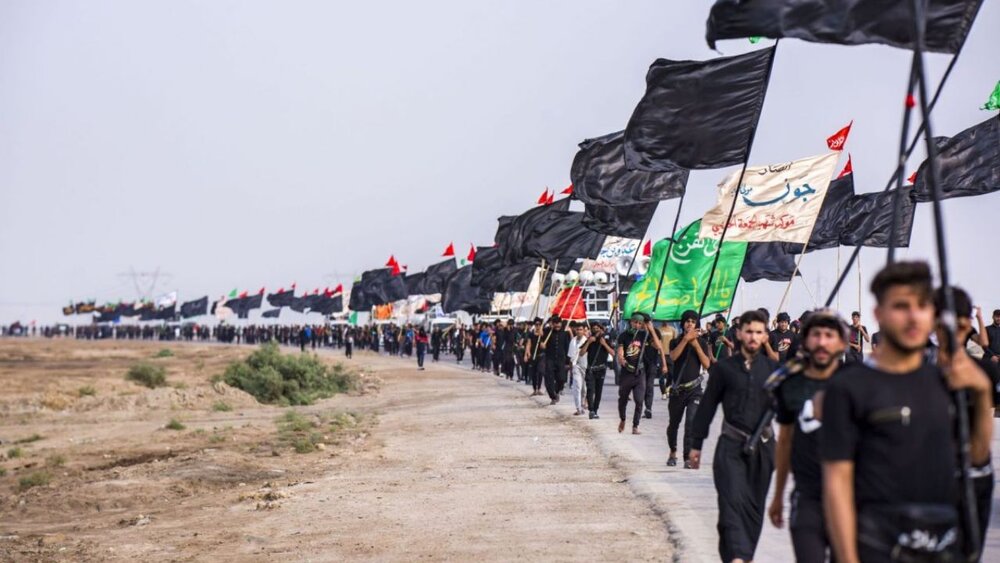
Each year millions of international pilgrims, including a record numbers of Iranians, come together in Iraq’s holy city of Karbala to commemorate Arbaeen, which marks an end to the 40-day mourning period following martyrdom of the Imam Hussein (AS) and his loyal companions at the Battle of Karbala on Muharram 10 in the year 61 AH (680 CE).
Pilgrims enter the holy cities of Najaf and Karbala up to two weeks before Arbaeen that this year falls on October 19. Many arrive in Karbala after trekking about 70 kilometers northward from the holy city of Najaf in a symbolic gesture honoring the third Shia Imam.
Pilgrims are warmly greeted by the generous hospitality of the Iraqi people, who provide them with food, beverages, transport and accommodation needed for the journey.
Many believe that the event has turned into a symbol of unity between the Iraqi and Iranian nations, who both profoundly respect Imam Hussein (AS) and his moral values.
Reverting to the news coverage, it is worthy to mention that some Western media usually represent the event skillfully mixed with scenes of violence or so to cultivate prejudice, irrationality and distorted images of Islam and Muslims in the minds of addressees.
That is because mass media have potential to manipulate portrayal of any image or occurrence in order to inscribe the meaning they want in the minds of audiences. Many media experts believe that there is no finally-fixed meaning of a happening in the world and interpretation of a meaning changes from person to person, and is entirely dependent on people’s historical and cultural framework.
On one hand, mass media are granted freedom to perform. On the other, they have social responsibility towards their audiences. Western people have absolute right to gain authentic information, news and images on such a peaceful and major religious gathering. 

Monday, September 09, 2019

Salutation to the Immortal Martyrs of Karbala

By: Seyyed Ali Shahbaz

      "O Aba Abd-Allah, your martyrdom was a great calamity and the cause of great distress for us and all followers of Islam! It was a tremendous calamity that befell the heavens and which affected all the denizens of the heavens! May Allah’s curse be on those who instituted a regime of wrongdoing and injustice against you Ahl al-Bayt! May Allah’s curse be on those who sidelined you from your rightful station and withheld from you the status that Allah had assigned you! May Allah’s curse be on those who slew you, and may His curse be on those who paved the way for them making it possible to wage war against you! Before God and you, I repudiate them, their supporters, their followers and those who befriend them!

     The above is the opening passage of the famous Ziyarat-e Ashura that the faithful recite on the 10th of Muharram every year to salute in the proper way the Chief of Martyrs, while commemorating history’s most heartrending tragedy.

      Imam Husain (AS) needs no introduction. The above passage is proof of his immaculate pedigree – exalted by God Almighty and protected from the least form of uncleanness, as ayah 33 of Surah Ahzab says:

       "We have desired to remove all uncleanness from you Ahl al-Bayt and keep you thoroughly purified.”

       Yet despite his impeccable credentials, he was martyred in the most cruel and brutal manner by persons who very well knew his prime position as the pivot of Islam.

       Why? The answer is simple. Imam Husain (AS) refused to acknowledge the illegitimate rule of the impious and ungodly tyrant, Yazid ibn Mu’awiyya, who was masquerading as caliph of Muslims, even though he openly rejected any belief in Islam.

        Then, who made him the ruler, and how come the majority of the so-called Muslims of those days yielded to his Godless rule?

       Good questions indeed, which are relevant to our own times, when persons pretending to be Muslims and hailed as such by the Zionist-controlled western press, are behaving in the manner of Yazid and the Omayyads by betraying the Islamic cause, massacring Muslims, destroying the lands of the believers, and desecrating the holy shrines.

        This is the reason we continue to commemorate the martyrdom of Imam Husain (AS) in order to keep our faith and conscience alive. Our tears for the Imam, his sons (18-year old Ali Akbar and 6-month infant Ali Asghar), his brothers (including the valiant standard-bearer Abu’l-Fazl al-Abbas), his nephews (such as the youth Qassem), and his steadfast companions, are not signs of sorrow, but proof of the inspiration we receive by contemplating on the magnitude of the tragedy of Karbala.

       At the same time, there is no desire for vengeance in our hearts, because the message of Imam Husain (AS) is one of love, affection, courtesy, unity, and brotherhood – not just among Muslims but fraternity with the followers of other creeds as well.

       Of course, there is the Avenger for the sacred blood of Imam Husain (AS). And He is God Almighty as we read in the Ziyarat-e Ashura. His instrument of bringing to justice the killers of the Prophet’s grandson and those who endorsed, and still continue to endorse his killing, is the Awaited Saviour of mankind.

       When Imam Mahdi (AS) appears, along with Prophet Jesus (AS) to establish the global government of peace, prosperity and justice, all traces of corruption and oppression will vanish from Planet Earth.

         In the meantime, we continue to commemorate the martyrdom of the Chief of Martyrs and salute him with a worthy salutation on the Day of Ashura, as was taught to us by his grandson, Imam Muhammad al-Baqer (AS), who was present in Karbala as a 4-year old boy.

        Here is a thought-provoking passage:

         "O Aba Abd-Allah! I make peace with those who are at peace with you and will make war against those who are at war with you, till the Day of Resurrection. May Allah’s curse be on the clan of Ziyad and the clan of Marwan! May Allah’s curse be on the generality of the Umayyads! May Allah’s curse be on the son of Marjanah! May Allah’s curse be on Umar ibn Sa'd! May Allah’s curse be on Shimr! May Allah’s curse be on the lot who saddled and harnessed their mounts and patrolled the land for the battle against you! Dearer than my father and mother, your martyrdom has caused me great sorrow! I beseech Allah, who has honoured you with your station and honoured me through you, to enable me to avenge your blood with the God-aided Imam from the Family of Muhammad, may Allah bless him and his Family! O Allah, make me eminent with You in the world and the Hereafter through Husain, peace on him.”

,,,,,,,,,,,,,,,,,,,,,,,,,,,,,,,,,,,,,,,,,,,,,,,,,,,,,,,,,,,,,,,,,,,,,,,,,,,,,,,,,,,,,,,,,,,,,,,,,,,,,,,,,,,,,

Condolences on the Eve of the HeartrendingTragedy of Ashura

Sunday, September 08, 2019

Here’s everything you need to know about the Battle of Karbala

Only 48 years after the death of the Prophet Muhammad, his grandson Hussain was murdered in the Battle of Karbala.
What was this battle, and why was the grandson of the Holy Prophet, alongside his family and companions, brutally killed on the plains of Karbala in now modern-day Iraq? And why do millions of people from around the world continue to remember and follow the legacy of Hussain?
TMV’s new video explains the history, battle, and the historical and religious importance of the Battle of Karbala in full, as the day of Hussain’s death, Ashura, the 10th day of the month of Muharram, draws closer.
Watch in full here:

Monday, September 24, 2018

How Muslim’s Imam Hussein inspired non-Muslim elites?


ALWAGHT– “THINK NOT OF THOSE WHO ARE SLAIN IN GOD’S WAY AS DEAD. NAY, THEY ARE LIVING, FINDING THEIR SUSTENANCE IN THE PRESENCE OF THEIR LORD.” (QUR’AN 3:169) INDEED, THIS VERSE OF THE HOLY QUR’AN EXPLAINS THAT MARTYRDOM IN THE PATH OF GOD IS NOT EQUIVALENT TO DEATH, FOR THE BODY MAY PERISH BUT THE SOUL IS IMMORTAL.
Hussein bin Ali (Peace Be upon Him), the third Imam (infallible leader chosen by God) according to Shiite Islam, sacrificed his life and family to rectify the Islamic religion which was being distorted under the tyranny of those in power.
Imam Hussein’s small group of companions and family members (in total around 72 men and few women and children) confronted a large army of the then corrupt caliph, Yazid, in place named Krabla, Placed in today’s Iraq.
The Battle of Karbala lasted from morning to sunset on October 10, 680 (Muharram 10, 61 AH known as Ashura). The Yazid’s army under the command of Umar ibn Sa’ad martyred Imam Hussein and his companions, Including his six-month son Ali-e-Asghar, near the river of Euphrates, from which they were not allowed to get water.
The innocent infant was killed during while his mother Rabab and sister Sukaina were also present.

When water was cut off from Imam Hussein’s camp, all attempts to reach the Euphrates and return with water were to no avail. Imam Hussein’s last resort was to beseech Umar ibn Sa’ad’s army for water for the women and children. Ali-e-Asghar was extremely thirsty so Imam Hussein took him along, conceivably hoping they would show mercy at the sight of his suffering. However, Harmala, a member of Yazid’s army killed Ali el-Asghar with a three-headed arrow, according to history.

The Painting Shows Scene that Imam Hussein’s Infant Was Martyred by a Three-headed Arrow
Living in 7th century, Imam Hussein’s legacy spread after his martyrdom reaching almost every corner of the earth. Those who believed in the values of freedom and justice came to cherish and respect Imam Hussein.
Of those who were inspired by Imam Hussein’s struggle for justice is Mahatma Gandhi, preeminent leader of the Indian independence movement in British-ruled India and spiritual icon for many. Gandhi’s first Salt Satyagrah was inspired by Imam Hussain’s resistance to the tyranny of Yazid, the caliph at the time.

He writes: “My faith is that the progress of Islam does not depend on the use of sword by its believers, but the result of the supreme sacrifice of Hussain, the great saint.”
It is notable that Imam Hussein stood in the face of his oppressors. Although he was martyred in the Battle of Karbala, his voice resonated across distances and time. His martyrdom is commemorated to this day by millions of mourners on the day of Ashura. His martyrdom is believed to symbolize the victory of sacrifice over the sword.
Winner of the Nobel Prize in Literature, Rabindranath Tagore also described Imam Hussein’s approach to the pursuit of justice as exemplary.
 “In order to keep alive justice and truth, instead of an army or weapons, success can be achieved by sacrificing lives, exactly what Imam Husain did.”
Imam Hussein’s heroic endurance has also turned heads in the Western world, particularly among historians, writers, and scholars.
Charles Dickens, the English novelist, deduces from the events of Karbala that Imam Hussein had given up everything for the sake of Islam, the religion Prophet Mohammad, his grandfather had enlightened people with.
 “If Husain had fought to quench his worldly desires…then I do not understand why his sister, wife, and children accompanied him. It stands to reason therefore, that he sacrificed purely for Islam,” Dickens writes.
Edward G. Brown, the professor of Arabic and oriental studies at the University of Cambridge, praises Imam Husain in the following passage:
“… a reminder of the blood-stained field of Kerbela, where the grandson of the Apostle of God fell at length, tortured by thirst and surrounded by the bodies of his murdered kinsmen, has been at anytime since then sufficient to evoke, even in the most lukewarm and heedless, the deepest emotions, the most frantic grief, and an exaltation of spirit before which pain, danger and death shrink to unconsidered trifles.” [A Literary History of Persia, London, 1919, p. 227]
Considered the greatest British historian of his time, Edward Gibbon said in The Decline and Fall of the Roman Empire that the events of Karbala that led to the beheading of the revered Imam has the power to ignite the flames of compassion even in a heart of ice.
 “In a distant age and climate the tragic scene of the death of Hosein will awaken the sympathy of the coldest reader.”
Thomas Carlyle, Scottish historian and essayist, understands from the story of Karbala that the minority can be victorious over the majority.
 “The best lesson which we get from the tragedy of Karbala is that Husain and his companions were rigid believers in God. They illustrated that the numerical superiority does not count when it comes to the truth and the falsehood. The victory of Husain, despite his minority, marvels me!”
Peter J. Chelkowski, Professor of Middle Eastern Studies, New York University, summarizes the events of Karbala in a few lines.
 “Hussein accepted and set out from Mecca with his family and an entourage of about seventy followers. But on the plain of Kerbela they were caught in an ambush set by the … caliph, Yazid. Though defeat was certain, Hussein refused to pay homage to him. Surrounded by a great enemy force, Hussein and his company existed without water for ten days in the burning desert of Kerbela. Finally Hussein, the adults and some male children of his family and his companions were cut to bits by the arrows and swords of Yazid’s army; his women and remaining children were taken as captives to Yazid in Damascus. The renowned historian Abu Reyhan al-Biruni states; “… then fire was set to their camp and the bodies were trampled by the hoofs of the horses; nobody in the history of the human kind has seen such atrocities.” [Ta’ziyeh: Ritual and Drama in Iran, New York, 1979, p. 2]


The Battle of Karbala took place in 680 A.D. Yet, millions mourn the martyrdom of Imam Hussein to this day. The followers of Shiite Islam have been committed to ensure the remembrance of the person who sacrificed his life so that true Islam can live, and, in this remembrance, the story of Imam Hussein has spread across the world. Those who value freedom and justice have praised Imam Hussein even though there are not enough words that could do him justice.

Friday, September 21, 2018

Message of Karbala

Islamic year, consisting of twelve months begins with the month of Muharram. Although all these months are significant, holding a special importance but the Quran has declared four months much sacred, which involves Zulqadah, Zulhijjah, and Rajab and the first month – Muharram. Even before the advent of Islam, it was considered as blessed owing to many historical events of great worth that took place in this month. Prophet Moses (A.s) triumphed over his rival Pharaoh and month was Muharram .It was this holy month wherein the ship of Noah (A.s) found resting place in the terrible flood. Also, in religion of Prophet Muhammad (pbuh), the month of Muharram acquired much sanctity. About this month, Prophet (pbuh) said; the best fasting after Ramadan is fasting in the month of Muharram (Sahih Muslim).
Later in 680 A.D, 10th Muharram turned out to be the day when beautiful flowers of Prophet Muhammad’s (pbuh) garden were trampled by the army of Yazeed in the battle of Karbala- that became the recognition of this month. The tragedy of Karbala has profound significance for all Muslims. It has left such an impact that even after hundreds of years it is fresh in minds of the Muslims. This tragic event has not only influenced Muslims but non-Muslims as well, for it was not the battle for gaining power or to conquest a territory. It was a clash between monarchy and Khilafat (Islamic mode of government based on consultation, selective democracy, and piety). It was a confrontation between justice and oppression and purely a courageous act of opposing falsehood, despotism, and savagery. It was the struggle where the hallowed family members of Prophet (pbuh) under the leadership of Prophet’s grandson Imam Hussein (a.s) preferred to lay down their lives rather than compromising on their scrupulous stand. Literally, they watered and rejuvenated the field of Islam with their pious blood to maintain its pristine and to provide it everlasting liveliness. Khawaja Moinuddin Chisti rightly said; ‘Haqa ke Binaye Laila ast Hussein. Hussein is the foundation of ‘There is no God but Allah’- the fundamental of Islam.
Allama Iqbal, while explaining the philosophy of this battle writes: Mudda’yash saltanat boody agar; Khud na harday ba chunin samaan e safar (Ramooz e Beykhoodi). Meaning, Imam Hussein’s only aim behind refusing to give allegiance to Yazeed was to uphold the truth and the glory of Islam. It is clear from the fact that when he left Medina for Mecca, he had a small band of his kith and kin, including sisters and children with him. Some companions were in their 80’s. If he had envisaged raging a political war, he would not have taken such people with him. As for war old men, women, and baby like 6-month old Ali-Asgar are not required, which were accompanying Imam Hussein in the battlefield.
Muslims worldwide commemorate this event in a way as if the tragedy of Karbala has occurred yesterday, which is indubitably enlivening. However, the mere commemoration of this tragedy is not enough. In fact, restricting this tragedy to remembrance and mourning is injustice to the teachings of Imam Hussein and his companions, because their sacrifice has enormous meaning. They gave a lesson to us with their blood. To defend the truth they chose to clash with the government of Yazid. They knew they could not defeat the mighty army of Yazeed, but did not tolerate any change in the Islamic principles. For holding up the head of the Ummah, Imam Hussein allowed his own head to be chopped. Thus, to express our love for martyrs of Karbala especially with the sacred reformative mission of Imam Hussein, the best way is to imbibe the message of Karbala.
The tyranny and oppression occur almost every day in different parts of the world. Almost everywhere, the people face atrocities, injustice has become the norm, and dishonesty has suppressed honesty. Morality has degraded. We have lost the ability to differentiate between good from bad. And in this situation, Karbala is issuing a clarion call to the people not to accept this system. It teaches us not be neutral or silent in situations of tyranny, oppression, and injustice, instead we ought to stand against all this. Karbala resounds even today asking us to reject any such idea that can be disadvantaging to our religion,  implicitly cautioning us to remain adhered to the teachings of Islam- a complete code of life.
May Allah grant us ability to follow teachings of Imam Hussein (A.S) and his comrades.
 Zeeshan Rasool Khan

Contemplation on the Ashura Tragedy


Heartfelt condolences to all our listeners on the anniversary of the most heart- wrenching event the world has ever seen, and which despite the passing over a millennium and three-and-a-half centuries, continues to interact with human conscience in every age and era to guide people and nations towards reforms and the quest for social justice based on dignity.
       "O Allah, exalted is Your station, great is Your power, and stupendous Your might! You have no need of the creatures, Your supremacy is all-embracing, and You have the power to do whatever You wish. Your mercy is near, Your promise is true, Your blessings are plenteous, and Your tests are beautiful…
      "I call You in the hour of my need and beseech You in the moment of my destitution! … I turn to Your help in my weakness and put my trust in You as being sufficient for me.
     "Judge between us and our people [with justice], for indeed they have dealt with us deceitfully and treacherously, forsaken us and betrayed us, and spilled our blood, though we are the progeny of Your Prophet and the offspring of Your beloved, Muhammad ibn Abdullah, whom You chose for Your apostleship and trusted with Your revelation…!"


The passages that you heard are excerpts from the famous supplication recited by Imam Husain (AS) on the day of his martyrdom in Karbala on the 10th of Muharram 61 AH (corresponding to 680 AD).
Today, a millennium, three centuries and seventy-nine years after history's most bloodcurdling tragedy the immortal saga of the grandson of the Seal of Divine Messengers, continues to be commemorated, not just in the land where he was treacherously martyred, but all over the world wherever are found the devout followers of Prophet Muhammad (SAWA).
We use the term "devout followers", since devotion is the highest degree of love and affection for the Prophet's person and his God-given position, coupled with practical adherence to his way of life and teachings (that is, Sunnah/Sirah).
Moreover, without devotion, the mere claim to be a follower could be dubious, as is clear from the words of Imam Husain (AS) in the above supplication that he and the other members of the Prophet's family were the victims of the treachery and deceit – not of adherents of other creeds but of those styling themselves as Muslims.
It is an irony of Muslim history that Imam Husain (AS) – as a member of the immaculate Ahl al-Bayt whose spotless purity God has vouched in the Holy Qur'an (ayah 33 of Surah al-Ahzaab), and decreed love and affection for them as token of a believer's gratitude to the Prophet for enlightening him/her with the message of Islam (as is evident by ayah 23 of Surah Shura) – was slain on the orders of a person claiming to be the political heir of Prophet Muhammad (SAWA).
Thus, although the Day of Ashura and the mourning ceremonies of Muharram and the subsequent month of Safar, might be expressions of devotional grief by the faithful and renewal of their allegiance to Imam Husain's (AS) ideals of justice and refusal to bow to tyranny, this annual commemoration definitely raises questions in the minds of conscientious non-Muslim observers.
They ask: How Yazid and the Omayyad regime climbed to the apex of power of the Islamic realm, since as late as 8 AH and the fall of Mecca (two years before the Prophet's departure from the world), Yazid's father Mua'wiyah, and grandfather, Abu Sufyan, were hardcore heathens, never missing an opportunity to strike at Islam and Muslims?
And if it is claimed that Omayyad rule was legitimate and as per the commandments of God in the Holy Qur'an and the Sunnah of Prophet Muhammad (SAWA), what unpardonable offence had Imam Husain (AS) committed to deserve such a tragic death along with 18 other male members of the Prophet's family including his 6-month old infant son?
Both Muslims and non-Muslims ought to ponder on these questions. If the verdict is in favour of the righteousness of the stand of Imam Husain (AS) and against Yazid and his Omayyad hordes, then they should be true to their conscience and probe in a diligently scientific manner as to what went wrong after the passing away of the Prophet that a tragedy of such a bestial magnitude occurred in Karbala, which did not even spare the womenfolk and children of the Prophet's Household from imprisonment.
It is an irony of Islamic history that in 19 AH (640 AD) Mua'wiyah was given the governorship of the vast province of Shaam – made up of today's Syria, Lebanon, Jordan and Palestine including the illegal entity called Israel.
In the subsequent years, Mua'wiyah, who is on record as saying that every time the Muezzin recites the Prophet's name in the Azan, he feels intense hatred deep down in his heart, came out into open armed rebellion against Imam Ali (AS). He next intimidated and bribed the Iraqis to betray Imam Hasan (AS) so as to seize the caliphate in 41 AH (661 AD). Then in violation of the clauses of the treaty with the elder grandson of the Prophet – whom he martyred through a fatal dose of poison in 50 AH (670 AD) – he nominated the libertine Yazid as his successor in 60 AH.
These are the bitter realities of Muslim history that climaxed at Karbala 61 AH (680 AD), where only the sacrifice on such a grand scale by the Prophet's younger grandson could salvage Islam. It ripped off the mask of hypocrisy from the face of Yazid, for the tyrant on seeing the head of Imam Husain (AS) in a tray before him, burst out saying that he had avenged his heathen ancestors killed in the battles of Badr and Ohad, which his grandfather Abu Sufyan had imposed on the Prophet and Muslims.
It should now be clear that the killers of Imam Husain (AS) were not Jews, not Christians, not Hindus, not Zoroastrians, not Buddhists, not Shamanists, not pagans, and not atheists, but people who called themselves Muslims, and knew him very well with full knowledge that he was a paragon of virtue.
Most of them had heard – either directly, or indirectly from their elders – the Prophet's immortal phrase "Inn al-Husain Misbah al-Huda wa Safinat an-Najah", whose English rendering is: "Indeed Husain is the Beacon of Guidance and the Ark of Salvation."
For the true believers, this wasn't the doting of a middle-aged grandfather, especially when God says that His Prophet neither errs nor speaks out of desire, and it is nothing but revelation revealed – as said in ayahs 2 to 4 of Surah Najm.
Perhaps, some of the Prophet's companions, who before becoming Muslims had spent the greater part of their life worshipping idols and indulging in all sorts of cardinal sins, might not have properly gauged the words of the Seal of Divine Messengers regarding his grandson or the rest of his Immaculate Ahl al-Bayt, whose spotless purity the Holy Qur'an vouches.
If they had, Islamic history would have been spared of the greatest ever discord as a result of their violation of Divine Commandments. If they had, 50 years after the Prophet's departure, Imam Husain (AS) would not have been so tragically martyred.
Now, we understand why the Prophet used to say in such explicit words: "Husainun minni wa ana min al-Husain" (Husain is from me and I am from Husain).
We also begin to comprehend his other immortal phrase regarding his two grandsons: "al-Hasan wa'l-Husain Seyyedai Shabab ahl al-Jannah" (Hasan and Husain are the Leaders of the Youth of Paradise).
Thus, it becomes obvious to us what Imam Husain (AS) means and to whom he refers in his supplication to God (cited at the start of this programme) when he speaks of the treachery, deceit and betrayal of the Ahl al-Bayt. 
Ashura and the ziyarat we recite on this day have drawn the clearest line between truth and falsehood for the guidance of human societies. For on this day blood triumphed over naked swords to jolt human conscience and present to mankind the most endurable barometer for ascertaining one's faith.
The Day of Ashura thus freshens up our memories every year of the heroic stand of the Prophet's grandson who refused to give his hand in allegiance to a tyrant, by preferring the glory of martyrdom to an abject life under an oppressive and corrupt system. Here is a passage from the famous Ziyarah or salutation to Imam Husain (AS) on this day:
"O Aba Abdallah, your martyrdom was a great calamity and the cause of great distress for us and all followers of Islam! It was a tremendous calamity that befell the heavens and which affected all the denizens of the heavens! May Allah’s curse be on those who instituted a regime of wrongdoing and injustice against you Ahl al-Bayt! May Allah’s curse be on those who sidelined you from your rightful station and withheld from you the status that Allah had assigned you! May Allah’s curse be on those who slew you, and may His curse be on those who paved the way for them making it possible to wage war against you! Before God and you, I repudiate them, their supporters, their followers and those who befriend them!

Standing by Iran is Hezbollah's duty: Nasrallah


Beirut, Sept 20, IRNA - Lebanese Hezbollah secretary-general said US is punishing Iran because Tehran refuses to subdue to Washington bullying and Hezbollah is duty-bound to stand by the Islamic Republic of Iran

Sayed Hassan Nasrallah stressed that “it is our duty to stand by” the Islamic Republic of Iran in face of all kinds of pressures.

“Iran is being punished by the US for a clear reason: it refuses to subdue to the American master like other states. It wants to stay an independent and sovereign state. We have to recall its support to the resistance in Palestine and Lebanon, its support to Iraq and Syria in face of ISIL.”

This year on Ashura anniversary, Sayyed Nasrallah told the Zionists that all their attempts to prevent Hezbollah from possessing advanced and accurate missiles have been foiled, stressing that the issue “is all over” and that the Israelis themselves can’t imagine their fate if these missiles are used in any future war.

Addressing attendees of Ashura march in Beirut’s southern suburb (Dahiyeh) on Thursday, Sayyed Nasrallah voiced Hezbollah’s stances on several regional and local issues.

Path of Dignity

Sayyed Nasrallah started his speech talking about the occasion. His eminence sent condolences to Imam Mohammad Al-Mahdi (AS) on the martyrdom anniversary of Imam Hussein (AS).

Sayyed Nasrallah saluted all those who took part on the Ashura march and ceremonies in the last ten days in Dahiyeh and in other areas across Lebanon. His eminence reiterated Hezbollah and the resistance’s commitment to the path of Imam Hussein, path of dignity, stressing that all sacrifices and victories were achieved due to the commitment to this path and this school.

“Imam Hussein’s resounding saying “Never to Humiliation” will last,” Sayyed Nasrallah said.

“Today, all crowds in Lebanon’s Dahiyeh, south, Bekaa and in the entire region is an indication that Imam Hussein’s blood really defeated the sword.”

Palestine, Yemen, Bahrain

Stressing that the tenth of Muharram is the “day of stances”, Sayyed Nasrallah reiterated Hezbollah’s firm position in supporting people of Palestine, Yemen and Bahrain.

“First, we reiterate our ideological commitment to Palestine and Al-Quds. We reiterate our support to Palestinian people and their legitimate rights to confront the so-called ‘deal of century’,” Sayyed Nasrallah said, as he hailed the Return Marches at the border between Gaza and the occupied territories.

“Second, we stress our firm stand by Yemeni people who have been witnessing Karbala for nearly four years. This oppressed people have been demonstrating all forms of steadfastness, courage and patience, just like Karbala… It is all Muslims and Arabs’ duty to denounce and act in order to prevent the Saudi war in Yemen, this is moral responsibility.”

Third, we reiterate our support to peaceful people of Bahrain whose scholars and youths have been jailed and suppressed by the Bahraini regime,” Sayyed Nasrallah said, as he lashed out at Bahraini regime’s policy of naturalization of foreigners in the country in a bid to make demographic change in the Persian Gulf island.

Lebanon

On Lebanon, Sayyed Nasrallah reiterated the call for calm and dialogue, as well as the call to hasten the formation of the new cabinet.

Future War with Zionist Entity

Turning to the struggle with the Zionist entity, Sayyed Nasrallah said that the resistance has to stay on alert, noting that the Israeli enemy has been furious because its scheme in the region has failed.

“They (Israelis) were betting on the events in Syria and Iraq. But now they know well that the axis of resistance is more powerful and that more sides joined this axis.”

“Israelis are concerned, and we have to be vigilant… We should not be at ease. The enemy fears any future confrontation in the region, especially with Lebanon. He (Israeli enemy) knows well that any future war will have massive repercussion, and that his points of weakness are known to us.”

Sayyed Nasrallah cited remarks of Israeli defense minister who talked about strategic changes that took place in the Middle East.

“A few days earlier, Israeli DM said that in the Middle East strategic changes took place, noting that the first change is that Israel’s enemies acquired accurate missiles and that the Israeli home front became the main front in any future war. The Israeli minister said that in 1973 war Israelis in Tel Aviv were at calm, they were taking coffee and reading newspapers. But he noted that now, everything has changed. I tell the Israeli minister: Yes, everything has changed.”

Sayyed Nasrallah meanwhile, pointed out to Israeli attempts to prevent Hezbollah from acquiring advanced and accurate missiles in Syria.

“They (Israelis) have been working hard to cut off the road and prevent us from possessing accurate missiles. I say whatever you do to cut off the road on us, it’s all over, we are now in possession of accurate missiles that if used in any future war you can’t expect what your fate will be.”

“The Israeli enemy knows well that technology alone can’t have the final word in the battle without the human capabilities.”

Sayyed Nasrallah furthermore hit back at Israeli remarks that the Hezbollah S.G. “threatens from a shelter,” by saying: “Allah has elongated my lifespan and you have been trying in day and night to kill me but I’m still alive. Staying alive is an indication for your failure.”

The resistance leader then concluded his speech by saying that all Hezbollah’s power and steadfastness “is from Imam Hussein (AS),” stressing that: “All our days are Ashura and we have written ‘At Your Service O Imam Hussein’ with blood and patience.”

Thursday, September 20, 2018

Iqbal’s Love of Hazrat Hussain (RA)

By Dr.Syed Taqi Abdi

Translated by Ayub Khan


Allamah Iqbal loved Hazrat Hussain immensely and considered his life and sacrifice to be a lesson in freedom for humanity. To him Hazrat Hussain’s life was a model for Muslims to emulate and offered a solution to all their problems. Iqbal considered both the arrogant pride of the royalty and the excessive poverty of the hospices to be harmful for Muslims. Therefore a couplet in “Armughan-e-Hijaz” he exhorts Muslim to adopt the example of Hazrat Hussain:

Nikal Kar Khankhahon Sey Ada Kar Rasm-e-Shabbiri
Key Fakhr-e-Khankhahi Hai Faqat Andooh was Dilgiri


(Get out of the hospices and fulfill the obligations of Hussain/For the poverty of the hospice delivers only woe and misery)

In “Masnavi-e-Faqr” Iqbal writes:

Fakhr Uryan Garmi-e-Badr was Hunayn
Faqr Uryan Bang-e- Takbeer-e-Hussain


(The genuine poverty in Islam is that of Badr and Hunayn and the war-cry of Hussain)

Iqbal despised those strains of tasawwuf which distanced Muslims from bravery, action, and struggle and which pushed them towards monasticism and renouncement of the world. He exhorted the Muslims to shun seclusion and urged them to follow in the foot-steps of Hazrat Hussain by adopting sacrifice.

In “Payam-e-Mashriq” he writes:

Teer wa Sanan wa Khanjar was Shamsheeram Arzoo Ast
Baman Miya Key Maslake-e-Shabbirem Arzoo Ast


(I long for arrow, lance, dagger and sword/ Oh so-called (Muslim) don’t walk with me because I long to emulate Hussain’s sacrifice).

Iqbal says that following in the foot-steps of Hussain is not an easy task as it if full of sacrifice and genuine love:

Zinda Haqq Az Quwwat-e-Shabbiri Ast
Batil Akhir Dagh-e-Hasrat Meri Ast
Bahr-e-Haq Dar Khak wa Khoon Ghaltida Ast
Pas Banae La Ilah Garweeda Ast


(Message of truth and justice is alive due to the sacrifice of Hussain who defeated injustice forever. It was to save justice and truth that Hussain and his companions bathed in their own blood. By following this path they renewed the foundations of Islam.) These same sentiments were penned seven hundred years ago by Hazrat Moinuddin Chishti:

Shah hast Hussain, padshah hast hussain
deen hast hussain deen panaah hast hussain
sar daad na daad dast dar dast-e-yazeed
haqqa ke binaye laa ilaa hast hussain


(Husayn is lord and the lord of lords.
Husayn himself is Islam and the shield of Islam.
Though he gave his head (for Islam) but never paid allegiance to Yazeed.
Truly Husayn is the founder of "There is no Deity except Allah).

In “Ramooz-e-Bekhudi” Iqbal has penned a long nazm (of 39 verses) in praise of Hazrat Hussain:

Aan Imam-e-Ashiqaan poor-e-Rasool
Saroo Azad-e-Zabistan-e-Rasool

Allah Allah Baey Bismillah pidr
Maani zabh-e-azeem Amad-e-pisr


(Hussain is the leader of the lovers and the son of Hazrat Fatima (RA). He is the cypress tree of the Prophet’s garden. In the second couplet Allamah Iqbal is indicating towards a Shiah tradition where Hazrat Ali (RA) reportedly said that the “nuqta” of the letter “Ba” in Bismillah, which is the essence of the Holy Qur’an, is him (Ali). Therefore it points to the glory of Hussain whose father is the “Baey Bismillah” and who himself is the exposition of the ultimate sacrifice.

In Baal-e-Jibraeel Iqbal writes:

Ghareeb was Saada, Rangeen Hai Dastan-e-Haram
Nihayat is ki Hussain, Ibteda Hai Ismaeel


(The story of Kaaba inspite of being plain and interesting sounds strange. Its foundation was laid by Hazrat Ibraheem (AS), in its early days Hazrat Ismaeel (AS) rubbed his feet out of thirst. It was cleansed of idols by Prophet Muhammad (SAW). Its sanctity was protected until the day of judgment through the ultimate sacrifice of Imam Hussain).

Hazrat Hussain was an apostle of love of God and displayed his passionate love like other lovers of God:

Sidq-e-Khaleel Bhi Hai Ishq, Sabr-e-Hussain Bhi Hai Ishq
Maarkey Wujood Mein Badr was Hunain Bhi Hain Ishq


(The friendship of Ibraheem (AS) is also love and so is the patience of Hussain/ In the struggle of existence Badr and Hunain are also examples of love).

In Ramooz-e-Bekhudi Iqbal expounds on the battle of Karbala :

Kyon Khilafat rishta as Qur’an gikht
Hurriyat-e-Raaz har andar kaam reekht
Khast aan sar jalwa khairul umam
Choon sahabe qibla baraan dar khadam
Bar zameene Karbala bareed wa raft
Lala dar weerana ha kareed wa raft
Ta qiyamat qata istabdad kard
Mauje khoon o chaman ijad karad


(When Khilafat strained its relationship with the Qur’an and abandoned Islamic and Qur’anic ideals by transforming it into a kingship and when freedom was poisoned, the grandson of Prophet Muhammad (SAW) did not tolerate its injustices. Like a blessed cloud he marched forwarded and through his rain of blood transformed the desert into a garden of martyrs. By doing so he ended the reign of injustice and breathed new life into the garden of freedom.

In another couplet Iqbal says:

Dushmanan-e-choon reege shera la ta’ad
Doostan aw ba yazdaan hum adad


(Hussain’s enemies were innumerable like grains of the desert sands/ Whereas his companions equaled ‘Yazdaan’ (Lovers). The numerical value of the word ‘yazdaan’ comes out to be seventy two which was the number of Hussain’s companions).

The battle between truth and and falsehood will continue until the end. Expounding on this Iqbal writes:

Moosa wa Fir’aun wa Shabbir was Yazeed
Aen do quwwat az hayat amad padeed
Sateeza kaar raha hai azal sey ta imroz
Chiragh-e-Mustafwi sey sharer-e-bu lahbi


(Moses and Pharaoh and Hussain and Yazeed. These forces have been in struggle from the beginning. The lamp of Prophet Muhammad (SAW) has always faced off with the spark of Abu Lahab.)

Qur’an is the key to success for a Muslim and its secrets too can be learned from the example of Hussain. Iqbal says:

Ramze-e-Qur’an az Hussain Amokhtam
Za Aatish-e-ao Shola ha Andokhtam


(I have learned the secrets of Qur’an from Hussain. I have inflamed my lamps through Hussain’s candle).