Showing posts with label humanitarian crisis in Yemen. Show all posts

Saturday, March 02, 2019

Why UN Should Be Concerned Over Saudi-UAE Aid Funding for Yemen

TEHRAN (FNA)- International aid leaders are saying now what has been known for several years that Saudi Arabia and the United Arab Emirates are practicing double standards for both providing aid and instigating violence and humanitarian crisis in Yemen.
Humanitarian aid leaders say the two Persian Gulf countries give large cash flows amid their vicious military campaign in the war-torn country. Worse still, aid chiefs note that the Saudi-led coalition members have been committing war crimes in Yemen, including bombing villages, torture and the use of child soldiers.

For instance, Jan Egeland, who previously headed United Nations aid operations, railed against the “hypocrisy of nations trading in arms or raining down shells and bombs on Yemeni civilians” in a strongly worded statement earlier this week.

According to Egeland, head of the charity Norwegian Refugee Council, 60 percent of last year’s aid to Yemen came from Saudi Arabia, the UAE and the US, which has at the same time helped its Arab allies’ war effort with arms, intelligence and aerial refuelling.

It is time for the United Nations to take aim at this vicious hypocrisy, this double standard. The world body should put people before politics and Saudi-Emirati cash flows.

It is no longer acceptable to hear that Saudi Arabia has once again managed to successfully lobby against such moves at the UN. There should be no compromise. The world body and its Human Rights Council should establish a new commission of inquiry into these violations in Yemen, where Riyadh and company have been killing thousands of innocent civilians with impunity and no accountability.

Per its Charter, the UN should carry out a comprehensive examination of such bogus aids and all violations and abuses of international human rights and other appropriate and applicable fields of International Law in war-torn Yemen. This includes embracing its legally defined duty to blacklist Saudi Arabia and the UAE for murdering children and using child soldiers in the vicious conflict.

Failure to do so will only scar the UN’s reputation, for the irresponsibility of allowing Western governments and others to help this humanitarian crisis continue to unfold as well, including the United States. 

The US continues to provide massive support for Saudi Arabia’s brutal military campaign. This illegal participation is equally responsible for creating the largest humanitarian crisis in the world, pushing millions of human beings to the brink of famine. Indeed without US participation and arms, this Saudi-UAE war and “humanitarian” theatre in Yemen would not be possible.

By looking the other way as this double standard and hypocrisy unfolds, the UN cannot bring stability to Yemen, nor can it increase prospects for lasting peace. The inaction will only help to turn a horrible circumstance into a nightmare. It is about time the world body got on the right side of history, played a real role in addressing and ending this deliberate catastrophe, and held to account those responsible.

Thursday, February 28, 2019

The complete failure of Washington and Riyadh in Yemen

By Hanif Ghaffari 

TEHRAN - The humanitarian crisis in Yemen continues. Famine has spread across Yemen. Meanwhile, the United States, and Germany, Britain and France as its allies continue to maintain arms support for the Saudi assassination regime.
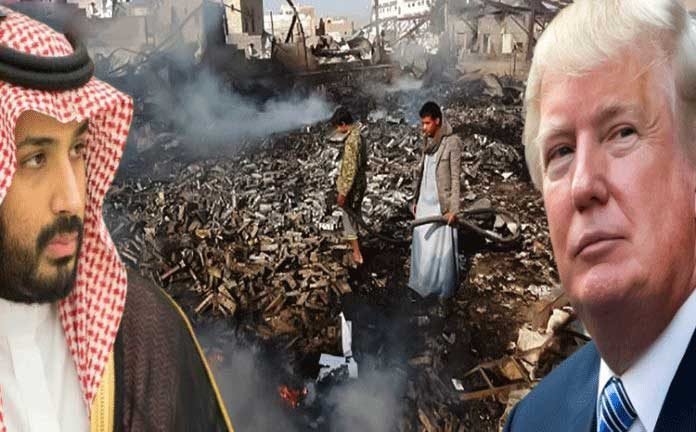
Undoubtedly, the role of Washington and its allies in the killing of Yemeni women and children is very high. The fact is that now, bin Salman is blamed by the Saudi court for of defeat in Yemen and the rising expense of the Saudis in this scene.
 However, the signs of Saudi Arabia's defeat in Yemen, throughout the region and in the world is becoming more and more clear. Under such conditions, Mohammed bin Salman seeks to reduce the cost of this heavy defeat in any way possible, but the harder he tries, Al Saud is more likely to fail.
Along with the ongoing developments in Yemen and the Saudi House, we should point to a more important issue, that is, the general dissatisfaction in Saudi Arabia of the ruling family. In the near future, this issue can turn into Saudis' Achilles heels (even if bin Salman is ousted from power).
 The corruption of the Saudi House can be in no way ignored. The financial corruption of the Royal Family is such that all Saudi citizens are aware of it. While poverty raises in many parts of Saudi Arabia, Saudi officials continue to plunder their country's resources.
 Despite the fact that Saudi Arabia is enjoying the rich revenues from oil sales and pilgrimages, the people of Saudi Arabia suffer from poverty, injustice, unemployment and other social problems. Experts see the cause of this in the appointment, and not selection of the rulers, the lack of public supervision over the authorities and budget spending, lack of a modern constitution, the monopoly of power in the hands of the Saudi family, and the Saudi family's dependence on the West, especially on the United States.
 Poverty and unemployment in Saudi Arabia, which is one of the richest countries in the world, have turned to a political bomb which may explode any moment.
The fact is that in a very near future, the Yemeni state will become a symbol of the defeat of the United States and Saudi Arabia and the European allies of Washington. This will not only weaken or even crush Saudi Arabia's Crown Prince of power, but also undermine the previous U.S. calculations in the region. Anyway, a complete failure will await Washington and Riyadh in West Asia.

Thursday, November 29, 2018

To Build a Fire in the Heart of Our Country

By George Capaccio


But for most of us, the movement was a life-giving force. To join a hundred thousand others in marches and rallies, to know that even if you felt helpless against the power of government you were not alone in your feelings—that people all over the country, of all ages, black and white, working people and middle-class people, were with you—was to be moved beyond words. … to see Mohammed Ali defy the authorities even at the cost of his championship title, to hear Martin Luther King speak out against the war, to see little children marching with their parents, carrying signs—“Save the children of Vietnam”—was to feel the best of human beings were fighting your cause. … millions of people protested the war not because their own lives were at stake, but because they truly cared about other people’s lives, the lives of Vietnamese, of fellow Americans.
– from You Can’t Be Neutral On A Moving Trainby historian and activist Howard Zinn.

November 27, 2018 "Information Clearing House" -  When I was young and the war in Vietnam was raging, I rejected much of what I associated with a government and a society that could undertake the destruction of an entire people and still carry on as if there were nothing in the least bit abnormal about that state of affairs. In time, I saw that the way forward, at least for me, was to join those who understood just how evil the war was and how imperative it was for people to lift their voices, take to the streets, and risk their personal well being to protest the war.

Reading Zinn’s account of the Vietnam antiwar movement (in his book You Can’t Be Neutral On A Moving Train) and how it grew from isolated pockets of opposition into a massive, nation-wide wave of resistance, I felt re-united with feelings that have languished inside me for the past decade and a half. In the winter of 2003, as the US prepared to invade Iraq, I was on the streets with hundreds of thousands of others who truly cared about preventing the needless deaths of both Iraqis and fellow Americans. For a time, I believed we would prevail over the Pentagon, the defense contractors, and the Department of Defense—each of which had its own reasons for wanting to prosecute yet another act of criminal aggression against a relatively defenseless country. This time around, however, it was conceivable that our passionate commitment to peace and its expression through movement building, rallies, and demonstrations might actually stay the hand of our “Commander-in-Chief” and his war-mongering, neo-conservative ideologues: Dick Cheney, Condoleezza Rice, Donald Rumsfeld, Paul Wolfowitz, et al.

That winter afternoon stands out in my memory as the last time I felt the degree of exhilaration Howard Zinn so beautifully evokes in his description of the camaraderie he experienced during the high watermark of the Vietnam antiwar movement. A month later, on March 20, 2003, the war we hoped to prevent officially began with the much ballyhooed “shock and awe” bombing of Iraq. As someone with deep, personal connections to people in Iraq and a long-term involvement with the anti-sanctions movement, I felt profoundly demoralized by our failure to stop Bush II from attacking yet another Muslim nation under the pretext of “defending the world from grave danger.” But fellow activists reminded me that our surrender was not an option. However much defeated many of us felt, we had to keep up the struggle to bring some measure of sanity to a world in which the glorification of military power and the choice of violence over diplomacy nine times out of ten trumps international law and humanitarian considerations.On a frigid, fingertip-freezing day in February 2003, close to a million of us hit the streets of New York to make our voices heard. Together with comparable numbers of our brethren in other countries, we declared our united opposition to a war against Iraq—a war that many in the peace movement judged would be both illegal and immoral, and unconscionably destructive.


This year, on the eve of Thanksgiving, I turned to historian and activist Howard Zinn, author of A People’s History of the United States, for a way to hold and live with the terrible knowledge that once again my country is putting the projection of power and the pursuit of hegemonic objectives (controlling global energy resources; maintaining ties with US-friendly regional allies, etc.) ahead of simple humanity. Instead of the Vietnamese, the latest target of the US government’s malevolent, calculated indifference to massive human suffering are the people of Yemen. Progressive writers and activists have spoken out forcefully against the genocidal nature of Saudi Arabia’s war on Yemen, and demanded a total suspension of arms sales to the Saudi regime and the cessation of all other forms of assistance, including mid-air refueling of Saudi war planes, targeting information, and diplomatic cover.

In this essay, I have no wish to repeat what has been said elsewhere about the conflict between the Kingdom of Saudi Arabia and the Houthi rebels of Yemen. Informed readers are aware of the Kingdom’s bogus claim that the rebels are significantly supported by Iran, its greatest foe. Therefore, the war is, in effect, a battle with the Islamic Republic of Iran for dominance of the Middle East and the ultimate victory of extremist Sunni Islam over the Shia theocracy of Iran. By this line of specious reasoning, the US alliance with Riyadh is a necessary bulwark against Iran’s growing regional influence and its purported role in fomenting terror and further destabilizing the Middle East.

I leave the delineation of such matters in far more competent hands. What matters most to me are the humanitarian consequences of this three-year-conflict, which shows no sign of stopping any time soon despite the recent US decision to stop re-fueling Saudi war planes and the growing, world-wide alarm that the Saudis are condemning an entire people to death from famine, sickness, and unrelenting airstrikes on civilian targets, like markets, hospitals, schools, and mosques. Consider the following figures from authorNicholas Davies, citing data from the Armed Conflict Location and Event Data Project (ACLED), a nongovernmental organization (NGO):


ACLED now estimates the true number of people killed in Yemen is probably between 70,000 and 80,000.ACLED’s estimates do not include the thousands of Yemenis who have died from the war’s indirect consequences, such as starvation and preventable diseases like diphtheria and cholera. UNICEF reported in December 2016 that a child was dying every 10 minutes in Yemen, and the humanitarian crisis has only worsened since then.  At that rate the total of all deaths caused directly and indirectly by the war must by now be more than one hundred thousand.


An estimated one hundred thousand people killed directly or indirectly in a war that never should have begun in the first place. A war that has the blessings of Donald Trump in the form of billions of dollars of arms sales; a “bromance” with Mohammed bin Salman (MbS), the Crown Prince of Saudi Arabia; and a brazen refutation of the CIA’s conclusion that the Crown Prince “personally ordered” the killing of Saudi journalist and self-imposed exile Jamal Khashoggi. Quoting Secretary of Defense Mike Pompeo, Trump told the world on Thanksgiving morning, “It’s a mean and nasty place out there.”

And thanks to people like Mike Pompeo, National Security Advisor John Bolton, Donald Trump, and his bosom buddy the Little Prince of the world’s leading autocracy and exporter of terrorist doctrine, it’s getting a whole lot meaner and nastier. According to a recent report issued by the charity Save the Children, about 85,000 children under the age of 5 have starved to death as a consequence of the civil war in Yemen. How can anyone possibly grasp the significance of that number and the scale of human suffering implicit in the deaths of so many little children. One only has to look at photos of severely malnourished Yemeni children to realize the inhumanity of this war and that of the people who either prosecute or condone the violence. Working in Yemen since 1963, Save the Children states unequivocally that “13 million people face starvation—many of them children.” Furthermore, “Over 22 million people—three out of every four—urgently need lifesaving assistance, including over 11 million children.” The following statistics are from the above-mentioned report:
  • Only 55% of girls 15 and older are literate
  • 29% of children are out of school, with up to 75% of schools destroyed
  • 55 out of 1000 children die before their 5th birthday
  • 23% of children are engaged in child labor
  • 54% of people live in poverty
  • 1,600 children have been killed since the start of the conflict
The US, first under Obama and now under Trump, does much more than condone the bombing of civilian, government, and military targets in Yemen. Not only do we provide the killers with bombs and guided missiles; we unashamedly support the economic war being conducted against the people of Yemen by Saudi Arabia and its coalition partners. Martha Mundy, Professor Emeritus of Anthropology at the London School of Economics, has done extensive fieldwork in Yemen and other Arab countries. In her recent report for the World Peace Foundation, Mundy notes the responsibility of the US, the UK, and France—the three major arms dealers—in the commission of war crimes in Yemen as a result of the bombing. But their support for the economic war being waged is generally ignored, she says, and it is this form of violence that is “the major cause of starvation” in Yemen.

According to Professor Mundy, the war has evolved in stages, from attacks on mainly military and government facilities to “civilian and economic targets, including water and transport infrastructure, food production and distribution, roads and transport, schools, cultural monuments, clinics and hospitals, and houses, fields and flocks.” In August 2016, the Coalition launched a third stage: 

economic war with intermittent blockades of al-Hodeidah, Yemen’s major port on the Red Sea; the closure of the airport in Sana’a to all commercial flights; and the transfer of the central bank of Yemen to the city of Aden. (Southern Yemen, where Aden is situated, is controlled by forces of the United Arab Emirates (UAE), which is aligned with Saudi Arabia in its war on the Houthi rebels, based in San’a’ in the north.) On the basis of her research, Mundy concludes that the economic war is the leading cause of the tragedy that has befallen the people of Yemen:

Today Yemen is commonly described as the greatest humanitarian crisis in the world with 80% of the population requiring food assistance and with outbreaks of cholera that have affected more than a million people. The causes of that include not just the effects of the bombing campaign on the quality and quantity of food and water available … but above all the impact of the deepening economic war from late 2016.

The good news is that this crisis is finally getting the attention it deserves. During the week of December 1, the US Senate is expected to vote on S. J. Resolution 54, the bipartisan War Powers Resolution on ending US support for the slaughter of innocents in Yemen. Voters are encouraged to contact their senators and urge them to support the bill, sponsored by Senators Bernie Sanders (I-VT), Mike Lee (R-UT) and Chris Murphy (D-CT).

In my home state of Massachusetts, a coalition of peace groups—including Mass Peace Action, Veterans for Peace, the American Friends Service Committee, and Friends Meeting at Cambridge (Quaker)—is undertaking a variety of actions to draw attention to the crisis and to get more people involved in working to end it. The centerpiece of our peace advocacy is an ongoing campaign to hold Raytheon accountable for its sale of deadly weapons to the Saudi-led coalition. To that end, we’ve held well-attended demonstrations in front of the company’s Cambridge office and encouraged attendees to play an active role in the campaign. Some of the tactics we advocate include organizing educational events, writing opinion pieces for local papers, and using social media to inform people about the crisis in Yemen.


The movement against that war is growing. My hope is that it will soon reach a critical mass, and that once again, as they did during the Vietnam War and in the build up to the Iraq war,  people from all walks of life, of every ethnicity and color under the sun will come together on the streets of their towns and cities, and with one indivisible voice, cry out in the wilderness, “Save the children of Yemen!”

Because the lives of those children matter every bit as much as the lives of our own children. Because our government, along with US-based arms manufacturers, is just as responsible for the bloodshed in Yemen as the Saudis and their allies. Because as members of a purportedly democratic society we are obliged to hold our leaders accountable and demand that they do everything in their power to protect and preserve the lives of the people of Yemen.

A CNN reporter once interviewed Denis Halliday about the sanctions regime imposed on Iraq by the UN but enforced by the US and the UK. A few years earlier, in 1998, Halliday resigned his post as the UN humanitarian coordinator of the Oil-for-Food program in Iraq to protest the sanctions and the devastation they caused. In response to the interviewer’s question about Saddam Hussein’s brutality and the need to keep the sanctions in place, Halliday said, “Nothing justifies the killing of children in Iraq. Nothing.”

What was true then is no less true today: “Nothing justifies the killing of children in Yemen. Nothing.”


George Capaccio is a writer, performer, and activist living in Arlington, MA. During the years of US- and UK-enforced sanctions against Iraq, he traveled there numerous times, bringing in banned items, befriending families in Baghdad, and deepening his understanding of how the sanctions were impacting civilians.

Tuesday, November 20, 2018

Roland Heday at: Saudis Target Yemeni Democratization Out of Fears of Domestic Discontent

Roland Hedayat: Saudis Target Yemeni Democratization Out of Fears of Domestic Discontent


TEHRAN (FNA)- Political commentator Roland Hedayat says the one-family kleptocratic ruling class in Riyadh have been unnerved by the democratic movement of the Yemeni people, fearing that it would inspire discontent among the Saudi population.
Mr. Hedayat, in an exclusive interview with FNA, said that “the humanitarian crisis in Yemen is intentionally caused by the Saudi war of aggression, not an unintended side effect of war.”
Commenting on the role of American and British governments, he added that human rights and democracy do not matter for the two governments unless these terms “can be used as self serving propaganda instruments.”
Roland Hedayat is an activist and political commentator who has been closely following the war of aggression on Yemen.
FNA has conducted an interview with Roland Hedayat about the ongoing Saudi war on Yemen and possible motives behind the war imposed on the impoverished Arab country by Saudi Arabia and its western allies.

Q: What do you think of the ongoing humanitarian crisis in Yemen caused by the Saudi war and blockade on the country?

A: The humanitarian crisis in Yemen is intentionally caused by the Saudi war of aggression, not an unintended side effect of war. Since day one, the aggressors have hit food production and storage facilities, civil infrastructure, such as water pumping, sewer and water cleaning facilities, thus actively engineering starvation, diseases and epidemics. Also, schools, hospitals, health care centers, weddings, and funerals have been targeted, with the aim of bringing the population to its knees. These acts are war crimes and should cause an outcry from the International Community.

Q: What are the Saudis’ objectives in their war on Yemen? It seems that the Saudis expected an easy-to-win combat when they first stepped into the war. What do you think is the root-cause of Riyadh's continued failure in Yemen?

A: There are several reasons for the Saudi/UAE (and also US/UK) war of aggression on Yemen. The last two are added to the list, because they are directly involved in the warfare as well as selling arms, providing diplomatic cover, and spreading war propaganda to the media.
Saudi Arabia has a long tradition of meddling in the internal affairs of Yemen, having intervened in several internal strides in that country, with the aim of keeping or increasing its control over it. Saudi Arabia shares about 1800 km of border with Yemen, and sees it as unacceptable that Yemen not be solidly under its control. The savageness of the present war shows to what extent they are serious about this, practicing an old colonial devise: What you can't control -- you must destroy.

The compulsory Saudi need for control can be explained by the fact that the country is run by, and to a large extent owned by one family, the house of Saud, constituting a "one family kleptocracy".  Such a system is inherently unstable. The popular movement and democratic aspirations of the Yemeni people has unnerved the Saudis, hell-bent on never accepting democratization in Yemen which could potentially inspire discontent among the Saudi population.

Yemen has also got an important geo-strategical location as well as vast unexploited oil and other natural resources that the aggressors want to control.

Q: Why do the US and the UK continue to supply Saudi Arabia with arms despite international criticism with regard to civilian casualties?

A: The US and UK are killing two (if not even three) birds with one stone: The massive arms sales to Saudi Arabia and the UAE is a lucrative business. They also serve the purpose of keeping the pressure on Iran for free (the vassals pay), a most welcome side effect. Also, they further increase the vassal's dependence on the US and UK, solidifying that relationship.

Regarding US/UK indifference to international criticism, the answer is simply that they do not care as long as it is controllable. "Human rights" and "democracy" have never been an issue for these countries when it comes to geopolitics, unless the terms can be used as self serving propaganda instruments.

Q: Why have the international organizations, particularly the UN, remained passive in the face of the ongoing Saudi atrocities?

A: With regard to Yemen, the UN has been part of the problem and not part of the solution. The UNSC resolution #2216 on Yemen is an example of an international system which is all but broken, if aimed at protecting and preserving peace.

When the resolution was adopted on April 15Th 2015, the bombing campaign against the civilian population of Yemen had lasted for three weeks without UN authorization, in breach of International law. The resolution text, however, did not even mention that attack, and almost nothing was said about it during the council meeting.

The resolution disregards the UN Charter itself by ignoring Yemen's sovereign rights, according to Article 2 (1): "The Organization is based on the principle of the sovereign equality of all its members."

The remaining paragraphs in Article 2 underscore the fundamental principles of equality, sovereignty and their implications.

The draft resolution was presented to the UNSC by Jordan, member of the coalition of aggression, hence fundamentally biased, turning the concepts of aggressor and victim upside down. The adopted UNSC Resolution #2216 effectively served as a green light for the Saudi-led aggressor coalition to proceed with the onslaught on Yemen, while at the same time imposing an arms embargo on the "Houthis" which has been used as a pretext for taking the civilian population as hostage: It has been enforced by a naval blockade which drastically hampers the vital supply of food and humanitarian aid. The UNSC Resolution #2216 has thus served as, and continues to serve as, a catalyst of the catastrophically deteriorating humanitarian situation in Yemen.

Q: The airstrikes by the Saudi-led coalition have mostly killed Yemeni civilians, including thousands of women and children. What do you see as the reason for the airstrikes targeting civilians?

A: Civilians are deliberately targeted. To avoid an outcry from the world opinion, the number of victims is downplayed. The constant number of about '10000' civilians has been circulating for some years. Does that mean that the killing has stopped? Of course not. Furthermore, by some twisted logic, only those killed by bombs are counted as victims of war, not counting those dead from imposed starvation and cholera epidemics. Taking all these into account the Yemeni catastrophe ranges in the hundreds of thousands of victims.

The world opinion and civilized nations must demand an immediate stop to this carnage and destruction, and in particular demand an immediate stop to the military assault on the port city of Hodeidah, the only life line for the starving population of Yemen.

Wednesday, July 25, 2018

No Liberal Rallies Yet for the Children of Yemen


Hundreds of thousands of people showed up across the United States at more than 600 gatherings three weeks ago. They came out to protest Donald Trump‘s “zero tolerance” immigration policy in highly choreographed, Democratic Party-affiliated “Families Belong Together” rallies and marches. Liberal celebrities marched and spoke. Local, state, and federal Democratic Party politicians and office-holders gave passionate speeches denouncing Trump’s separation of Central American migrant children from their parents at the southern U.S. border.
Marchers carried signs expressing their concern for children and families. Here are some of the messages written on the posters displayed at these gatherings:
“We care”
“I Raise my Voice Not so I can Shout but So that Those Without a Voice Can be Heard”
“Do All Lives Still Matter?”
“What Would Mr. Rogers Say?”
“Compassion”
(The issue that sparked this remarkable outpouring has already been pushed off the front pages and the cable news headlines by the resurgent RussiaGate story, brought to new intensity by Trump’s “spectacular debacle” alongside Vladimir Putin in Helsinki, Finland. It is a victim of the all-powerful “now we see you, now we don’t” U.S. news cycle – this even as nearly two-thirds of the migrant children criminally separated have yet to be reunited with their parents and as evidence emerges that the Trump administration intended for the family separations to be permanent.)
“Emaciated Babies”: 50,000 Yemeni Children May Have Died in 2017
We have yet to learn of any large and widespread U.S. demonstrations on behalf of the children and families of Yemen, where the U.S. is deeply complicit in the creation of a situation that “looks,” in the words of the United Nations’ humanitarian chief, “like the Apocalypse.” UNICEF reported last year that a child dies from preventable causes on the average of once every 10 minutes in Yemen.
As the Associated Press (AP) reported last May, roughly 3 million Yemeni women and children are “acutely malnourished; another 400,000 children are fighting for their lives.” Further:
“Nearly a third of Yemen’s population — 8.4 million of its 29 million people — rely completely on food aid or else they would starve. That number grew by a quarter over the past year…Aid agencies warn that parts of Yemen could soon start to see widespread death from famine. More and more people are reliant on aid that is already failing to reach people. …It is unknown how many have died, since authorities are not able to track cases. Save the Children late last year estimated that 50,000 children may have died in 2017 of extreme hunger or disease (emphasis added), given that up to 30 percent of children with untreated cases of severe acute malnutrition die.”
The AP told the heartbreaking story of Umm Mizrah and her children, tragic drops in the bucket of what could become one of the biggest humanitarian catastrophes of the last half-century:
“The young mother stepped onto the scale for the doctor. Even with all her black robes on, she weighed only 84 pounds …The doctor’s office is covered with dozens of pictures of emaciated babies who have come through Al-Sadaqa Hospital in Aden …Mothers like Umm Mizrah…skip meals, sleep to escape the gnawing in their stomachs. They hide bony faces and emaciated bodies in voluminous black abaya robes and veils…The doctor asked the mother to get back on the scale holding her son, Mizrah. At 17 months, he was 5.8 kilograms (12.8 pounds) — around half the normal weight for his age. He showed all the signs of ‘severe acute malnutrition,’ the most dire stage of hunger. His legs and feet were swollen, he wasn’t getting enough protein. When the doctor pressed a finger into the skin of his feet, the indentation lingered.”
Things have gotten worse in the last two and half months. According to Lisa Grande, head of the UN humanitarian effort in Yemen, “8.5 million people that we describe as being pre-famine… when they wake up in the morning, they have no idea if they will eat that day…by the end of this year, another 10 million Yemenis will be in that situation.”
Two and a half weeks ago, special PBS correspondent Jane Ferguson related the plight of Maimona Shaghadar, who “suffers the agony of starvation in silence. No longer able to walk or talk, at 11 years old, little Maimona’s emaciated body weighs just 24 pounds…Every day,” a nurse told Ferguson in a remote Yemen hospital, medical personnel “see these sorts of cases.”
Cholera, a prominent 19th-century disease, has become epidemic there, thanks to the collapse of water sanitation. Cholera has already killed thousands of Yemeni civilians, children especially, and a million Yemenis are currently infected. Yemen is now home to what Ferguson calls “the worst cholera outbreak in modern history. Now every time the rains comes, people fall ill.”
“American Made”

The cause? In “mainstream” U.S. media, the Yemeni children and families suffering this near “apocalypse” are victims of a three-year-old war between Yemen’s Iran-backed Shiite Houthi rebels who hold the country’s north, and a Saudi Arabian-led coalition, armed and backed by the United States. But there is little evidence of significant Iranian involvement in Yemen. The desperately poor nation’s “civil war” is a remarkably one-sided affair in which the world’s only Superpower (the United States) has been providing critical support for what amounts to the crucifixion of millions of innocent children and families. Combined with a vicious economic blockade, the US-Saudi coalition’s relentless bombing campaign has collapsed Yemen’s economy, leaving two-thirds of the population to depend outside on food aid for survival. The air onslaughts have devastated much of Yemen’s basic infrastructure so that more than half the population lacks access to safe drinking water – the key cause of the cholera epidemic. In a recent trip deep into Yemen’s countryside, Ferguson found a Doctors Without Borders cholera treatment center that had been crushed into rubble by a U.S.-Saudi airstrike the day before – an obvious war crime. “It was just about to open its doors to patients,” Ferguson reports.
Ferguson spoke to Dr. Ali Al Motaa, a Yemeni college professor who did his doctorate in the US. “The missiles that kill us,” Motaa said, “American-made. The planes that kill us, American-made. The tanks, Abrams, American-made. You are saying to me, where is America? America is the whole thing.”
By Ferguson’s account, from deep inside rebel-controlled territory:
“The aerial bombing campaign has not managed to dislodge the rebels, but has hit weddings, hospitals and homes. The U.S. military supports the Saudi coalition with logistics and intelligence. The United States it also sells the Saudis and coalition partners many of the bombs they drop on Yemen. In the mountains outside the capital, we gained exclusive access to the site where the Houthis store unexploded American-made bombs, like this 2000-pound Mark 84 bomb made in Garland, Texas. It landed in the middle of the street in the capital, we are told.”
That was before he U.S.-Saudi forces, with the Trump administration’s approval, decided to launch an offensive against the Red Sea port city of Hodeidah, through which almost all the food and medicine coming into Houthi-held Yemen passes. As Al Jazeera reported three days ago, the UN is warning that “the humanitarian crisis in Yemen is worsening as tens of thousands of families are displaced by the Saudi-UAE coalition offensive to retake the strategic port city….the relentless air raids and lack of aid are making an already dire humanitarian crisis even worse for the civilians who live in the region….tens of thousands of families have been displaced from Hodeidah as a result of the fierce fighting.
The U.S. is involved in direct as well as indirect assault on Yemen. Yemen was home to the first known U.S. drone attack outside Afghanistan in 2002. Hundreds of U.S. drone and other airstrikes have targeted Yemen since 2009.
Trump drew his first military blood in Yemen. U.S. Navy special forces carried out a raid—planned by the Obama administration and handed off to the incoming Trump team—that killed 25 civilians, including 10 children in the mountainous Yakla region of Yemen’s Al Bayda province. One of the children killed was an 8-year-old girl, Nawar al-Awlaki, daughter of the Islamist preacher Anwar al-Awlaki, who was killed on Barack Obama’s orders in a September 2011 U.S. drone strike in Yemen. Nawar’s older brother, 16-year-old Abdulrahman, was killed in a second Obama-commanded drone strike soon afterward.
Trump’s continuation of the U.S. slaughter of al-Awlaki’s children was consistent with his campaign claim that he would kill the relatives of terrorist suspects—a war crime. “The other thing with the terrorists is you have to take out their families; when you get these terrorists, you have to take out their families,” Trump pronounced on Fox News in December 2015.
A PBS NewsHour report earlier this month describes the Yemen tragedy as a “man-made” catastrophe. A more historically specific characterization would be “Empire-made” or “Washington-made.” As Bill Van Auken accurately reported on the World Socialist Web Site five weeks ago:
“This total war against an entire population…would be impossible without the uninterrupted support—military and political—of US imperialism since its outset…The US, together with its main NATO allies the UK and France, has supplied the planes, warships, bombs, missiles and shells used to devastate Yemen and slaughter its people. In his eight years in office, President Barack Obama presided over some $115 billion in arms sales to the monarchical dictatorship in Riyadh. The Trump administration, which has sought to forge an anti-Iran axis with Saudi Arabia, the other reactionary Gulf oil sheikhdoms and Israel, has touted arms deals with Riyadh that potentially would amount to $110 billion.”
“The Pentagon has given direct and indispensable aid to the Saudi-led onslaught, providing midair refueling for the planes that bomb Yemeni civilians, staffing a joint command center in Riyadh with US intelligence and logistics officers and reinforcing the Saudi-UAE blockade of the country with American warships. Recently, US Green Berets have been deployed with Saudi ground forces to assist in their anti-Yemen operations. Under the banner of the ‘war on terror,’ the Pentagon is waging its own air war in Yemen, conducting at least 130 air and drone strikes in 2017, quadruple the number in 2016…The Trump administration gave the go-ahead for the current siege of Hodeidah Pentagon officials have reported that US officers are helping to select targets in the port city.”
Historical Continuities
The Trump administration’s funding and equipping of the savage war on Yemen shares three key characteristics with the “zero tolerance” immigration policy that Trump was recently forced to (partially and haltingly) rescind. First, it unconscionably uses innocent children and families as hostages and pawns in the advance of White House policy goals.
Second, it is richly consistent with U.S. policy stretching far back in history (see this on the long U.S. record of family separation and thison the long U.S. history of directly and indirectly attacking and killing children and other civilians in foreign nations).
Third, it is consistent with Barack Obama’s record. The Obama administration backed the Saudi-led Arab assault on Yemen. It also (as few marching against Trump’s border policy seem to know or care) responded to Central American migration and asylum-seeking with a policy of aggressive deterrence and detention – a policy that included the caging of children.
Why No Mass Marches for Yemeni Children?
Clearly the murder of tens of thousands of (Yemeni) children is a bigger crime than the undoubted transgression of traumatically if (hopefully temporarily) separating 2300 Central American children form their migrant parents. Why don’t hundreds of thousands of U.S.-Americans march on behalf of Yemeni children and families killed, maimed, starved, sickened, and otherwise placed at grave risk by Washington and its Arab allies?
Differences of geographical proximity and familiarity are part of the explanation. Equally if not more significant: the dominant U.S media’s systematic under-reporting of U.S, imperial aggression in the Middle East; that media’s portrayal of is the Yemen war as a regional Sunni-Shia and Saudi-Iranian conflict in which the U.S. is only peripherally involved; the Yemeni victims’ status as Muslim Others who are linked in the dominant U.S. media and politics culture with the officially U.S,- and Israel-demonized state of Iran (a nation that all too unmentionably looks like a model of democracy, social justice, and women’s rights in comparison to its regional arch-enemy and Washington’s “good friend” the absolutist and arch-reactionary state of Saudi Arabia). For these and other reasons, the Democratic Party establishment sees no political advantage in confronting Trump on U.S. Yemen policy, a policy in which both reigning U.S. political parties are deeply complicit.

Friday, July 20, 2018

YEMEN The last straw

By JOHN CHERIAN


The humanitarian crisis in Yemen, caused by the war started by Saudi Arabia and the UAE in 2015, has been aggravated by the latest military assault on Hudaydah, a port city through which much of the relief supplies for the country’s beleaguered population are routed.
Despite repeated pleas from the United Nations and humanitarian aid groups and others working in war-ravaged Yemen, Saudi Arabia and its principal ally, the United Arab Emirates, launched in the third week of June a full-scale military assault on the Yemeni port city of Hudaydah. The city, with a population of around 6,00,000, is currently in the hands of the Houthi-led alliance which controls the central government in Sana’a and most of the populated parts of the country. Hudaydah is the only port through which much-needed humanitarian aid is routed to the starving Yemeni populace. “A military assault on the port and the city could put literally hundreds of thousands of people into a life-threatening situation,” Lise Grande, the U.N.’s resident and humanitarian commissioner for Yemen, warned before Saudi Arabia and the UAE finally carried out their threat just as the holy month of Ramzan was about to end. The people in the port city were not even allowed the small luxury of celebrating Eid in peace. The attack has already led to serious disruption of food and medical supplies to other parts of the country. According to the U.N., the attack will make the situation worse in a country where eight million people are on the verge of starvation.
The UAE’s Minister of State for Foreign affairs, Anwar Gargash, has claimed that peace will return to Yemen once Hudaydah falls. The Saudis and their backers claim that a negotiated settlement to end the war will be facilitated once Hudaydah is wrested from the Houthi-led coalition. The Houthi-led opposition forces on their part have said that they will fight to retain the city. “Because Hudaydah is a matter of life and death, the free people have decided to die with dignity to defend it,” the official spokesman for the Houthis declared.
Even many of Saudi Arabia’s Western backers, such as France and the United Kingdom, had cautioned against the attack on Hudaydah. But once the Donald Trump administration gave the green signal, the Saudi leadership under the new Crown Prince was not willing to listen to reason. Seventy per cent of Yemen’s imports pass through Hudaydah. Two-thirds of the country’s 29 million people rely on international aid for survival, and around 80 per cent of the aid comes through Hudaydah. The province of al Hudaydah is one of the areas worst affected by the war triggered by the Saudis in 2015, with disease and malnutrition rampant among its population. According to U.N. and other aid agencies, one-third of the 4,00,000 severely malnourished Yemeni children live in the province.
Humanitarian crisis

The World Heath Organisation (WHO) has estimated that war has claimed more than 10,000 Yemeni lives. But other estimates put the death toll at more than 44,000. As a result of the conflict, Yemen faced the “largest documented cholera epidemic in modern times”; 50,000 people were infected and 2,000 children died at the height of the epidemic last year. The epidemic is still lurking and could once again resurface on a larger scale in areas like Hudaydah that are being devastated by the war. The U.N. has described the situation in Yemen as the “worst humanitarian crisis” the world is facing today.
So far, the Saudi-led coalition, despite having immense firepower, has only managed to gain control of Hudaydah’s disused airport. The siege is nominally led by officers of the UAE’s army. Most of the fighters are either local recruits or mercenaries from other countries. In 2011, the UAE hired Eric Prince to set up a training institute for mercenaries. Prince was the boss of the mercenary-recruiting firm Blackwater, which supplied “military contractors” for the United States Army in Iraq and elsewhere. Most of the recruits for the UAE are from Latin American countries like Colombia, Panama and El Salvador.
Air strikes target civilians

The Royal Saudi Air Force is helping its ally by launching air strikes, which have killed many innocent civilians. The U.S. is helping the Saudi Air Force with mid-air refuelling and intelligence inputs, avowedly to help it distinguish civilian targets from military ones. Yet, in the last three years, Saudi warplanes have targeted schools, hospitals, wedding receptions and funerals, causing hundreds of civilian casualties, many of them children. In Hudaydah now, the number of civilian casualties is rising as the siege continues. The Houthi spokesman has said that a bus carrying civilians was hit by the Saudi-led coalition in the battle for the city.
The recent Saudi actions in Yemen have angered many U.S. Congressmen, cutting across the ideological divide. The Barack Obama administration had warned the Saudis and the UAE against launching an assault on Hudaydah. An attack on Hudaydah was crossing a “red line”, warned the Democratic Congressman Ted Lieu, saying that such an attack “would plunge the country further into humanitarian disaster and risk opening another power vacuum for Al Qaeda to fill”. Bipartisan voices in the U.S. Senate have warned that a military assault on Hudaydah could result in the U.S. cutting off funding for aerial refuelling for the fighter planes that have been relentlessly attacking Yemen.
U.S. Army Special Forces, known as the “Green Berets”, were deployed on the Saudi border with Yemen last year after a Houthi ballistic missile flew over the international airport in Riyadh. The official line from Washington is that the Green Berets are helping the Saudi military to locate and destroy Houthi missile sites. The French newspaper La Figaro has reported that French special forces are also working with the UAE military in Yemen.
Saudi and UAE officials argue that once the government in Sana’a is deprived of the taxes it levies in Hudaydah, it will be forced to sue for peace. But like most claims by the Saudis and their allies, this argument so far is not supported by the facts on the ground. The Houthis seem determined to keep on fighting despite the odds. The capture of Hudaydah was supposed to be a short, clinical operation. Those advising the UAE officer corps had apparently convinced it that the operations, which have been in the planning stage for the last two years, could be completed within a matter of days. The Houthis have indicated that they are prepared for a long-drawn-out siege. There are reports that a few UAE officers were killed on the battlefield. U.S. military officers had warned the UAE that a military operation in Hudaydah would inevitably end in a quagmire.
The Houthi coalition has been firing ballistic missiles into Saudi cities in retaliation for the unceasing Saudi air attacks, which have increased since the beginning of this year. The Saudis and their allies, including the U.S., insist that the missiles originate from Iran. Indeed, Saudi and UAE officials justify the attack on Hudaydah on the grounds that the port city serves as the conduit for the supply of Iranian-made missiles and armaments to the Houthis. But U.N. officials say that the tight monitoring of Hudaydah and the close watch kept on the Yemeni coast by the U.S. Navy make the smuggling of Iranian weapons impossible. Most observers are of the view that the long-range missiles that are being fired into Saudi Arabia are old Russian missiles from the Yemeni army’s stockpile. The Americans, too, had supplied the Yemeni army with sophisticated weaponry, which is now in the hands of the government in Sana’a.
U.S. Secretary of State Mike Pompeo, on a visit to Saudi Arabia in May, reiterated that Iran was supplying the Houthi-led fighters with arms and missiles. Both the Houthis and Iran have denied the allegations. The Saudis, the Americans and the Israelis would like the world to believe that the war in Yemen is a proxy one between the Saudi-led Sunni alliance and Iran. The Western media continues to describe the Houthi movement as an instrument for the consolidation of so-called Iranian plans to dominate the region. The Houthis belong to the Zayyidi sect of Shia Islam.

In the 1960s, the Zayyidis, who were then ruled by a monarch, had an alliance with the Saudis. For almost a decade, they fought together against the Republican government in Sana’a, which was supported by Egypt’s Gamal Abdel Nassser and Arab nationalists. Today, as then, the Saudi monarchy is more afraid of Republican and democratic governments than it is of the perceived Iranian influence growing in its own backyard. The residents of Hudaydah and surrounding areas are mostly Sunnis. The Saudis and the Emiratis do not seem to mind that in the name of fighting the Houthis, tens of thousands of their fellow Sunnis are starving to death in Yemen.
After the Houthis took power, they decided to normalise relations with Iran. Regular flights started operating between Sana’a and Tehran, which infuriated the Saudis and their allies. One of the first actions taken when the war started in 2015 was the destruction of the runway at the Sana’a airport. Three years after the Saudi-led alliance backed by the Americans started its war in Yemen, optimistically code named “Operation Decisive Storm”, victory is nowhere in sight. Iran is being used as a convenient scapegoat for the alliance’s failure to defeat the Houthi-led resistance in Yemen.

Monday, March 26, 2018

All About Yemen’s Revolution


It has been three years since Saudi Arabia initiated a war against Yemen, the Saudi coalition continues to carry out the barbaric attacks on the Yemeni people, and as a result of the continued blockade it has placed Yemen socially and economically in critical situations, while the Yemeni army and revolutionary forces continue their struggle in the war and launched several ballistic missiles with successful hit targets inside Saudi soil.
Qodsna

On this regard our correspondent in Beirut in an interview with Ebrahim al-Dulaimi, member of the Political Bureau of Ansarullah Movement and Director General of the Al-Masirah Network, discussed the issue as follows:

- It has been three consecutive years since Saudi’s led strikes started over Yemen, How is the situation evaluated there on the ground in Yemen?

-- The situation on the ground in this country in 3 years of war can be divided into three parts; in the first part, we have witnessed targeting of everything from trees and plants to Human beings and children, and nothing has been left untargeted. The siege targets women and children and has been preventing them from the least of a living. This is resulted from the use of international prohibited weapons produced by West and delivered to Saudi Arabia. This tragic scene has occurred in the 21st century and fully describes the critical situation of Yemeni people, which west keeps closed eyes on it.

-- The next part is the resistance and sacrifice of Yemeni people and their struggling against oppression in all fields and faces. This has increased the level of resistance in Yemeni people. And it influences both the society and the military. This overwhelming situation became epidemic throughout Yemen, they enter the scene and devote themselves and fight. The right to resist and choose independence is what it gives them supremacy to encounter the materialistic weapons of west.

-- The third part is the scandal of the international community which refused to provide support to the Yemeni people’s development; the failure proved that international laws and standards have no meaning when it’s violated by the Saudis, Americans and Zionists. All these together raise an overview of international laws that have been cited for many centuries in human societies.


- The role of resistance media in the process of this brutal assault on Yemen is highly essential. How do you think these media can confront Saudi aggression and the blockade of Yemen?

-- Resistance Media’s have a lot of responsibilities of course; the lack of media facilities and media resources somehow influenced the complete agenda. Inside Yemen some media’s are influenced by the regime and our hostiles. Most of the media in Yemen are run by the government, and some other media outlets influenced by political parties and groups such as Riyadh and Abu Dhabi. These media outlets are supporting the mercenaries, and they did nothing for national and patriotic interests.

-- The rest of media outlets were also providing wrong data, because they were full of former regime employees, who were providing biased data over the interest of the former regime, but since the annihilation of the former regime, many of them flee abroad and people had a chance of taking control of the official media outlets of the country.