Showing posts with label Shah Abbas. Show all posts

Tuesday, December 10, 2019

CHELEL SOTUN PALACE ISFAHAN

                    Several palaces were built in Isfahan, during Safavid era few of them have survived. Even those which have survived were severely damaged. The palace of Chehel Sotun (palace of 40 pillars) is located in a vast beautiful garden. The original garden was larger than now. The present garden is 60000 square meters. The palace area is about 2125 square meters.  There is a large pool in front of the palace. The first part of palace was built during Shah Abbas the great period. The beautiful frontal porch and the mirror ornamented Eivan were built during Shah Abbas the second era. It was used as a reception palace; foreign delegations and royal guests were entertained in this palace.
Chehelsotoun3.JPG
          In some parts of the palace more than three layers of plaster work has been found, made by the commands of different rulers. The palace was completed in 1647. it was restored by the last Safavid king. The palace has some of pre- Islamic architecture's specification. For example like Persepolis, the palace stands on a platform higher than ground floor. Chehel means forty. This number is used to indicate a large number. There are twenty wooden pillars in the front porch. These pillars are reflected in the pool located in front of palace. Twenty pillars and bright reflected pillars in the pool is a reason to call it "The Palace of Forty Pillars".
          Each pillar was made of Sycamore trunk, originally decorated with coloured wooden ornamentation and mirror work. Unfortunately pillars decoration has been vanished.
          The ceiling of porch is decorated with Beautiful inlaid works. It has the best kind of inlaid decoration among Iranian palaces. In the centre of this part there is small marble pool. At four corners of rectangular shaped pool there are four stones made lions, facing toward the pool. These lions were used as bases of four pillars and the same lions work as water fountains.
          Above the entrance door of the main reception hall, there used to be a holy Quran which was stamped by the Third Immam of Shiites (Immam Hossein). It is a popular tradition even today, that when people who travel pass under the holy Quran, for luck and safe journey. The above mentioned holy Quran is kept in the palace’s museum.
          Three remarkable kinds of paintings can be seen in the main reception hall. First the ceiling has a wonderful glittering gold designs. Second, traditional miniature paintings which have decorated lower parts of the hall. Different ideas were taken from Iranian literature, in order to create these paintings. The third type is portraits of kings, rulers, battle scenes and royal receptions, from different periods. On some parts of walls more than two layers of painting can be seen.
          This palace was restored by Iranian and Italian masters. All paintings have been cleaned and some parts were repaired. The famous Chaldoran war and Karnal war paintings belong to Qajar period. Original Safavid era’s paintings are beneath these two paintings.
Chaldoran war took place between Shah Ismail Safavid and the Ottoman’ Karnal war paintings are about invasion of India by Nader shah Afshar.
One of the paintings shows a reception feast by Shah Abbas the great, receiving Vali Mohammad Khan king of Turkistan. Another painting is showing Shah Thahmasb Safavid receiving Homayon Shah from India.
Chehelsotoun2.JPG
Another painting shows a battle between Shah Ismail Safavid and Uzbeks. The last one shows Shah Abbas the second receiving Mahmood Khan from Turkistan. For visitors short tables are hanged under large paintings, with very brief information.
On northeastern and southeastern of the palace there are two beautiful semi large rooms which are beautifully ornamented with plasters works and paintings. Unfortunately these rooms have been seriously damaged.
The northern eivan and western eivan was decorated with portraits of European ambassadors and famous members of European delegations. The Chehel Sotun palace is also used as a small museum, worth visiting.
Chehelsotoun1.JPG
In the south eastern rooms, there is a master piece of art, a strained glass window, which was transferred from another monument, called Darbe Emam.
At the southern garden’s wall of Chehel Sotun palace glorious portal of a mosque was transferred from Qotbieh Mosque. Unfortunately expansion of Isfahan and construction of new streets has deeply damaged historic part of Isfahan. Qotbieh Mosque was one of them. There are four statues showing human and lion at four corners of the large pool in the front of palace. These stones belonged to a palace called “Ghasre Sarpush Khaneh”.
The palace like hundreds of other historic monuments was ruined. These statues were pillar’s bases have been removed to Chehel Sotun.
Chehelsotoun4.JPG
                     
40sotoun old2D2.jpg

Sunday, December 08, 2019

CHURCHES IN ISFAHAN- JULFA AND VANK CATHRDRAL

       Shah Abbas the great was an international minded ruler. He received several foreign delegations especially European delegations, trade men, and diplomats. He was interested in news regarding other countries development. He wished to construct an advanced and prosperous country. Due to consultations with foreigners he realized that trade, business and technical affairs could create a more developed capital city and country. Armenians (a branch of Christians) who lived in Julfa of Azerbaijan area were transferred to Isfahan. They were settled in a rich village on the southwestern side of Isfahan.
Jolfa District1.jpg
   Jolfa District
       The village was called Julfa. Plots of lands were distributed among Armenians for agricultural proposes and also for construction of new small Armenian town. Some of Armenians were skilled in Technical affairs, and many in trade and business. Above all these aims, Armenians could develop very friendly atmosphere with Christians.
chuch2beitollahm2.jpg
          Soon Julfa became a prosperous community. Armenians were permitted to hold their own religious ceremonies and activities. Moslems were ordered to respect Armenians. If some body made problems for the new minorities he or she was punished severely.


Churchs.JPG


          Armenian merchants took trips to several European and Asian destinations for trade and business. Exchange of commodities, new knowledge about other advanced societies of that time was very important for Shah Abbas.
          Julfa is now a district of Isfahan, because the city has expanded and has converted many other villages to a city called Isfahan. Armenian merchants were among the richest citizens of Isfahan.
Church.JPG
          They were allowed to construct their own churches. Merchants had traveled to some of European cities, visited beautiful churches in other countries. Not only collected remarkable information regarding church buildings but also brought European artists and masters to Julfa. Today Julfa is one of the most expensive quarters of Isfahan but Armenians live in different metropolitan cities of Iran.
THE VANK CATHEDRAL
          The Vank church is the most beautiful and magnificent church in Iran. It is a master piece of architecture.
          Construction of this church started at the time of Shah Abbas the second. Expenses of building were mainly provided by Armenian merchants. Khajeh Stepanusian paid expenses of glorious paintings of interior parts of church. Major parts of these paintings were implemented by local Armenians who had learned the art in European countries and churches. Armenian artists and painters were deeply influenced by Italian and Dutch artists. All paintings are related to old and new testament and about holy life of Jesus Christ.
Jolfa church1.JPG
          Lower part of painting was ornamented with beautiful examples of square tile from 1710- 1716.
          Fortunately Armenians have preserved this treasury and weekly ceremonies are held in the church.
          Next to the church there is a remarkable museum. This rich museum shows a collection of various items dedicated by Armenians to the church.
Jolfa church2.JPG
          One of the most important parts of museum shows a series of commands and orders by different rulers, regarding Armenian society and their freedom. Beautiful testaments which have been adorned by fantastic paintings are shown in the museum.
          The church’s administrative building is located in the same campus.
          There are thirteen churches in Isfahan which belong to Armenians. Other prominent churches are Bethlehem church, St. Mary’s church and St. George’s church.
Jolfa church3.JPG 
          Armenians speak their own language (Armenian language). All of them speak Farsi too. The Armenian cemetery is also located on the slopes of Sofeh Mountain. They have their own clubs and societies. Like Christians they are free to produce, alcoholic beverages only among Armenian community. 

Friday, March 22, 2019

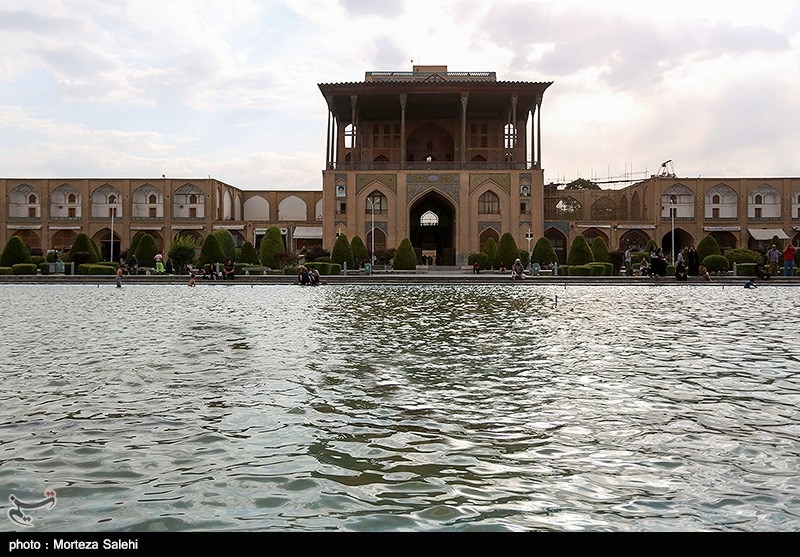
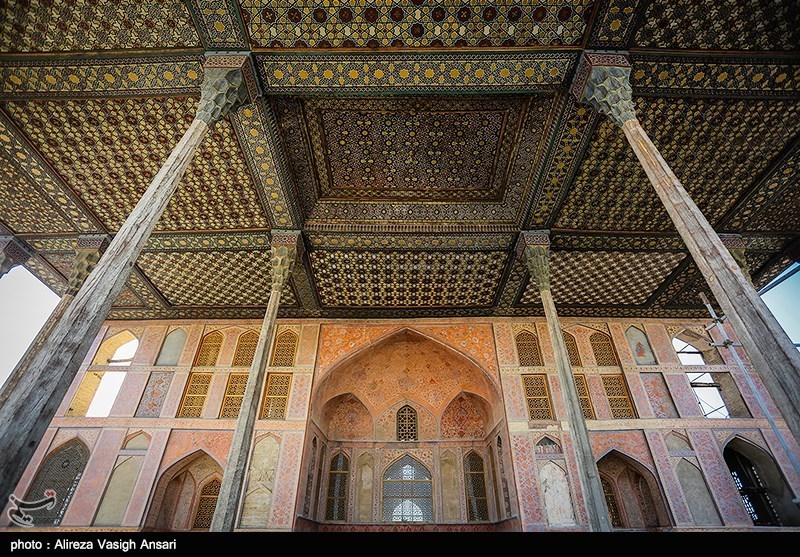
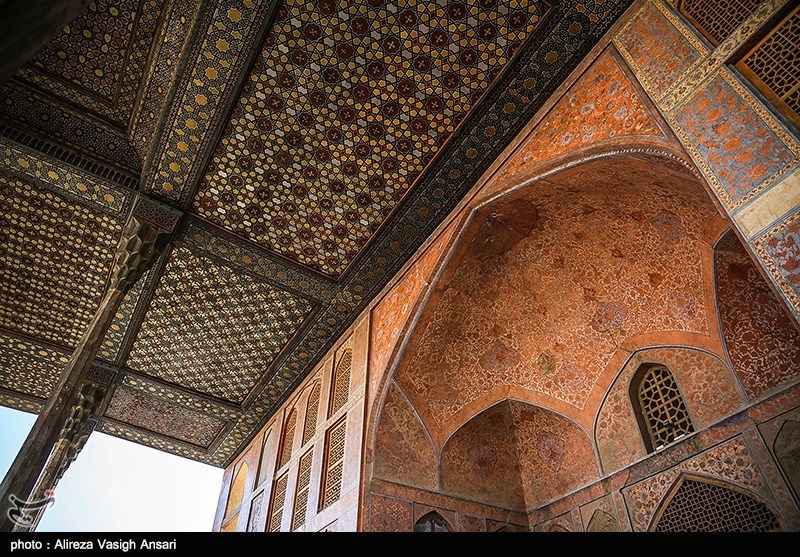
Ali Qapu: A Grand Palace in Isfahan, Iran

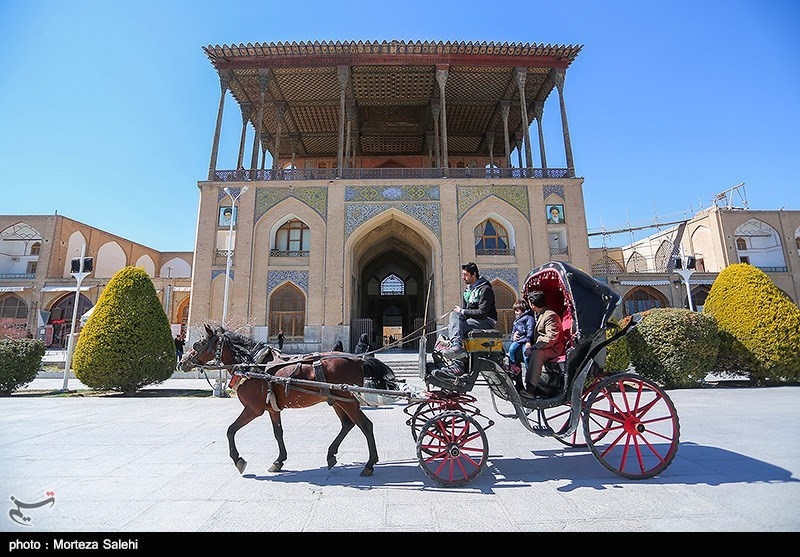
TEHRAN (Tasnim) - At the west of Maidane Immam (Naghsh-e Jahan) in Iran's central city of Isfahan, just in front of the Sheikh Lotfollah mosque, one of the most magnificent palaces of 17th century is located.

The Ali Qapu palace is well-known palace all over Iran. The first part of palace was built in 1597. It was used as a residential palace.
Shah Abbas the great, ordered to construct the palace on the site of palace and garden from the Timurid time. Shah Abbas’s palace was a four floors with a veranda.  Shah Abbas the second, expanded the palace and a music hall (room) was constructed on the top of palace.
The palace is about 38 meters high, the loftiest and tallest building in the 17th century.
There are 52 rooms, but because a long restoration most of rooms are closed to visitors.
Iranian empire, in 17th century was a serious rival to Ottoman Empire. European countries wished to create hostility between two empires. Their plans and plots were successful. In Istanbul of 17th century there was a palace with the same name.
Some of Isfahanologists believe that Shah Abbas the great highly respected the first Shiite Immam Ali. On the other hand Qapu is a Turkish word means,” the magnificent door”.
An old door was replaced from the shrine of Immam Ali in Najaf, to Isfahan. All people even the Shah, when they entered the palace dismounted from horses, in order to respect Immam Ali.
Shah Abbas considered himself as a real follower of Immam Ali. A beautiful door ornamented with gold, silver and other fine arts was made in Isfahan and dedicated to the holy shrine of Immam Ali which is located in Najaf Iraq.
Ali Reza Abbasi the prominent artist has worked on glorious miniature paintings. The main reception hall and all other rooms were decorated with fabulous plaster work, plaster carving and miniature paintings.
There are two sets of staircases to the top floor. Staircases are very narrow only one Person can climb the stairs at the same time. On the west side of the fifth floor, there is a balcony facing to royal gardens, and the palace of Chehel Sotoun. Just on western side in the same neighborhood there is an old monument, called Tohid Khaneh. It was used by Dervishes at the time of Shah Abbas the great. This monument and all rooms enclosed the Tohid Khane’s courtyard, now are used as a part of the Faculty of Fine Arts of Isfahan.
Unfortunately some crazy visitors have damaged lower plaster and stucco works. One of the most attractive parts of the palace is the Verandah, in the third floor. A beautiful panoramic view of the Imam square, the Seljuk old town and also Isfahan can be seen.
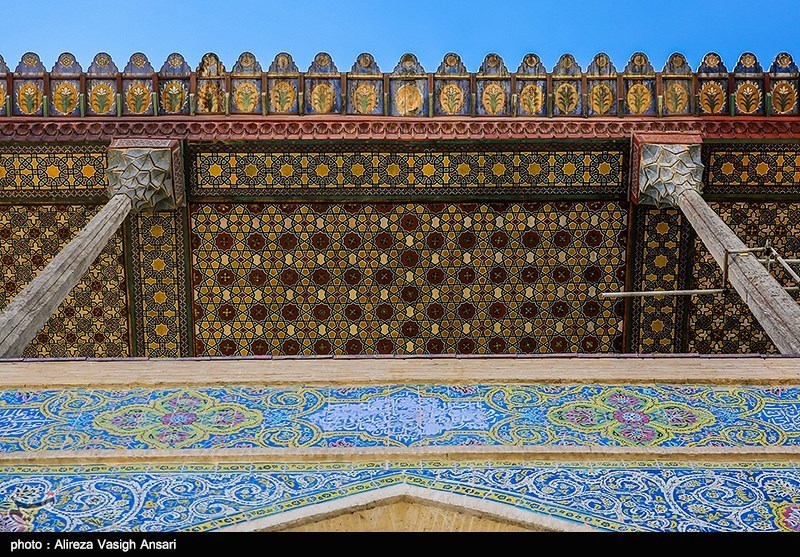
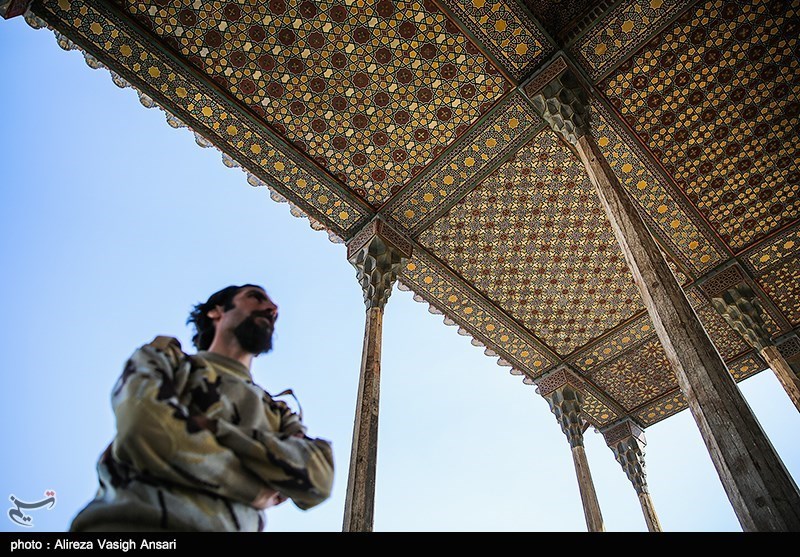
The verandah has 18 wooden pillars in three rows. The ceiling of verandah is a two shell roof. Inner shell is decorated with mirror, and paintings on wood. The outer shell is used as a protection shell. Originally, wooden pillars were decorated with mirror and painted inlaid wood. There is a remarkable pool in the centre of verandah made of copper plates and has fountains. For certain occasions the pool was filled with water, brought to the pool by bucket-wheel (Charkh Ab).
Water was collected from semi deep well and transferred to the pool. Beautiful certains covered three sides of verandah, when privacy needed. The royal family and their guests could watch polo games and different ceremonies from the verandah. On the west of verandah there is a magnificent throne hall decorated with fabulous plaster carvings and miniature painting.
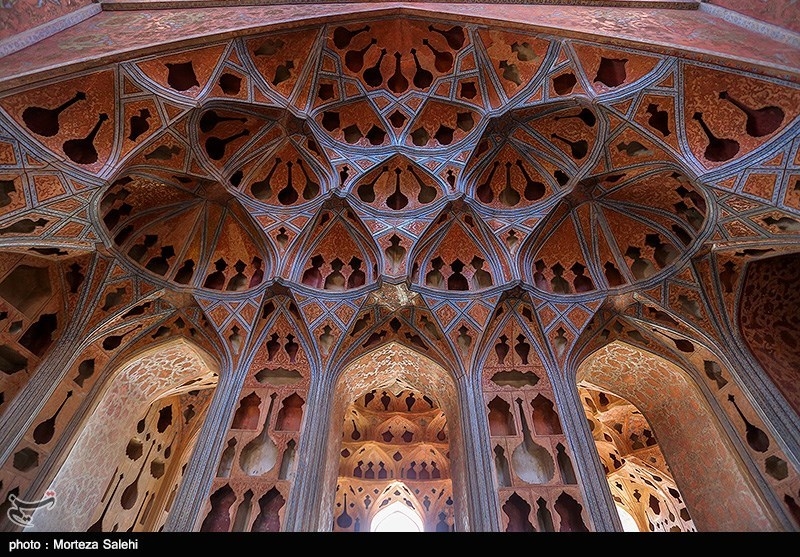
Reza Abbasi and his team of painters have left extraordinary paintings, especially on the ceiling. The last floor of the palace is famous as the music hall. The most unique plaster work has ornamented upper parts and the ceiling. Through this plasters work different imaginary shapes, such as flower vases, dishes, plates and bottle can be seen.
 Music hall’s ornamentation is a new decorative invention of Safavid era. Sad to say that in 19th century magnificent original paintings and gilded decorations were notched and destroyed and a new layer of inartistic plaster work covered original works.
The Ali Qapu palace was fundamentally restored and repaired by Iranian and Italian artists and masters. Different walls and pillars of palace have been strengthened by iron beams. 
Source: Isfahan .ir

Wednesday, February 06, 2019

Sheikh Lotfollah Mosque, cozy and symmetrical

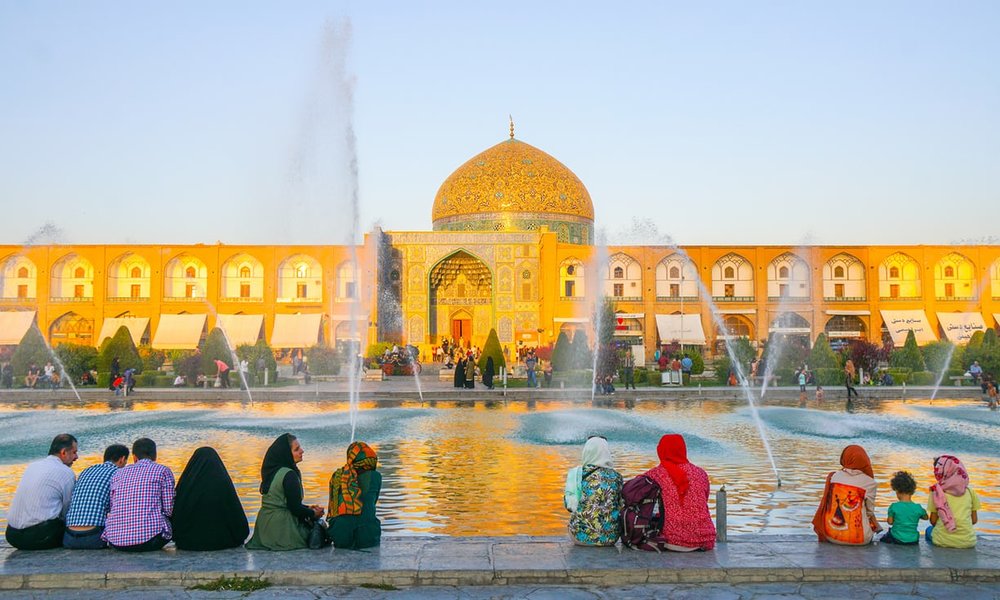
PHOTO: Travelers sit overlooking the Sheikh Lotfollah Mosque in Isfahan. (Photograph: James Strachan/Getty/Robert Harding World Imagery)

TEHRAN – The 17th century Sheikh Lotfollah Mosque in Isfahan, central Iran, is one of the architectural masterpieces of Iranian architecture.
In comparison to many mosques scattered across the country, it appears to be relatively unusual, having neither a minaret nor a courtyard probably because the mosque was never intended for public use, but rather served as a worship place for women.
The Sheikh Lotfollah Mosque punctuates the middle of two-story arcades that are encircling the enormous Emam Square, itself a UNESCO World Heritage site.
Inside the sanctuary, there are thousands of mosaics that adorn the walls and its extraordinarily gorgeous ceiling that features a series of shrinking, yellow motifs, itself a masterpiece of design. Photography is allowed but using a flash is not.
Built between 1603 and 1619 during the reign of Shah Abbas I, the mosque was dedicated to the ruler’s father-in-law, Sheikh Lotfollah, a revered Lebanese scholar of Islam who was invited to Isfahan to oversee the king’s mosque (now the Emam Mosque).
The mosque is also very famous for having a very picturesque dome that makes extensive use of delicate yet very intercalate cream-colored tiles, changing color throughout the day from cream to pink. Some say the sunset is usually the best time to witness the change.
The exterior panels boasts collections of arabesques and floral designs that have become a signature motif of the masterpiece. The portal itself contains some stalactite-type stone carving used to decorate doorways and window recesses with rich concentrations of blue and yellow motifs.
Also known as Naghsh-e Jahan (“Image of the World”), the Emam Square is a public urban square in the center of Isfahan, a city located on the main north-south and east-west routes crossing central Iran. The square is anchored on each side by four magnificent buildings: to the east, the Sheikh Lotfallah Mosque; to the west, the pavilion of Ali Qapu; to the north, the portico of Qeyssariyeh; and to the south, the celebrated Emam Mosque.
According to UNESCO, the Emam Square was at the heart of the Safavid capital’s culture, economy, religion, social power, government, and politics. Its vast sandy esplanade was used for celebrations, promenades, and public executions, for playing polo and for assembling troops.
Under tourists’ eyes:
Here is a select of comments that visitors to the historical mosque have posted to TripAdvisor, one of the most popular travel websites in the world:
‘The most beautiful mosque’
The mosque itself is small but the impact is great. I love the fact that you can lay down and watch the main hall ceiling. The lonely planet describe the ceiling as “harmonious understatement”. I didn't understand it until I saw it in real life. It's harmonious and stunning. (Stephen C. form Canada, visited July 2017)
‘The inside just makes one well up’
Beautiful mosaics - and that doesn't go near to describing it. We sat on the floor staring at the dome – exquisite. (Drift T. from the UK; visited June 2017)
‘The most atmospheric mosque’
From the entrance you walk down a gold clad corridor to this huge domed room which is just breath taking. It is like nothing else we had seen in the whole of Iran. The basement is also worth visiting. (R. Della from United Kingdom; visited April 2017)
‘A must if you are in the square’
Fantastic architecture. The tile work was most impressive. You need a guide to explain it all. Well worth a visit. (Madeleine S. from the UK; visited April 2017)
‘A nice visit’
The amount of mosaic and wall painting is amazing. You can visit the whole Mosque in half hour time.   (Covaltio from Greece; visited January 2017)
‘Magnificent jewel’
After the splendors of the neighboring Shah Mosque, one might expect a visit to the Sheikh Lotfollah Mosque to be anti-climactic… The design provides for an amazing reveal as the visitor turns at the end of the passageway to confront the mosque's hidden magnificence. (Kirk E. form the U.S.; visited Nov. 2016)