Showing posts with label Naghsh-e Jahan. Show all posts

Sunday, September 29, 2019

UNESCO-tagged Ali Qapu receives over 375,000 visitors in H1

TEHRAN – The 16th-century Ali Qapu Palace, an element of the UNESCO-registered Imam Square in Isfahan, central Iran, welcomed over 375,000 visitors during the first half of the current Iranian calendar year (started March 21).
Best known as Naghsh-e Jahan Sq. (literary meaning “Image of the World”), the property is hemmed on four sides by magnificent buildings: to the east, the Sheikh Lotfollah Mosque; to the west, the palace of Ali Qapu; to the north, the portico of Qeyssariyeh; and to the south, the eminent the Imam Mosque.
Amongst monuments of the Imam Square, Ali Qapu Palace received topmost number of visitors during the six month period,”Fariba Khatabakhsh, director of the World Heritage site, said on Wednesday, IRIB reported.
“It drew 375,919 people, 337,525 of whom were domestic and 37,555 were international travelers,” she said.
Over 1,800,000 tickets were sold to visitors of Isfahan’s cultural heritage sites during the six month, the official noted.
During the period, the Imam Mosque attracted 118,858 domestic and 38,955 international travelers, the Sheikh Lotfollah Mosque lured 77,330 Iranian and 31,899 foreign nationals, the report said.
One of Isfahan’s other top destinations, Chehel Sotoun, a 17th-century royal palace, welcomed 300,125 Iranian visitors and 34,277 international holidaymakers, IRIB quoted another tourism official as saying.
Naghsh-e Jahan Sq. was laid out in the very early 17th century under the reign of the Safavid ruler, Shah Abbas the Great, to signal the importance of Isfahan as a capital of a powerful empire.
The sizeable open space has changed little since it was built, the only modern additions are some fountains added during the Pahlavi era. Its vast sandy esplanade was used for celebrations, promenades, and public executions, for playing polo and for assembling troops.
Profusion of tree-lined boulevards, Persian gardens and important Islamic buildings give Isfahan a highly touristic appeal that is unmatched by many other Iranian cities. In addition, the city is home to many versatile artisans who underpin its reputation as a living museum of traditional culture.
Iranians have long termed Isfahan “Nesf-e Jahan”, which literary means “Half of the World”.

Wednesday, February 06, 2019

Sheikh Lotfollah Mosque, cozy and symmetrical

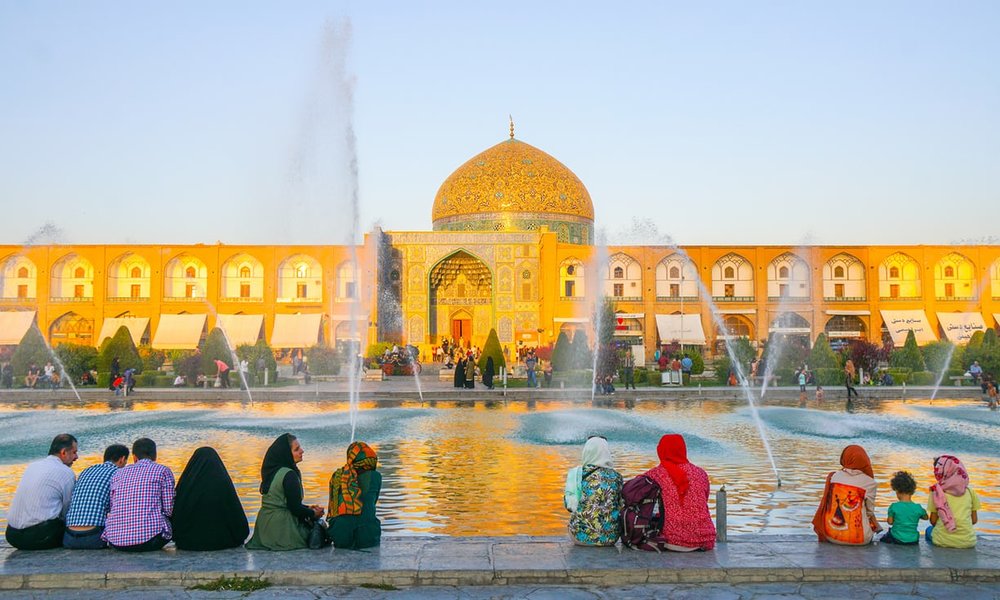
PHOTO: Travelers sit overlooking the Sheikh Lotfollah Mosque in Isfahan. (Photograph: James Strachan/Getty/Robert Harding World Imagery)

TEHRAN – The 17th century Sheikh Lotfollah Mosque in Isfahan, central Iran, is one of the architectural masterpieces of Iranian architecture.
In comparison to many mosques scattered across the country, it appears to be relatively unusual, having neither a minaret nor a courtyard probably because the mosque was never intended for public use, but rather served as a worship place for women.
The Sheikh Lotfollah Mosque punctuates the middle of two-story arcades that are encircling the enormous Emam Square, itself a UNESCO World Heritage site.
Inside the sanctuary, there are thousands of mosaics that adorn the walls and its extraordinarily gorgeous ceiling that features a series of shrinking, yellow motifs, itself a masterpiece of design. Photography is allowed but using a flash is not.
Built between 1603 and 1619 during the reign of Shah Abbas I, the mosque was dedicated to the ruler’s father-in-law, Sheikh Lotfollah, a revered Lebanese scholar of Islam who was invited to Isfahan to oversee the king’s mosque (now the Emam Mosque).
The mosque is also very famous for having a very picturesque dome that makes extensive use of delicate yet very intercalate cream-colored tiles, changing color throughout the day from cream to pink. Some say the sunset is usually the best time to witness the change.
The exterior panels boasts collections of arabesques and floral designs that have become a signature motif of the masterpiece. The portal itself contains some stalactite-type stone carving used to decorate doorways and window recesses with rich concentrations of blue and yellow motifs.
Also known as Naghsh-e Jahan (“Image of the World”), the Emam Square is a public urban square in the center of Isfahan, a city located on the main north-south and east-west routes crossing central Iran. The square is anchored on each side by four magnificent buildings: to the east, the Sheikh Lotfallah Mosque; to the west, the pavilion of Ali Qapu; to the north, the portico of Qeyssariyeh; and to the south, the celebrated Emam Mosque.
According to UNESCO, the Emam Square was at the heart of the Safavid capital’s culture, economy, religion, social power, government, and politics. Its vast sandy esplanade was used for celebrations, promenades, and public executions, for playing polo and for assembling troops.
Under tourists’ eyes:
Here is a select of comments that visitors to the historical mosque have posted to TripAdvisor, one of the most popular travel websites in the world:
‘The most beautiful mosque’
The mosque itself is small but the impact is great. I love the fact that you can lay down and watch the main hall ceiling. The lonely planet describe the ceiling as “harmonious understatement”. I didn't understand it until I saw it in real life. It's harmonious and stunning. (Stephen C. form Canada, visited July 2017)
‘The inside just makes one well up’
Beautiful mosaics - and that doesn't go near to describing it. We sat on the floor staring at the dome – exquisite. (Drift T. from the UK; visited June 2017)
‘The most atmospheric mosque’
From the entrance you walk down a gold clad corridor to this huge domed room which is just breath taking. It is like nothing else we had seen in the whole of Iran. The basement is also worth visiting. (R. Della from United Kingdom; visited April 2017)
‘A must if you are in the square’
Fantastic architecture. The tile work was most impressive. You need a guide to explain it all. Well worth a visit. (Madeleine S. from the UK; visited April 2017)
‘A nice visit’
The amount of mosaic and wall painting is amazing. You can visit the whole Mosque in half hour time.   (Covaltio from Greece; visited January 2017)
‘Magnificent jewel’
After the splendors of the neighboring Shah Mosque, one might expect a visit to the Sheikh Lotfollah Mosque to be anti-climactic… The design provides for an amazing reveal as the visitor turns at the end of the passageway to confront the mosque's hidden magnificence. (Kirk E. form the U.S.; visited Nov. 2016)