Showing posts with label Mohammad Mosaddegh. Show all posts

Saturday, August 10, 2019

How History Shapes Strategic Thinking: The Iranian Case


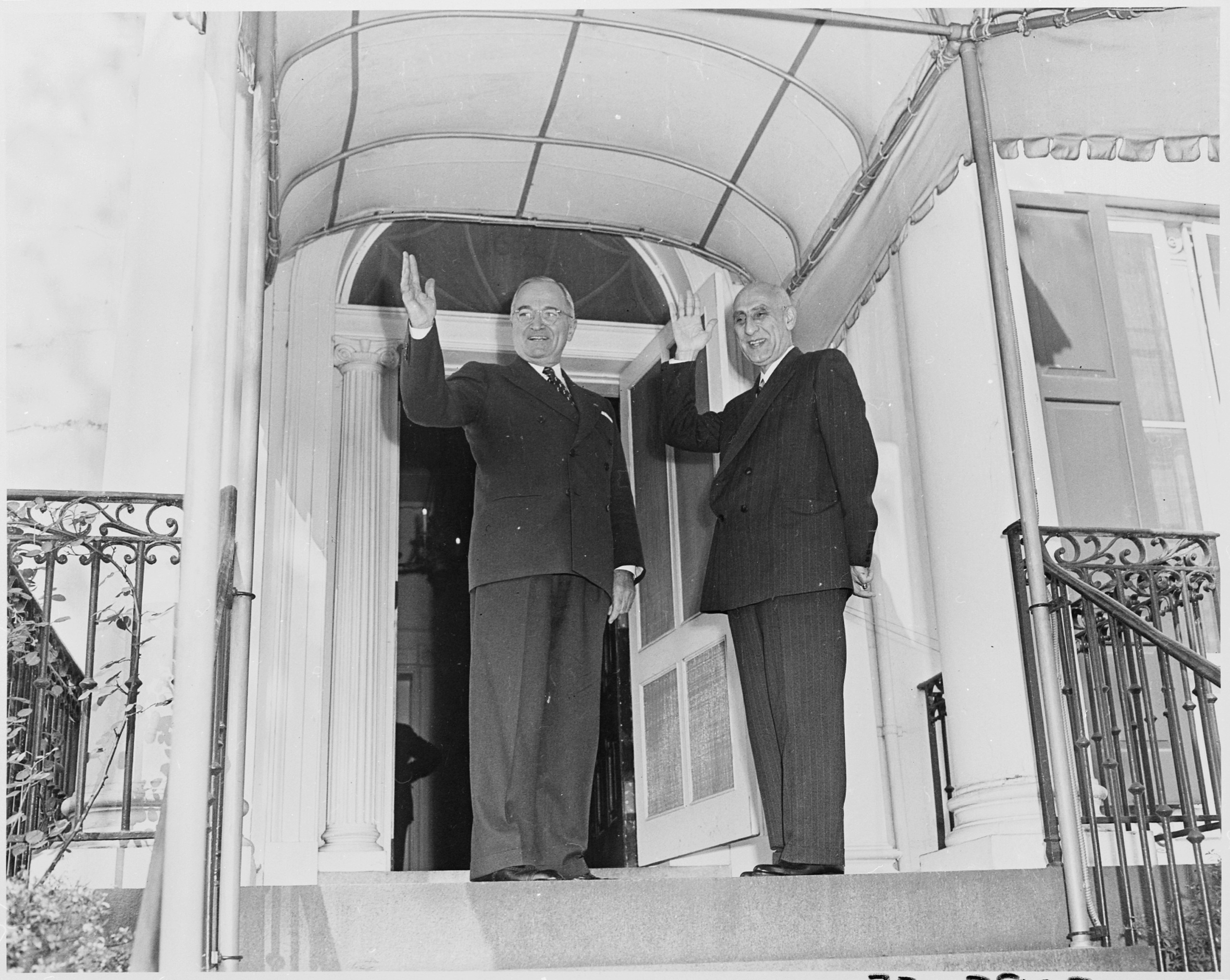
Mohammad Mosaddegh (left) with U.S. President Harry S. Truman (Wikimedia Commons)

by Mohammad H. Pirkoohi
It is almost impossible to decouple the behavior of international players from their historical experiences. From this perspective, history does not belong to the past but to the future. It is a compass that helps anticipate the future policy directions that countries can be expected to take. Within that understanding, three events have basically formed Iranian strategic thinking during the last seventy years and will continue to shape Iran’s foreign policy behavior for the foreseeable future. Even if they so wish, Iranian decision makers—regardless of their political beliefs or worldview—cannot avoid the weight of these three major events. Almost all of the current and future international decisions of Iran and their consequences will be directly linked to these three events, although the impact of one of them is still developing.
The first event is the failure of the constitutionalist movement in Iran following the 1953 U.S.-UK orchestrated coup that overthrew the popular government of Mohammad Mosaddegh for his role in the nationalization of Iran’s oil industry. The coup that restored dictatorship for another twenty five years in the country, engraved the deepest hatred of colonialism in the Iranian mindset. It would not be far from the truth to argue that the seeds of the 1979 Islamic Revolution were sown immediately after the coup. Winston Churchill himself may have had no idea what unforgettable damage he was doing to the Iranian image of the West while he was whispering to Dwight Eisenhower about the falsely exaggerated threat of Communism in Iran.
The reason for this imprudence may have been that the British already had a record of launching successful coups in Iran. However, Iranians had no particularly strong feelings when a British-instigated coup in 1921 ousted Ahmad Shah Qajar, who unlike his ancestors was loyal to the principles of constitutionalism. That military coup wiped a royal dynasty out of Iran’s history and yet it was not the only 20th century success story for the UK. In September 1941, Britain, supported by the U.S. and Soviet Union, intervened again and intrusively ousted Reza Shah, the same king they brought to power in 1921, expelling him from Iran in absolute disgrace. 
Unlike those 1921 and 1941 coups, in 1953 Iranians felt as though their democratic aspirations were defeated by a foreign intervention. Even religious politicians, who at least in public show little attachment to nationalists or nationalism, often bring up this bitter part of Iran’s 20th century history to their supporters. Resentment over the coup still weighs heavily on Iranians’ mindset. It is fair to assert that anger over the 1953 coup provided the motivation, following the 1979 revolution, behind the creation of the Popular Mobilization Forces and the Islamic Revolutionary Guard Corps, or even the occupation of the U.S. Embassy. These measures were basically reactionary moves to prevent a repeat of what happened in 1953.  The coup seems to be one historical event that the Iranians could neither forget nor forgive.
The second event was the eight-year Iran-Iraq war during the 1980s. That war was imposed on Iran by one of the world’s cruelest dictators, Iraqi leader Saddam Hussein, and the whole world—from the Soviet Union to the United States and Europe—offered him their support (an exceptional turn of events, given the Cold War environment). On the other side, Iran—not yet fully recovered from the turmoil of the 1979 revolution—found itself isolated and fighting a full-fledged war. Iran’s historical loneliness in that war was profound. Its inability to secure even rudimentary defensive materiel meant that it could not protect its civilians and soldiers. It is said that Iran had even problem buying barbed wire. When the world turned a blind eye to Saddam’s use of banned chemical weapons against the Iranians, and when the U.S. Navy cruelly eight-year Iran-Iraq war the Iranians learned their lesson. Iranian politicians have realized that, for its security, the country must stand on its own .
The need to strengthen Iran’s military capabilities was a priority for senior decision-makers even before the 1979 revolution. However, the Shah of Iran was of the view that to do so he could fully rely on the United States. Like other tyrants, he had little appetite for listening to dissenting voices, but his view that Iranians were not capable of securing the country against Soviet and Iraqi invasions, and that Iran had no choice but to buy security from the U.S. and to some extent Europe, was shared by many. However, Iran’s post-revolutionary isolation led to a strategic decision that changed the security realities of not only the Persian Gulf region, but the whole Middle East.
Iran’s focus on developing its domestic capabilities, producing relatively inexpensive and not-so-sophisticated defensive tools (speed boats, drones, missiles and cyber warfare capabilities) to encounter highly sophisticated and expensive military equipment, and most importantly its development of an effective asymmetric capability throughout the Middle East, have made any potential aggression against Iran too costly. Unlike the 1980s, should another Saddam in the neighborhood dream of military conflict with Iran, he must think more than twice. In fact, this strategic shift in the regional security environment is the source of the anger in the U.S., in Israel, and among some Arab rulers. It explains to a large extent the drive behind their pervasive Iranophobic campaigns.
Besides the Iran-Iraq war, other major events during the last four decades have further developed the strategic thinking of Iranians as to the way that the country should defend itself. The 1981 pre-emptive attack by Israel against the Osirak nuclear reactor in Iraq and its total destruction, which was viewed around the world as a sign of Israeli strength rather than aggression, was a powerful lesson for the Iranians. However, the wars that followed the September 11 terrorist attacks were the most instructive. The West, led by the U.S., essentially destroyed Afghanistan, Iraq, and, within a few years, Libya, all on the basis of false and erroneous pretexts. Then came Syria’s turn to be crushed. One thing was common in all of these situations: the targeted countries  had developed almost no meaningful means of defense against foreign aggression and inevitably collapsed. The one exception was Syria thanks largely to the defensive capabilities mustered by Iran.
All these developments have opened Iranians’ eyes to reality. During these years, the lessons of the war with Iraq have been repeated over and over, making Iranians even more determined to protect their country against the arrogance and greed of the West. Iranians have realized that Western governments do not take weaker nations seriously enough to negotiate with them. Iranians may have forgiven those behind the Iran-Iraq war, but they have not forgotten its instructive lessons.
More recently came the third historic event: the completion of the 2015 nuclear deal (Joint Comprehensive Plan of Action or JCPOA) and the U.S. withdrawal from that deal in 2018. Though this event’s repercussions are still taking shape, it seems safe to assume that it will leave a lingering and deep impact, on par with the other two events, on the strategic thinking of Iranians. Perhaps similar to Churchill in 1950s, Donald Trump and his inner circle had little understanding of the scars that the U.S. departure from the deal would leave on Iranians’ mindset. Iran entered sincerely into an intensive negotiation process. To prove and guarantee that their nuclear program is solely peaceful, they made significant concessions. In order to relieve international sanctions, Iranians fulfilled in a timely manner, with honesty and without any excuse, all their commitments under the deal. The International Atomic Energy Agency (IAEA), as the agreement’s authoritative monitoring body, has verified in one report after another Iran’s full compliance. In return, what the other parties to the deal did was essentially hopeless. During negotiations, they time and again resorted to good cop-bad cop games. While negotiating, the U.S. continued imposing new sanctions on non-nuclear grounds, casting the shade of dishonesty on the negotiating table. They continued the same path following the conclusion of the deal until Trump found his way to the Oval Office.
Hawkish warmongers in Trump’s administration, along with Iranophobic lobbyists, took advantage of his personal feud with former President Barack Obama and persuaded him to scrap the hard-won deal by the turn of a pen. Instead of appreciating Iranians for their flexibility and for keeping their promises, the Trump administration has targeted the people of Iran with the harshest sanctions ever imposed, sanctions that have been described as “economic terrorism.” The target of the U.S. orchestrated “capitulate-or-else campaign” against Iran and Iranians has been crystal clear: regime change in Tehran or, even better, the obliteration of Iran’s economy and ultimately its annihilation as a country. At the same time, the rest of the parties to the deal, instead of complying with their commitments in accordance with the JCPOA and the related UN Security Council resolution 2231, have chosen to waste time and threaten Iran.
As a matter of fact, the JCPOA is not an Iranian deal per se. It does not belong to Iran. Having been enacted under UN Security Council resolution 2231, its implementation is mandatory for all members of the international community. It is an international security agreement, an advanced non-proliferation text and an outstanding achievement for multilateralism in the field of international peace and security—a win-win solution for all involved parties. It could have been replicated elsewhere as a reliable model for nuclear non-proliferation. However, what happened in practice has been sad yet instructive—sad for international peace and instructive for Iranians. 
The way that the JCPOA was treated by the U.S. revived the lessons of the past seven decades for Iranians. They already knew that powerful players had a repulsive desire to interfere in the internal affairs of weaker countries and to defeat their nationalist and indigenous democratic movements. Iranians had also learnt the lesson that to defy such interference in the future there is no choice but to rely on their own defensive capabilities. It is not yet clear what the combination of these three historic lessons will mean for the future of Iran, the Middle East, and the world. However, the bitter fact that multilateralism has been overweighed by the unilateral coercion of a single state while others exhibited complacency will linger for a long time in the Iranian strategic mindset. Once again, they have learned their lesson.
An alumnus of the College of International Relations in Tehran, Mohammad Hassani Pirkoohi is a career diplomat and currently serves as the Counsellor in the Permanent Mission of the Islamic Republic of Iran to the United Nations.

Friday, July 26, 2019

Iranian Monarchists Praise the Shah’s Brutal Rule on the Anniversary of his Death


On July 27, 1980, Mohammad Reza Shah Pahlavi finally succumbed to cancer in Cairo, Egypt. In 1953, he was installed as the dictator of Iran after the CIA overthrew the democratically elected government of Prime Minister Mohammad Mosaddegh. 
There are a few tributes to the brutal dictator posted on social media ahead of this anniversary. Most are nostalgic for the good old days when the Shah ruled with an iron fist and unleashed his notorious and brutal SAVAK secret police on Iranians opposed to his rule. 
As the corporate media dwells on the mullahs, it doesn’t bother to explain how the Islamic Republic of Iran came to be and why. It’s basically ignored. For those interested, a few links follow.
SAVAK is listed on this page as number six of “10 of the Most Brutal Secret Police Forces in History,” right up there with the Gestapo, the Stasi, and the Khmer Rouge’s Santebal. 
It took a couple decades after the revolution for The New York Times to publish an expose on the Shah’s torture. Years of Torture in Iran Comes to Light.
In 2009, The Inquisitor nominated the Shah “Despot of the Week.” 
The Shah and his family amassed a huge fortune—estimated at $20 billion in 1979—said at that time to be “a staggering sum that would probably exceed or at least equal the wealth of any of the other royal families of Middle East Oil-producing states.” 
“By 1977 [two years before the Revolution] the sheer scale of corruption had reached a boiling point… Even conservative estimates indicate that such [bureaucratic] corruption involved at least a billion dollars between 1973 and 1976,” according to research by IPFS. 
Americans wonder why Iranians chant “Death to America” and “Death to Israel.” Soon after the Revolution, students began compiling an archive of memos, titled “Documents from the US Espionage Den, Iran Embassy—CIA Station 1979.” The documents reveal in detail how the CIA collaborated with SAVAK. 
Ya’acov Nimrodi, Israel’s military attaché to Iran prior to the Revolution, admitted Mossad helped build-up and fine-tune SAVAK. In the book The Iran Contra Connection: Secret Teams and Covert Operations in the Reagan Era, Johnathan Marshall, Peter Dale Scott, and Jane Hunter write that Nimrodi was “the Mossad agent who could properly boast of having ‘built’ SAVAK into an efficient if brutal intelligence service.”
There is much more to the story we’re not told as the media continues to demonize the current government of Iran. The rule of the Shi’a theocracy is a direct result of meddling by the United States, Britain, and Israel. The Iranian parliament (the Majlis) elected Mohammad Mosaddegh and his National Front was popular with the Iranian people. 
The trouble began when Mosaddegh declared Iran’s oil belonged to the people, not the Anglo-Iranian Oil Company. 

Tuesday, February 05, 2019

US has used every possible coercion policy against Iran - and it failed

By: Hossein Mousavian*

Tehran, Jan 30, IRNA - Iranian ex-diplomat and former nuclear negotiator Hossein Mousavian in an article said all the possible coercion policies adopted by the US against Iran have been defeated.

'Over the next two years, this battle will have tremendous effects on the region - but there will be no winner until all concerned parties shift from confrontation to cooperation,' Mousavian said.

The full text of Mousavian’s article that originally appeared in middleeasteye.net is as follows:

Shortly after Secretary of the State Mike Pompeo embarked on a Middle East tour to mobilise US allies to “confront” Iran, his Iranian counterpart, Mohammad Javad Zarif, tweeted that “whenever/wherever US interferes, chaos, repression & resentment follow”. 

From overthrowing the democratically elected government of the late prime minister Mohammad Mosaddegh in 1953, to continuously supporting authoritarian states, to waging wars in Afghanistan, Iraq and Libya, all US interventions have led to the destruction of physical capital and democratic institutions, collateral damage, political instability, displacement and the empowerment of autocratic rulers. 

Where direct military intervention may not be a viable solution, as seems to be the case with Iran, imposing illegal sanctions has been a convenient strategy for the US to exert power and project its hegemony. 'America’s economic sanctions against the regime are the strongest in history, and will keep getting tougher until Iran starts behaving like a normal country,” Pompeo recently said in Cairo.
US coercion policy

From Carter to Reagan, and Bush to Obama, US presidents have long viewed sanctions as an effective means of achieving political gains with respect to Iran. Short of full-fledged military action, the US has deployed every possible coercion policy against Iran - but thus far, it has failed. 

In US President Donald Trump’s era, however, these pernicious policies are being pursued most comprehensively and aggressively. A clique of notorious warmongers, including Pompeo and National Security Adviser John Bolton, have taken key policymaking positions in the Trump administration.

Representing the most radical and conservative factions of the American polity, they have mobilised all their resources not just to put pressure on the Iranian government, but also to possibly overthrow it. 

The US focus is now on garnering further international support to confront Iran. It will host an international summit next month to promote stability and freedom in the Middle East, focusing on Iran’s regional influence. “We’ll bring together dozens of countries from all around the world,” Pompeo said in announcing the 13-14 February event in Poland.

Moreover, top US officials and their Arab allies in the region, along with Israel, hold regular meetings to hatch plots against Iran. This new strategy has economic, political and military dimensions. From violating the terms and conditions of the Iran nuclear deal, to impeding Iran’s European and Asian trade partners, the US has become the flag-bearer of an economic war against Iran. 
Israel’s role

On the military side of this strategy, Israel has vowed to take action if necessary. Prime Minister Benjamin Netanyahu recently said Trump was “acting against Iran at the economic level, and we here in Israel are acting against Iran at the military level”. This is only part of Netanyahu’s warmongering strategy: he also invoked God to destroy the Iranian government. 

Despite these collective effort to “contain” Iran’s regional role, recent developments in the region have seemed to favour Iran, Russia and Turkey. The US and its allies waged wars in Libya, Yemen, Iraq, Syria and Afghanistan, with very mixed results.

In Lebanon, Hezbollah played a key role in the establishment of a cabinet in 2016 headed by Saad Hariri and in the appointment of Hezbollah ally Michel Aoun as president. 

In Syria, Russian and Iranian support for the Syrian government undermined the US regime-change strategy and played a decisive role in preventing the country’s collapse.

In Iraq, Tehran came to Baghdad’s aid to manage a military force in the form of the 120,000-strong Popular Mobilisation Units to liberate Iraqi lands occupied by the Islamic State group (IS). In Yemen, the US and Saudi Arabia are bogged down in a costly war. 

As analyst Jonathan Spyer said, “So far, the Iranians have effectively won in Lebanon, are winning in Syria and Iraq, and are bleeding the Saudis in Yemen.'

Iran has been doing its best to minimise the deleterious effects of the US sanctions. Evading sanctions is an art that Iran has perfected, as Zarif said. Still, there is no doubt that the sanctions have been effectively hitting the Iranian economy.

Iran’s Achilles heel comprises the US sanctions, the US-Saudi-Israeli alliance and its confrontational strategy, and domestic economic problems, such as inflation, corruption, unemployment and political factionalism, which undermine Iran’s internal social cohesion.
Internal divisions

Containing the current political factionalism and social polarisation will be difficult, given upcoming Iranian parliamentary and presidential elections in the next two years, which may further divide the country’s social and political forces. 

Meanwhile, the US domestic Achilles heel, as noted by Andy Surabian, the Republican strategist and former special assistant to Trump, is “that the next two years are going to be nonstop political war”.

On foreign policy, the major US weakness is its strategy of unilateralism, undermining international treaties, losing traditional allies and investing in palaces in the Middle East rather than nations. Pompeo's Cairo speech 'praised dictators and ignored the aspirations of ordinary people. But give the secretary of state this: he was honest,” noted an analysis in Bloomberg. 

In short, the US-Iran duelling over next two years will have tremendous impacts on the region’s political trajectory. In the end, there will be no winner unless all parties divert from confrontation to cooperation. 

*Hossein Mousavian is Middle East Security and Nuclear Policy Specialist at Princeton University and a former spokesman for Iran’s nuclear negotiators. 

Sunday, August 19, 2018

Dangerous Confrontation in The Middle East

The Zionist Khazarian mafia; the shadow government, has been gradually taking control of the American government system since the mid-1940s until it gained total control in our present day. Presidency has been a bought commodity granted to the presidential candidate, who would play as the complete puppet in their hands following their sinister agendas. President Donald Trump represents the ultimate Zionist Khazarian puppet. The ultimate Zionist goal is the establishment of the Greater Israel Project in the heart of the Middle East after destroying every possible rival state in the region.
To protect the Israeli colony, successive American administrations had adopted foreign policies of dividing the Arab World into smaller states, creating chaos and rivalries among them, creating religious and sectarian conflicts, and destroying some strong states while neutralizing and crippling others. One state in the region; Iran, was able to renew itself and stood strong as a major stumbling block to the Zionist project. Israel and the US have recently refocused their aggression on Iran again. Thus, we witness the recent escalating confrontation that could devastate the whole world, not just the region, if it develops into a military action.
The focus on Iran started with the discovery of its vast oil fields in 1908. During WWII an Anglo-Soviet invasion of Iran led to the installation of puppet Mohammad Reza Pahlavi as the shah and the Iranian oil was used to power the Allied forces. After the war, Soviet Union withdrew from Iran but British forces remained. In 1951 Mohammad Mosaddegh was elected as prime minister. He nationalized Iranian oil fields. This action led the US and Britain to orchestrate a coup (Operation Ajax) in 1953 to remove him from power and to reinstate the Shah, who brutally ruled the country for the next 25 years. In 1955 the US and Iran signed the Treaty of Amity to regulate the economic relations between the two countries. The US helped Iran build its first nuclear reactor and provided Iran with weapons grade enriched uranium as part of the Atom for Peace program.
In 1979 the Iranian revolution kicked the Shah out, closed the American embassy taking 53 Americans hostage, and regained control of oil fields. After the failure of Operation Eagle Claw to rescue the hostages the US and Iran signed the 1981 Accord in Algiers according to which Iran released the hostages and the US agreed not to intervene politically or militarily in Iranian affairs. The US, then, pushed Iraq’s Saddam Hussein into eight years war against Iran. Although the war devastated the country, the Iranians used the oil revenue to later rebuild and to modernize their country.
Iran continued to pursue its nuclear program with the help of the Soviet Union. The US then led a western economic sanction on Iran accusing the Iranian government of violating the NPT and demanding to open the nuclear facilities for inspection. After almost 13 years of negotiations the Joint Comprehensive Plan of Action (JCPOA) was signed in 2015 and the United Nations Security Council passed resolution 2231 approving the deal. The Iranian nuclear facilities were opened for IAEA inspectors, who verified 11 times so far that Iran has been complying with the nuclear deal.
Yet the Zionist Khazars were not satisfied with the deal and Israel never stopped lying about the alleged secret Iranian nuclear bomb program. Trump’s administration joined in expressing its dissatisfaction with the Iran nuclear deal stating that it was horrible, one sided and had failed to protect American national security, and eventually unilaterally withdrew from the deal in violation of the UNSC resolution.  Trump wanted to draft what he called a more comprehensive deal that would address the full range of Iran’s activities, including its ballistic missile program and its alleged destabilizing military interventions in the region especially in Syria threatening Israel’s security, and its alleged sponsor of terrorist groups; Lebanese Hezbollah, Palestinian Hamas and Yemeni Houthis; all labeled as terrorist groups by the US, Israel, Saudi Arabia and UAE. Claiming a policy to modify Iranian regime behavior, not a regime change, Trump’s administration demanded that Iran capitulate to a dozen tough demands otherwise suffer the “strongest sanctions in history” as emphatically stated by the Secretary of State Mike Pompeo.
Iran’s sin, as perceived by the American administrations, was its opposition to the Zionist Project of Greater Israel in support for the Arab resistance axis, and its help to Lebanese Hezbollah to liberate Lebanon from the 18 years Israeli occupation (1982-2000). Iran had again armed Hezbollah with weapons and missiles to inflict heavy casualties upon the Israeli army during the 2006 Israeli aggression against south Lebanon. The greatest Iranian sin was its help to Iraq and particularly to Syria to defeat the American/Israeli/Saudi/Qatari created and armed ISIS terrorists.  American Israeli need to curtail and contain Iran became critical especially after the Iran’s nuclear deal opening Iran to the global market.
We cannot stress the following facts enough times. Iran has never initiated a war of aggression against any other country during the last 400 years. The US on the other hand had initiated 222 wars of aggression (by 2017) all around the whole world throughout its 239 years of history or 93% of the time. The US had attacked many countries virtually on every continent using all types of weapons including chemical, biological and nuclear weapons. Since the end of WWII, the US had killed between 20 – 30 million people. American administrations had used lies, fake news, false flag attacks, and manufactured terrorist groups to justify its own many wars.
Israel had initiated 12 wars of aggression against its Arab neighbors throughout its short history of 70 years since its illegal occupation of Palestine, not mentioning its continuous sporadic aggressive bombings against its neighbors; Gaza Strip, Lebanon, Iraq, Yemen and Syria provoking further conflicts.
Iran does not have any military bases outside of its own borders. The US has approximately 800 formal military bases in 80 countries, many of which are surrounding and threatening Iran. Although Israel does not have any military base in other countries, yet its embassies act as its military bases, out of which Mossad’s assassins target whom they consider anti-Israel political and media activists. It is also an open secret exposed by Seymour Hersh’s book “The Samson Option”that these Israeli embassies store tactical nuclear bombs targeting capitals of states and threatening to take down the world if its policies are opposed.
Although Iran has harnessed nuclear energy for peaceful usage as verified many times by IAEA inspectors it does not have any nuclear bomb building program. Iran is a party in the NPT and had opened its nuclear facilities for IAEA inspectors. Although the US is a member in the NPT, yet IAEA inspectors have never published any report of their inspections of any American nuclear facility. It is well known that the US has the largest number of nuclear bombs and although US has committed to taking thousands of warheads offline since 2010 as part of the New START treaty the Trump administration plans to overhaul America’s nuclear bombs and develop new type of low-yield tactical nukes as proposed by Pentagon’s Nuclear Posture Review. Trump wants to update American nuclear weapons to become “… so strong and so powerful that it will deter any acts of aggression by any other nation or anyone else.”
General Jack Weinstein, deputy chief of staff of the US Air Force had announced that the US is in the final stages of a nuclear program of the production of 500 B61-12 tactical nuclear bombs for the cost of over $10 billion. Weinstein stated “we’ve already conducted 26 engineering, development and guided flight tests … the program’s doing extremely well.”
Trump signed Monday August 13th the John S. McCain National Defense Authorization Act with a record-setting $716 billion military spending bill that includes over $21 billion for nuclear weapons programs. Major news outlets neglected to mention nuclear weapons program, rather stressed the trivial fact that Trump did not mention Senator McCain in his speech.  The US allows itself to build nuclear bombs in violation of the NPT but sanctions other countries who allegedly do the same thing.
It is no secret that Israel is a nuclear country. The plight of the Israeli nuclear technician whistleblower; Mordechai Vanunu, is very well known.  Israel started its nuclear program in 1949 with the help of France building Dimona nuclear plant and with stolen American and Belgian nuclear material and technology. Israel had stolen uranium and nuclear technology from the US in what is known as NUMEC Affair (Nuclear Materials and Equipment Corporation in Pittsburgh, Pennsylvania) known also as Apollo Affair. In 1968 Israel had also illegally obtained and smuggled 200 tons of yellowcake from Belgian mining company Union Miniere, in what is known as Operation Plumbat.
It is Israel, not Iran, that has a secret nuclear weapons program as accused by courageous Jill Stein; the 2016 nominee for the American presidency. Israel seemed to have upgraded its nuclear arsenal with smaller tactical bombs and had used them at least twice to bomb its Arab neighbors; once in Yemen and another in Syria. In May 20th 2015 two Israeli F-15 fighter planes painted with Saudi insignia (Saudi Arabia does not have F-15 planes) dropped what is believed to be a neutron bomb on Yemen. It was revealed by Russians that analysis of videos taken of the attack revealed proton bombardment from a neutron bomb. Receiving no international condemnation of this crime, Israel was emboldened and dropped another tactical neutron bomb on Hama, Syria, on Saturday night of 28th April 2018, whose tremor recorded a magnitude of 2.6 earthquake on European seismic monitoring stations. Israel is a rogue nuclear state that is not a party in, and refuses to sign the NPT.
Iran has never created, trained, financed, or armed any terrorist groups to destroy its neighboring countries, but has been fighting them on its own borders with Pakistan, Afghanistan, Turkmenistan, and in Iraq and Syria.  Yet Trump’s administration is accusing Iran of terrorism. Trump accused “no matter where you go in the Middle East, you find the finger prints of Iran.” Actually, it is the Israeli/American terrorist finger prints that could be detected in every Middle Eastern country. The US created, trained, and armed terrorist groups such as ISIS and its sister shoots. When terrorists got defeated in Deir Ezzor American helicopters evacuated their leaders. US and UK had also helped terrorists move back to Europe as reported by BBC. After the liberation of terrorists controlled areas in Syria, such as Ghouta, the Syrian army found large underground storages of American and Israeli weapons, including chemical weapons and American equipment to manufacture chemical weapons (here, and here).
Israel has been supporting terrorist groups in Syria; providing them with weapons, intelligence and even treating injured terrorist fighters in Israeli hospitals. Watch Israeli Prime Minister Netanyahu visiting these terrorists and inciting against Iran. Even the Wall Street Journal has reported that Israel routinely gives secret aid to “Syrian rebels.” Many Israeli weapons were discovered in terrorist underground warehouses. Lately, Israel had rescued many members of the White Helmets terrorist group and their families, and shipped them to Jordan, from where they will be resettled in Europe and Canada as refugees.  The group was reportedly founded by former British army officer and military contractor James Le Mesurier in 2014.
The Zionist plan to destroy Arab states has met strong hurdles due to Russian and Iranian interference. Arab states such as Lebanon, Iraq and Syria entered into alliances with Iran and Russia to protect their citizens from terrorism. Iran’s security lies into the security of the whole region. Russia has military and economic interests in the region.
Since the American/Israeli military wars in the Middle East had failed to produce the sought for results, Trump’s administration is waging now economic wars to push the people to force regime change. The US has re-imposed sanctions against Iran, imposed unfair trade tariffs on China, Russia, Canada, Turkey, and European Union in the hope to impose American will. To protect their economies these countries had retaliated and imposed counter tariffs on the US. To protect its companies doing business with Iran the EU had updated its 1996 Blocking Statute forbidding its companies from complying with the American sanctions legislation unless authorized by the European Commission. China decided to drop the Dollar and use its Yuan in its trade with Iran, which will boost the global value of the Yuan. Germany promised to improve its economic trade with Turkey while Qatar’s prince Tamim bin Hamad promised to invest $15 billion in Turkey.
Iranian president; Hassan Rouhani, responded to Trump’s threat of sanctioning Iranian oil with a warning that also carries what could be a peace offering. “… America should know that peace with Iran is the mother of all peace, and war with Iran is the mother of all wars.” Rouhani stated.  War against Iran would involve at least all American military bases in the Gulf, all the Gulf states, Israel, Lebanon, Syria and Iraq. Turkey, Russia and China may somehow get involved. Iran threatened to close the Strait of Hormuz; the entrance to the Persian Gulf, against all oil exports. Yemeni Houthis also threatened to close Bab al-Mandab Strait; the entrance to the Red Sea, against all marine traffic. These closures would cause great economic impact on the whole world. In Trump’s trade war the US seems to stand alone and isolated. American economy, although the world’s largest, would suffer greatly.
Will Trump’s administration choose “the mother of all wars” or the “mother of all peace” is the question.
Dr. Elias Akleh is an Arab American from a Palestinian descent. His family was evicted from Haifa, Palestine, after the 1948 Nakba when the Zionists stole his family’s property. Then the family was evicted again from the West Bank during the 1967 Naksah, after the Zionist, again, occupied the rest of Palestine.

Saturday, August 19, 2017

Mosaddegh and the coup d'état of 1953

By Mohammad Homaeefar


TEHRAN – Sixty-four years ago, a foreign-backed coup d’état - known in Iran as the 28 Mordad coup - was staged in Iran which saw the overthrow of the democratically elected government of Prime Minister Mohammad Mosaddegh on 19 August 1953 in favor of strengthening the monarchical rule of Mohammad Reza Pahlavi.


Known as Operation Ajax, the coup was carried out after an earlier coup attempt failed to overthrow Mosaddegh and install General Fazlollah Zahedi, the shah’s reliable ally, as prime minister. As a result, Mohammad Reza Pahlavi, the shah of Iran, had fled to Baghdad.
Days before the first coup attempt, Mosaddegh had dissolved the parliament to get rid of the shah’s close allies, giving himself and his cabinet more power to rule, while effectively stripping the shah of his powers. 
With the success of the second coup, Zahedi was installed as prime minister, and the shah returned to Iran and continued to rule more firmly as monarch.
Mosaddegh was then arrested, tried and convicted of treason by the shah's military court. He was sentenced to death, but on the shah’s personal orders, his sentence was commuted to three years in solitary confinement in a military prison, followed by house arrest until his death.
Mosaddegh had also played a key role in the country’s 1951 movement that resulted in the nationalization of oil industry, which had been mainly controlled by the British-owned Anglo-Iranian Oil Company (AIOC), also known as BP.
Experts say the 1953 coup was aimed at securing the West’s oil interests in the country by restoring power to the Shah.
For years, the United States and Britain were blamed for the coup but both governments tried their best to sweep the story under the rug.
In 1989, the U.S. State Department first released coup-related documents, but edited out any reference to American or British involvement. Since then, the omission of CIA’s role has been widely criticized by historians.
Finally, in 2013, the CIA publicly admitted for the first time that it was behind the coup. It also released documents that showed how the British government tried to block the release of information about its own involvement in overthrow of Mosaddegh.
Again, the CIA failed to release all documents. According to Malcolm Byrne, who directs the U.S.-Iran Relations Project at the National Security Archive at George Washington University, the full installment of declassified material was scheduled to be released in 2013, but might have interfered with the Iran nuclear talks and were delayed again.
“This is going to be an important source for anyone interested in the tortured relationship between Washington and Tehran,” said Byrne. “But the fact that it has taken over six decades to declassify and release these records about such a pivotal historical event is mind-boggling.”
In June 2017, the CIA declassified more documents, shedding more light on the agency’s role in the coup, though numerous original CIA telegrams from that period are known to have disappeared or been destroyed long ago. 
The approximately 1,000 pages of documents revealed that the CIA, believing the coup to have failed, attempted to call it off.
“Operation has been tried and failed and we should not participate in any operation against Mosaddegh which could be traced back to US,” CIA headquarters wrote to its station chief in Iran on August 18, 1953. “Operations against Mosaddegh should be discontinued.”
According to Byrne, the message was purportedly and famously ignored by Kermit Roosevelt, top CIA officer in Iran. “One guy was in the room with Kermit Roosevelt when he got this cable. [Roosevelt] said no – we’re not done here.”