Showing posts with label Security Council resolution 2231. Show all posts

Sunday, July 21, 2019

What Iran Could Do To Support The Europeans

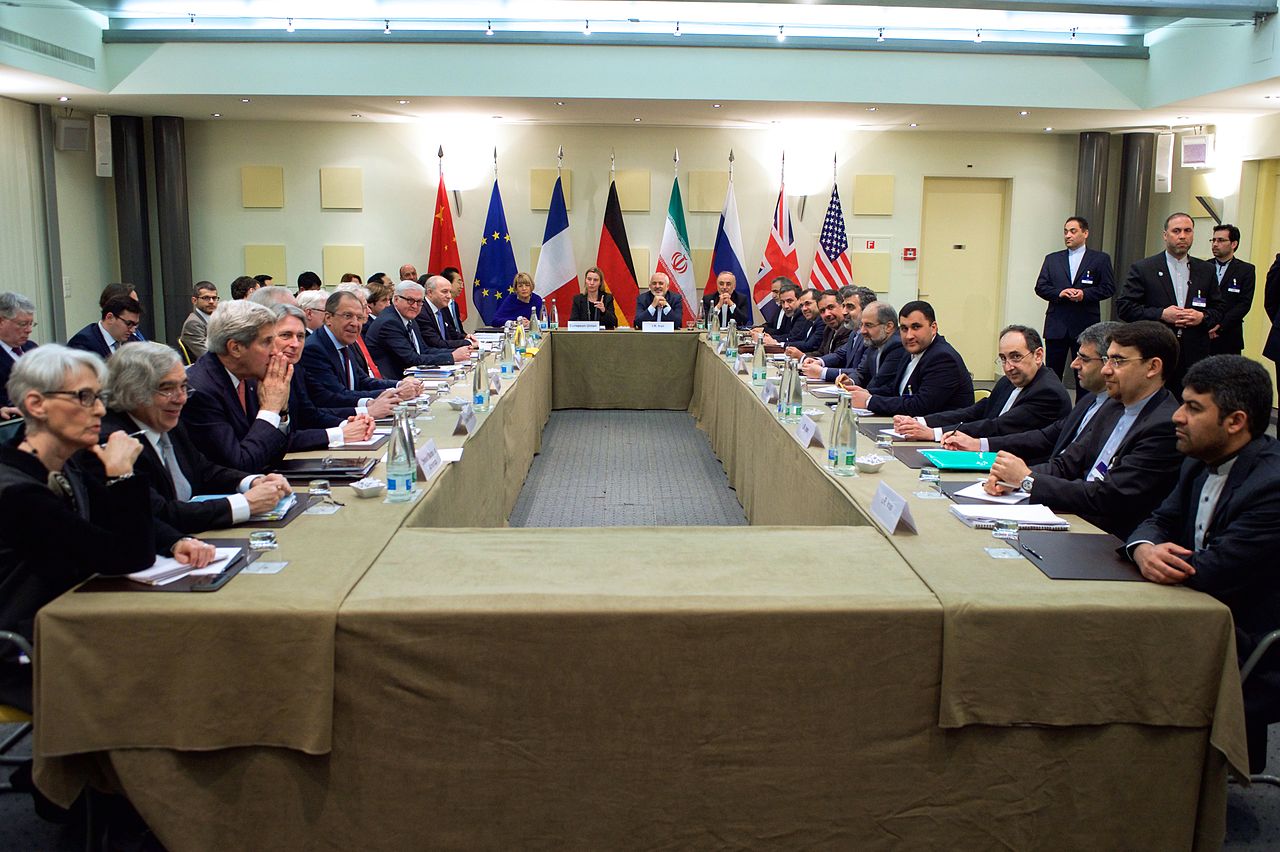
Negotiations over the Iran nuclear deal in March 2015 (U.S. Department of State via Wikimedia Commons)
The EU-3 (France, Germany, and the United Kingdom) and three other UN-Security Council members (U.S., China, and Russia) negotiated an agreement with Iran in July 2015 in Vienna that limited Iran’s nuclear program, known as the Joint Comprehensive Plan of Action (JCPOA). This agreement, widely hailed by arms control experts, is based on a simple formula: in return for relief from U.S. and international sanctions, Iran agreed to accept restrictions on its nuclear program and a robust system of monitoring and verification. In the JCPOA’s preamble, it is stated that Iran’s nuclear program will be exclusively peaceful and Iran will under no circumstances “ever seek, develop or acquire any nuclear weapons”. This sentence is legally binding because it was subsequently enshrined in United Nations Security Council Resolution 2231.
After the Trump administration withdrew from the JCPOA in May 2018, U.S. Secretary of State Mike Pompeo tabled twelve conditions for potential talks with Iran. They included demands that Iran cannot and will not meet. Among them is the demand that Iran end all its uranium enrichment, a request Iran could not accept even before the JCPOA was adopted. Another condition is that Iran opens up all its military—not only nuclear—sites for inspection. No country in the world would allow this. A similar request in an Austrian ultimatum to Serbia once provided the pretense for Austria to enter the First World War. U.S. President Donald Trump has suggested negotiating a “bigger deal” that covers not only nuclear issues but also Iran’s missile program and “regional behavior”. No arms control treaty includes “behavior”. It would have been impossible to negotiate Cold War arms control agreements between the U.S. and the Soviet Union if “behavior” were part of the discussion. Although U.S. officials have since proposed talks with Iran without preconditions, the Iranians have no reason to believe that these conditions would not come back during those negotiations.
Disappointed Iran
Iran has been dissatisfied with European efforts to protect the JCPOA from the effects of the U.S. withdrawal. Most recently, they’ve expressed frustration with the activation of a European financial mechanism (the Instrument in Support of Trade Exchanges or INSTEX), which was designed to counter the impact of U.S. sanctions. European leaders, buckling under U.S. pressure, have dragged out INSTEX’s implementation and have reduced its initial scope in hopes of avoiding a punitive response from the Trump administration.
Because the U.S. withdrawal has nullified nearly all of the benefits Iran was to receive under the JCPOA, Iranian officials have begun to question their adherence to the agreement. They announced earlier this year that they would suspend some provisions of the JCPOA and refer this matter to the Joint Commission and the Advisory Board established by the agreement. The JCPOA permits Iran to take these steps if it believes that one of the signatories is not meeting its commitments under the agreement (Article 26, 36).
It seems clear that the Trump administration’s real issue with Iran is not about the country’s nuclear program. What really seems to concern the U.S. security establishment appears to be its hegemonic regional competition with Tehran. The 2018 U.S. Nuclear Posture Review, which is supposed to address the country’s nuclear strategy, stresses this hegemonic aspect:
Iran views U.S. influence in the Middle East as the foremost threat to Iran’s goal to establish itself as the dominant regional power. Iran is committed to increasing its influence over neighboring countries and countering US influence. This goal directly threatens U.S allies and partners, and Iran’s defense policy, strategy, and force structure indicate an attempt to create exploitable military advantages.
Talking Could Save the JCPOA
Iran wants European leaders to help salvage the JCPOA, but it could be doing far more to support the Europeans. Iran itself could present some offers for the talks with the U.S. Talking alone would not cost Iran much, but it would take pressure off the Europeans and justify their decision to stand by the deal.
What could be achieved in Iran-U.S. talks? Here are some suggestions.
First, both sides can easily agree on a general declaratory statement. They can pledge to renounce hegemonic aspirations in the Gulf region. While this may sound too sweeping, there is a historical analogy to that: the 1972 Shanghai Declaration between U.S. President Richard Nixon and Chinese leader Mao Zedong stated that neither they nor any other power should “seek hegemony in the Asia-Pacific region” and was the basis for the most successful summit meeting during the Cold War. China’s support for insurgents across Asia declined after the meeting.
There is another parallel between the current situation and Nixon’s outreach to China. In the early seventies the U.S. was looking for ways to reduce its presence in Asia and to end the war in Vietnam. President Trump has announced several times that he wants to decrease the U.S. military presence abroad. A declaration along the lines of the Shanghai Declaration would give him a justification for a further reduction of U.S. troops in the Middle East. There is also some discontent among Iranians about the resources their government spends in other countries. Such an agreement could give Iranian authorities an argument to decrease these expenses.
Second, addressing the missile issue outside the JCPOA could alleviate the pressure the U.S. puts on Europe to punish Iran. A missile accord should involve other regional powers like Saudi Arabia, whose missiles already have a longer range than those of Iran. Other heavy weapons could be included as well. A model could be the 1990 Treaty on Conventional Armed Forces in Europe. That accord covers tanks, artillery, armored combat vehicles, combat aircraft and attack helicopters. The talks could be accompanied by confidence-building measures, such as an exchange of military information and notification of certain military activities. The provisions of the JCPOA could serve as an example. Such talks could well take place within the framework of the “Regional Dialogue Forum” and new security networks suggested by Iranian Foreign Minister Mohammad Javad Zarif. The European signatory states of the JCPOA could make efforts to promote such security dialogue.
Third, Iran could pledge to join the Central Asian Nuclear Weapon-Free Zone (CANWFZ) treaty provided the USA ratifies the protocol of the treaty, which provides assurances not to attack or threaten to attack parties to the zone with nuclear weapons. A similar project in the Middle East has not made any progress for decades because of U.S. resistance in the UN Security Council. Geographically, historically, and culturally, Iran is closer to the countries of the Central Asian treaty (Kazakhstan, Kyrgyzstan, Tajikistan, Turkmenistan, and Uzbekistan) than to its Arab neighbors. This move would add an additional security layer to the JCPOA, perhaps placating skeptics who are concerned that some of its provisions are set to expire.
To come closer to the implementation of a nuclear weapon-free zone in the Middle East, the African Nuclear Weapon Free Zone (ANWFZ) treaty could be extended north to include the Arab states. Egypt has already signed but not ratified the treaty. If the Arab states and Iran are serious about the creation of a nuclear weapon-free zone in the Middle East, they should support this idea and try to join one of these already existing treaties. The Arab states and Iran would not have to give up anything themselves to do so.
Israel would not join any NWFZ treaty immediately, even if other states in the region did so. However, if Iran, Egypt, and Saudi Arabia were to become members of one of those zones, it would give Israel a greater feeling of security. At the same time, the rationale for Israel to possess nuclear weapons would also change over time. This stability might pave the way for Israel to join a zone at a later time.
To conclude, if President Trump is serious about his offer to meet with Iranian leaders “anytime they want to”, Iran should make use of the opportunity. Tehran itself could offer to talk. This would not cost Iran, but could go a long way toward bolstering international support for the JCPOA.
Dr. Heinz Gärtner is lecturer in the Department of Political Science at the University of Vienna and at Danube University. He was academic director of the Austrian Institute for International Affairs. He has held various Fulbright Fellowships and the Austrian Chair at Stanford University. He was Austrian Marshall Plan Foundation Fellow at the Johns Hopkins University in Washington DC. Among other things, he chairs the Strategy and Security advisory board of the Austrian Armed Forces, is a political analyst at the International Institute for Peace in Vienna, and an expert for EU and Euratom programmes at the European Commission. Heinz Gärtner ist editor (together with Mitra Shahmoradi) of the book “Iran in the International System: Iran between Great Powers and Great Ideas” (Routledge, January 2020).

Saturday, January 12, 2019

New Dimensions of human rights violations - Zaeri Amirani


article_imageAlmost every day when browsing through the media, a new sanction by the U.S. government on other countries comes up. They are applied so frequently that it seems imposing sanctions has become the favorite pastime of the U.S. The sanctions which are so called "punitive", are imposed on any state that acts against the will of the U.S. says says Iran’s Ambassador to Sri Lanka Zaeri Amirani.


The Ambassador said that although such measures were meant to target governments and force them to back down, the ultimate victims were the people.


"The sanctions and its political, economic and legal aspects have been widely addressed by politicians and the mass media, but its impact on the people in the country receiving the sanctions has received less attention. A significant matter that relates to some basic rights of the people and disregarding it, could be considered a form of human rights violation.


The Universal Declaration of Human Rights, proclaimed by the General Assembly in 1948, entitles all people to have the right to life, liberty, nationality, freedom of thought, conscience and religion, the right to work and to be educated and the right to food and housing. All economic sanctions targeting any state will directly influence the people and their quality of life, hence depriving them of a normal life, is in contradiction with human rights principles.


When it comes to Iran, sanctions go beyond the limits and take newer forms to fulfill multi–pronged purposes. Sanctions become a race for the U.S. and its allies to compete on imposing the strongest restrictions and to boast about. The history of sanctions against Iran dates back to almost four decades. The first sanctions along with freezing Iran’s assets, which kicked in against the country in 1979 and aggravated by eight years of Saddam imposed war, inflicted heavy casualties and grievous sufferings on the Iranian people.


Imposition of severe sanctions on Iran, which at times are eased in parts and reimposed again, has been an inalienable part of U.S. policy towards Iran during the past forty years. However, it’s not the sanctions per se that are important here, but it’s the double standards approach on human rights and its philanthropic gesture towards Iranian people that matters.


Many instances of violation of Iranian people’s rights can be seen, by taking a brief glance at what is happening in the international arena. The U.S. decision to unilaterally withdraw from the Iran nuclear deal and rejecting recent ruling by the International Court of Justice ordering Washington to lift restrictive measures linked to humanitarian trade, food, medicine and civil aviation are the most recent cases to name a few.


The nuclear deal, formally known as the Joint Comprehensive Plan of Action (JCPOA), was finalized in 2015 in Vienna by Iran and six world powers and endorsed by United Nations Security Council Resolution 2231, to restrict Iran nuclear program in return for the lifting of sanctions. Needless to mention that all member states are required to commit themselves to implement the JCPOA and normalize their economic, trade and banking relations with Iran.


The US pulled out of the agreement in May 2018 and reimposed tough sanctions on Iran. It’s so much surprising that a UN member blames and imposes sanctions on a country which abides by the UN Security Council resolution. Worse is to persuade other members to cease implementing the JCPOA by cutting their ties with Iran and threatening to punish countries and companies which keep their cooperation with Iran. This is a true indication of unilateralism and disrespect to international norms and a clear breach of international law.


It goes without saying that violation of international treaties, imposition of oppressive sanctions against innocent people, bullying, intimidation and lack of basic decorum for nations and cultures, results in extremism in the world, which in turn leads to turmoil, bloodshed and finally violation of human rights", the Ambassador said


Ambassador Amirani, quoting Iran’s famous 13th century poet Saadi said ;


Human beings are members of a whole In creation of one essence and soul If one member is afflicted with pain Other members uneasy will remain If you have no sympathy for human pain The name of human you cannot retain.

Wednesday, September 26, 2018

Rouhani: Sanctions and extremism are the same

'Confronting multilateralism is not a sign of strength; rather it is a symptom of the weakness of intellect'
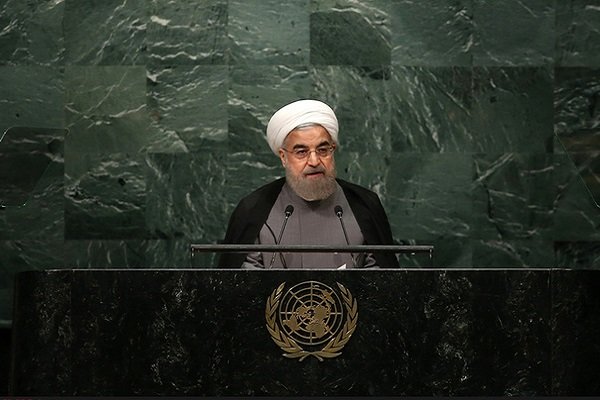
President Hassan Rouhani of Iran tells the United Nations General Assembly that “sanctions and extremism are two sides of the same coin”.
Following is the text of his speech:
In the name of God, the Merciful, the Compassionate
“Praise be to God, the Lord of the universe and Peace and Blessings be upon the Messenger of God and his Family and Companions”
Madam President,
I take this opportunity to felicitate your election to the presidency of the 73rd Session of the United Nations General Assembly.
We have assembled here today as the world is suffering from the recklessness and disregard of some states for international values and institutions. The message of our presence here is that the preservation of interests and security in the world in the least costly manner is solely possible through the cooperation of, and coordination among, countries. However, it is unfortunate that we are witnessing rulers in the world who think they can secure their interests better—or at least in the short-term ride public sentiments and gain popular support—through the fomenting of extremist nationalism and racism, and though xenophobic tendencies resembling a Nazi disposition, as well as through the trampling of global rules and undermining international institutions; even through preposterous and abnormal acts such as convening  a high-level meeting of the Security Council.
This illusion should be cast away, once and for all, that one can aspire to securing more peace and security at the cost of denying others’ peace and security. We should not allow the breathing space for and growth of the line of thinking that holds others to ransom through the artificial creation of insecurity. Along this tack, confronting multilateralism is not a sign of strength; rather it is a symptom of the weakness of intellect—it betrays an inability in understanding a complex and interconnected world.   
Under such circumstances, negligence or inefficacy of international institutions can endanger world peace. Those seeking dominance and hegemony are enemies of peace and the perpetrators of war.
The government of the United States—at least the current administration—seems determined to render all international institutions ineffectual. This government, having withdrawn from a multilateral agreement adopted by the Security Council, in contravention of the rules and norms of international law, invites the Islamic Republic of Iran to bilateral talks. An administration that is inviting Iran to engage in talks is not ready to consult its own experts nor willing to recognize the requirements of a modern state, including the paramount principle of continuity of state responsibility, and hence openly violates state obligations undertaken by its predecessor.
On what basis and criteria can we enter into an agreement with an administration misbehaving such as this? Any talks should be within the framework and in continuation of the JCPOA and Security Council resolution 2231, and not in a framework of breaching them and reverting to the past. It is ironic that the US government does not even conceal its plan for overthrowing the same government it invites to talks!         
Distinguished Colleagues,
The approach of the Islamic Republic of Iran in the field of foreign policy has been based on multilateralism and compliance with the recognized principles of international law. Our respect for the Non-Proliferation Treaty and the long and difficult negotiations with the Group of 5+1, which led to the conclusion of the Joint Comprehensive Plan of Action—the JCPOA—illustrates a clear manifestation of this approach.
We are pleased that the international community did not acquiesce to the US government’s unilateral and illegal withdrawal from the JCPOA, and adopted a categorical position vis-à-vis that decision. The JCPOA is the outcome of more than a decade of diplomatic efforts and a period of intensive negotiations to resolve an artificial crisis. This document was unanimously approved by Security Council resolution 2231 and codified into an international obligation. According to this resolution, all countries and international and regional organizations were called upon to support the implementation of the JCPOA, and to refrain from any actions that undermine implementation of commitments under the JCPOA.
Confronting multilateralism is not a sign of strength; rather it is a symptom of the weakness of intellect—it betrays an inability in understanding a complex and interconnected world.Based on 12 consecutive reports of the International Atomic Energy Agency – the IAEA – Iran has thus far complied with all of its commitments. However, the United States, from the very beginning, never remained faithful to its obligations. Later, the current administration, resorting to flimsy excuses and in open violation of its commitments, finally withdrew from the accord. The United Nations should not allow its decisions to fall victim to the domestic election and propaganda games of some of its members, and should not allow any Member State to dodge the execution of its international commitments.  
Additionally, the United States also pressures other countries to violate the nuclear accord. And more dangerously, the United States is threatening all countries and international organizations with punishment if they comply with Security Council resolution 2231. It is the first time in the history of the United Nations that such ‘a general invitation to violation of law’ is coupled with ‘threatening law-abiders with punishment.’ This is not just peculiar to the JCPOA, but a pattern that even applies to the US approach to the International Criminal Court. 
We appreciate the efforts of the international community, the European Union, Russia, and China in supporting the implementation of the JCPOA and consider the full realization of the commitments stipulated in it a precondition for the survival of this significant accomplishment of diplomacy. 
Ladies and Gentlemen,
Unlawful unilateral sanctions in themselves constitute a form of economic terrorism and a breach of the ‘Right to Development.’ The economic war that the United States has initiated under the rubric of new sanctions not only targets the Iranian people but also entails harmful repercussions for the people of other countries, and that war has caused a disruption in the state of global trade.  
The Iranian people have demonstrated their unwavering resilience during the past forty years despite the difficulties and constraints caused by sanctionsand have shown that they can overcome this difficult phase as well. The multi-millennial history of our country demonstrates that Iran and Iranians have never broken in the face of a storm of events—not even been bowed. I state here, in clear, unambiguous terms, that the United States policy vis-à-vis the Islamic Republic of Iran has been wrong from the beginning, and its approach of resisting the wishes of the Iranian people as manifested in numerous elections is doomed to failure. Iran, with its historical and civilizational longevity, rich cultural heritage, and foremost geopolitical position, is an undeniable reality. The policy of engagement and cooperation with Iran has produced positive outcomes for other nations, as best reflected in Iran’s cooperation with friendly countries in the fight against terrorism. 
The United States’ understanding of international relations is authoritarian. In its estimation, might makes right. Its understanding of power, not of legal and legitimate authority, is reflected in bullying and imposition. No state and nation can be brought to the negotiating table by force, and if so, what follows is the accumulation in the ‘grapes of wrath’ of those nations, to be reaped later by the oppressors.
It is the first time in the history of the United Nations that such ‘a general invitation to violation of law’ is coupled with ‘threatening law-abiders with punishment.’We concur that, at the end of the day, there is no better way but dialogue. However, dialogue is two-way: it should be based on equality, justice, and human integrity and honor, and conducted in accordance with the rules and norms of international law. UN Security Council resolution 2231 is not a ‘piece of paper’. We invite you to return to that Council resolution. We invite you to come back to the negotiating table you left. If you dislike the JCPOA because it is the legacy of your domestic political rivals, then we invite you to come back to the Security Council resolution. We invite you to remain in the international institutions. Do not engage in imposing sanctions. Sanctions and extremism are two sides of the same coin: Extremism involves negating the thinking of others, and sanctions negate the life and prosperity of people.     
For dialogue to take place, there is no need for a photo opportunity. The two sides can listen to each other right here in this Assembly. I am starting the dialogue right here, and state—in unequivocal terms—that the question of international security is not a toy in American domestic politics. The United Nations is not a  part of the United States administration. Dialogue can resume in this Assembly from the same point and by the same person who left the dialogue table, and walked away from the accord. Beginning the dialogue starts with ending threats and unjust sanctions that negate the principles of ethics and international law.
Our proposal is clear: commitment for commitment; violation for violation; threat for threat; and step for step, instead of talk for talk.
What Iran says is clear: no war, no sanctions, no threats, no bullying; just acting according to the law and the fulfillment of obligations. We support peace and democracy in the entire Middle East. We consider nuclear knowledge an imperative and nuclear weapons prohibited.
It is ironic that the US government does not even conceal its plan for overthrowing the same government it invites to talks! As victims of terrorism in the past and today, we have always been and will always remain in the forefront of genuine confrontation with terrorism.  Today, we mourn the martyrdom of tens of innocent people, who were recently murdered in cold blood by terrorists who shamelessly accepted responsibility from a number of Western capitals for their heinous crime in interviews with some Western-based broadcasting outfits that are financed by petrodollars. In Iran we have condemned all acts of terrorism without equivocation and will continue to do so.  We welcome the strong statement from the Security Council on this issue. But why can the leaders of these terrorist operations – including the organization that has publicly claimed responsibility for Saturday’s crime—live and operate freely in Western countries, and even openly solicit funds?  Are these activities not in violation of international counter-terrorism norms? Why have the official State-financiers of anti-Iranian terrorist organizations –with their record of financing Al-Qaeda, ISIS and al Nusrah—not only been spared any punishment but are supported and armed? If you want the world public to take your claim of fighting terrorism seriously, it is imperative to start a joint global campaign to fight this scourge, irrespective of the victims or culprits.
Distinguished Colleagues
In the same vein, from the very beginning of the crisis in Syria, we have warned against any foreign intervention in the internal affairs of this country and the use of unlawful means, including supporting extremist and terrorist groups in order to exert pressure on the government of Syria, and have consistently emphasized that the crisis can only be resolved through intra-Syrian dialogue. To this end, the presence of our military advisors in Syria has been at the request of the Syrian government and consistent with international law, and has aimed at assisting the Syrian government in combatting extremist terrorism. Iran, Russia, and Turkey, in cooperation with the government of Syria and other Syrian parties, have succeeded through the Astana Process, the third summit meeting of which took place in Tehran earlier this month, in playing a positive role in reducing tension in Syria, and in their last common effort have prevented escalation and bloodshed in the Idlib region. 
We have witnessed a tragic humanitarian catastrophe in Yemen over the past three years which has caused the destruction of infrastructure, the killing and injury of hundreds of thousands, the displacement of millions of innocent people, and the occurrence of widespread famine and chronic diseases. These inhuman acts represent clear examples of crimes against humanity and war crimes. The crisis in Yemen can be resolved solely through intra-Yemeni talks and without foreign interference. And to this end, we are ready to assist in any possible way. 
The most pressing crisis in the Middle East, however, is the question of Palestine. The passage of time cannot – and must not –justify occupation. The innumerable crimes of Israel against the Palestinians would not have been possible without the material and military assistance, and political and propaganda support of the United States. Israel, equipped with a nuclear arsenal and blatantly threatening others with nuclear annihilation, presents the most daunting threat to regional and global peace and stability
The abhorrent U.S. decision to transfer its embassy in Israel to Jerusalem, and the recent enactment of the racist Jewish State law are violations of international law and norms, and unmistakable manifestations of apartheid.
Madam President,
The expansion of relations with neighbors and the creation of a more secure and more developed region are among the main priorities of Iran’s foreign policy. A few weeks ago Iran, along with the other four coastal states, signed the Convention on the Legal Status of the Caspian Sea, which will strengthen good-neighborliness and bring prosperity and progress for all of the coastal states. We also desire the same relations with our southern neighbors in the Persian Gulf. We believe in the formation of a collective mechanism for the Persian Gulf region with the presence and participation of all regional countries. The security of the Persian Gulf and the Strait of Hormuz has always been important for us, and just as we defended this security during the war imposed on us by Iraq, we will confront any and all disruptive efforts in this critical waterway in the future.
We espouse a peaceful view in  political and international issues and have not sought, nor do we seek, war with any country. Iran does not need an empire. Iran is an empire in terms of its civilization and its culture; not through political domination.
Iran has served as the link between east and west and will continue to do so; remaining a meticulous guardian for a world free from violence.
The Islamic Republic of Iran is the same state that understood the fascistic nature of the Ba’athist regime in Iraq before anyone else in the world, and bravely resisted its aggression against us. We fought against the Ba’ath Party of Iraq beforeKuwait was occupied by it.
The Islamic Republic of Iran is the same state that was on the forefront of the struggle against Taliban terrorism, and gave up martyrs in that struggle. We fought against Al-Qaida and the Taliban before the attacks on New York and Washington.
The Islamic Republic of Iran is the same state that fought against Daesh – a fake, distorted representation of Islam. We were engaged in the fight against Daesh before their operations in Paris, London and Brussels.
Appreciate these historical realities about Iran. Quit imposing sanctions and end extremism. The world will not have a better friend than Iran, if peace is what you seek.   
I thank you for your attention.