Showing posts with label Saudi and UAE. Show all posts

Monday, August 26, 2019

The US Keeps “Promoting Peace and Stability” with its Record Weapons Sales

 By Jean Perier

USW
Among those major geopolitical challenges the world faces these days, the so-called arc of instability that stretches from North Africa to Pakistan is by far the most pressing one. The volatile situation in the Middle East has turned those states that used to enjoy relative stability into potential war zones due to Washington’s extensive meddling in Iraq, Libya, Syria and even Egypt. Should this region be plunged into the depths of a wider regional conflict, the repercussions for the rest of the world are going to be grave, including such developments as soaring global oil prices, a massive migrant influx, along with an ever increasing number of those young men opting to stay in the region in a bid to join those radical terrorist organizations that do not seem to experience any shortage of capital no matter what.

However, in a bid to carry on enjoying their super profits US military contractors carry on pumping weapons into the region, refusing to defuse the potentially catastrophic situation, as Washington makes one bold statement against individual regional players after another. This conviction of the US that there’s no peace on the table in the Middle East can be witnessed in its continuous attempts to establish the so-called Sunni Arab “NATO”

Last February, in its typical fashion Voice of America would try to create a favorable media buzz by solemnly announcing to the rest of the world that the US would summon high-profile representatives of 60 states in Warsaw to discuss the prospects of its new Middle Eastern military block. However, there was no mention of the fact that Mike Pompeo had to change the agenda of the summit, as there was no more than a handful of participants willing to discuss “Iran’s destabilizing role.” Yet, the number of states that would participate in the summit re-branded as the discussion aimed at the promotion of peace and stability in the Middle East shows that most international players have no interests in searching a casus belli against Tehran. Nevertheless, the US Secretary of State couldn’t prevent himself from revealing the original plan behind the Warsaw summit, as he would outline the steps that Washington was going to make in its opposition against Iran.

However, those were hardly a secret as new weapons shipments continue arriving at a number of Middle Eastern states without delays, which blows the lid off an active phase of war preparations. According to the data presented by Stockholm International Peace Research Institute (SIPRI), the sheer volume of the arms trade between certain regional players and the West is large enough to fuel an all-out regional conflict for years.

In particular, it’s been revealed that Middle Eastern arms imports accounted for 35% of global arms imports in the 2014–18 timespan. Over the last five years the number of small arms, armored vehicles and munitions purchased across the region has almost doubled.

It should be noted that a total of four regional players entered the list of top 10 largest importers of weapons over the five year span: Saudi Arabia (1st place in the global rating with a share of 12%), Egypt (3rd place in the global rating with a share of 5.1%), the United Arab Emirates (7th place with a share of 3.7%) and, curiously enough, there’s Iraq on that list (8th in the global rating with a share of about 3.7%).

The ever increasing number of arms deals being signed by the leading players of the region is of particular concern against the backdrop of the possible development of the situation in the region. Thus, the growth of arms imports in 2014–2018 compared to the period of 2009–2013 showed that Egypt has more than doubled its arms imports with a 206% increase, Saudi Arabia coming second with its 192%, with Iraq (139%) lagging slightly behind. However, over the same period of time, Qatar showed an increase of 225%, while Israel is topping the charts with its 354%.

What that essentially means is that even those regional states that had no original intention of fighting anyone are getting more susceptible to being drawn into a shooting conflict. It goes without saying that the absolute majority of American, French and British weapon systems shipped to the region are being delivered to the Persian Gulf that remains riddled with internal contradictions.

It’s hardly a secret that the United States remains the world’s biggest exporter of weapons that controls 36% of the market. Over the last five years it has shipped its weapon systems to some 98 countries of the world, with pretty much every single conventional item of its arsenal being for sale, starting with modern armored vehicles and ending with short-range ballistic missiles. At the same time, France wants its own piece of the market, increasing its weapons sales by 43% over the last five years.

Of course, it’s hardly a secret that well over 50% of all the weapon systems sold by the above mentioned players are being shipped to the Middle East, with Britain selling some 60% of its fighter jets to Saudi Arabia and Oman.

It’s safe to say that these days nobody wants to know where those weapons Washington, Paris and London sold are going to be deployed, as long as they are being paid for in hard cash. However, with the Middle Eastern region remaining the most unstable part of the world it’s simply irresponsible to carry on dumping weapons into this conflict-ridden land. The US behavior starts looking even more morally bankrupt if you take into consideration the fact that to this very day Washington remains the self-proclaimed world gendarme that is engaged in virtually every single military conflict that breaks out across the globe, which means that it has a vested interest in protracting those instead of assisting the parties involved in their attempts (however genuine) to find a peaceful solution.

Back in the Cold War days communist countries would typically accuse the West of being a “war arsonist” that sets a country on fire on one day and then pretends to act as a firefighter squad on the other. No matter what you attitude towards socialist ideas may be, it’s hard to describe both the US and UK in any other terms than the one used by the Soviet propaganda some three decades ago.

It’s safe to say that once a wider regional conflict in the Middle East is triggered, there’s no predicting its outcome or the damage it may cause to both the regional players and the rest of the world, especially in a situation when there’s no shortage of modern weapons.

Jean Périer is an independent researcher and analyst and a renowned expert on the Near and Middle East, exclusively for the online magazine “New Eastern Outlook.”

Friday, April 26, 2019

CIA, Mossad behind Sudan Coup: US Analyst

TEHRAN (Tasnim) – An American political analyst blamed the US and Israeli regimes for a recent military coup in Sudan and said the Central Intelligence Agency (CIA) and Mossad were most likely behind the recent removal of Omar al-Bashir.


“I suspect the CIA and maybe Israel’s Mossad are behind al-Bashir’s removal - even though his forces are aiding the Saudis in Yemen,” Chicago-based Stephen Lendman told Tasnim in an interview.
Stephen Lendman is a writer, syndicated columnist, activist, News TV personality, and radio show host. He currently writes for MoneyNewsNow.com and VeteransToday.com and hosts, since 2007, a progressive radio show at The Progressive Radio News Hour on The Progressive Radio Network.
The following is the full text of the interview:
Tasnim: Sudan's President Omar al-Bashir was recently removed by a military coup after months of anti-government protests against his three-decade rule. A military council led by Lieutenant General Abdel Fattah al-Burhan is now in power and says it will oversee a transitional period that will last a maximum of two years. What do you think about the latest developments in the African country? How do you predict the future of the developments? Would the military council hand over the power to a democratic government?
Lendman: Many post-WW II coups had dirty US hands on them. I suspect the CIA and maybe Israel’s Mossad are behind al-Bashir’s removal - even though his forces are aiding the Saudis in Yemen.
By its very nature, military rule is repressive. Just societies want a clear separation between military and political authorities, the former serving the latter.
Al-Bashier has been in power for about 30 years. The US wants him tried in the International Criminal Court because he hasn’t surrendered Sudanese sovereignty to Washington. The Trump regime wants a subservient puppet replacing him.
What's going on in Sudan should be for the Sudanese to decide, not a hostile foreign country like the US, meddling in the affairs of most other nations.
The coup virtually assures democratic governance will not come to power when the Sudanese military relinquishes it - likely to retain it for an extended period.
Tasnim: According to media reports, there have been some meddlesome measures by Saudi Arabia and the UAE in Sudan. However, Sudanese protesters have declared their strong opposition to the two countries. What do you think about the future of relations between Sudan and the two Arab countries and do you think that the next Sudanese government would be an ally of the two?
Lendman: I heard something about the Saudis and UAE meddling in Sudan. What's going on in virtually all conflict theaters was orchestrated in Washington, likely together with the UK, other NATO countries, Israel and other regional ones like the Saudis and UAE in the Middle East, Central Asia and North Africa.
The Sudanese want foreign hands off their country. The US wants the country transformed into a vassal state, it aims the same for all other nations - notably Russia, China, Venezuela and Iran, along with control over their oil and other resources.
Most Arab countries go along with the US agenda. Because of its sovereign independence, Syria is targeted for regime change, Yemen was targeted because the US wants a puppet regime in charge of it controls, not the independent Houthis.
Tasnim: As you know, Sudan is part of Saudi Arabia's disastrous military campaign against Yemen. Given that a huge number of the Saudi-led coalition forces fighting in Yemen are Sundanese, what do you think about the effect of developments in Sudan on the protracted war on Yemen?
Lendman: What’s going on in Sudan will have no effect on the US war in Yemen, begun by the Bush/Cheney regime in October 2001 - shortly after its naked aggression on Afghanistan.
The key issue is this. The US under Republicans and undemocratic Dems want dominion over planet earth, its resources and populations - by whatever it takes to achieve its objectives.
Naked aggression, color revolutions, and old-fashioned coups like what’s being attempted in Venezuela are its favored strategies.
US rage for dominance is humanity’s greatest threat. I greatly fear the unthinkable nuclear war against Russia and/or China eventually. Together they’re the last powerful frontier against Washington’s hegemonic aims. If things turn out this way, we’re all doomed.

Friday, March 01, 2019

The dark side of the UAE

Eldar Mamedov has worked in the Ministry of Foreign Affairs of Latvia and as a diplomat in Latvian embassies in Washington and Madrid. Since 2009, Mamedov has served as a political adviser in the Foreign Affairs Committee of the European Parliament (EP) and is in charge of the EP delegations for inter-parliamentary relations between with Iran, Iraq, Mashreq and Arabian Peninsula countries.
On February 19, the Sub-Committee on Human Rights of the European Parliament, jointly with the Delegation for Relations with the Arabian Peninsula, held a hearing on the situation of human rights in Persian Gulf countries. In this regard, Eldar Mamedov has written an article titled “The dark side of the UAE.”
The event featured an impressive line-up of speakers, such as Matthew Hedges, a British scholar who was jailed in the UAE on trumped-up espionage charges.  Other witnesses included Hatice Cengiz, a Turkish academic and the fiancé of slain Saudi journalist Jamal Khashoggi, and Ali Alaswad, former member of Bahrain’s parliament from the outlawed al-Wefaq Party.
In recent years, the human rights situation in the oil-rich monarchies of the Persian Gulf has finally received the scrutiny it deserves in the European Parliament. EU governments consider the countries in question as their strategic allies in terms of regional security, energy, trade, and, disturbingly, burgeoning arms exports. This geopolitical status, however, no longer shields them from public criticisms.
This new scrutiny, however, is somewhat unevenly applied. Saudi Arabia has attracted by far the most attention. This is partly because of its terrible attitude in different aspects. Saudi Arabia also makes an easy target because it is perceived as a “medieval kingdom” ruled by a capricious prince who bombs and starves civilians in Yemen, jails women´s right activists, and has his critics bone-sawed—not to mention the worldwide spread of militant Wahhabism, and laxity over terrorism financing and money laundering.
The European Parliament condemned these abuses in its resolutions. It also demanded, repeatedly, sanctions such as an end of arms sales, asset freezes, and travel bans for the individual Saudi perpetrators.
By comparison, the closest Saudi ally in the region—the United Arab Emirates—gets kid-gloves treatment. True, the European Parliament adopted a resolution condemning the UAE for persecuting human rights defenders such as Ahmed Mansour. The house also voted to call for an arms embargo on the UAE, alongside Saudi Arabia, for the country’s role in Yemen. This would have been unthinkable only a couple of years ago.
Overall, however, the reaction to human rights abuses in and by the UAE is much more subdued. This is because the Emiratis enjoy a much better image in Brussels and other Western capitals than their Saudi peers. Emirati diplomats and lobby firms at their service portray the country as a beacon of modernity, tolerance, and inclusion in a region where these values are often found wanting. The recent visit of Pope Francis to Abu Dhabi for an interfaith meeting was instrumental in promoting this fabricated image of the UAE.
Through different channels and showoffs, the Persian Gulf Sheikhdom tries to position itself as a successful model of a Muslim society in the twenty-first century. However, the relative social openness and the interfaith dialogue are only the visible side of the Emirati model. The other, much less glamorous, side involves a strictly authoritarian regime and repression.
None is better qualified to cast a light on this dark side of the UAE than Matthew Hedges, a British PhD student who is researching the Emirates security apparatus. He was arrested in the UAE in May 2018 on espionage charges and spent seven months in solitary confinement. Hedges gave powerful testimony about this experience in the European Parliament.
He spoke about how he was interrogated non-stop during six or seven weeks, at times for 15 hours a day. He was kept in a small, dark, and windowless cell, from which he could hear other inmates being tortured. Hedges was drugged and manipulated into confessing to crimes he did not commit. Only after he confessed, under heavy duress, to spying for the British intelligence service M16 was he allowed to contact the British embassy.
The tormentors made a mockery of a fair trial. He was sentenced to life imprisonment. Eventually, after UK diplomatic intervention, he was released on a pardon. The UAE presented it as a gesture of magnanimity towards a citizen of a friendly nation. However, a pardon means that technically the conviction for espionage still stands. It also does not compensate for the violations of his human rights or the consequences to his health of forced drug injection.
There are many others who are still languishing in Emirati prisons for their political activities and can count on virtually no international support. In 2013, 94 activists were arrested and accused of being members of the Islah party (the Emirati Muslim Brotherhood) and conspiring to overthrow the monarchical regime. Mohammed al-Roken, the last human rights lawyer in UAE, was arrested in 2013 and sentenced to 10 years in prison for essentially exercising his profession. According to the Human Rights Watch, in March 2018, the UAE imposed a 10-year prison sentence on prominent academic Nasser bin-Ghaith, whom authorities forcibly disappeared in 2015, for charges that included peaceful criticism of the UAE authorities.
All this repression is conducted by the State Security Court, which operates outside the ordinary legal system, with no oversight and accountability of any sort. And the definition of “state security crimes” is so broad that it can cover not just political opposition activists, but anyone with a semblance of independent thought. In December 2018, the UAE also widened the scope of the penal code in a way that enables the authorities to treat almost any information as a secret vital to the country’s defense.
Hedges concluded his testimony by calling on EU governments to hold the “despotic regimes” accountable. He said, at the very least, “enjoying the friendly, blossoming relations with the UAE should not lead us to pretend that we share the same values.”

Saturday, December 01, 2018

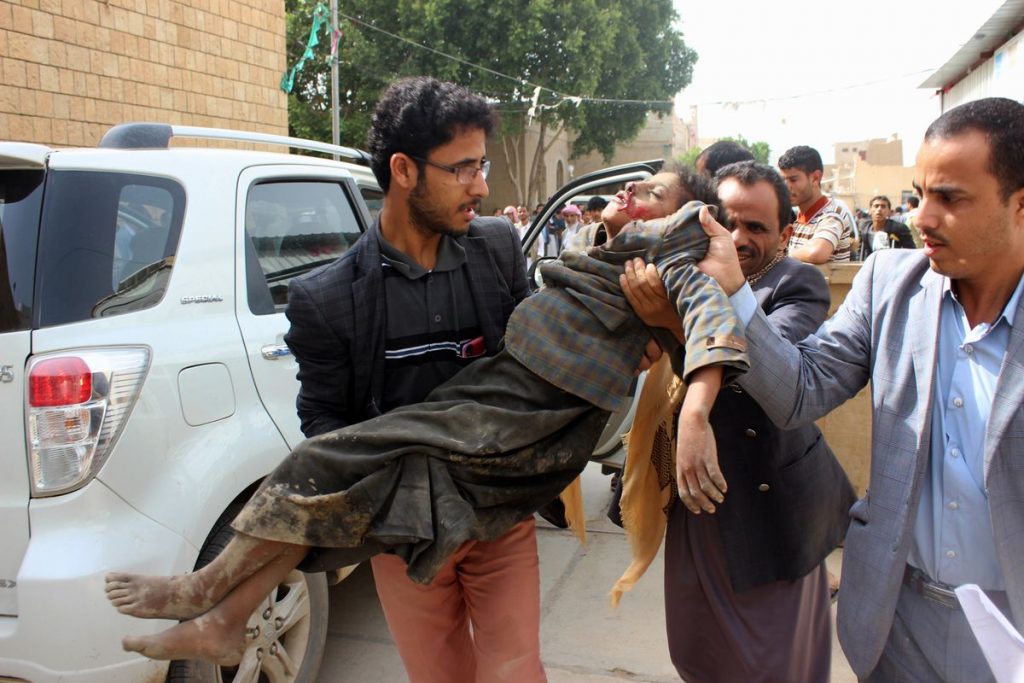
The Long, Brutal U.S. War on Children in the Middle East

 
On November 28, sixty-three U.S. Senators voted in favor of holding a floor debate on a resolution calling for an end to direct U.S. Armed Forces involvement in the Saudi-UAE coalition-led war on Yemen. Describing the vote as a rebuke to Saudi Arabia and the Trump Administration, AP reportedon Senate dissatisfaction over the administration’s response to Saudi Arabia’s brutal killing of Jamal Khashoggi last month. Just before the Senate vote, Secretary of State Mike Pompeo called current objections to U.S. relations with Saudi Arabia “Capitol Hill caterwauling and media pile-on.”
The “caterwaul” on Capitol Hill reflects years of determined effort by grassroots groups to end U.S. involvement in war on Yemen, fed by mounting international outrage at the last three years of war that have caused the deaths of an estimated 85,000 Yemeni children under age five.
When children waste away to literally nothing while fourteen million people endure conflict-driven famine, a hue and cry—yes, a caterwaul —most certainly should be raised, worldwide.
How might we understand what it would mean in the United States for fourteen million people in our country to starve? You would have to combine the populations of New York, Chicago, and Los Angeles, and imagine these cities empty of all but the painfully and slowly dying, to get a glimpse into the suffering in Yemen, where one of every two persons faces starvation.
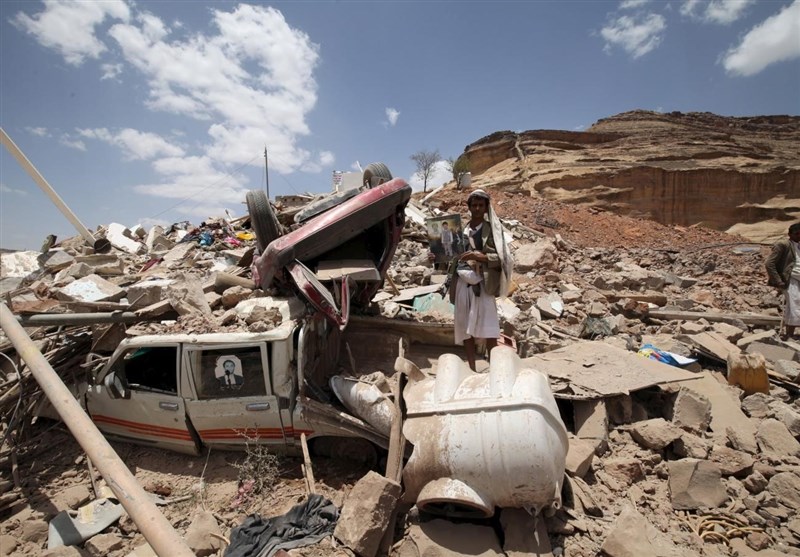
Antiwar activists have persistently challenged elected representatives to acknowledge and end the horrible consequences of modern warfare in Yemen where entire neighborhoods have been bombed, displacing millions of people; daily aerial attacks have directly targeted Yemen’s infrastructure, preventing delivery of food, safe water, fuel, and funds. The war crushes people through aerial bombing and on-the-ground fighting as well as an insidious economic war.
Yemenis are strangled by import restrictions and blockades, causing non-payment of government salaries, inflation, job losses, and declining or disappearing incomes. Even when food is available, ordinary Yemenis cannot afford it.
Starvation is being used as a weapon of war—by Saudi Arabia, by the United Arab Emirates, and by the superpower patrons including the United States that arm and manipulate both countries.
During the thirteen years of economic sanctions against Iraq— those years between the Gulf War and the devastating U.S.-led “Shock and Awe” war that followed—I joined U.S. and U.K. activists traveling to Iraq in public defiance of the economic sanctions.
We aimed to resist U.S.- and U.K.-driven policies that weakened the Iraqi regime’s opposition more than they weakened Saddam Hussein. Ostensibly democratic leaders were ready to achieve their aims by brutally sacrificing children under age five. The children died first by the hundreds, then by the thousands and eventually by the hundreds of thousands. Sitting in a Baghdad pediatric ward, I heard a delegation member, a young nurse from the U.K., begin to absorb the cruelty inflicted on mothers and children.
“I think I understand,” murmured Martin Thomas, “It’s a death row for infants.” Children gasped their last breaths while their parents suffered a pile-up of anguish, wave after wave. We should remain haunted by those children’s short lives.
Iraq’s children died amid an eerie and menacing silence on the part of mainstream media and most elected U.S. officials. No caterwauling was heard on Capitol Hill.
But, worldwide, people began to know that children were paying the price of abysmally failed policies, and millions of people opposed the 2003 Shock and Awe war.
Still the abusive and greedy policies continue. The U.S. and its allies built up permanent warfare states to secure consistent exploitation of resources outside their own territories.
During and after the Arab Spring, numerous Yemenis resisted dangerously unfair austerity measures that the Gulf Cooperation Council and the U.S. insisted they must accept. Professor Isa Blumi, who notes that generations of Yemeni fighters have refused to acquiesce to foreign invasion and intervention, presents evidence that Saudi Arabia and the UAE now orchestrate war on Yemen to advance their own financial interests.
In the case of Saudi Arabia, Blumi states that although Crown Prince Mohammad bin Salman wants to author an IPO (Initial Public Offering), for the Saudi state oil company, Aramco, no major investors would likely participate. Investment firms know the Saudis pay cash for their imports, including billions of dollars’ worth of weaponry, because they are depleting resources within their own territory. This, in part, explains the desperate efforts to take over Yemen’s offshore oil reserves and other strategic assets.
Recent polls indicate that most Americans don’t favor U.S. war on Yemen. Surely, our security is not enhanced if the U.S. continues to structure its foreign policy on fear, prejudice, greed, and overwhelming military force. The movements that pressured the U.S. Senate to reject current U.S. foreign policy regarding Saudi Arabia and its war on Yemen will continue raising voices. Collectively, we’ll work toward raising the lament, pressuring the media and civil society to insist that slaughtering children will never solve problems.
Kathy Kelly is a peace activist and a co-coordinator of Voices for Creative Nonviolence http://vcnv.org/ . Kathy Kelly’s email is kathy@vcnv.org

Saturday, October 27, 2018

Yemen’s Death Toll Five Times Higher than Previously Though

TEHRAN (Tasnim) - A study by a non-partisan group has demonstrated that 56,000 people have been killed in Yemen since early 2016 and more than 2,000 people are being killed due to Saudi-backed war and manmade famine, which puts the number five times more than previously thought.


Yemen’s Death Toll Five Times Higher than Previously Though
One reason Saudi Arabia and its allies are able to avoid a public outcry over their intervention in the war in Yemen, is that the number of people killed in the fighting has been vastly understated. The figure is regularly reported as 10,000 dead in three-and-a-half years, a mysteriously low figure given the ferocity of the conflict.
Now a count by a non-partisan group has produced a study demonstrating 56,000 people have been killed in Yemen since early 2016. The number is increasing by more than 2,000 per month as fighting intensifies around the Red Sea port of Hudaydah. It does not include those dying of malnutrition, or diseases such as cholera, Independent reported.
“We estimate the number killed to be 56,000 civilians and combatants between January 2016 and October 2018,” says Andrea Carboni, who researches Yemen for the Armed Conflict Location and Event Data Project (ACLED), an independent group formerly associated with the University of Sussex that studies conflicts and is focusing attention on the real casualty level. He told me he expects a total of between 70,000 and 80,000 victims, when he completes research into the casualties, hitherto uncounted, who died between the start of the Saudi-led intervention in the Yemen civil war, in March 2015, and the end of that year.
The oft-cited figure of 10,000 dead comes from a UN official speaking only of civilians in early 2017, and has remained static since. This out of date statistic, drawn from Yemen’s patchy and war-damaged health system, has enabled Saudi Arabia and the UAE – who lead a coalition of states strongly backed by the US, UK and France – to ignore or downplay the loss of life.
Casualties are rising by the day as Saudi and UAE-directed forces try to cut off Hudaydah – the last port controlled by the Houthis – from the capital, Sanaa. Oxfam said this week, a civilian is being killed every three hours in the fighting, and between 1 August and 15 October, 575 civilians were killed in the port city, including 136 children and 63 women. An airstrike on Wednesday killed 16 civilians in a vegetable market in Hudaydah, and other strikes this month have hit two buses at a Houthi-held checkpoint, killing 15 civilians, including four children.
Little information about casualties in Yemen reaches the outside world because Saudi and the UAE make access difficult for foreign journalists and other impartial witnesses. By contrast to the war in Syria, the American, British and French governments have no interest in highlighting the devastation caused in Yemen – they give diplomatic cover to the Saudi intervention. But their deliberate blindness to the death of so many Yemenis is starting to attract more negative attention, as a byproduct of the flood of international criticism of Saudi Arabia in the wake of the premeditated murder of Jamal Khashoggi – now admitted by Saudi officials – in Istanbul on 2 October.
The absence of credible figures for the death toll in Yemen has made it easier for foreign powers to shrug off accusations they are complicit in a human disaster. That is despite frantic appeals from senior UN officials to the organization’s Security Council to avert a manmade famine which now threatens 14 million Yemenis – half the population.
The crisis has worsened because of the siege of Hudaydah – with the city a lifeline for aid and commercial imports – since mid June, a situation that has forced 570,000 people to flee their homes. UN humanitarian affairs chief Mark Lowcock warned on 23 October “the immune systems of millions of people on survival support for years on end are now literally collapsing, making them – especially the elderly – more likely to succumb to malnutrition, cholera and other diseases”.
Just how many people die because they are weakened by hunger is difficult to know accurately, because most of the deaths happen at home and are unrecorded. This is particularly true of Yemen, where half the meagre health facilities no longer function, and people are often too poor to use those that do.
Loss of life from fighting should be easier to record and publicize, and the fact this has not happened in Yemen is a sign of the lack of interest by the international community in the conflict. Carboni says ACLED has been able to tally the number of civilians and combatants killed in ground fighting and bombing by drawing on the Yemeni press and, to a lesser extent, international media. ACLED has used these sources, after carefully assessing their credibility, to calculate the number of fatalities. Where figures differ, the group uses lower estimates and favors the claims of those who suffered casualties, over those who say they inflicted them.
It is difficult to distinguish between civilian targets that are deliberately attacked, and non-combatants who died because they were caught in the crossfire, or were close to a military unit or facility when hit.
A study by Professor Martha Mundy – Strategies of the Coalition in the Yemen War: Aerial Bombardment and Food War – concludes the Saudi-led bombing campaign deliberately targeted food production and storage facilities. Some 220 fishing boats have been destroyed on Yemen’s Red Sea coast and the fish catch is down by half.
ACLED began counting casualties after the war was under way, which is why it is only now researching loss of life in 2015, with its findings due to be published in January or February.
Carboni adds, the trend is for the number of people being killed to rise. The monthly total before December 2017 was fewer than 2,000 casualties, but since then it has always been more than 2,000. Almost all those who died are Yemenis, though the figures also include 1,000 Sudanese troops killed fighting on behalf of the Saudi coalition.
The Khashoggi affair has led to greater international focus on the calamitous war in Yemen, and the role of Saudi Arabia and Crown Prince Mohammed bin Salman in the conflict. But there is no sign of the US, Britain or France curtailing military assistance to the kingdom and the UAE, despite the likelihood the coalition will fail to win a decisive victory.

The true “butcher’s bill” in the Yemen war has taken too long to emerge, but it may help to increase pressure on outside powers to stop the killing.