Showing posts with label Battle of Idlib. Show all posts

Wednesday, November 21, 2018

Will Turkey attack the Kurds in eastern Euphrates?

By Ramin Hossein Abadian
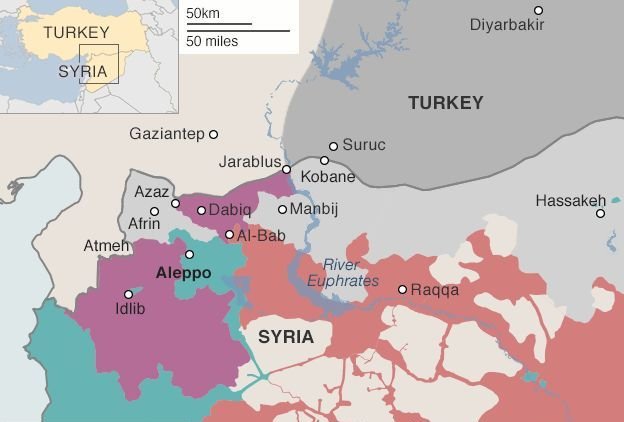
TEHRAN - The eastern Euphrates, which is under the control of the U.S. allies, has taken the attention of most regional actors in Syria. 
The region has the largest and most important oil fields, particularly al-Omar filed, which before 2011 produced around 300 barrels of oil per day.
Al-Raqqah, alone, has 70 percent of Syria’s water resources, not to mention its fertile land for agricultural products. The area accounts for one-third of Syria’s fertile land and plays a big role in Syrian food and economy. 
Al-Raqqah, also called Raqqa, is a city in Syria located on the northeast bank of the Euphrates River, about 160 kilometres east of Aleppo. It is located 40 kilometres east of the Tabqa Dam, Syria's largest dam. 
The area also contains 90 percent of Syria’s gas and oil revenue and over half of the country’s wheat and cotton. Deir ez-Zor province, in eastern Euphrates, is the second most prominent Syrian province in terms of area (about 33,000 square kilometers). Most of the Syrian oil production comes from these areas, and it also is the richest source of Syria's gas. 
After the Syrian army defeated terrorists in various parts of the country, especially on the outskirts of Damascus and in the south, and made advances in the depths of As-Suwayda, two regions are still not in the control of the Syrian government. One is the province of Idlib that based on Putin and Erdogan agreement it is kept a weapons-free area, despite the attacks carried out on the Syrian army's positions there by the terrorists. Some Syrian military experts, including the Brigadier General Hamdan believe that the Syrian army will soon embrace Idlib too. 
General Hamdan said, “Terrorist activities that resulted in the deaths of 18 Syrian soldiers and the failure of other players to subside terrorism have put a halt to the ceasefire in Idlib. Thus, the final operation by the Syrian army is approaching fast.
Syrian army, as we have repeatedly said, continues on the path of self-restraint, but it seems the purpose of the moves is to bring all parties to war in Idlib, be it with a political reason, for exploiting the military movements of the Syrian army politically or with the aim of targeting more Syrian army personnel, militarily.  
The goal of the Russian moves in the next few weeks before the coming New Year is to gain more international support for the region in bringing an end to the daily activities of terrorists.  And that is only possible when everyone takes responsibility for their own action. In a clearer sense, provokers must be put in a bottleneck and pushed aside. 
The U.S., the greatest supporter of terrorism, is the only actor that gets benefit from terrorist acts in Idlib, and therefore is seeking to defeat the military victories of the Syrian army and the political achievements of Damascus.”
Syrian actors’ view of eastern Euphrates 
The other area, out of the Syrian army’s control, is the eastern Euphrates that all actors of the Syrian affairs are keeping an eye on. This region has its own story. The other day, Recep Tayyip Erdogan, Turkish President warned the U.S. and said “no one can turn Turkey into their own backyard.”
Turkey's Defense Minister Hulusi Akar, who was attending Halifax International Security Forum in Canada, expressed indignation at photos showing U.S. troops dining with Kurdish militants near the Turkish border in Syria and said, “We expect U.S. to stop cooperation with the YPG terror group as promised.”
“These photos have found wide coverage in our media and disturbed our people. They tarnished the image of the U.S. and its army... for the Turkish public. It is unacceptable for the U.S. to provide arms and ammunition by plane and trucks to the YPG terrorist group even when Daesh has been neutralized to a large extent. We will not allow the formation of a terrorist corridor on our southern border,” Akar said.
It seems that north-east of Syria, where the U.S.-backed Kurds are present, will face new developments, as Ankara has threatened to intervene in the area, and Damascus has announced to send the Syrian forces to east of Euphrates after the liberation of Idlib. 
The Syrian newspaper Al-Watan has quotes the Syrian opposition as saying, “Turkey intends to attack the Syrian Democratic Forces, SDF, in Tel Avia, located on the southern border of Turkey, where these Kurds are supported by the U.S.”
Turkey has told armed groups in Idlib, and in the western and northern Aleppo that they are ready to move to the east of Euphrates to confront the Kurdish forces who are in control of the area. Erdogan is seeking an invasion of Kobai as a starting point for moving to other parts of eastern Euphrates to dominate the border areas in the second phase.
In October, the Turkish army struck Kurdish positions in eastern Euphrates, coinciding with the statement made by Turkish President Erdogan on the determination of his country to overcome Kurdish forces in eastern Euphrates.
This is while the U.S.-backed Kurdish forces, SDF, in northern Syria also stepped in and patrol the area which invited Erdogan criticism, saying that that joint U.S.-Kurdish patrols just over the Turkish border with Syria were unacceptable and that he expected U.S. President Donald Trump to stop them. 
Iran-Syria-Russia axis 
Meanwhile, Damascus considers the military presence of the U.S. and Turkey illegitimate in the country. The Syrian army has announced that the next step will be eastern Euphrates after the liberation of Idlib. If the area east of the Euphrates were not given to the Syrian government, this will led to the confrontation between the Syrian army and U.S.-backed.
Syrian President Bashar al-Assad warned U.S.-backed Kurdish forces. “We're going to deal with it by two options: the first one we started now opening doors for negotiations, because the majority of them [SDF] are Syrians. If not, we're going to resort ... to liberating those areas by force”, Assad said.
Moscow, on the other hand, considers the U.S. actions in eastern Euphrates to be an attempt to create a region separate from Syria, and considers it unacceptable. Russia’s Foreign Minister Sergey Lavrov said on Oct. 12, 2018: “In eastern Euphrates, the situation is such that there are inevitable actions. And the United States seeks to exploit this land through its Syrian allies, in particular the Kurds, to create a region similar to that of the country.”
But Iran has consistently stated that the presence of the United States is in the eastern Euphrates as an occupation. Iran's President Hassan Rouhani during the Tehran summit saw the post-Idlib phase against the Syrian army as the U.S. forces in the east of Euphrates.

Friday, October 19, 2018

The endgame?

JOHN CHERIAN


Free Syrian Army fighters eating in the cave where they
live on the outskirts of the northern town of Jisr
al-Shughur, west of the city of Idlib, on September 9.
As the decisive battle for Idlib province looms, a motley
crew of opposition fighters are holed up in this last
rebel stronghold. 

The Syrian government claims that the conflict in the country is nearing an end as its troops prepare for an offensive against the last rebel stronghold, in Idlib province, and Israel, despite its aggressive posturing, seems to be lying low following the downing of a Russian military plane.
September was an eventful month in Syria. Even as the Western powers led by the United States were predicting a humanitarian catastrophe in the rebel-held areas of Idlib province in western Syria, Russia and Turkey sprang a surprise by announcing in the third week of September that a deal had been reached whereby the Syrian government would temporarily put on hold its plans for launching a military offensive. Russia and Turkey agreed to establish “a demilitarised zone” that would separate the rebels and the Syrian army, which is determined to purge the last remnants of terrorism from the country. The agreement was announced after a meeting between Turkish President Recep Tayip Erdogan and Russian President Vladimir Putin in the Russian resort town of Sochi. President Putin said that the two sides had agreed to the creation of a 20-24-kilometre-wide buffer zone separating the rebel forces from the Syrian army by the middle of October. The rebel fighters, along with their heavy weaponry, will have to exit from the demilitarised zone by October 10.
Turkey now fears that the imminent defeat of the rebels and their jehadist compatriots will trigger a new refugee flow into its territory. Many of the extremists currently holed up in Idlib will also eventually find their way into Turkey, which is among the main backers of the principal rebel groups in Idlib. This motley group of rebels has hard-core jehadists, including those owing allegiance to Al Qaeda outfits such as the Tahrir al Sham. Idlib is the last pocket of resistance following the fall of rebel strongholds in Aleppo, Daraa and Damascus in the last couple of years.
The government in Damascus has been trying to get the rebels there to surrender or defeat them militarily. It was evident, despite forecasts by the West of an imminent attack by government forces, that Damascus was ready to exercise patience. Senior officials in the Donald Trump administration such as Nikki Haley had gone to the ridiculous extent of predicting that the Syrian government was preparing to use poison gas on its people. The Trump administration was evidently waiting for an excuse to bomb Syria again. The Russian government had issued a series of warnings that the rebel groups were preparing to stage a fake chemical attack, like they had done in the past, in order to precipitate a Western military attack on Syria.
Russian Foreign Minister Sergei Lavrov, speaking at the United Nations General Assembly, issued a strong warning to the terrorist groups and their patrons. “We warn the terrorists and their sponsors that new provocations involving chemical weapons are unacceptable,” he declared. He said that reconstruction of the war-torn country should be the priority for the international community and that it should be implemented without any “double standards”. He told the media in New York that the American military presence in Syria was illegal and went against U.N. Security Council resolutions. He also said that the United States was protecting terrorist groups in the al-Tanf area.
Reports from the ground in Syria, including from reputed Western correspondents like Robert Fisk, had belied stories of an imminent large-scale aerial and ground attack against the populated parts of Idlib province, which has an estimated three million people, along with 30,000 rebel fighters. The rebels have been evidently told by their patrons such as Turkey to give up fighting. The Syrian government has promised them amnesty or safe passage out of Idlib. The die-hard jehadi fighters, especially those belonging to the al Nusra, are still insisting that they would rather die fighting than surrender.
Displaced Syrian children at a refugee camp in Atimah
village of Idlib province on September 11. 

‘Occupying forces should withdraw’


Russia’s Deputy Foreign Minister Mikhail Bogdanov, who is the Special Representative of the Russian President, said in late September that the goal of liberating the whole of Idlib from terrorists remained unchanged and that setting up “de-escalation zones” was only a “temporary measure”. Syrian Deputy Prime Minister Walid al Moualem, who is also Foreign Minister, said in his speech at the General Assembly that the U.S., French and Turkish troops operating in Syrian territory, which he described as “occupying forces”, should withdraw immediately and “without conditions”. He assured the General Assembly that the battle against terrorism was nearing its end and that the need of the hour was to ensure the quick return of millions of Syrians displaced during seven years of bloodshed. Blaming the “illegal coalition” led by the U.S. for the widespread destruction in his country, he said it had “fought everything but terrorism…. Instead it has proved that its goals are almost the same as the terrorist groups, mainly fostering chaos, death and destruction.”
Israel, a de facto member of the coalition, has been trying to undo the substantive gains made by Syria, Russia, Iran and allies such as Hizbollah in the war against terrorism. Israel has the dubious distinction of having carried out more than 200 air strikes on Syrian government targets in the last two years in its increasingly desperate efforts to stop the decimation of the terror groups by the Syrian army. In recent years, it has been justifying its attacks by saying that the real targets are Iranian military advisers who have played a crucial role in the defeat of the jehadi forces. Before that, the Israelis said that they were targeting Iranian missiles and armaments meant for the Hizbollah militia in Lebanon that were transiting through Syria. The Russians, for reasons of their own, had decided to look the other way as Israel was allowed a free run over Syrian airspace. Moscow is playing a careful balancing game as it manages friendly relations with both Tel Aviv and Tehran.
But predictably, the Israelis overplayed their hand. In the second week of September, a Russian military surveillance plane inside Syrian airspace was shot down. Israeli fighter jets on a bombing mission over Latakia had taken shelter behind the Russian IL-20 reconnaissance plane as they came under attack from Syrian ground defences. The Russian plane came down in the crossfire. The Israelis had not bothered to inform the Russian ground control either about the presence of the plane or about the mission it was conducting. All 15 crew members on board were killed.
The Kremlin was livid. Israeli Prime Minister Benjamin Netanyahu, who thinks he has “a special relationship” with Putin, tried to blame the Syrian army. The Russian Defence Ministry angrily accused the Israelis of positioning their F-16 jets behind the Russian transport plane. Israel was also accused of not adhering to the one-minute warning system agreed between the two militaries, whereby notice is given to the Russian military before the Israelis decide to strike a military target inside Syria. Russian Defence Minister Sergei Shoigu said that the Israelis had deliberately used the Russian surveillance plane as a cover for their own war planes “on the assumption that Syrian air defences would not be operating in the area”. Shoigu pledged that Russia would not leave “such provocations unanswered”.
The Kremlin seems to have at last decided to end the free run Israel enjoyed over the skies of Syria. Within days of the downing of the Russian plane, the Kremlin announced that it was bringing in the lethal S-300 missile batteries to Syria. Netanyahu had wanted to send a high-level delegation to Moscow to persuade the authorities there about Israel’s non-culpability in the downing of the Russian plane. Moscow politely refused to receive it. The Kremlin said there was enough evidence to prove Israel’s guilt. The S-300s, which have been compared to the U.S.’ Patriot systems, have a range of more than 250 km. The Russians have also installed an electronic system in Syria that is able to distinguish between friendly and enemy aircraft. According to reports, Russia will shortly dispatch two to four S-300 systems to guard Syria’s coastline and its borders. More S-300 units will be sent in later.
The Russians have already sent sophisticated electronic equipment to Syria that is able to interrupt the radar and navigation equipment of hostile aircraft. Military experts agree that the deployment of the new missiles will significantly curb Israel’s ability to hit targets in Syria at will. If deployed in Damascus, the missile system will be able to monitor the entire Israeli airspace. According to Russian officials, the S-300s will help Syria regain full sovereignty over its airspace as it will now have the capability to close its airspace “where necessary”. The “defensive weapons”, according to defence analysts, will lead “to the stabilisation of the region”.
John Bolton, National Security Adviser to U.S. President Donald Trump, has termed the stationing of the S-300 missiles as “a significant escalation”. But Netanyahu has said that it will not stop Israel from continuing with its raids. He told the media that he had got assurances from the Trump administration that it would continue backing Israel’s bombing campaign in Syria. “We will continue to act to prevent Iranian build-up in Syria,” he said. There are only a handful of Iranian military advisers in Syria. Iran does not need military bases in the region to spread its political influence. Israeli Defence Minister Avignor Lieberman has talked of destroying all missile systems in Syria if Israeli planes are targeted on their bombing missions. This prompted Russia to issue a warning that any such act would result in a dramatic escalation of the conflict.
There have not been any serious Israeli acts of aggression against Syria since the downing of the Russian plane despite the threats issued by Netanyahu and his Defence Minister. The recent events could in fact hasten the end of the insurrection supported by the West and its allies in Syria. More than 50,000 Syrian refugees have returned home in the last couple of months. Once Idlib is liberated and U.S troops leave the eastern part of Syria, comprehensive peace could once again return to the country.
Courtesy- Frontline.

Saturday, September 08, 2018

Battle of Idlib: No Mass Flight, Expulsion or Humanitarian Crisis


TEHRAN (FNA)- Syrian President Bashar Assad says “Idlib province is home to tens of thousands of terrorists and the region is among the priority areas for the Syrian military's operations.”
So it makes perfect sense to liberate the terror-held area. After all, the Syrian Army is sending military equipment and ammunition to the borders of Idlib, preparing for a large-scale operation to clear the area of terrorists.

Sadly, most of Idlib province is occupied by a disparate collection of foreign-backed terrorist groups. The region has been home to infighting between Nusra Front (also known as Tahrir al-Sham Hay'at or the Levant Liberation Board)and Ahrar al-Sham as well, a coalition of Salafist, Takfiri and Wahhabi jihadists. And with the liberation of broad areas of Southern Syria this month, Idlib has become one of the last terrorist strongholds in Syria – all armed with US-made weapons, including anti-tank missiles.

The good news is that Turkey has officially designated the Tahrir al-Sham Hay'at jihadist group as a "terrorist" organization, ahead of the operation by the Syrian Army. Turkey, which has already listed Al-Nusra and Al-Qaeda as terror groups, has updated its list of terror groups. It has been keeping a wary eye on the Idlib offensive, as the long-awaited operation is seen as a prelude to efforts to bring peace to Syria. To that end, the presidents of these three countries are scheduled to meet in Iran this week. The talks will include prospects of peace with the opposition groups.

The military operations in Idlib are not designed to cause catastrophe or trigger an influx of refugees across its borders. That’s not the intention. Reconstruction in Syria cannot begin as long as there are still remnants of ISIL and Al-Qaeda in the war-torn country. No international company or bank is willing to build or finance any infrastructure project if parts of Syria are still under the control of militant groups.
For that reason, recapturing the province of Idlib makes sense. It will pave the way for full resumption of reconstruction efforts nationwide. Private companies from Iran have already agreed to build 30,000 homes for the Syrian people. They also say they could only begin work when they feel safe. That safety could be guaranteed with liberation of Idlib.

In between, Western media outlets are free to claim sectarian and ethnic cleansing will be inevitable once Idlib is fully liberated. And even if the war ends, many refugees will find it too dangerous to return to their homes. They can even claim communities which once lived together in peace will be too frightened of each other to return to Idlib.

But guess what? They made the same claims when other regions were liberated by the allied forces and nothing terrible happened afterwards. This means there are no reasons for the civilians to be afraid; there is no sectarian or ethnic and political agenda; and certainly no “displacement, elimination, mass flight and expulsion” plans. Much to the chagrin of “fakestream” media in the West, civilians will be able to return home in safety and with full protection from the central government.

There is no denying that the decision to liberate Idlib has enraged the United States and its rogue partners. They are using their “humanitarian crisis” concerns to prolong the unnecessary conflict, to justify their presence and occupation, and to keep their terror proxies at an arm’s length. Backed by corporate media propaganda, they allege liberation will look like occupation and ethnic cleansing. Other allegations include government forces will be carrying out summary execution of Qaeda sympathizers, looting, and burning homes for the run of it.

The frantic propagandists are in the know that these barbaric acts are what their terror proxies have done in Syria for so many years - and continue to do in Idlib under the horrible campaign of regime-change bloodletting. To be sure, the government-led campaign to liberate Idlib will have the minimum number of civilian casualties. It has nothing to do with sectarian tensions or people and everything to do with the plan to kick start nationwide reconstruction efforts.

In brief, it is the terrorist groups and their enablers that have committed and continue to commit war crimes, crimes against humanity and genocide in Syria. The War Party in Washington and its rogue partners in crime are not fit to judge the sensible conducts of the Syrian government forces and allies in Idlib. One instance is the tens of thousands of former rebels who have all been pardoned by the government in the last several years and are living in peace in their cities. Still better, some of the same are fighting alongside the Syrian army against their former comrades to end the war. The peace agreements signed with numerous militant groups constituted one of the main reasons why the operation in Sweida was wrapped up in a matter of weeks than months.

Predictably, the United States and its allies will still issue statements blaming Syria and its allies for the carnage wrought by ISIL and Al-Qaeda in Idlib, and that includes their sectarian massacres, summary executions, and destruction of public property among others. The reason is obvious. They are unhappy at the reversal of fortunes because the Syrian Army in collaboration with allied forces has liberated the rest of the country from the bloodthirsty demons Washington and partners created. They are now heading towards Idlib where the fate of foreign-backed terrorists is sealed.