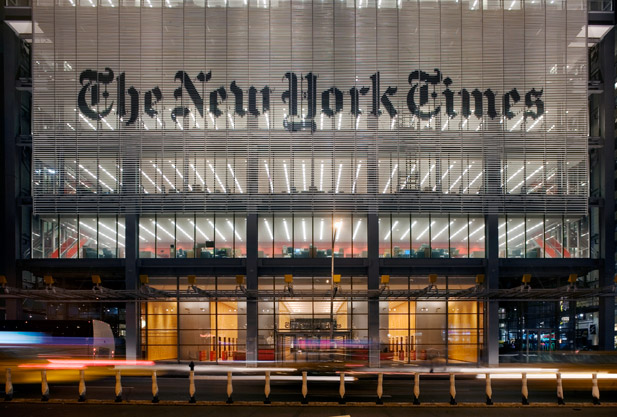
The New York Times wants to make sure you know that Trump’s withdrawal of US troops from northern Syria has strengthened US adversaries.
On Tuesday, after Kurds imperiled by the withdrawal cut a deal with the Syrian government to step in and protect them—thus expanding the influence of the Syrian regime and its allies, Iran and Russia—the Times featured two front page stories about Syria. Over one of them was a headline that said “Battle Lines Shifting to the Benefit of Iran, Russia and ISIS.” The other one said, in its very first paragraph, that Trump had “given an unanticipated victory to four American adversaries: Russia, Iran, the Syrian government, and the Islamic State.”
OK, we get the message. But there’s a problem with the message. These two stories are at best misleading and at worst flat-out wrong. And, sadly, they’re typical of much mainstream media coverage of Syria—and reflective, I think, of cognitive distortions that afflict many American journalists, warping our view of the world.
The first warning sign, in both of these stories, is a paradox: some of the parties they call beneficiaries of recent developments—Syria, Iran, Russia—are enemies of another party they call a beneficiary of recent developments: The Islamic State, or ISIS.
Now, it’s not impossible that a deal that strengthens Syria and its allies could also help their enemy. On the other hand, the Syrian regime considers ISIS a very threatening enemy, and can be counted on to try to destroy any remnants of ISIS within reach. And when these two stories appeared, that reach had just been greatly expanded, via the deal that the Kurds had cut with the Syrian regime. So isn’t it possible that the deal would actually hurt ISIS rather than help it?
I want to be clear: Trump’s original withdrawal of American troops had presumably helped ISIS by directing the attention of the Kurds away from ISIS and toward the Turkish incursion. I noted this effect in last week’s newsletter (qualifying it with “at least in the short run”).
But now we were seeing an influx of Syrian and Russian troops into Kurdish territory, and that could direct fresh and hostile attention toward ISIS. So, all told, this influx was cause to think that the previous week’s concerns about a resurgent ISIS (which the Times had spent plenty of ink on) may have been overblown. Indeed, was it even conceivable that the long-run consequences of Trump’s troop withdrawal could turn out to be, on balance, bad for ISIS?
To check this speculation, I emailed Paul Pillar, who from 2000 to 2005 was National Intelligence Officer for the Near East and South Asia, which means he was in charge of the analysis of those regions for the CIA and all other American intelligence agencies. I asked whether it was crazy to think that Trump’s withdrawal of US troops could wind up being a “net negative for ISIS”—since, as I put it, there would now be an overall increase in “the number of armed enemies of ISIS” in Kurdish territory.
Pillar replied that he wouldn’t jump to the “net negative for ISIS” conclusion just on the basis of the number of anti-ISIS troops in the area. He wrote, “Rather, the basic point is that those other players [Syria and its allies] have at least as much of a direct interest in combating ISIS as the United States does.” But then he added, “The one possible way you might get a ‘net negative’ out of it is that having the U.S. military on the ground as a foreign presence has been—as earlier events in Iraq and Saudi Arabia have demonstrated—a recruiting asset for radical Sunni terrorists.”
In short: the situation is complex—complex enough that the New York Times’s casual assertions about the impact on ISIS (which were basically just unreflectively recycled assertions from the previous week, when they’d made more sense) weren’t really up to New York Times standards.
And, anyway, leaving aside the question of the net impact on ISIS of Trump’s troop withdrawal, one thing is hard to deny: if you compare ISIS’s prospects the day before the Kurds OK’d the influx of Syrian and Russian troops to ISIS’s prospects the day after, they had gotten dimmer. Mightn’t the Times have at least mentioned this fact—since, after all, this influx was precisely the big development that was being reported and assessed in that day’s paper?
>No such luck. Neither of these two front page stories acknowledged that expanded Syrian influence should be expected to undo at least some of the damage done to the war on ISIS by the American troop withdrawal announced the previous week. Both stories (one by David Sanger and one by Ben Hubbard and Eric Schmitt) kept their preferred narratives—that the wind was in ISIS’s sails—unsullied by fresh analysis.
I don’t think any of these reporters are trying to deceive us. I suspect they’re victims of two cognitive distortions, and are inadvertently inflicting those distortions on us.
1) Crudely zero-sum thinking. There definitely are dimensions along which the US has a zero-sum relationship with Russia, with Syria, with Iran. But the trouble with the label “adversaries” (or, worse still, “enemies”) is that it suggests a zero-sum relationship along all dimensions. It keeps you from even entertaining the possibility that something that’s good for Russia, Syria, or Iran could be good for the US. But it could be. In the real world—whether we’re talking about a person’s relations with “friends” and “enemies” or a nation’s relationship with them—there are very few purely zero-sum or purely non-zero-sum relationships.
2) #Resistance thinking. The New York Times, the Washington Post, and other media outlets are working in a polarized political environment, which means they can best prosper by catering to one political tribe or the other. And they’re working in a technological environment that provides precise and instantaneous information about how many readers each of their stories gets—a fact that puts individual reporters and editors who want a big readership (and don’t all of us want a big readership?) directly in touch with this tribalizing incentive. Plus, of course, a lot of journalists have feelings about Trump that are strong enough to color their thinking without them realizing that.
All told, media sites tend to move toward one of two camps—Trump or the Resistance. I don’t think the New York Times is as much in the Resistance camp as, say, Fox News is in the Trump camp. But I think it leans in that direction, even if that’s not the conscious intention of its reporters and editors. Possible bad consequences of Trump policies come more readily to mind than possible good consequences.
My speculations about the Times’s institutional psychology aside, there’s no doubt that a Times story saying Trump has delivered a victory to our enemies, like a Fox News story saying he has vanquished our enemies, will draw a bigger audience than a story saying the truth is more complicated than either of those narratives. Yet complicated is what the truth often is. And I think our foreign policy would be less destructive than it’s been in recent years if our most important media outlets did a better job of conveying the complexity.
Robert Wright is editor of Nonzero Newsletter, where this article originally appeared, and the author of The Evolution of God (a finalist for the Pulitzer Prize), Nonzero, The Moral Animal (named one of the ten best books of the year by The New York Times Book Review), and, most recently, the New York Times bestseller Why Buddhism Is True. He is visiting professor of science and spirituality at Union Theological Seminary in New York.