Showing posts with label John Bolton and Mike Pompeo. Show all posts

Saturday, July 20, 2019

On Preventing War With Iran, Congress Finally Listens To The American People

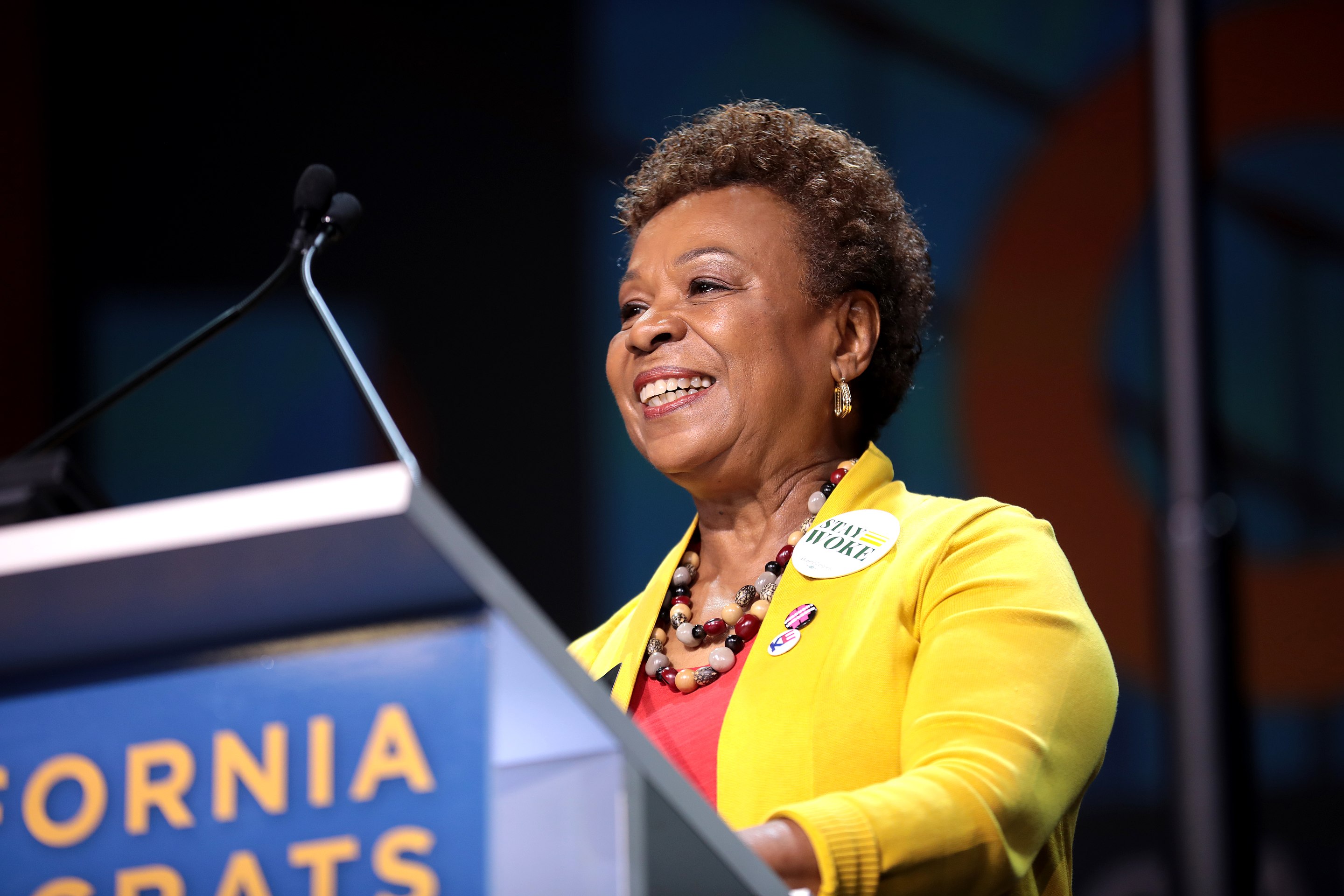
Congresswoman Barbara Lee (Gage Skidmore via Wikimedia Commons)
by Kate Kizer
In Washington, there’s a common refrain that regular Americans don’t care about foreign policy. Yet a flurry of activity in the House of Representatives, during debate over the Fiscal Year 2020 National Defense Authorization Act (NDAA), may prove otherwise, particularly on matters of war and peace. 
Last week, the House of Representatives voted on and passed some of the most progressive foreign policy measures in years. From repealing the outdated 2002 Iraq war authorization to banning U.S. military support and bombs for the war in the Yemen, the House NDAA did much to begin reversing the United States’ over-militarized foreign policy. In addition to rebuking the longstanding bipartisan consensus for a military-first approach to foreign affairs, the House also foreclosed the prospect of yet more endless U.S. war abroad by rejecting an unauthorized war with Iran.
A group of 27 Republicans joined nearly all Democrats to vote for the House provision that would prohibit funds for an illegal war with Iran, offered by progressive champion Congressman Ro Khanna (D-CA) and Trump ally Congressman Matt Gaetz (R-FL). This action was preceded by a bipartisan majority of Senators voting in support of a near-identical measure from Senators Tom Udall (D-NM) and Tim Kaine (D-VA) before the July 4th recess.
Meanwhile, a consensus has emerged in the 2020 Democratic presidential primary that returning to the Iran nuclear deal (the Joint Comprehensive Plan of Action, or JCPOA, which blocks Iran’s path to a nuclear bomb) is a necessary first step toward repairing Trump’s damage to U.S. and global security. Representatives Barbara Lee (D-CA), Jan Schakowsky (D-IL), and David Price (D-NC) bolstered that consensus this week, introducing a resolution calling for the U.S. to reenter the deal.
These actions represent a sea change from just a few years ago, when Congress was loathe to vote on ending wars—let alone voting to prevent future ones. And it’s no wonder considering that National Security Advisor John Bolton and Secretary of State Mike Pompeo, and their far-right allies, have made clear they will stop at nothing to continue barreling towards military conflict with Iran. Indeed, they have ensured Iran warmongering—in part at the behest of authoritarian leaders in Saudi Arabia, the United Arab Emirates (UAE), and Israel—is the centerpiece of Trump’s regional policy, even though it has only made the world less safe and further destabilized the region.
Team Trump’s constant warmongering on Iran has also helped galvanize a left-right coalition of grassroots activists pushing Congress to act. The coalition that pushedCongress to demand an end to U.S. involvement in the disastrous Saudi and Emirati-led intervention in Yemen has now turned its sights on preventing a new war that would make the U.S. invasion of Iraq look like a cakewalk. By working under the common understanding that the harmful effects of endless war are not limited to devastation and carnage abroad, this coalition has now successfully gotten Congress to vote on war and peace more times over the last two years than in the previous 16 years combined.
While it remains to be seen whether the—bipartisan ban on illegal war with Iran will make it into the final version of the NDAA—if there is a final version—these successful votes are a monumental step forward toward Congress reasserting its war powers and preventing the war that is the logical conclusion of Trump’s Iran policy. Given that Trump was only a television host and a few minutes away from bombing Iran just weeks ago, these votes are a welcome signal that Congress is finally listening to the American public—who, as it turns out, care deeply about foreign policy and are unequivocally opposed to a U.S. war with Iran.
avatar

KATE KIZER

Kate Kizer is the Policy Director at Win Without War. She has nearly a decade of experience working on human rights, democratization, and U.S. foreign policy in the Middle East. Kate previously served as the Director of Policy and Advocacy at the Yemen Peace Project and as U.S. Advocacy Officer for Americans for Democracy and Human Rights in Bahrain. She has also held leadership roles in the private sector and on political campaigns. Kate received her B.A. in Middle Eastern & North African Studies from UCLA and her M.A. in Democracy & Governance from Georgetown University.

Friday, May 17, 2019

Baiting Iran

by 

Ever since Donald Trump became president, regime change in Iran has been a prominent US aim. Trump began by backing out of the nuclear deal and imposing harsh sanctions, setting the stage for a confrontational policy. Secretary of State Mike Pompeo and national security adviser John Bolton followed Trump’s lead, repeatedly denouncing Iran’s leadership, calling for Iranians to rise up against it, and issuing vague warnings of US punishment.
This US policy is absolutely inexcusable: It is aggressive and baseless, oblivious to diplomacy, and guaranteed to cause untold hardship and chaos for the people of the region.
I have argued a number of times that Iran, not North Korea, is Trump’s principal national security target. Trump’s extraordinary patience with Kim Jong-un, and willingness to go to two summits with him that have gotten nowhere, can be understood as having given him time to focus on “maximum pressure” on Iran. In his mind, the North Korea “threat” has been deterred; let South Korea deal with it. US interests in the Middle East are far more important anyway, and with Iran Trump has the firm backing of two “great friends”: Saudi Arabia’s criminal crown prince and Israel’s newly reelected prime minister, who is as much a militaristic far-right hawk as Bolton and Pompeo. If war broke out, the Saudis and Israelis would be expected to provide on-the-ground personnel, permitting the US to rely on air and naval power.
What Trump is now doing is baiting Iran with war talk and deployments of overwhelming military power. Bolton, well known for having wanted to attack Iran years ago, and defeated in his attempts to lure Trump into using force against Venezuela, is looking for a way to sucker Tehran into creating a “provocation” that would provide a pretext for a US “counterattack.” The public US position is not credible: “The president has been clear, the United States does not seek military conflict with Iran, and he is open to talks with Iranian leadership,” Garrett Marquis, a National Security Council spokesman, said Monday in an email. “However, Iran’s default option for 40 years has been violence, and we are ready to defend U.S. personnel and interests in the region.”
Talks, really? Trump “open to talks” after tearing up a negotiated deal with Iran that took many years to conclude—a deal that is working? Defend US personnel from what? Defend what interests, other than those of the Saudis and the Israelis who have been itching to eliminate the rule of Iran’s Shia clergy for decades? If there is a “default option,” it is the US preference under Trump for resolving international disputes by threats rather than engagement. The US Congress, the European Union, Russia, and China must act fast to isolate Trump and insist that their interests lie in continued trade with Iran and respect for its sovereignty.

Tuesday, April 23, 2019

Trump’s one opportunity left to survive with any positive legacy: dumping his Neocon, Zionist advisors

By Martin Love

NORTH CAROLINA - Well, for sure, the designation by Trump of the IRGC as a “terrorist” organization is a foolish move, but not Iran’s tit for tat response to it – designating the same for the U.S. central military command, or CENTCOM. This all can mostly present a warning for the remaining 5000 U.S. soldiers and diplomats in Iraq and the 2000 or so still lingering in Syria.
The Trump move is clearly because John Bolton and Mike Pompeo and some other de facto Zionist Neocons in his administration seek some kind of clear provocation for a military attack on Iran and not merely an attack on Iranian forces outside Iran. But Trump, intellectual and strategic weakling that he truly has become, wants nothing but fuel for his narcissism and popularity, which he is not going to get from the American voters by sparking another Middle Eastern war. None has gone as planned by the U.S. and Trump’s tenure and any kind of positive legacy may be dependent on NOT starting any more wars in the Middle East and not in Venezuela, too. Will Trump understand this? Hard to know. 
And does Trump fully realize that Syria, Iraq, Iran and even Lebanon are beginning to bind themselves closer together in a mutual allegiance of some sort? And Egypt has just refused inclusion into the Arab “NATO” that the U.S. wants to create. Of course Trump knows all this, and it could be fuel for further U.S. aggression in the region, but to use it as such is a mistake of the first order.
At any rate, these countries along or near the northern edge of the Arab Mideast, and Iran, are talking about connecting and rebuilding their railways, providing Iraq and Iran, with Chinese assistance related to the Belt and Road initiative, a means to access ports on the Mediterranean. This project could take several years given that much railway infrastructure, which was in fair condition until 2011, has been destroyed in the wars.
If one stands back a bit and takes a look at the overall picture of U.S foreign policy currently, and not just in the Middle East, it is failing. Even while many, Iranians especially, suffer from it. 
The Neocons have been stalled in Venezuela and a few hundred Russian and Chinese troops are there to help the stall stick. The Syrian government continues to consolidate its grip despite Israeli missile attacks and further attacks by terrorists in the Idlib area on Syrian civilians. Iraqis may be close to demanding the exit of U.S. troops. Most in the U.S. Congress want to deny the U.S. further support for the Saudi war on Yemen, but Trump just foolishly vetoed the legislation while the best of the Democratic challengers for the 2020 election for POTUS are pushing harder for a full stop end to the foreign wars.
 The most notable among them is the eloquent and attractive Rep. Tulsi Gabbard of Hawaii whose consistency and vision is attracting more and more fans. She has the makings of the best possible female candidate ever to campaign to occupy the White House. But no question Trump has gotten a boost in the popularity polls by his apparent exoneration from conspiring with the Russians in the 2016 election where he did not even win a plurality of the popular vote.
The long running and absurd “War on Terror” since the turn of the century, it is clear, is in effect a war on Muslim countries that have foreign policies independent of Washington and especially the Zionists, with other targets like Venezuela under Maduro. The world knows, at least, who the real “terrorists” are. Iranians need to know this latter fact whether anything can be done about it immediately. There are some scattered positives appearing:
Executives at the IMF, for example, have allegedly voted NOT to recognize puppet Juan Guaido as president of Venezuela, realizing it may not be wise to condemn themselves to dealing with a bloc that lacks any sovereign authority. Jimmy Carter, the last U.S. President who could possibly claim to be attempting to adhere to moral principles was preaching in his hometown church in Georgia last Sunday pointing out that the U.S. in its 240 plus years has only been at peace for 16 years, making the U.S. “the most warlike nation in world history”.
 He went on to point out that China has been at war with no one for decades and enjoyed enormous economic benefits, including a growing infrastructure second to none, while the U.S. has spent itself towards moral and financial bankruptcy. Trump’s MAGA plan: a very sick joke.
Perhaps best of all, some observers have noted that Trump’s foreign policy advisors, notably John Bolton, whose prescriptions for decades have been disastrous for the U.S., ought to be fired immediately. Most of these advisors like Bolton have been shills for the Zionists and pushed Trump to make his number one foreign priority support for the Zionists, who by the day are more reviled than ever worldwide. But just as some Democrat presidential hopefuls have vowed, if elected, to push the U.S. to rejoin the JCPOA, the Zionists are pushing for attacks on Iran’s nuclear facilities claiming that such would not lead to a wider war in the Mideast.
 This latter is a complete lie, as Iranians well and rightfully know. Israel has been and remains the most self-serving, and corrupted country for over seven decades, and their traitorous U.S. servants, like Bolton and other Neocons, MUST be derailed somehow. 

Tuesday, January 29, 2019

Venezuela: What Activists Need To Know About The US-Led Coup

Co-Written by Kevin Zeese and Margaret Flowers
Two things stand out about the US coup in Venezuela. First, it is unusually open. Typically, the US tries to hide its coups. Second, the coup is built on a series of obvious falsehoods, yet the bi-partisans in Washington, with a few exceptions, keep repeating them.
First, we will correct the falsehoods so readers are all working from the same facts. Second, we will describe how this coup is being defeated. It will be another major embarrassment for the Trump administration and US foreign policy.
It is important to understand Venezuela has become a geopolitical conflict as Russia and China are closely allied with Venezuela. China and Russia coming into the backyard of the United States challenges the antiquated Monroe Doctrine.
Venezuela has the largest oil reserves in the world and the second largest gold reserves, as well as diamonds and other minerals such as coltan (needed for electronic devices). And, Venezuela is taking over as president of OPEC and will be in a position to push for oil payments in non-dollar currencies or in cryptocurrencies, a major threat to the US dollar.
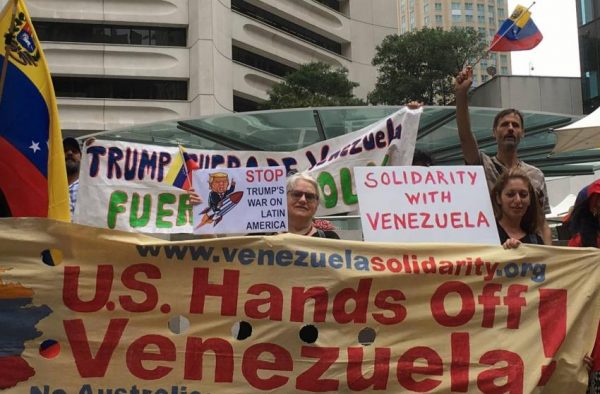
A protest outside the United States Consulate in Sydney on January 23 to demand no US intervention in Venezuela. Photo: Peter Boyle
Correcting the Record
There are a series of false statements repeated by DC officials and corporate media to justify the coup that are so obvious, it is hard to believe they are not intentional. In his two-paragraph comment on the coup, even Senator Bernie Sanders repeated them.
1. Truth: President Nicolás Maduro is the legitimate president.
President Maduro was re-elected on May 20, 2018, in response to the opposition demanding an early election. The legitimacy of the election of Maduro is so evident that it must be assumed those who say he is illegitimate are either intentionally false or ignorant. The election was scheduled consistent with the Venezuelan Constitution and in consultation with opposition parties. When it became evident that the opposition could not win the election, they decided, under pressure from the United States, to boycott the election in order to undermine its legitimacy. The facts are 9,389,056 people voted, 46% of eligible voters. Sixteen parties participated in the election with six candidates competing for the presidency.
The electoral process was observed by more than 150 election observers. This included 14 electoral commissions from eight countries among them the Council of Electoral Experts of Latin America; two technical electoral missions; and 18 journalists from different parts of the world, among others. According to the international observers, “the elections were very transparent and complied with international parameters and national legislation.”
Venezuela has one of the best electoral systems in the world. Voter fraud is not possible as identification and fingerprints are required for each voter. Voting machines are audited before and immediately after the election. Venezuela does something no other country in the world does — a public, citizen’s audit of a random sample of 53% of voting machines that is televised. All 18 parties signed the audits.
Maduro won by a wide margin, obtaining 6,248,864 votes, 67.84%; followed by Henri Falcón with 1,927,958, 20.93%; Javier Bertucci with 1,015,895, 10.82%; and Reinaldo Quijada, who obtained 36,246 votes, 0.39% of the total.
This same voting system has been used in elections that Maduro’s party has lost in governor’s and legislative elections. Venezuela is a real democracy with transparent elections. The United States could learn a good deal about real democracy from Venezuela.
2. Truth: The economic crisis is caused by outside intervention, internal sabotage and the decline in oil prices.
There is no doubt the economic situation in Venezuela is dire. The cause is the economic war conducted by the United States, the major decline in oil prices and economic sabotage by the opposition. In essence, the United States and opposition created problems in the Venezuelan economy and now say Maduro must be replaced because of problems they created.
Oil was discovered in Venezuela in the early part of the 20th Century and has dominated the economy since then. The Dutch Disease, the negative impact of an economy based on one natural resource, causes a sharp inflow of foreign currency, which raises the value of the country’s currency, making the country’s other products less price competitive. It is cheaper to import products rather than create them. This makes it more difficult for segments of the economy like agriculture and manufacturing to develop.
Chavez/Maduro sought to diversify the economy. They put in place thousands of communes and hundreds of thousands of people working in cooperatives to build agriculture and manufacturing. When the global price of oil was cut by more than half, it collapsed Venezuela’s public finances undermining these efforts. The economic war by the US made it difficult for Venezuela to borrow and trade with some countries.
Economic sanctions against Venezuela began under President Obama, and the Trump administration escalated them with financial sanctions. United States sanctions cost Venezuela some $6 billion since August, according to an October analysis. Measures against the nation’s oil industry have prohibited the Venezuelan majority-owned company, CITGO, from sending profits back to Venezuela, a $1 billion loss to the government yearly. Now, the Bank of England is refusing to return $1.2 billion in gold reserves after US officials, including Secretary of State Michael Pompeo and National Security Adviser John Bolton, lobbied them to cut Venezuela off from its overseas assets.
The US economic war and sabotage of the economy by business interests has been exposed as part of the effort to remove Maduro by creating social unrest and lack of confidence in the government.  This has included hoarding of goods, storing essentials in warehouses and selling Venezuelan goods in Colombia.
In September 2018, Venezuela pointed to a false media campaign exaggerating migration from Venezuela. They highlighted statistics from the United Nations High Commissioner for Refugees to affirm that Venezuela has the fewest volunteer migrants in the continent. They pointed out 5.6 million Colombians have fled violence in their country and live in Venezuela. Venezuela has programs that have helped thousands of Venezuelans return home.
Socialism strengthens economies, as demonstrated in Portugal. Indeed, one criticism of Venezuela is that the Bolivarian Process is moving too slowly to put in place a socialist economy. There is a need for more sectors to be nationalized and put under democratic control of the people.
3. Truth: The opposition is violent, not the Maduro government.
Opposition protesters have been extremely violent. One tactic of the opposition was to be violent and then film the government’s response to make the government look violent. When Abby Martin was confronted by opposition protesters, they told her, “Do not film anything that we do. Just film what the government does to us.” She reported on the violence saying, “the vast majority has been caused by either indirect or direct violence by the opposition.”
Martin reports the opposition attacked hospitals, burned down the Housing Ministry, assassinated Chavistas and attacked citizen communes such as an art commune that gave free dance and music lessons to local children. Afro-Venezuelans were burned alive. Protesters pulled drivers out of buses and torched the buses. When photos and videos of opposition violence were put on social media, Martin and her colleague, Mike Prysner, became the target of a false media campaign on social media. The opposition did all they could to prevent them from reporting the truth using hundreds of death threats and threats they would be lynched.
In 2017, Venezuela Analysis reported that violent opposition protests included an attack on a maternity hospital endangering the lives of more than 50 newborn babies. Another report described the opposition using snipers to shoot government officials and civilians. Opposition newspapers urged that blunt objects be used to “neutralize” pro-government protesters, resulting in serious injuries and death.
Steve Ellner also reported that violence was coming from the opposition. He pointed to attacks at grocery stores, banks, buses, and government buildings.  Other commentators described specific incidents of violence by the opposition including killing people. Maduro ordered the arrest of a retired general who tweeted how to use wire to decapitate people on motorcycles, which happened, and how to attack armored vehicles with Molotov cocktails.
Documents show that violence was the opposition’s strategy. They sought to “Create situations of crisis in the streets that will facilitate US intervention, as well as NATO forces, with the support of the Colombian government. Whenever possible, the violence should result in deaths or injuries.”
The tales of government violence are rooted in lies. The government’s response was Maduro calling for a peace conference describing it as “a national peace conference with all the country’s political sectors … so we Venezuelans can try to neutralize violent groups.”
4. Truth: The National Assembly acted in violation of the law and is in contempt of court.
The National Assembly is not the only democratic body in Venezuela. Indeed, its actions since the opposition won a majority have violated the law and protected the violence of the opposition with an embarrassing amnesty bill.
On December 6, 2015, the opposition won a parliamentary majority in the Assembly. There were allegations of vote buying in Amazonas state that were investigated by the National Electoral Council, another branch of the government. The Supreme Court barred four legislators from Amazonas taking office, two from the opposition, one allied with the opposition and one from the ruling party. The National Assembly allowed three candidates to take office. The Assembly has been held in contempt of court since July 2016 and their decisions were nullified.
Before the court ruling, the Assembly passed an amazing amnesty law, which granted amnesty for crimes the opposition has committed since 1999 (Chavez’ election). The law is an admission of guilt and provides a well-organized catalog of crimes including felonies, crimes committed at public rallies, terrorist acts involving explosives and firearms and undermining the economy. They essentially admitted exactly what Chavez/Maduro have claimed — crimes to overthrow the government for 17 years. Venezuela’s Supreme Court ruled the amnesty law was unconstitutional. Inaccurately, the Trump administration calls the Assembly Venezuela’s only remaining democratic institution.
This January, a subsidiary of the state oil company asked the Assembly to intervene claiming the president cannot make reforms to mixed public-private oil businesses without the prior approval of the National Assembly. On January 16, the court ruled that the Assembly was still in contempt of court and could not act. This is also when the Assembly elected Juan Guaidó as their president, who would later appoint himself President of Venezuela, as part of the US-led coup. Guaidó’s election to head the legislature was illegal and nullified by the court.
The Assembly still exists but remains in a state of contempt of the judiciary. It can rectify the situation by removing the lawmakers accused of electoral fraud. The Assembly refuses to do so because their goal is to remove Maduro from office and they need a super-majority to do so.
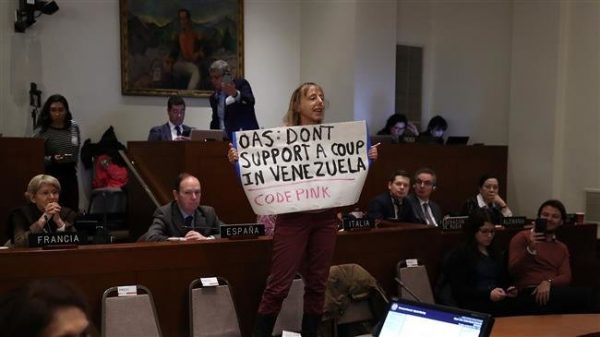
Medea Benjamin of CODEPINK disrupts Mike Pompeo at the OAS. Press TV.
A Timeline of the US Coup in Venezuela
In “Anti-Maduro Coalition Grew from Secret Talks,” the Associated Press explains the coup was “only possible because of strong support from the Trump administration, which led a chorus of mostly conservative Latin American governments that immediately recognized Guaidó.”
Since August 2017, Donald Trump has been saying that military interventionagainst Venezuela was a distinct possibility. AP describes this as a “watershed moment” in the coup planning. They report Trump pressuring aides and Latin American countries to invade Venezuela. In September, the New York Times reported that the Trump administration had been meeting with coup plotters since mid-2017.
The Wall Street Journal reports Trump has long viewed Venezuela as one of his top-three foreign policy priorities, with Iran and North Korea. Trump requested a briefing on Venezuela on his second day in office, talking of the immense potential of Venezuela to become a rich nation through its oil reserves. AP reports that Trump “personally sparked” this as he brought up regime change in Venezuela in every meeting with Latin American leaders.
After Maduro was re-elected, administration plans began taking shape, driven in part by key members in the National Security Council and anti-Maduro advocates in Congress like extreme interventionist Senator Marco Rubio.
On November 1, John Bolton zeroed in on Latin America, calling Cuba, Nicaragua, and Venezuela a “troika of tyranny.” On January 2, Bolton met with his Brazilian and Colombian counterparts to collaborate to “return Venezuela to its democratic heritage.”
On January 10, Maduro was sworn in for his second term, Pompeo spoke with opposition leader Guaidó, pledging support. Canada also played a key role, AP reports that Foreign Minister Chrystia Freeland spoke to Guaidó the night before Maduro’s inauguration offering Canada’s support. This was 13 days before Guaidó announced he was president of Venezuela.
On January 12, the State Department backed Guaidó’s move to invoke his authority as president of the assembly, saying, “It is time to begin the orderly transition to a new government.” On January 15, the National Assembly declared Maduro as illegitimate. The Trump administration worked to get allies lined up to support Guaidó’. By January 18, the Venezuela Foreign Minister was describing a US coup in progress.
The night before Guaidó’s announcement on January 23, Vice President Mike Pence put out a video message encouraging Venezuelans to overthrow their government, saying, “We are with you. We stand with you, and we will stay with you.” Guaidó also received a phone call from Pence the night before he appointed himself president where he pledged that the U.S. would back Guaidó.
Guaidó declared that Maduro’s government was illegitimate and he was assuming the presidency. In a well-coordinated charade, almost instantly, Trump recognized Guaidó as the country’s rightful leader. To further demonstrate the preconceived, tightly coordinated and efficiently carried out the coup, US allies, among them Canada, Brazil, Argentina, Colombia, Chile, and Peru, quickly recognized the coup president.
The Trump administration is claiming Guaidó represents the lawful government and is entitled to all Venezuelan revenues. The State Department notified the Federal Reserve that Guaidó is the agent for access to Venezuelan assets in US banks.
Nearly as quickly, Maduro drew statements of support from Russia, China, Turkey, Mexico, Cuba, Bolivia, and others. The Venezuelan Supreme Court called for an investigation into the National Assembly and Guaidó, regarding the illegal usurpation of Executive power. The Venezuelan military announced it supported Maduro and Russia warned the US not to intervene militarily.
On January 25, the Organization of American States, which is traditionally a US tool, rejected a resolution to recognize Guaidó. Medea Benjamin of CODE PINK interrupted Pompeo at the OAS holding a sign that said: “a coup is not a democratic transition!” Venezuelan Foreign Minister Jorge Arreaza thanked Benjamin, saying, “With her protest, she revealed the macabre coup plan against Venezuela, we will always prevail, thank you!” Eighteen countries defeated the proposal.
At the UN Security Council meeting on January 26, Russia’s UN Ambassador Vassily Nebenzia accused the United States of attempting “to engineer a coup d’etat.” He demanded to know whether the Trump administration “is ready to use military force” against Venezuela. European countries gave Venezuela eight days to hold an election, a suggestion Venezuela rejected. Secretary of State Mike Pompeo called Venezuela an “illegitimate mafia state.” He accused Russia and China of trying “to prop up Maduro.”
Both China and Russia have told the US not to intervene in Venezuela’s internal affairs. In December, Russia sent two nuclear-capable strategic Tu-160 bombers to Venezuela along with an An-124 heavy military transport plane and an II-62 long-haul plane. As of December, Russia has one brigade in Venezuela and was discussing sending a second military brigade to Venezuela even before the coup due to the continued threat of intervention from the United States.
China has lent over $50 billion to Venezuela through oil-for-loan agreements over the past decade and has become a partner in the Venezuelan oil industry. In December, seven months since signing a financial business venture with China, Venezuela’s oil production has doubled to 130,000 barrels per day. The take-over of Venezuela’s oil would also be an attack on China. China and Venezuela signed 28 bilateral strategic cooperation agreements on September 14 in the areas of oil, mining, security, technology, finance, and health.
Demonstrating the nature of the coup president, the first acts that Guaidó took were to seek a loan from the International Monetary Fund, which would put Venezuela in debt to western bankers and under their control, and to privatize the Venezuelan oil industry, which would rob Venezuela of the funds being used to lift up the poor and working class.
The appointment by Mike Pompeo of Elliott Abrams as the person in charge of overseeing operations “to restore democracy in Venezuela” is an ominous sign. It is scandalous and demonstrates the most extreme elements of the US establishment are leading the charge. Abrams was convicted during the Iran-Contra scandal, supported US-backed death squads in Guatemala and El Salvador in the 1980s, played a key role in the Reagan administration support for the murderous Contras in Nicaragua and was the person who gave approval for the US-backed coup in Venezuela in 2002.
Analyst Vijay Prashad writes the coup violated the charters of the United Nations and of the Organisation of American States and describes efforts to call on the military to rise up against the government have failed. The Trump administration is now threatening a total oil embargo on Venezuela and is leaving the “military option” open.
The concerted campaign by the US and Canada to install Juan Guaidó as the new ‘self-declared’ interim President of Venezuela has been met with initial failure. Unfortunately, the illegal and undemocratic attempts to destabilize the country and overthrow the democratically-elected President will continue with harmful consequences. The people of Venezuela are rising once again to defend their country against hostile foreign intervention. It is essential that we support them in this fight. Many groups are holding solidarity rallies and issuing statements of support. Find rallies and protests here and here.
While Sanders got all the facts wrong about Venezuela, he did reach the right conclusion: “The United States has a long history of inappropriately intervening in Latin American countries. We must not go down that road again.” People in the United States have an important role to play in supporting Venezuela and defeating the coup.
Kevin Zeese and Margaret Flowers are directors of Popular Resistance

Thursday, January 17, 2019

Inside the Beltway: Iran hardliners vs Iran hardliners

Alarm bells went off last September in Washington’s corridors of power when John Bolton’s national security council asked the Pentagon for options for military strikes against Iran.
The council’s request was in response to three missiles fired by an Iranian-backed militia that landed in an empty lot close to the US embassy in Baghdad and the firing of rockets by unidentified militants close to the US consulate in the Iraqi port city of Basra.
“We have told the Islamic Republic of Iran that using a proxy force to attack an American interest will not prevent us from responding against the prime actor,” Mr. Bolton said at the time.
Commenting on the council’s request, a former US official noted that “people were shocked. It was mind-boggling how cavalier they were about hitting Iran.”
Then US Defense Secretary Jim Mattis, like Mr. Bolton an Iran hawk, worried that military strikes would embroil the United States in a larger conflagration with Iran.
The request, moreover, seemed to call into question US President Donald J. Trump’s promise to America’s European allies that he would rein in Mr. Bolton who has a long track record of advocating military action against Iran.
Months before joining the Trump administration in the spring of 2018, Mr. Bolton drafted at the request of Mr. Trump’s then strategic advisor, Steve Bannon, a plan that envisioned US support “for the democratic Iranian opposition,” “Kurdish national aspirations in Iran, Iraq and Syria,” and assistance for Iranian Arabs in the oil-rich Iranian province of Khuzestan and the Baloch who populate the Pakistani province of Balochistan and Iran’s neighbouring Sistan and Baluchistan province.
Frustrated by the Trump administration’s failure to respond to his suggestions, Mr. Bolton published the memo in December 2017.
Almost to the day two years after the publication and two months before the 40th anniversary of the Iranian revolution, Mr. Bolton asserted in a policy speech in Cairo, that the United States had “joined the Iranian people in calling for freedom and accountability… America’s economic sanctions against the (Iranian) regime are the strongest in history, and will keep getting tougher until Iran starts behaving like a normal country.” Mr Bolton was referring to harsh US sanctions imposed in 2018 by Mr. Trump after withdrawing the United States from the 2015 international agreement that curbed Iran’s nuclear program.
Mr. Bolton’s plan stroked with Saudi thinking about the possibility of attempting to destabilize Iran by stirring unrest among its ethnic minorities. The thinking was made public in a November 2017 study by the International Institute for Iranian Studies, formerly known as the Arabian Gulf Centre for Iranian Studies, a Saudi government-backed think tank.
The study argued that Chabahar, the Indian-backed Iranian deep-sea port at the top of the Arabian Sea, posed “a direct threat to the Arab Gulf states” that called for “immediate counter measures.”Pakistani militants claimed in 2017 that Saudi Arabia had stepped up funding of militant madrassas or religious seminaries in Balochistan that allegedly serve as havens for anti-Iranian, anti-Shiite fighters.
Mr. Bolton’s memo followed an article he wrote in The New York Times in 2015 headlined ‘To Stop Iran’s Bomb, Bomb Iran’ at the time that President Barak Obama was negotiating the international agreement to curb Iran’s nuclear program.
Mr. Bolton argued in the op-ed that diplomacy would never prevent the Islamic republic from acquiring nuclear weapons. “The inconvenient truth is that only military action like Israel’s 1981 attack on Saddam Hussein’s Osirak reactor in Iraq or its 2007 destruction of a Syrian reactor, designed and built by North Korea, can accomplish what is required. Time is terribly short, but a strike can still succeed,” Mr. Bolton wrote.
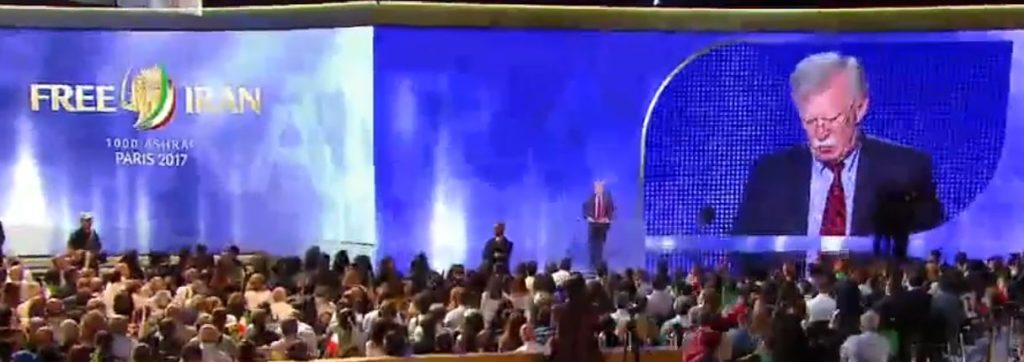
The memo was written at about the same time that Mr. Bolton told a gathering of the Iranian opposition group Mujahedin-e-Khalq that “the declared policy of the United States of America should be the overthrow of the mullahs’ regime in Tehran” and that “before 2019, we here will celebrate in Tehran.”
While Mr. Bolton has remained outspoken even if he has been careful in his wording as national security advisor, other past advocates of military action against Iran have taken a step back.
Mike Pompeo has since becoming secretary of state hued far closer to the Trump administration’s official position that it is pursuing behavioural rather than regime change in Iran. But as a member of the House of Representatives, Mr. Pompeo suggested in 2014 launching “2,000 sorties to destroy the Iranian nuclear capacity.”
While the Trump administration has largely explained its hard line towards Iran as an effort to halt the country’s missile development, roll back its regional influence, and ensure that the Islamic Republic will never be able to develop a nuclear weapon, Mr. Bolton has suggested that it was also driven by alleged Iranian non-compliance with the nuclear accord.
“Report: Iran’s secret nuclear archive ‘provides substantial evidence that Iran’s declarations to IAEA International Atomic Energy Agency) are incomplete & deliberately false.’ The President was right to end horrible Iran deal. Pressure on Iran to abandon nuclear ambitions will increase,” Mr. Bolton tweeted this month, endorsing a report by the Washington-based Institute for Science and International Security.
Based on Iranian documents obtained by Israel, the report identified an allegedly undeclared Iranian nuclear site. “Documentation seized in January 2018 by Israel from the Iranian ‘Nuclear Archive’ revealed key elements of Iran’s past nuclear weaponization program and the Amad program more broadly, aimed at development and production of nuclear weapons. The material extracted from the archives shows that the Amad program had the intention to build five nuclear warhead systems for missile delivery,” the report said.
Similarly, Mr. Bolton this month told Israeli prime minister Benyamin Netanyahu on a visit to Jerusalem that “we have little doubt that Iran’s leadership is still strategically committed to achieving deliverable nuclear weapons. The United States and Israel are strategically committed to making sure that doesn’t happen.”
Mr. Bolton’s assertion contrasted starkly with then Director of National Intelligence Dan Coats’ assessment in his 2017 Worldwide Threat Assessment of the US Intelligence Community that “we do not know whether Iran will eventually decide to build nuclear weapons.”
Mr. Bolton’s hardline position within the Trump administration could be cemented if Iran were to decide that upholding the nuclear agreement no longer served its interest. Anti-agreement momentum in Iran has been fuelled by the European Union’s seeming inability or unwillingness to create a financial system that would evade US sanctions and facilitate trade with Europe.
Mr. Bolton’s hard line has also been bolstered by the imposition of European Union sanctions on Iran’s ministry of intelligence and two individuals on charges of plotting to kill leaders of an Iranian Arab separatist movement in Denmark and the Netherlands.
An Iranian abrogation of the nuclear agreement would likely lead to a reshuffle of the Iranian cabinet and the appointment of hardliners that would in turn bolster Mr. Bolton’s argument that the Iran issue has to be resolved before the United States can militarily truly disengage from the Middle East and South Asia.
Hardliners like Mr. Bolton may have one more development going for them: Disillusionment in Iran with the government of President Hassan Rouhani is mounting.
The disappointment is being fuelled not only by the failure of the nuclear accord to drive economic growth and the government’s mis-management of the economy and inability to take on nepotism, vested interests such as the Revolutionary Guards and the growing income gap accentuated by the elite’s public display of ostentatious wealth, but also the fact that Mr. Rouhani appears to have lost interest in reform and implementing change.
“Unfortunately, Mr. Rouhani´s second term has been extremely ignorant (about the demands) of the twenty-four million people who make up Iranian civil society. Most of the reformists believe that he no longer wants to interact (with the reform movement). All that concerns him is to emerge from the remaining two years (of his second term) undamaged, and thus maintain his privileged spot in the pyramid of power,” said Abdullah Naseri, a prominent reformist and adviser to the former president Mohammad Khatami. Mr. Naseri was referring to the 24 million people who voted for Mr. Rouhani.
A reformist himself, Mr. Khatami warned that “if the nezam (establishment) insists on its mistakes… (and) reform fails, the society will move toward overthrowing the system.”
The roots of Mr. Bolton’s thinking lie in a policy paper entitled US Defense Planning Guidance that has been in place since 1992. The paper stipulates that US policy is designed “to prevent any hostile power from dominating a region whose resources under consolidated control be sufficient to generate global power.” The paper goes a long way in explaining why the US and Saudi Arabia potentially would be interested in destabilizing Iran by stirring unrest among its ethnic minorities.
Iran scholar Shireen Hunter suggests that squashing Iran’s ambition of being a regional and global player may be one reason why senior Trump administration officials, including Mr. Bolton, Mr. Pompeo and Rudolph Giuliani, the president’s personal lawyer, alongside the Saudis support the Mujahedin e-Khalq even if its domestic support base is in question.
“The MEK was willing to support Saddam Hussein and cede Iran’s (oil-rich) Khuzestan province to Iraq. There is no reason to think that it won’t similarly follow U.S. bidding,” Ms. Hunter said referring to the Mujahedeen’s support of Iraq during the Iran-Iraq war in the 1980s.
Mr. Bolton appeared to be fortifying what amounted to the most hard-line approach towards Iran in an administration that was already determined to bring Iran to its knees by elevating Charles M. Kupperman, a long-time associate and former Reagan administration official, to deputy national security adviser.
Mr. Kupperman, a former Boeing and Lockheed Martin executive, previously served on the board for the Center for Security Policy, a far-right think tank advocating for a hawkish Iran policy founded by  Frank Gaffney, a former US government official who is widely viewed as an Islamophobe and conspiracy theorist.
Similarly, Mr. Trump, reportedly on Mr. Bolton’s advice, hired this month Richard Goldberg as the national security council’s director for countering Iranian weapons of mass destruction.
As a staffer for former Senator Mark Kirk, Mr. Goldberg helped write legislation that served as the basis for the Obama administration’s sanctions regime on Tehran prior to the nuclear deal. He went on to work for the Washington-based Foundation for Defense of Democracies, which advocates a hard line towards Iran.
Earlier, Mr. Bolton hired Matthew C. Freedman, who in March 2018, together with Messrs. Kupperman and Bolton registered the Institute for a Secure America as a non-profit organization on the day that Mr. Trump announced Mr. Bolton’s appointment as national security advisor.
A long-standing Bolton associate and one-time member of Mr. Trump’s transition team, Mr. Freedman worked in the 1980s and 1990s as a foreign lobbyist with Paul Manafort, who managed Mr. Trump’s election campaign for several months and was last year convicted as part of special counsel Robert Mueller’s investigation into alleged collusion between the campaign and Russia to influence the outcome of the 2016 presidential election.
David J. Rothkopf, a former Clinton administration official who wrote a definitive history of the National Security Council described Mr. Bolton as a man “who has never crossed a bridge he hasn’t burned behind him, who is surrounding himself with what appears to be a second-tier group of advisers who have spent a disproportionate amount of time on the swamp side of things — as consultants or working on his extreme political projects.”
Said journalist and political commentator Mehdi Hasan: “You underestimate John Bolton at your peril… In 2003, Bolton got the war he wanted with Iraq. As an influential, high-profile, hawkish member of the Bush administration, Bolton put pressure on intelligence analysts, threatened international officials, and told barefaced lies about weapons of mass destruction. He has never regretted his support for the illegal and catastrophic invasion of Iraq, which killed hundreds of thousands of people. Now, he wants a war with Iran.”
Dr. James M. Dorsey is a senior fellow at the S. Rajaratnam School of International Studies, co-director of the University of Würzburg’s Institute for Fan Culture, and co-host of the New Books in Middle Eastern Studies podcast. James is the author of The Turbulent World of Middle East Soccer blog, a book with the same title and a co-authored volume, Comparative Political Transitions between Southeast Asia and the Middle East and North Africa as well as Shifting Sands, Essays on Sports and Politics in the Middle East and North Africa and just published China and the Middle East: Venturing into the Maelstrom

Saturday, October 13, 2018

Relation between Ahvaz terrorist attack and the White House

By: Mohammad Ghaderi

Relation between Ahvaz terrorist attack and the White House
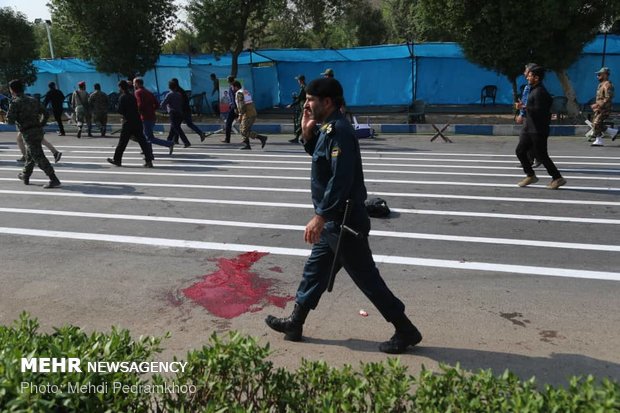
TEHRAN, Oct. 08 (MNA) – The martyrdom of some of our compatriots in the Ahvaz terrorist attack hurt the hearts of all Iranians. The crimes committed by the United States, its western allies, and its Arab pieces in Ahvaz can be analyzed from different dimensions. What's important in this regard is "finding the origin of this attack," and putting together the puzzle pieces that are set by the United States of America.
Although the US government is trying to convince others that the American authorities are basically innocent in Ahvaz terrorist attack, the role of Trump's government in the incident is so highlighted that even his closest companions like John Bolton and Mike Pompeo aren't able to justify it. There is no distinction between producing terrorism (the US and its allies), and field terrorism (operational groups affiliated with the West and the Zionist regime). The United States seeks to encourage individuals to distinguish between supporters and the elements which are involved in the emergence of terrorism.
However, a comprehensive look at terrorist attacks will prevent this distinction. In finding the relationship between the field terrorism and producing terrorism, we should note that the origin and the function of the two are the same. In other words, we are faced with a single network headed by the United States, and the body consists of those terrorist groups.
Another point that should be taken into consideration here is the specific efforts of the Trump government to support anti-Iranian terrorist groups (over the past two years). Rudy Giuliani, who is currently an attorney to Trump, and served as the former mayor of New York, is among the supporters of the Mujahedin terrorist group.
During a recent meeting in New York, Giuliani and some members of the Trump government have expressed support for members of this terrorist group. Obviously, the Ahvaz terrorist attack is the result of the secret (and at times open) lobbies of the White House and anti-Iranian terrorist groups. Trump and other US officials from both the Republican and Democrat parties are responsible for the operational, intellectual, financial and arsenal support of anti-Iranian groups which tried to make our country insecure for four decades and made every effort to create or establish a security crisis in Iran. Therefore, in focusing on the Ahvaz terrorist attack, we can't simply close our eyes on its origin, or consider it as marginal.
Here we're not faced with an "independent terrorist group", but with an "extensive and complex network" that interacts with the main directors (the United States, Britain, and the Zionist regime), the mediating leaders (Arab pieces) and the players (the members of the terrorist groups). There is a direct and deep connection between these three which calls for our close attention.
Obviously, our country's foreign ministry will play an important role in introducing this network, and in taking a tough political response against both its main and minor players. Of course, in this equation, the main players are of more importance. Undoubtedly, all those who were involved in the recent terrorist attack in Ahvaz will pay for it, and the Iranian security officials have emphasized this stance.