Alarm bells went off last September in Washington’s corridors of power when John Bolton’s national security council asked the Pentagon for options for military strikes against Iran.
The council’s request was in response to three missiles fired by an Iranian-backed militia that landed in an empty lot close to the US embassy in Baghdad and the firing of rockets by unidentified militants close to the US consulate in the Iraqi port city of Basra.
“We have told the Islamic Republic of Iran that using a proxy force to attack an American interest will not prevent us from responding against the prime actor,” Mr. Bolton said at the time.
Commenting on the council’s request, a former US official noted that “people were shocked. It was mind-boggling how cavalier they were about hitting Iran.”
Then US Defense Secretary Jim Mattis, like Mr. Bolton an Iran hawk, worried that military strikes would embroil the United States in a larger conflagration with Iran.
The request, moreover, seemed to call into question US President Donald J. Trump’s promise to America’s European allies that he would rein in Mr. Bolton who has a long track record of advocating military action against Iran.
Months before joining the Trump administration in the spring of 2018, Mr. Bolton drafted at the request of Mr. Trump’s then strategic advisor, Steve Bannon, a plan that envisioned US support “for the democratic Iranian opposition,” “Kurdish national aspirations in Iran, Iraq and Syria,” and assistance for Iranian Arabs in the oil-rich Iranian province of Khuzestan and the Baloch who populate the Pakistani province of Balochistan and Iran’s neighbouring Sistan and Baluchistan province.
Frustrated by the Trump administration’s failure to respond to his suggestions, Mr. Bolton published the memo in December 2017.
Almost to the day two years after the publication and two months before the 40th anniversary of the Iranian revolution, Mr. Bolton asserted in a policy speech in Cairo, that the United States had “joined the Iranian people in calling for freedom and accountability… America’s economic sanctions against the (Iranian) regime are the strongest in history, and will keep getting tougher until Iran starts behaving like a normal country.” Mr Bolton was referring to harsh US sanctions imposed in 2018 by Mr. Trump after withdrawing the United States from the 2015 international agreement that curbed Iran’s nuclear program.
Mr. Bolton’s plan stroked with Saudi thinking about the possibility of attempting to destabilize Iran by stirring unrest among its ethnic minorities. The thinking was made public in a November 2017 study by the International Institute for Iranian Studies, formerly known as the Arabian Gulf Centre for Iranian Studies, a Saudi government-backed think tank.
The study argued that Chabahar, the Indian-backed Iranian deep-sea port at the top of the Arabian Sea, posed “a direct threat to the Arab Gulf states” that called for “immediate counter measures.”Pakistani militants claimed in 2017 that Saudi Arabia had stepped up funding of militant madrassas or religious seminaries in Balochistan that allegedly serve as havens for anti-Iranian, anti-Shiite fighters.
Mr. Bolton’s memo followed an article he wrote in The New York Times in 2015 headlined ‘To Stop Iran’s Bomb, Bomb Iran’ at the time that President Barak Obama was negotiating the international agreement to curb Iran’s nuclear program.
Mr. Bolton argued in the op-ed that diplomacy would never prevent the Islamic republic from acquiring nuclear weapons. “The inconvenient truth is that only military action like Israel’s 1981 attack on Saddam Hussein’s Osirak reactor in Iraq or its 2007 destruction of a Syrian reactor, designed and built by North Korea, can accomplish what is required. Time is terribly short, but a strike can still succeed,” Mr. Bolton wrote.
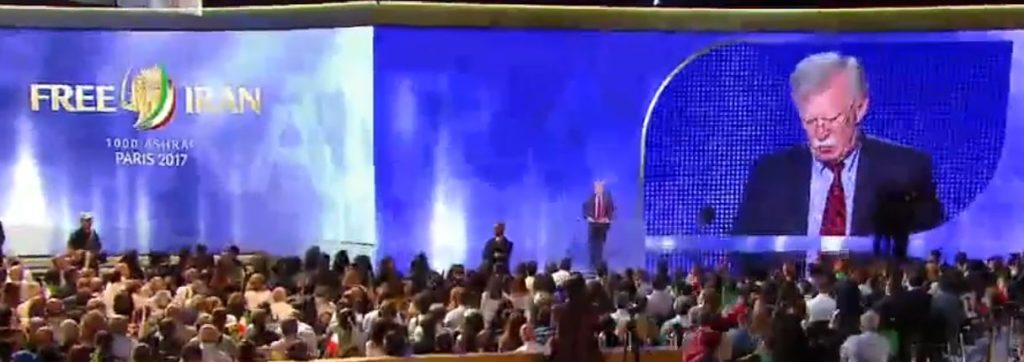
The memo was written at about the same time that Mr. Bolton told a gathering of the Iranian opposition group Mujahedin-e-Khalq that “the declared policy of the United States of America should be the overthrow of the mullahs’ regime in Tehran” and that “before 2019, we here will celebrate in Tehran.”
While Mr. Bolton has remained outspoken even if he has been careful in his wording as national security advisor, other past advocates of military action against Iran have taken a step back.
Mike Pompeo has since becoming secretary of state hued far closer to the Trump administration’s official position that it is pursuing behavioural rather than regime change in Iran. But as a member of the House of Representatives, Mr. Pompeo suggested in 2014 launching “2,000 sorties to destroy the Iranian nuclear capacity.”
While the Trump administration has largely explained its hard line towards Iran as an effort to halt the country’s missile development, roll back its regional influence, and ensure that the Islamic Republic will never be able to develop a nuclear weapon, Mr. Bolton has suggested that it was also driven by alleged Iranian non-compliance with the nuclear accord.
“Report: Iran’s secret nuclear archive ‘provides substantial evidence that Iran’s declarations to IAEA International Atomic Energy Agency) are incomplete & deliberately false.’ The President was right to end horrible Iran deal. Pressure on Iran to abandon nuclear ambitions will increase,” Mr. Bolton tweeted this month, endorsing a report by the Washington-based Institute for Science and International Security.
Based on Iranian documents obtained by Israel, the report identified an allegedly undeclared Iranian nuclear site. “Documentation seized in January 2018 by Israel from the Iranian ‘Nuclear Archive’ revealed key elements of Iran’s past nuclear weaponization program and the Amad program more broadly, aimed at development and production of nuclear weapons. The material extracted from the archives shows that the Amad program had the intention to build five nuclear warhead systems for missile delivery,” the report said.
Similarly, Mr. Bolton this month told Israeli prime minister Benyamin Netanyahu on a visit to Jerusalem that “we have little doubt that Iran’s leadership is still strategically committed to achieving deliverable nuclear weapons. The United States and Israel are strategically committed to making sure that doesn’t happen.”
Mr. Bolton’s assertion contrasted starkly with then Director of National Intelligence Dan Coats’ assessment in his 2017 Worldwide Threat Assessment of the US Intelligence Community that “we do not know whether Iran will eventually decide to build nuclear weapons.”
Mr. Bolton’s hardline position within the Trump administration could be cemented if Iran were to decide that upholding the nuclear agreement no longer served its interest. Anti-agreement momentum in Iran has been fuelled by the European Union’s seeming inability or unwillingness to create a financial system that would evade US sanctions and facilitate trade with Europe.
Mr. Bolton’s hard line has also been bolstered by the imposition of European Union sanctions on Iran’s ministry of intelligence and two individuals on charges of plotting to kill leaders of an Iranian Arab separatist movement in Denmark and the Netherlands.
An Iranian abrogation of the nuclear agreement would likely lead to a reshuffle of the Iranian cabinet and the appointment of hardliners that would in turn bolster Mr. Bolton’s argument that the Iran issue has to be resolved before the United States can militarily truly disengage from the Middle East and South Asia.
Hardliners like Mr. Bolton may have one more development going for them: Disillusionment in Iran with the government of President Hassan Rouhani is mounting.
The disappointment is being fuelled not only by the failure of the nuclear accord to drive economic growth and the government’s mis-management of the economy and inability to take on nepotism, vested interests such as the Revolutionary Guards and the growing income gap accentuated by the elite’s public display of ostentatious wealth, but also the fact that Mr. Rouhani appears to have lost interest in reform and implementing change.
“Unfortunately, Mr. Rouhani´s second term has been extremely ignorant (about the demands) of the twenty-four million people who make up Iranian civil society. Most of the reformists believe that he no longer wants to interact (with the reform movement). All that concerns him is to emerge from the remaining two years (of his second term) undamaged, and thus maintain his privileged spot in the pyramid of power,” said Abdullah Naseri, a prominent reformist and adviser to the former president Mohammad Khatami. Mr. Naseri was referring to the 24 million people who voted for Mr. Rouhani.
A reformist himself, Mr. Khatami warned that “if the nezam (establishment) insists on its mistakes… (and) reform fails, the society will move toward overthrowing the system.”
The roots of Mr. Bolton’s thinking lie in a policy paper entitled US Defense Planning Guidance that has been in place since 1992. The paper stipulates that US policy is designed “to prevent any hostile power from dominating a region whose resources under consolidated control be sufficient to generate global power.” The paper goes a long way in explaining why the US and Saudi Arabia potentially would be interested in destabilizing Iran by stirring unrest among its ethnic minorities.
Iran scholar Shireen Hunter suggests that squashing Iran’s ambition of being a regional and global player may be one reason why senior Trump administration officials, including Mr. Bolton, Mr. Pompeo and Rudolph Giuliani, the president’s personal lawyer, alongside the Saudis support the Mujahedin e-Khalq even if its domestic support base is in question.
“The MEK was willing to support Saddam Hussein and cede Iran’s (oil-rich) Khuzestan province to Iraq. There is no reason to think that it won’t similarly follow U.S. bidding,” Ms. Hunter said referring to the Mujahedeen’s support of Iraq during the Iran-Iraq war in the 1980s.
Mr. Bolton appeared to be fortifying what amounted to the most hard-line approach towards Iran in an administration that was already determined to bring Iran to its knees by elevating Charles M. Kupperman, a long-time associate and former Reagan administration official, to deputy national security adviser.
Mr. Kupperman, a former Boeing and Lockheed Martin executive, previously served on the board for the Center for Security Policy, a far-right think tank advocating for a hawkish Iran policy founded by Frank Gaffney, a former US government official who is widely viewed as an Islamophobe and conspiracy theorist.
Similarly, Mr. Trump, reportedly on Mr. Bolton’s advice, hired this month Richard Goldberg as the national security council’s director for countering Iranian weapons of mass destruction.
As a staffer for former Senator Mark Kirk, Mr. Goldberg helped write legislation that served as the basis for the Obama administration’s sanctions regime on Tehran prior to the nuclear deal. He went on to work for the Washington-based Foundation for Defense of Democracies, which advocates a hard line towards Iran.
Earlier, Mr. Bolton hired Matthew C. Freedman, who in March 2018, together with Messrs. Kupperman and Bolton registered the Institute for a Secure America as a non-profit organization on the day that Mr. Trump announced Mr. Bolton’s appointment as national security advisor.
A long-standing Bolton associate and one-time member of Mr. Trump’s transition team, Mr. Freedman worked in the 1980s and 1990s as a foreign lobbyist with Paul Manafort, who managed Mr. Trump’s election campaign for several months and was last year convicted as part of special counsel Robert Mueller’s investigation into alleged collusion between the campaign and Russia to influence the outcome of the 2016 presidential election.
Messrs. Bolton, Kupperman and Freedman also established in 2015 the Foundation for American Security and Freedom to campaign against the Iran nuclear deal.
David J. Rothkopf, a former Clinton administration official who wrote a definitive history of the National Security Council described Mr. Bolton as a man “who has never crossed a bridge he hasn’t burned behind him, who is surrounding himself with what appears to be a second-tier group of advisers who have spent a disproportionate amount of time on the swamp side of things — as consultants or working on his extreme political projects.”
Said journalist and political commentator Mehdi Hasan: “You underestimate John Bolton at your peril… In 2003, Bolton got the war he wanted with Iraq. As an influential, high-profile, hawkish member of the Bush administration, Bolton put pressure on intelligence analysts, threatened international officials, and told barefaced lies about weapons of mass destruction. He has never regretted his support for the illegal and catastrophic invasion of Iraq, which killed hundreds of thousands of people. Now, he wants a war with Iran.”
Dr. James M. Dorsey is a senior fellow at the S. Rajaratnam School of International Studies, co-director of the University of Würzburg’s Institute for Fan Culture, and co-host of the New Books in Middle Eastern Studies podcast. James is the author of The Turbulent World of Middle East Soccer blog, a book with the same title and a co-authored volume, Comparative Political Transitions between Southeast Asia and the Middle East and North Africa as well as Shifting Sands, Essays on Sports and Politics in the Middle East and North Africa and just published China and the Middle East: Venturing into the Maelstrom