Showing posts with label Islamic Unity Week. Show all posts

Tuesday, November 12, 2019

Unity Week Special (2)

These days most Muslims all over the world are marking the Islamic Unity Week on the occasion of the blessed birth anniversary of the Messenger of Mercy, Prophet Mohammad (blessings of God upon him and his progeny). According to Sunni Muslims, on the basis of the narrations of the Sahaba, he was born on the 12th of Rabi’ul Awwal, while Shi’a Muslims who regard the accounts of the Prophet’s Ahl al-Bayt or Impeccable Household as more reliable, he was born on the 17th of this month.
Forty years ago, in order to bridge this 5-day gap and to bring the Islamic Ummah on the platform of solidarity, the Father of the Islamic Revolution, Imam Khomeini (RA) took the dynamic initiative of declaring the Prophet’s birthday as Islamic Unity Week.
We use this opportunity to study in brief some of the merits of Allah’s Best-Ever Creation. Please stay tuned for the second episode of the Unity Week Special.
Today, it is very unlikely to find a person who has not heard the name of the Prophet of Islam. He is undoubtedly the Messenger of Mercy and the Prophet of Peace. His name Mohammad (blessings of God upon him and his progeny), was mentioned in all the previously revealed scriptures to the Prophets of the past, such Noah, Abraham, Moses, Jesus and others (peace upon them). He was entrusted by God Almighty with the universal message of Islam for the benefit of all mankind. Today, Muslims, as those who claim to be his followers, call themselves, number almost 1.8 billion all over the globe, where his name is glorified day and night than that of any other person, as is evident by the Azan or the call to prayer that is recited from the mosques five times a day, and the ritual prayers that Muslims perform throughout the world.
The human being always seeks an exemplar to follow. Exemplars have a high status in education, psychology, management and so on. Islam has also paid attention to this fact. As we said yesterday in the previous episode of this series, God says in ayah 21 of chapter Ahzaab of the holy Qur’an, “Indeed, in the Messenger of Allah there is certainly for you an Excellent Exemplar, for those who look forward to Allah and the Last Day, and remember Allah greatly.”
                                              
This ayah addresses all Muslims in every age and place. It is obvious that the Prophet of Islam is the Finest Exemplar for every believer as long as the transient world exists. The holy Qur’an has not referred to his excellent characteristics. On the one hand he is mentioned as other persons; i.e. he lives like others, he eats food, he sleeps and so on. But, on the other hand, he is the unmatched jewel of creation which shines forever. Each and every deed and word of the Last and Greatest Messenger is an example to be emulated by the believers.
The Prophet lived a simple life. He worked like all other people. For instance during the siege laid to Medina by a combined army of pagan Arabs and Israelites, the Prophet rubbed shoulders with the rest of the Muslim defenders, in digging the ditch around the city, on the suggestion of his new companion, the Iranian, Salman Farsi. The Prophet, besides reciting the ayahs of the Qur’an to the people on their revelation to him through Archangel Gabriel, the emissary of God Almighty, used to engage in humour with his companions in a polite manner, as part of his policy of educating them and imparting to them the finesse of faith. He always encouraged people, in addition to cautioning them against the conspiracies of the hypocrites. In all fields, he was the epitome of perfection to be emulated by his followers.
The holy Qur’an says in ayah 4 of surah Qalam, “Indeed, indeed you possess a great character.”
The holy Qur’an even stresses that the Prophet owes his success in attracting the people to his kind and lenient manners and the fact that he was more loving toward them than their own parents. Ayah 128 of surah Tawba says, “There has certainly come to you a Prophet from among yourselves. Grievous to him is your distress; he has deep concern for you, and is most kind and merciful to the faithful.”
The Prophet of Islam would act very prudently and he was very quick in his decisions although he was the most forbearing of the people. He was the most generous. He would ear simple food and would sit on the ground like ordinary people. His disposition would impact every viewer. His silence was as instructive and impressive as his speech. Anas ibn Malek, his servant, says, “I was the servant of God’s Messenger. By God, he never uttered a scornful word to annoy anyone. He never reprimanded for anything and never disputed with me.”
The love and affection of the Prophet was a byword among people. Prophet Mohammad (blessings of God upon him and his progeny) would always ask about the state of his companions and if they were on a journey he would look after their family. If he didn’t see a person for three days, he would ask from his whereabouts. If the man had come on a trip, the Prophet would pray for him; and if he was at home the Messenger of Mercy would pay a visit to him.
Even the enemies enjoyed his mercy. During the battle the Arab polytheists had imposed upon the Prophet at a place called Badr near Medina, the Muslim defenders took control of the water wells of the region. They made ponds and filled them for consumption. When the enemies approached the ponds, the Prophet of Islam ordered the Muslims not to block their way but to let them avail of this elixir of life!
The justice of the Prophet of Islam was very famous in every aspect. He would even divide his looks among the attendees justly. This was stressed by his sixth Infallible Successor, Imam Ja’far Sadeq (AS) when he said, “The Messenger of God would divide his glances among his companions and would look at this and that justly.”
One of the congenial characteristics of human being is his logicality and reasonability. The Prophet too, invited the people on the same basis. Now, the Islamic Ummah is increasing in number every day. The Prophet of Islam staged the greatest revolution in the history of mankind.
The Leader of the Islamic Revolution, Ayatollah Khamenei, says, “Almighty God has ordered us Muslims to follow the Prophet. This following is in every aspect of life. That Great person, not in his speech, but through his behavior, way of living, interaction with people and family, dealing with friends, engagement with enemies and strangers, in his treatment of the poor and the weak, in everything he is the exemplar. Our Islamic society will be the perfect Islamic society, in the real sense of the word, only when it adapts its behavior with the Prophet’s behavior. If it is not practical to act 100% as he did- which is not- let us at least be similar to him; not the way that the opposite of his way of living rules in our life. Let us move in that line.”

Unity Week Special (1)

These days most Muslims all over the world are marking the Islamic Unity Week on the occasion of the blessed birth anniversary of the Messenger of Mercy, Prophet Mohammad (Blessings of God upon him and his progeny).
According to Sunni Muslims, on the basis of the narrations of the Sahaba, he was born on the 12th of Rabi’ul Awwal, while Shi’a Muslims who regard the accounts of the Prophet’s Ahl al-Bayt or Impeccable Household as more reliable, he was born on the 17th of this month. Forty years ago, in order to bridge this 5-day gap and to bring the Islamic Ummah on the platform of solidarity, the Father of the Islamic Revolution, Imam Khomeini (RA) took the dynamic initiative of declaring the Prophet’s birthday as Islamic Unity Week.
We use this opportunity to study in brief some of the merits of Allah’s Best-Ever Creation.
Trustworthiness is one of the most prominent characteristics of divine messengers. But, this was very obvious in the Prophet of Islam so much so that years before he was ordered by God Almighty to formally announce his universal mission of Islam, he was known among the people of Mecca and beyond as Amin or Trustworthy, and Sadeq or Truthful. Trustworthiness is the first and foremost virtue for the divine messengers as they are duty-bound to discharge the commandments of God and communicate His words to the masses without any blemish or shortcoming. The trustworthiness and honesty of the Prophet of Islam was so outstanding that it attracted the people towards his mission, although the powerful and rich infidels of Mecca strongly opposed him for fear of losing their their position and wealth. God says in ayah 21 of chapter Ahzaab of the holy Qur’an, “Indeed, in the Messenger of Allah there is certainly for you an Excellent Exemplar, for those who look forward to Allah and the Last Day, and remember Allah greatly.”
The Prophet’s way of living was so perfect and comprehensive that he was regarded as the Most Excellent Exemplar in every aspect of human life.  
The Prophet would divide his time into three parts: The first part was dedicated to worship and prayer; the second part was dedicated to the family and fulfilling their material and other needs; and the third part was the special time for dealing with the problems of people and social engagements.
Family is based on love and kindness as God says in ayah 21 of surah Roum, “And of His signs is that He created for you mates from your own selves that you may take comfort in them, and He ordained affection and mercy between you. There are indeed signs in that for a people who reflect.”
Love and affection can compensate many defects in the marital life. The Prophet of Islam used to say: “The more a person’s faith increases, the more he expresses his love towards his spouse.”
This great personality used to recommend men to treat their wives kindly and affectionately. Once he said, “The man who has married a woman, should respect her. If he tells his wife, ‘I love you’, this will never leave the wife’s heart.”
As a matter of fact, the love of the Prophet for Lady Khadija (peace upon her), his first and only wife for 25 long years till her death, has been mentioned in the history of Islam. She was as a very virtuous and monotheist lady and he greatly respected her and even after her death used to glorify her. He would stress that no other woman could match Lady Khadija as she offered her entire wealth to the Prophet to use it in the way of God. The Prophet called a man’s work at home as charity and alms-giving. He told his cousin, son-in-law and divinely-designated Vicegerent, Imam Ali (AS), “O Ali! Serving the wife at home is the atonement of great sins and it cools down God’s wrath.”  
The Prophet used to sit with the family and would say that sitting with the family is better in the divine court than staying and worshipping at the mosque. He has said, “A man who spreads the table, calls his wife and children and starts eating the food in the name of God and ends it with thanking God, God will send His mercy and forgiveness to them as long as the table is there.”
When his Immaculate Daughter, Hazrat Fatema Zahra and her husband Imam Ali (peace upon them) sought his advice for division of their daily work, the Messenger of Mercy said, “The housework will be done by Fatema and the works outside home will be done by Ali.”
Dear listeners, this does not mean that a man should always expect his wife to do the housework no matter how tired she is. There are other statements narrated from the Prophet of Islam that helping one’s wife with the house chores is very valuable and will have great reward in the divine court.
As for the children, the Prophet of Islam would always try to make them happy. He stated, “Anyone who gladdens a girl it is as if he had freed one of the children of Prophet Ishmael; and he who gladdens a boy it is as if he had shed tears for the fear of God.”
The Messenger of Mercy, Prophet Mohammad (Blessings and greetings of God upon him and his progeny) emphasized that the duty of parents begins with the choice of spouse. In other words, to have good and decent children we should first take care of choosing a decent and chaste wife. The Prophet said, “If any of you is engaged in raising his child it is better than giving half of his wealth everyday as alms in the way of God. You should choose good names for your children and leave them the best legacy through correct training.”
In the view of the Qur’an, the highest stage of lifestyle is “Hayaat Tayyiba” (Virtuous Life). For sure it is the lifestyle that the divine Prophets and Friends of God maintained. This concept has been mentioned in ayah 97 of surah Nahl, “Whoever acts righteously, [whether] male or female, should he be faithful, —We shall revive him with a good life and pay them their reward by the best of what they used to do.”
While the west exerts its utmost to confine religion in the personal life, it is essential to introduce the comprehensive social programs of Islam. Islam has instructions for all minutiae of human life and the Prophet of Islam has shown the best example for humans. Islam guarantees the human happiness both in this world and the Hereafter. 

Wednesday, November 28, 2018

From Palestine to Rohingya – talking points at Islamic unity conference

By Syed Zafar Mehdi


TEHRAN _ During the three-day International Islamic Unity Conference in Tehran this week, many brainstorming discussions were held as part of various commissions on some of the most pressing and significant issues facing the Muslim world today.
Many distinguished scholars, authors, cultural experts, diplomats, and politicians took part in these discussions and threw light on various issues.
In one of the commissions, former Iranian Foreign Minister Manouchehr Mottaki spoke about the plight of Rohingya refugees and their impoverished conditions in Bangladesh’s refugee camps. He said the commission, which comprises foreign ministers of Jordon, Syria, Iraq, and Mauritania, will work to aid Rohingya refugees and highlight their issues in the media.
It has been one year since Rohingya Muslims were forced to leave Myanmar following a brutal crackdown by Myanmar military with support from the government. As per conservative estimates, there are around 905,000 Rohingya refugees presently in Bangladesh's Cox's Bazar.
The savagery in Rakhine was described by the United Nations as “a textbook example of ethnic cleansing”. The atrocities were widely documented by human rights bodies, including gang rapes, cold-blooded killings, torture and destruction of properties belonging to Rohingya Muslims.
In another commission, Palestinian resistance movement Hamas leader Ismail Radwan expressed anguish over growing proximity between some Arab states and the Zionist regime of Israel. He said the Palestinians with their unflinching resistance and continued struggle for the liberation of occupied territories would never allow any such “deal” from taking place.
Noted Islamic luminary Ayatollah Taskhiri, speaking in one of the commissions, also denounced Zionist regime’s war crimes in Palestine and called for the boycott of regime.
The unrelenting injustices perpetrated against the Palestinian people have stirred the conscience of people worldwide, transcending the religious divide. On the other hand, some Arab regimes, having ties with Israel and U.S., have been siding with the oppressors because of business interests.
U.S. President Donald Trump created a flutter last week when he remarked that Israel would be in “big trouble” without Saudi Arabia. “The fact is that Saudi Arabia is tremendously helpful in the Middle East, if we didn’t have Saudi Arabia we wouldn’t have a big base, we wouldn’t have any reason probably,” Trump told reporters, while defending Saudi crown prince over Jamal Khashoggi murder.
Mesbahi Moghadam, a senior Iranian politician and former lawmaker, speaking at the conference said one of the methods of forging unity and foiling the enemy plots was to reduce our dependence on dollar. If Muslim countries eliminate the use of dollar, he affirmed, the dollar will be lost and that would deal a body blow to the enemy.
Faisal Mostafa, a scholar from Algeria, in his talk accused Saudi Arabia of providing a launch pad to ISIS terrorists, who have wreaked havoc in many Muslim countries in recent years. He said a trial should be conducted for those Muslim rulers who betray fellow Muslims.
A delegation of students from Philippines said the role of Supreme Leader Ayatollah Khamenei in forging unity in the Muslim world should serve as a source of inspiration. They said the Leader has kept all sections of society in Iran, Shia and Sunni, in tandem and prevented major troubles.  
Ayatollah Mohsen Araki, the General Secretary of World Forum for Proximity of Islamic Schools of Thought, which organizes the conference, in his keynote address said Muslims should excel in cultural, economic, scientific, political and military fields. He said the Muslim world owns 70 percent of the world’s energy, water, and has significant population that utilizes these capacities to blend Islamic countries with the Islamic world.
Ayatollah Araki reiterated that supporting the oppressed people of Yemen was a “religious obligation” for all conscientious Muslims. The victory of the people of Yemen, he said, will expose the ‘enemies of Islam’.
Adnan Kafla, the representative of Ansarullah Yemen, highlighted the horrors of Saudi-led war and blockade in Yemen, quoting UNHCR figures, he said 24 million people needed immediate medical aid and 10 million people needed drinking water.
Pertinently, a much-anticipated UN Security Council resolution calling for a cessation of Saudi-led war in Yemen and for the humanitarian aid to be allowed to reach millions of starving people was “stalled” last week after British Foreign Secretary Jeremy Hunt, who had moved the resolution, met with Saudi crown prince in Riyadh.
On the sidelines of the conference, the participants visited the shrine of Imam Khomeini, the founder of the Islamic revolution, on Sunday where they interacted with his grandson Syed Hassan Khomeini.
In his brief talk, Khomeini said the idea of ‘unity’ was not about abrogating one’s own beliefs, but respecting each other’s beliefs. He said the disintegration of Muslims gives the enemy an upper-hand. However, he added that Shias and Sunnis have opened channels of communication and dialogue to make their relationship better and stronger.
It is pertinent to note that Holy Qur’an considers all Muslims ‘brothers’ as stipulated in Surah Hujurat: “The faithful are indeed brothers. Therefore make peace between your brothers and be wary of Allah, so that you may receive His mercy.” This verse calls Muslims brothers in faith and makes unity and brotherhood between them a precondition for receiving God’s mercy.
The element of ‘mercy’ is extremely important in the Islamic discourse and in this conference, speakers put a lot of emphasis on ‘mercy’ and how the Holy Prophet (pbuh) was sent as a ‘mercy’ to mankind.

Tuesday, November 27, 2018

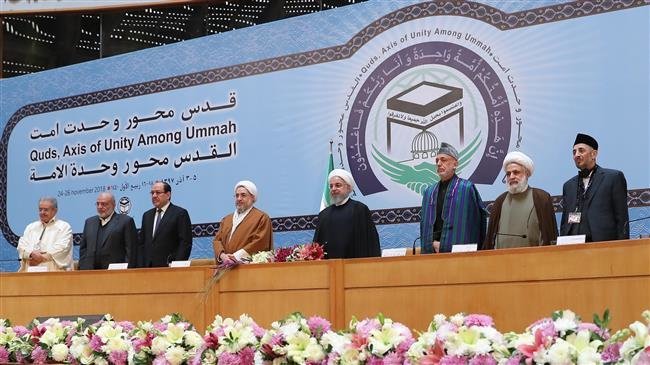
Iran opens 32nd International Islamic Unity Conference with a harsh attack on U.S.

Iranian President Hassan Rouhani on Saturday (Nov 24)  called for Muslim unity and resistance against what he called “hostile” policies of the United States and Israel.
“Muslims have no way but to remain united in order to achieve victory over the US and fight its blatant oppression,” Rouhani told  the 32nd International Islamic Unity Conference which kicked off in the capital Tehran earlier in the day.
“Submitting to the West headed by America would be treason against our religion … and against the future generations of this region,” Rouhani told the international conference.
In an apparent reference to Saudi Arabia and other Gulf states which have close relations with the United States, President Rohani said:  “We have a choice to either roll out red carpets for criminals, or to forcefully stand against injustice and remain faithful to our Prophet, our Koran and our Islam.”
Iran and Saudi Arabia are presumed regional rivals as they supported opposing sides in conflicts in Syria and Yemen and different political factions in Iraq and Lebanon.
“We are ready to defend the interests of the Saudi people against terrorism, aggression and the superpowers… and we don’t ask for $450 billion to do it,” Rouhani said, referring to Saudi Arabia’s contracts with the United States.
“You gifted them $450 billion to guarantee your security; you purchased $110 billion worth of weapons. You were told you were a milk cow which had to be milked. They told you without them you would not last two weeks.”
“Today, the Muslim world is alone and Muslims should join hands. Relying on outsiders is the biggest historical mistake,” he said adding:
“Today, there is no way for Muslims except unity and solidarity and if we unite, we can undoubtedly score a victory against the Zionists and the Americans.”
President Rouhani said unity and brotherhood among Islamic countries must be assumed as a duty. Unity, however, cannot be achieved with words and requires collective action, he said.
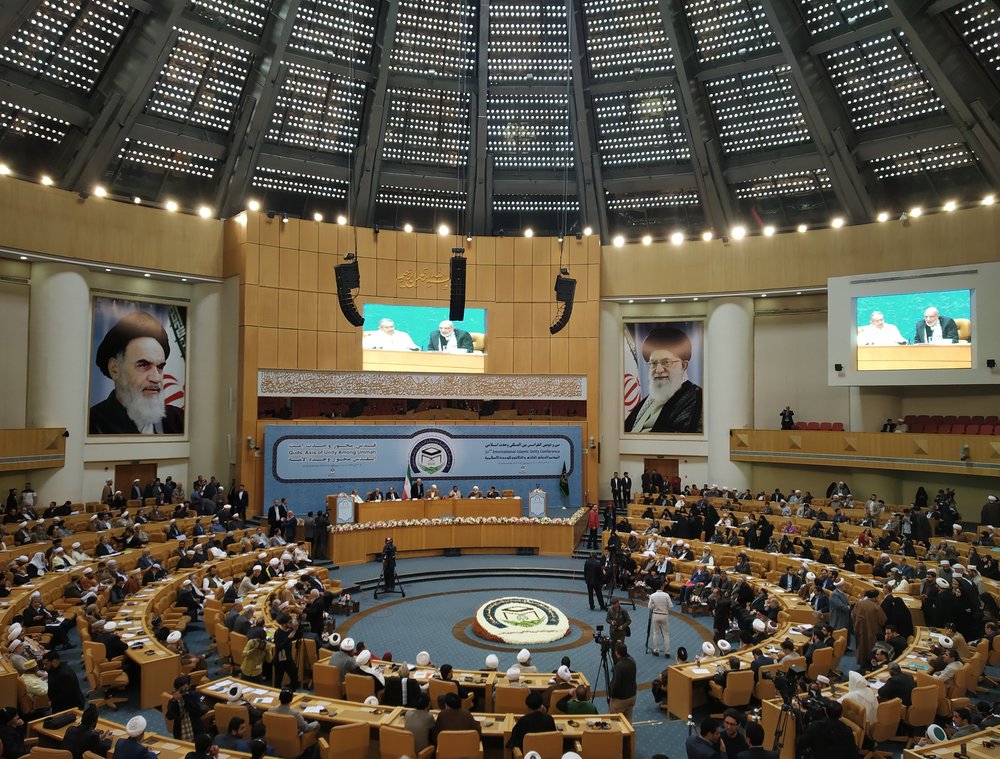
The 32nd International Islamic Unity Conference began in the Iranian capital under the motto “Quds, axis of unity among Ummah.”
The event is held annually on the occasion of the birth anniversary of Prophet Muhammad in a bid to lay the ground for stronger solidarity among Muslims and provide appropriate solutions to their problems.
According to Xinhua news agency, high-ranking political officials and religious figures, including 10 ministers and 40 Muftis, most senior religious scholars, were participating in the Nov. 24-26 international event.
The First International Islamic Unity Conference was inaugurated in 1987 in Tehran, Iran. After holding the 4th Islamic unity conference which was organized by Islamic Promotions Organization of Iran, then Ayatollah Khamenei as the supreme leader of Iran ordered to establish “the World Forum for Proximity of Islamic Schools of Thought”, since then, the conference is organized by the mentioned forum.
Abdus Sattar Ghazali is the Chief Editor of the Journal of America (www.journalofamerica.net) 

Iran, a torch-bearer of Islamic unity

By Syed Zafar Mehdi
TEHRAN _ At a time when many countries in the Muslim world have brazenly become facilitators and enablers of America’s neo-imperialism, helping to advance its political and economic hegemony, there is one country that clearly and categorically says ‘no’ to Washington and its allies.
Why does Iran refuse to pledge allegiance to America? Why is the Iranian government willing to face crippling sanctions than accept diktats from Washington? The answer lies in the pages of history.
The idea of the Islamic Republic of Iran, as envisaged by its founder, was based on the pristine principles of truth and justice that were exemplified by a group of righteous men in Karbala centuries ago. As we saw in Karbala, right always prevails over might, truth always prevails over falsehood. Humiliation is unacceptable to those who belong to the Karbala school of thought.
For the record, Iran has not invaded or attacked any country in its modern history. And there is still no credible evidence confirming the presence of nuclear weapons in Iran. On the other hand, the history of American imperialism is replete with horrific stories of military invasions, gory massacres and socio-cultural aggression, especially in the Middle East and South Asia. Its obligation as the signatory of Non Proliferation Treaty (NPT) to work towards total disarmament has turned out hogwash.
Iran is perhaps the only country that has maintained consistent and uncompromising stand on America’s hegemonic policies since the Islamic revolution in 1979. While Washington has used many arm-twisting tactics and bullying methods to coerce Iran into toeing its line, Tehran has refused to play along.
America, however, has to some extent managed to fan the flames of sectarianism and Takfirism to divide Muslims, because the united Muslim Ummah can prove its nemesis. It has been overly and covertly promoting radical Takfiri groups like ISIS, Taliban and Boko Haram to pit Muslims against each other. The divided Muslim Ummah only benefits the neo-imperialists and Zionists.   
Quite regrettably, many of the powerful Muslim-Arab states have become its pawns in this sinister game. Today, Muslims are getting killed in Palestine, Syria, Yemen, Afghanistan, Nigeria, Pakistan, Iraq, Myanmar etc and the Muslim leaders are silently watching the spectacle. Zionists, supported by the Americans, have occupied Palestine because some Arab countries are sleeping with the enemies.
In this scenario of despair and hopelessness, Iran presents a glimmer of hope. It has emerged as a powerful torchbearer of Islamic unity, and a potent threat to the designs of Americans and Zionists.
To mark the birth anniversary of Holy Prophet (pbuh), who was sent as a ‘mercy’ to mankind, Iran hosts an annual conference that focuses on Islamic unity and its significance in present times. This week, the 32nd edition of the conference was held in Tehran which saw participation of Islamic scholars from across the world.
The three-day conference takes places in the ‘week of unity’ (hafte wahdat), the idea of which was born in mid-1980s, when Imam Khomeini suggested that Muslims, cutting across sects, should come together to honor the memory of Holy Prophet (pbuh), who championed the cause of Islamic unity and brotherhood all his life.
“The origin of this question concerning Shia and Sunni, the one on one side and the other on the other side, is caused by ignorance and by the propaganda spread by enemies,” said the architect of the Islamic revolution. He would often quote the Quranic verse pertaining to unity: “And hold firmly to the rope of Allah all together and do not become divided” (Surah Aali Imran).
In 1990, a year after Imam’s death, The World Forum for Proximity of Islamic Schools of Thought was established by his successor Ayatollah Syed Ali Khamenie, which organizes the International Islamic Unity Conference in Tehran every year in the month of Rabiul Awwal.
This year, high-profile speakers included President Hassan Rouhani, former Afghan President Hamid Karzai, former Iraqi Prime Minister Nour al-Maliki, Hamas leader Ismail Haniyeh, Hezbollah Deputy General Secretary Sheikh Naim Qassem among others.
The conference was thrown open on Saturday morning by Ayatollah Mohsen Araqi, who heads the World Forum for Proximity of Islamic Schools of Thought, which was followed by speeches by guests, press conference and panel discussions. The other two days were dedicated to commissions and cultural activities with emphasis on the element of Islamic unity, solidarity and brotherhood.
In his inaugural address on day one, President Hassan Rouhani called on Muslims around the world to close ranks against the U.S. “Submitting to the West led by U.S. would be treason against our religion and against the future generations of this region,” he said to the loud applause of audience.
President Rouhani lambasted the policies of successive regimes in Washington and said Iran will never accept humiliation. He also denounced the illegal occupation of Palestine by the ‘illegitimate’ Zionist regime, which he called a “cancerous tumor” of the Middle East. Pertinently, the main focus of the conference this year was Palestine and Al-Quds occupied by the illegitimate Israeli regime.  
In a significant but subtle overture to rulers in Riyadh, President Rouhani called Saudi Arabia “a brother”. “We do consider you a brother,” he said. “We do consider the people of Mecca and Medina our brothers,” he hastened to add. Commenting on the cozy relationship Saudi Arabia and other Gulf states have with the U.S. he said it was harming the interests of Muslim Ummah.
“We have a choice to either roll out red carpets for criminals or to powerfully stand against injustice and remain faithful to our Prophet (pbuh), our Quran and our Islam,” he said. “Iran is ready to defend the interests of Saudi people against terrorism, aggression and the superpowers... and we don't ask for $450 billion to do it,” President Rouhani said, referring to recent lucrative deals signed between Riyadh and Washington.
He said the Muslim world was “alone” today and Muslims needed to join hands. “Relying on outsiders is the biggest historical mistake,” he said. “Today, there is no way for Muslims except unity and solidarity and if we unite, we can undoubtedly score a victory against Zionists and Americans,” he added.
Ismail Haniyeh addressed the conference from Palestine through video, urging the Muslim world to speak in one voice against the oppressors and aggressors of the world, including the regime in Tel Aviv. He said the people of Palestine were bravely struggling for the liberation of Palestinian occupied territories and called on Muslim rulers to unite against forces that seek to sow seeds of discord among Muslims.
Hamid Karzai, addressing the gathering, praised the efforts of Iran to advance the narrative of unity in the Muslim world and urged Muslim rulers to support peace efforts in Afghanistan while referring to last week’s attack on a Mawlid conference in Kabul that killed more than 60 people. He said Islamic unity is the need of an hour and it has become even more relevant today with the emergence of Takfiri groups like ISIS.
Nour al-Maliki, in his speech, said the people of Iraq were strong advocates of unity and brotherhood which was instrumental in the defeat of ISIS in his country. He also strongly denounced the occupation of Palestine by the Zionist regime and called for the liberation of Al-Aqsa.  
“Muslim nations must rise up against the Zionist regime, stand up to them and pave the ground for a mass movement,” said the former Iraqi prime minister. He said more countries must come forward and organize such conferences to create unity and solve problems of the Islamic world.
Sheikh Naim Qassem, who represented Hezbollah at the conference, said Islamic unity for Al-Quds cause requires supporting the resistance movements across the region, like Hezbollah in Lebanon, Bashar Assad in Syria, Iraq’s popular mobilization forces, Yemen’s Houthis and the Bahrainis. He said Muslims need to unite to collectively resist the forces of evil.
The Leader of the Islamic Revolution Ayatollah Khamenei, during his meeting with the conference participants, said the Iranian people have stood against sinister plots hatched by enemies “like a mountain”, and today the Islamic system and the Iranian nation were “increasingly making progress”.
In an oblique reference to some U.S. allies in the Arab world, the Leader said they were complicit in war crimes in Palestine and Yemen. But hastened to add that Yemenis and Palestinians would gain victory and the U.S. and its allies would be brought to knees.
The Leader said the Islamic awakening was the “only way to rescue the region” and this Islamic unity conference was an endeavor to awaken the Muslim Ummah to the challenges facing it.
In contemporary times, Ayatollah Khamenei along with Ayatollah Sistani has played an instrumental role in espousing the cause of Islamic unity. Both of them have regularly issued statements calling for unity between Shias and Sunnis and denouncing attempts to sow seeds of discord between them.
Before them, Islamic luminaries who made untiring efforts to bridge the chasm between Shias and Sunnis included Sheikh Mahmoud Shaltut, who served as the grand Imam of Al-Azhar Egypt between 1958 and 1963 and issued a famous fatwa (religious edict) in 1959 pertaining to faith and beliefs of Shias.
Ayatollah Syed Hussain Borojerdi, who was a leading Shia religious authority in 1950s, also worked untiringly to foster unity among Muslims and established close contact with Dar ul-Taqrib Center in Egypt.
The need of the hour is unity and rapprochement, and what better time to shun antagonism and embrace the spirit of camaraderie than the birth anniversary of Holy Prophet (pbuh). That was the main takeaway from this year’s conference.

Monday, November 26, 2018

In pictures: Muslims celebrate Islamic Unity Week

Iranians celebrate the birth anniversary of Prophet Mohammad
(Peace Be Upon Him) in the Holy Shrine of Imam Reza (PBUH),
 in Mashhad, Iran, during the Islamic Unity Week festivities.


Muslims around the world celebrate the birth anniversary of Prophet Mohammad (Peace Be Upon Him) during the Islamic Unity Week festivities:


Iranians celebrate the birth anniversary of Prophet Mohammad (PBUH) in the Holy Shrine of Imam Reza (PBUH), in Mashhad, Iran, during the Islamic Unity Week festivities. (Photo by Fars)
Iranians celebrate the birth anniversary of Prophet Mohammad (PBUH) in Sanandaj, Iran, during the Islamic Unity Week festivities. (Photo by Fars)
Iranian people of Arab descent celebrate the birth anniversary of Prophet Mohammad (PBUH) in Tehran during the Islamic Unity Week festivities. (Photo by Fars)
Iranians in tribal costumes celebrate the birth anniversary of Prophet Mohammad (PBUH) in Tehran during the Islamic Unity Week festivities. (Photo by Fars)
Iranians dressed in tribal costumes celebrate the birth anniversary of Prophet Mohammad (PBUH) in Tehran during the Islamic Unity Week festivities. (Photo by Fars)
Iranian women dressed in tribal costumes celebrate the birth anniversary of Prophet Mohammad (PBUH) in Tehran, during the Islamic Unity Week festivities. (Photo by Fars)
Children pose as Pakistani Muslims take part in a procession during Eid Milad-un-Nabi, which marks the birth anniversary of Prophet Mohammad (PBUH), in Lahore, Pakistan, on November 21, 2018. (Photo by AFP)
Pakistani Muslim girls take part in a rally during Eid Milad-un-Nabi, which marks the birth anniversary of Prophet Mohammad (PBUH), in Karachi, Pakistan, on November 21, 2018. (Photo by AFP)
Pakistani Muslims take part in a procession during Eid Milad-un-Nabi, which marks the birth anniversary of Prophet Mohammad (PBUH), in Lahore, Pakistan, on November 21, 2018. (Photo by AFP)
Kashmiri cleric Manzoor Banday displays a holy relic during Eid Milad-un-Nabi, the birthday of Prophet Mohammad (PBUH), at the Hazratbal Shrine in Srinagar, India, on November 21, 2018. (Photo by AFP)
Kashmiri Muslims offer prayers during the last Friday of Eid Milad-un-Nabi, which marks the birth anniversary of Prophet Mohammad (PBUH), at the Hazratbal Shrine in Srinagar, India, on November 23, 2018. (Photo by AFP)
Iraqi Muslim Kurds join in prayers to commemorate the birth of Prophet Mohammed (PBUH) in the Kurdish town of Akra, 500 km north of Baghdad, Iraq, on November 19, 2018. (Photo by AFP)
A handout picture released by the official Syrian Arab News Agency (SANA) on November 19, 2018 shows Syrian President Bashar al-Assad (C) performing a prayer along with other officials to mark Prophet Mohammed (PBUH)'s birthday at a mosque in the Syrian capital, Damascus. (Via AFP)

Sunday, November 25, 2018

United We Stand Divided We Fall


By: S. Nawabzadeh


     "Hold fast to the Rope of Allah, altogether, and do not be divided.” (Holy Qur’an 3:103)
     God Almighty’s command to the believers is crystal clear, and the Prophet of Peace spared no efforts during his 23-year long mission to preach the universal message of Islam in uniting not just the fratricidal Arab tribes, but all those who came into contact with him, like the enslaved black Africans, the Romans such as Suhayb, and the Persians represented by Salman Farsi, into the monolithic Muslim Ummah. 
     While departing from the mortal world for his heavenly abode the Messenger of Mercy bequeathed to the Muslims the excellent formula of unity, saying they will never go astray if they hold fast to the Two Weighty Things (Thaqalayn), that is, the Book of God (Holy Qur’an) and his progeny the Ahl al-Bayt that he was leaving behind for guidance.
     The Revealed Word of the Almighty Creator and the Hadith or statements of Prophet Muhammad (SAWA) transcend the barriers of time and geography, which means they are beacons of light for all eras and all places, especially for members of the Ummah who today inhabit all parts of the globe.  
 
     Today when Muslims account for a fifth of the world’s estimated 7 billion population and 53 of the countries where they are in majority, have got together to form the Organisation of Islamic Cooperation (OIC), along with 4 countries where they have sizeable numbers (the country left out being India and its huge Muslim population of around 250 million Muslims), the Ummah, unfortunately, presents the spectacle of a house divided against itself, for the simple reason the rulers, not the people they rule, have decided to drift away from the Qur’an and the Sunnah (the Prophet’s practice and behaviour).
     Instead of trying to bridge the gaps that have grown over time in jurisprudential matters, in order to build ideological unity, or to cooperate and coordinate with each other to at least promote political proximity for proper use of the vast natural resources bestowed by the Almighty Creator, these so-called Muslim rulers, in addition to repressing the people they rule and creating terroristic sectarian divisions, dance to the tune of the avowed enemies of the Ummah, such as the US and the illegal Zionist entity, to whom the wealth of the lands of Islam is being systematically channeled.
     The result has been the destabilization of Syria, the devastation in Iraq, the destruction of Yemen, the desertion of Palestine and the cause of Islam’s First Qibla, the US occupation of Afghanistan, the brutalization of Bahrain, the crushing of the people’s Islamic aspirations in Egypt, the fragmentation of Libya, the weakening of Pakistan, the terrorization of Nigeria, and last but not the least the humiliating surrender of all Arabia including Hijaz the Land of Revelation to the Americans and the Israelis.
     Gone are the days when the enemies of Islam and Muslims used to laugh behind backs at the ideological ignorance and political immaturity of their client regimes in the Muslim world. Now, these archenemies of the Ummah are arrogantly and openly giving orders to these regimes to indulge in fratricide and internal conflicts.
     In such a horrific situation what is the responsibility of the Muslim masses, especially of the ulema, who are supposed to be religious, spiritual, and social guides of the people? 
     The answer is obvious. They should endeavor to narrow the ideological, especially the jurisprudential gaps among the believers.
     It is now almost 40 years since the Father of the Islamic Revolution, Imam Khomeini (AS) made the dynamic move in designating the birth anniversary of Prophet Muhammad (SAWA) as Islamic Unity Week, spanning the two dates of the moth of Rabi al-Awwal believed to be the actual birthday of the Seal of Messengersm – 12th for the Sunnis in accordance with the narrations of the Prophet’s companions, and 17th for the Shi’as who deem family accounts to be more reliable. 
      Thanks to the enedavours of the Islamic Republic, the Islamic Unity Week has not just succeeded in fostering solidarity in Iran but has spread in the region and all over the world to arouse the conscience of the Muslims to the benefits of knitting their ranks on the basis of the ayahs of the holy Qur’an and the Prophet’s Hadith, much to the chagrin of the Ummah’s satanic enemies who in a desperate attempt to undermine Iran’s efforts have launch a war of economic terrorism. 

      Nonetheless, Tehran which is hosting the 32nd International Islamic Unity Conference where some 350 leading figures from over a hundred world countries are participating, continues to play its role as the leader of the Ummah’s solidarity.
     Undaunted by the plots of the US and the Zionists, or the conspiracies of the so-called Muslim regimes, the message of Iran to the ulema of Islam all over the world, irrespective of the minor jurisprudential differences, is crystal clear: Adhere to the Holy Qur’an and the Prophet’s Sunnah, whose most clear manifestation is love for the Ahl al-Bayt, and the Ummah will indeed triumph over sectarianism, terrorism, and thralldom to the US and the Zionists.  

In pictures: Muslims celebrate Islamic Unity Week

Muslims around the world celebrate the birth anniversary of Prophet Mohammad (Peace Be Upon Him) during the Islamic Unity Week festivities:
Iranians celebrate the birth anniversary of Prophet Mohammad (PBUH) in the Holy Shrine of Imam Reza (PBUH), in Mashhad, Iran, during the Islamic Unity Week festivities. (Photo by Fars)
Iranians celebrate the birth anniversary of Prophet Mohammad (PBUH) in Sanandaj, Iran, during the Islamic Unity Week festivities. (Photo by Fars)
Iranian people of Arab descent celebrate the birth anniversary of Prophet Mohammad (PBUH) in Tehran during the Islamic Unity Week festivities. (Photo by Fars)
Iranians in tribal costumes celebrate the birth anniversary of Prophet Mohammad (PBUH) in Tehran during the Islamic Unity Week festivities. (Photo by Fars)
Iranians dressed in tribal costumes celebrate the birth anniversary of Prophet Mohammad (PBUH) in Tehran during the Islamic Unity Week festivities. (Photo by Fars)
Iranian women dressed in tribal costumes celebrate the birth anniversary of Prophet Mohammad (PBUH) in Tehran, during the Islamic Unity Week festivities. (Photo by Fars)
Children pose as Pakistani Muslims take part in a procession during Eid Milad-un-Nabi, which marks the birth anniversary of Prophet Mohammad (PBUH), in Lahore, Pakistan, on November 21, 2018. (Photo by AFP)
Pakistani Muslim girls take part in a rally during Eid Milad-un-Nabi, which marks the birth anniversary of Prophet Mohammad (PBUH), in Karachi, Pakistan, on November 21, 2018. (Photo by AFP)
Pakistani Muslims take part in a procession during Eid Milad-un-Nabi, which marks the birth anniversary of Prophet Mohammad (PBUH), in Lahore, Pakistan, on November 21, 2018. (Photo by AFP)
Kashmiri cleric Manzoor Banday displays a holy relic during Eid Milad-un-Nabi, the birthday of Prophet Mohammad (PBUH), at the Hazratbal Shrine in Srinagar, India, on November 21, 2018. (Photo by AFP)
Kashmiri Muslims offer prayers during the last Friday of Eid Milad-un-Nabi, which marks the birth anniversary of Prophet Mohammad (PBUH), at the Hazratbal Shrine in Srinagar, India, on November 23, 2018. (Photo by AFP)
Iraqi Muslim Kurds join in prayers to commemorate the birth of Prophet Mohammed (PBUH) in the Kurdish town of Akra, 500 km north of Baghdad, Iraq, on November 19, 2018. (Photo by AFP)
A handout picture released by the official Syrian Arab News Agency (SANA) on November 19, 2018 shows Syrian President Bashar al-Assad (C) performing a prayer along with other officials to mark Prophet Mohammed (PBUH)'s birthday at a mosque in the Syrian capital, Damascus. (Via AFP)