Showing posts with label Rohingya refugees. Show all posts

Saturday, January 12, 2019

On Refugees….And Myanmar-It’s Not Just The Rohingya

… And my life’s cold winter that knew no spring;
Of my mind so weary and sick and wild,
   Of my heart too sad to sing.
                       — Paul Laurence Dunbar

The world now has more refugees than at any time since after WW2, more than the population of Britain.  They are often the consequence of wars usually instigated by great powers directly or through proxies.  Civil strife accompanied by the demonization of minorities, killing and expulsion is another reason.  Such is the story of the Rohingya in Burma, or Myanmar as it now likes to be known.
It is a country with the river Irrawaddy as a central artery.  Bordering it is the heartland, peopled by the Bamar who make up 68 percent of the population and are Buddhist.  The Rohingya are Muslim, look different and have lived in Rakhine state for at least five centuries.  During WW2 they supported the British while the Buddhist Burmese supported the Japanese, their coreligionists.  It brought lasting enmity.  After years of propaganda and vilification, the Rohingya were stripped of citizenship.  Not unlike Nazi Germany targeting Jewish people, new restrictive laws curtailed liberties, marriage rights, even children — limited to two.  The vilification turned most neighboring Buddhist villages against the Rohingya, and those attacking and burning their villages were often these neighbors when not the military.
In this latest violence, 90 percent of the Rohingyas were driven out and about three-quarters of a million sought refuge across the border in Bangladesh.  The story does not end with the Rohingya for there are other threatened minorities in Burma occupying the periphery in the north and south:
In northern Shan state, a simmering conflict with the Taang National Liberation Army dating back to 1963 has displaced 300,000.  The army emboldened by the relatively meek response to the assault on the Rohingyas have intensified their efforts also against the ethnic Kokang’s  Myanmar National Democratic Alliance Army.  The consequence is an addition to the tens of thousands that had streamed from earlier conflicts over the border into China.  Also in the north the largely Christian Kachin minority formed the Kachin Independence Army to defend their villages.   The ongoing conflict has displaced more than 135,000 internally.  And in the south the conflict with the Karen(Buddhist, Animist and 15 percent Christian) resulted in over 100,000 refugees … this time in Thailand, plus a 100,000 diaspora to the rest of the world including some 65,000 in the US.  Myanmar’s perverse antipathy towards all its minorities makes a mockery of the Nobel Peace Prize awarded to Aung San Suu Kyi, its leader.  Is meaningful censure an answer, or is innate tribalism an unconquerable primitive amygdala response?
The top five refugee hosting countries might also come as a surprise.  Amid all the news of Angela Merkel’s generous offer to accept everyone entering her country, Germany is not one of them.  Shortly thereafter her party lost by-elections and she is departing.  The actual figures are Turkey (3.5 million), Pakistan (1.4 million), Uganda (1.4 million), Lebanon (1 million) and Iran (0.98 million).  The chaos in countries adjoining them (think of Afghanistan, Iraq, Syria and Somalia) explains why, and the great power with a finger in each pie, when not actually baking it, is also not difficult to discern.
Imagine being forced to flee with just the clothes on your back or just a bag.  A word here also for the people who had to do just that to escape wildfires.  They all have our heartfelt sympathy, often taking a concrete form through donations to help.  A happy new year to everyone and a better one for the unfortunate among us.  We can try to make it so.
Dr Arshad M Khan (http://ofthisandthat.org/index.html) is a former Professor based in the U.S. whose comments over several decades have appeared in a wide-ranging array of print and internet media.  His work has been quoted in the U.S. Congress and published in the Congressional Record.

Wednesday, November 28, 2018

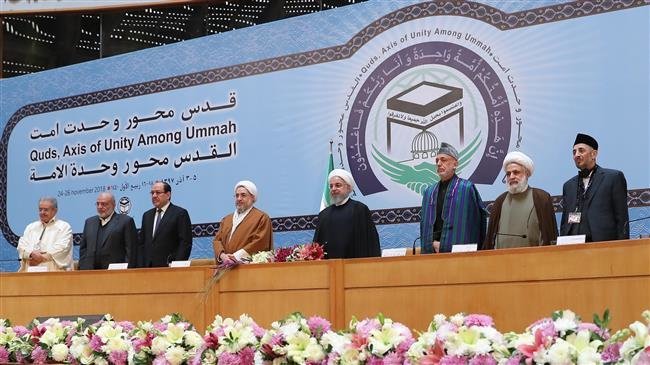
From Palestine to Rohingya – talking points at Islamic unity conference

By Syed Zafar Mehdi


TEHRAN _ During the three-day International Islamic Unity Conference in Tehran this week, many brainstorming discussions were held as part of various commissions on some of the most pressing and significant issues facing the Muslim world today.
Many distinguished scholars, authors, cultural experts, diplomats, and politicians took part in these discussions and threw light on various issues.
In one of the commissions, former Iranian Foreign Minister Manouchehr Mottaki spoke about the plight of Rohingya refugees and their impoverished conditions in Bangladesh’s refugee camps. He said the commission, which comprises foreign ministers of Jordon, Syria, Iraq, and Mauritania, will work to aid Rohingya refugees and highlight their issues in the media.
It has been one year since Rohingya Muslims were forced to leave Myanmar following a brutal crackdown by Myanmar military with support from the government. As per conservative estimates, there are around 905,000 Rohingya refugees presently in Bangladesh's Cox's Bazar.
The savagery in Rakhine was described by the United Nations as “a textbook example of ethnic cleansing”. The atrocities were widely documented by human rights bodies, including gang rapes, cold-blooded killings, torture and destruction of properties belonging to Rohingya Muslims.
In another commission, Palestinian resistance movement Hamas leader Ismail Radwan expressed anguish over growing proximity between some Arab states and the Zionist regime of Israel. He said the Palestinians with their unflinching resistance and continued struggle for the liberation of occupied territories would never allow any such “deal” from taking place.
Noted Islamic luminary Ayatollah Taskhiri, speaking in one of the commissions, also denounced Zionist regime’s war crimes in Palestine and called for the boycott of regime.
The unrelenting injustices perpetrated against the Palestinian people have stirred the conscience of people worldwide, transcending the religious divide. On the other hand, some Arab regimes, having ties with Israel and U.S., have been siding with the oppressors because of business interests.
U.S. President Donald Trump created a flutter last week when he remarked that Israel would be in “big trouble” without Saudi Arabia. “The fact is that Saudi Arabia is tremendously helpful in the Middle East, if we didn’t have Saudi Arabia we wouldn’t have a big base, we wouldn’t have any reason probably,” Trump told reporters, while defending Saudi crown prince over Jamal Khashoggi murder.
Mesbahi Moghadam, a senior Iranian politician and former lawmaker, speaking at the conference said one of the methods of forging unity and foiling the enemy plots was to reduce our dependence on dollar. If Muslim countries eliminate the use of dollar, he affirmed, the dollar will be lost and that would deal a body blow to the enemy.
Faisal Mostafa, a scholar from Algeria, in his talk accused Saudi Arabia of providing a launch pad to ISIS terrorists, who have wreaked havoc in many Muslim countries in recent years. He said a trial should be conducted for those Muslim rulers who betray fellow Muslims.
A delegation of students from Philippines said the role of Supreme Leader Ayatollah Khamenei in forging unity in the Muslim world should serve as a source of inspiration. They said the Leader has kept all sections of society in Iran, Shia and Sunni, in tandem and prevented major troubles.  
Ayatollah Mohsen Araki, the General Secretary of World Forum for Proximity of Islamic Schools of Thought, which organizes the conference, in his keynote address said Muslims should excel in cultural, economic, scientific, political and military fields. He said the Muslim world owns 70 percent of the world’s energy, water, and has significant population that utilizes these capacities to blend Islamic countries with the Islamic world.
Ayatollah Araki reiterated that supporting the oppressed people of Yemen was a “religious obligation” for all conscientious Muslims. The victory of the people of Yemen, he said, will expose the ‘enemies of Islam’.
Adnan Kafla, the representative of Ansarullah Yemen, highlighted the horrors of Saudi-led war and blockade in Yemen, quoting UNHCR figures, he said 24 million people needed immediate medical aid and 10 million people needed drinking water.
Pertinently, a much-anticipated UN Security Council resolution calling for a cessation of Saudi-led war in Yemen and for the humanitarian aid to be allowed to reach millions of starving people was “stalled” last week after British Foreign Secretary Jeremy Hunt, who had moved the resolution, met with Saudi crown prince in Riyadh.
On the sidelines of the conference, the participants visited the shrine of Imam Khomeini, the founder of the Islamic revolution, on Sunday where they interacted with his grandson Syed Hassan Khomeini.
In his brief talk, Khomeini said the idea of ‘unity’ was not about abrogating one’s own beliefs, but respecting each other’s beliefs. He said the disintegration of Muslims gives the enemy an upper-hand. However, he added that Shias and Sunnis have opened channels of communication and dialogue to make their relationship better and stronger.
It is pertinent to note that Holy Qur’an considers all Muslims ‘brothers’ as stipulated in Surah Hujurat: “The faithful are indeed brothers. Therefore make peace between your brothers and be wary of Allah, so that you may receive His mercy.” This verse calls Muslims brothers in faith and makes unity and brotherhood between them a precondition for receiving God’s mercy.
The element of ‘mercy’ is extremely important in the Islamic discourse and in this conference, speakers put a lot of emphasis on ‘mercy’ and how the Holy Prophet (pbuh) was sent as a ‘mercy’ to mankind.