Showing posts with label Houthi Ansarullah movement. Show all posts

Sunday, October 13, 2019

Al-Houthi to U.S.: Learn From Vietnam

SANAA (Kayhan Intl.)– Head of Yemen's Supreme Revolutionary Committee has called on the U.S. to "learn from Vietnam" after Washington announced plans to deploy about 2,000 additional troops to Saudi Arabia.
An "increase in numbers does not mean victory,” Mohammed Ali al-Houthi warned in a series of tweets, adding the U.S. should also learn from its "useless wars” in countries such as Yemen and Iraq.
The official vowed that the Yemeni nation would continue its resistance against Saudi Arabia and other countries which are supported by the U.S. in their war on the impoverished nation.
"Your previous forces, weapons and military commanders, which proved that the US is killing the Yemeni people, did not frighten us,” he said.
"An increase in your numbers will surely not be a concern for us,” al-Houthi added.
The remarks came a few hours after Washington announced the deployment of 1,800 additional troops, two fighter squadrons, two Patriot batteries, and a Terminal High Altitude Area Defense System (THAAD) in the oil-rich kingdom.
The deployment follows a successful Yemeni drone attack on Saudi Arabia’s Khurais and Abqaiq oil facilities last month in retaliation for the kingdom’s U.S.-backed aggression against the country.
On Friday, al-Houthi called on the United States to "surprise the world” and demonstrate the "little bit of humanity that they claim to have” by turning away from its "hostile policy” despite its role in "creating the worst humanitarian crisis in the world”.
"Such a policy has led to nothing but frustration and harm for you,” he added, referring to recent statements made by U.S. President Donald Trump highlighting the high costs of America’s wars in the Middle East.
The U.S. has been a major backer of a Saudi Arabia ever since it launched a devastating campaign against Yemen in March 2015, with the aim of bringing the government of former president Abd Rabbuh Mansur Hadi back to power and crushing the Houthi movement.
Resistance by Yemen’s armed forces, led by the Houthi Ansarullah movement, has pushed the Saudi war to a stalemate, with Yemeni forces deploying increasingly sophisticated retaliatory attacks against the Saudis.
Meanwhile, according to reports Saudi Arabia has been holding talks with Yemen’s popular Houthi movement for the first time in more than two years in a sign that the kingdom is willing to end hostilities, The Financial Times reports.
The "back-channel" negotiations began after the Houthis announced they would stop launching retaliatory drone and missile attacks against positions inside Saudi Arabia if Riyadh stopped its aggression, the paper said Saturday.
"There has been a lot of progress in the talks,” a Dubai-based political commentator was quoted as saying.
"We are now in the last five minutes of the Yemen war,” Abdulkhaleq Abdulla told the British newspaper.
The paper, citing a Western diplomat, said the drone attacks on the Saudi oil facilities were key to the shift in Riyadh’s position.
"Another factor behind Riyadh’s shift has been the weakening of its coalition after the United Arab Emirates," it added.
The UAE is Saudi Arabia’s main ally in the military campaign against Yemen. But Abu Dhabi announced in July that it was drawing down its troop presence in Yemen.
The Saudi-led war has been deadlocked for years and experts have persistently said there is no military solution.
The U.S.-based Armed Conflict Location and Event Data Project (ACLED), a nonprofit conflict-research organization, estimates that the war has claimed more than 91,000  lives over the past four and a half years.
The war has also taken a heavy toll on the country’s infrastructure, destroying hospitals, schools, and factories. The UN says over 24 million Yemenis are in dire need of humanitarian aid, including 10 million suffering from extreme levels of hunger.

Thursday, August 08, 2019

Yemen slams Saudi Arabia for politicizing Hajj pilgrimage

Yemen slams Saudi Arabia for politicizing Hajj pilgrimage


Yemen’s top cleric and minister of endowments have condemned the restrictions imposed by the Saudi regime on the Yemeni pilgrims. 

AhlulBayt News Agency (ABNA): Yemen’s top cleric and minister of endowments have condemned the restrictions imposed by the Saudi regime on the Yemeni pilgrims. 

According to the Arabic-language al-Masirah television network, Yemen’s Minister of Endowments Najib al-Aji said Saudi Arabia’s Ministry of Hajj and Umrah refused to respond to Yemeni correspondence regarding coordinating efforts to facilitate the pilgrimage or conducting flights to carry Yemeni pilgrims planning to carry out the religious duty this year. 

He added that the National Salvation Government denounces the restrictions imposed by the Saudi regime on the Yemeni pilgrims. 

According to Yemen’s Deputy Minister of Endowments Fuad Naji, the Saudi restrictions includes refusing to recognize passports issued in the capital Sana’a, closing Sana’a International Airport and opening only one crossing to Yemenis. 

Yemen’s Mufti Sham al-Din Sharaf al-Din said politicizing Hajj is used by the Saudi regime against its opponents in Yemen, Palestine, Iraq and Libya. 

The top cleric slammed Riyadh for normalizing ties with the Israeli regime and arresting scholars, saying such a regime has no mandate to control the Grand Mosque in the Saudi city of Mecca, referring to the Saudi incompetence in the management of Hajj. 

Saudi Arabia organizes the Hajj pilgrimage as the custodian of Islam's holiest sites in the cities of Mecca and Medina. 

However, serious questions were raised about the competence of Saudi authorities to manage the Hajj rituals following two deadly incidents in September 2015. More than 100 pilgrims lost their lives after the collapse of a massive construction crane into Mecca’s Grand Mosque. About 4,700 people also died in a human crush, according to figures provided by Iran. 

Depending on the pilgrim's nationality, Hajj costs thousands of dollars per person. Hajj and Umrah make up 20 percent of Saudi Arabia’s non-oil-related GDP. 

Last month, the American magazine Foreign Policy said in a report that Saudi Arabian Crown Prince Mohammed bin Salman's policies prompted large groups of Muslims across the world to boycott this year's Hajj, citing concerns that Riyadh may use the revenues from the pilgrimage to pursue the young prince's destructive foreign policies, including his deadly war on the people of Yemen. 

Saudi Arabia and a number of its regional allies launched a devastating campaign against Yemen in March 2015, when bin Salman was just the kingdom's defense minister, with the goal of bringing the government of former president Abd Rabbuh Mansur Hadi back to power and crushing the Houthi Ansarullah movement. 

The US-based Armed Conflict Location and Event Data Project (ACLED), a nonprofit conflict-research organization, estimates that the Saudi-led war has claimed the lives of over 60,000 Yemenis since January 2016. 

In late April, Libya’s Grand Mufti Sadiq al-Ghariani urged Muslims to abstain from traveling to Saudi Arabia for pilgrimage more than once, saying the kingdom uses Hajj revenues to commit crimes against "fellow Muslims." 

Monday, January 07, 2019

Yemen, Where No One Hears You Scream

by 


Now we know what it takes to briefly flip the script on Saudi Arabia. A journalist has to be murdered in an embassy on the orders of the Crown Prince, his body dismembered with a bone saw and then the butchered remains dissolved in a vat of acid. But not just any journalist.  The Saudis have killed and imprisoned many journalists before. But Jamal Khashoggi was journalist working for theWashington Post, a paper owned by the world’s richest man. Usually, the Saudis just buy off their critics. But in Jeff Bezos they may have encountered a man too rich to be bought.
Still there was no anguished outcry, from the Washington Post or the New York Times, three months earlier, after a Saudi Arabian fighter jet launched an airstrike on a school bus in Yemeni village of  Dahyan. The bus had stopped in Dahyan for refreshments, after a picnic, and was heading back to the school when it was struck by a laser-guided MK 82 bomb manufactured by Lockheed and sold to the Saudis by the Pentagon. Fifty people were killed in the bombing, all of them civilians, 30 of them children, most of them 10 years old and younger. Another 48 people were wounded.
One of the school’s teachers, Yahya Hussein, was driving behind the bus in a car. She arrived in Dahyan a few minutes after airstrike and encountered a scene of unspeakable horror. “There was body parts and blood everywhere,” she told Al Jazeera.
The Saudis didn’t bother cleaning up the blood or hiding the severed limbs. Instead the Crown Prince declared the school-bus bombing a “legitimate military attack.” A few days later, the Saudis bombed a funeral for one of the victims, killing and maiming another dozen people. The Saudis said the victims were being used as human shields by the Houthi militias. “I’ll be talking about a lot of things with the Saudis,” Trump quipped to Axios recently. “But certainly I wouldn’t be having people that don’t know how to use the weapons shooting at buses with children.”
One might have hoped for at least a little introspection from the Pentagon in the wake of this gruesome child slaughter.
Instead we were treated to some appalling nonsense from the liberals’ favorite general, James Mattis, who said that the US’s role in the war was helping to prevent civilian casualties. “Therearen’t news reports when Saudi coalition pilots exercise restraint,” Mattis declared. Which begs the question: who is being killed when the Saudis show restraint with their American weapons and the press isn’t around to examine the body parts?
After all, the Dahyan bombing was far from first the massacre of civilians perpetrated by the Saudis using American-made “smart bombs.” In March 2016, 97 civilians were killed when the Saudis bombed the Kames Market in Mastaba. According to Human Rights Watch, 25 children died in that attack. Seven months later, the Saudis targeted another laser-guided missile at a funeral hall in Sanaa, killing 195 civilians. In between, those atrocities the Saudis bombed hospitals, schools, power plants and water treatment facilities, all in violation of international law.
In all, more US-backed Saudi airstrikes have killed more than 5,000 people, 60 percent of them civilians. This lethal lawlessness eventually proved too much even for the drone king himself. After the Sanaa bombing, Obama ordered a halt new weapons sales to the Saudis. Of course by this time, his administration had already sold the Saudis more than $115 billion in weapons, the most of any administration in the 70-year history of the US/Saudi relationship. The ban was swiftly lifted under Trump, who wasted little time in brokering his own $110 billion arms deal with the House of Saud.
The war in Yemen, started under Obama and accelerated under Trump, can legitimately be called a war on children. The famine sweeping the country largely as a result of the crushing embargo against the nation may be the worst on the planet in more than a century, according to the United Nations. More than 1.8 million children are the brink of starvation, with at least 130 dying each day.
Despite the rising death toll, Yemen remains a place few Americans have heard of or could place on map. Yet it is where Barack Obama ordered the assassination by drone of an American citizen, Anwar al-Awlaki, and two weeks later called up another hit that killed his 16-year-old son, Abdulrahman, also an American citizen. Neither were afforded any kind of due process by the peace prize president.
Yemen is also where Donald Trump committed his first war crime, authorizing a commando raid eight days after his inauguration on a village that killed 15 civilians, including, al-Awlaki’s 8-year-old daughter, Nora. Why is the US killing children in Yemen? Who authorized it? What is the goal? When will it end? No one is saying. Few in congress or the press even bother to ask.
It’s not a secret war, the way Afghanistan was under Jimmy Carter. It’s something worse: a war no one cares enough about to mention, assess or debate. Yemen is the place where no one hears you scream, even as you shout in horror at the sight of the dismembered bodies of the 10-year-olds who were once your students.
Freedom is the Whole Life of Everyone
Vasily Grossman: “I used to think freedom was freedom of speech, freedom of the press, freedom of conscience. But freedom is the whole life of everyone. Here is what it amounts to: you have to have the right to sow what you wish to, to make shoes or coats, to bake into bread the flour ground from the grain you have sown, and to sell it or not sell it as you wish; for the lathe operator, the steelworker, and the artist it’s a matter of being able to live as you wish and work as you wish and not as they order you to. And in our country there is no freedom – not for those who write books nor for those who sow grain nor for those who make shoes.”
Jeffrey St. Clair is editor of CounterPunch. His new book is Bernie and the Sandernistas: Field Notes From a Failed Revolution.

Monday, December 17, 2018

Yemen agreement and Riyadh’s double standards

By Ramin Hossein Abadian
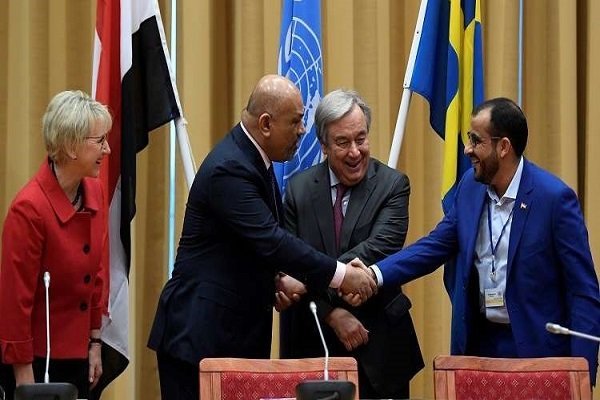
TEHRAN - The Yemen peace talks began with the attendance UN envoy Martin Griffiths on Dec. 13, 2018 in Stockholm and led to an agreement between the two sides, the Sana'a delegation and the Saudi-backed Hadi’s outgoing government representatives.
The agreement came about as Saudi Arabia stepped up its aggressive attacks in various parts of Yemen so that the current peace talks in Stockholm. The Saudis apparently wanted the talks to fail. However, the seriousness of the Sana'a delegation made it impossible for the other party to scuttle the talks and a bilateral agreement was the result.
In the course of the talks that began on Thursday last week, the Hadi aligned delegation often raised irrational, impossible conditions, but to no avail.
The warring parties in Yemen have agreed to a ceasefire in the strategic port city of Hudayda, Al Salif and Ras Issa. They are the main entry points for food and aid shipments to Yemen. The parties must abstain from dispatching any military reinforcements to the city and port of Hudaydah.  The accord also calls for the creation of a joint committee, supervised by the UN, to oversee redeployment and de-mining, which will occur in three ports. The committee chair will report weekly to the UN Security Council.
The agreement places the Red Sea port city under the control of local forces recognized by the Yemeni government. Meanwhile, the UN will also play a “leading role” in supporting management and inspections at the ports.
The document also said that all revenues gathered from the port would be transferred to Yemen's central bank in Hudaydah which would then start paying the salaries of civil servants.
The security of Hodeidah city and the ports of Hudaydah, Salih and Ras Issa are the responsibility of the security forces, in accordance with Yemeni law. The legal tracks of the Authority must be respected and any obstacles or impediments to the functioning of local institutions, including Houthi supervisors, should be eliminated.
The agreements over the province of al-Hudaydah and its harbors seem to be the most important achievement of the Stockholm peace talks.  It was the alertness of the Sana'a delegation that paved the way for the agreement on al-Hudaydah, which included the withdrawal of foreign forces from the province. Responsibility for the security of al-Hudaydah and the ports of al-Hudaydah, Saleef and Ras Isa is the job of the security forces of Yemen according to Yemeni law, which means that no foreign troops, no external forces, can be deployed in al-Hudaydah. And this means that no external force can be deployed in al-Hudaydah. Therefore, it may be said that with this clause in the agreement, the Saudi-UAE dream of occupying al-Hudaydah has been lost.
The head of the Houthi delegation, Mohammad Abdul Salam,  said: “We made great concessions for the sake of the Yemeni people because Hudaydah is the last remaining corridor to save the country from famine”. “We proposed that civilian aircraft go to Jordan and Egypt before heading to Sanaa airport,” he added. “We called for UN surveillance on imports, but the opposition was opposed. But the agreement was positive and we hope that the exchange of prisoners will be done in full and on the basis of an agreed upon mechanism.”
Despite the agreement of the Yemeni parties in the Stockholm talks in Sweden and the official support of the United Nations Secretary-General Antonio Gutierrez of this agreement, Saudi Arabia has adopted a double standard policy with regard to what has happened in Sweden. “We hope that the Houthis accept a comprehensive political solution, in accordance with relevant UN resolutions, that serves the interests of Yemen and its people rather than working on behalf of the Iranian regime's interests,” the Saudi ambassador to the U.S., Khalid bin Salman, said.
These hostile statements by the Saudi ambassador indicate that Riyadh is still not committed to peace in Yemen and it is unlikely that, in light of the current agreement, the Saudis would cease its military aggression against the defenseless and innocent people of Yemen.
After the Yemeni side announced at the end of  the talks  the ceasefire in al-Hudayda, coalition bombers fled the city and targeted the al-Adha area. It’s clear that the Saudi aggression against the Yemeni people is still on their agenda even after the accords in Stockholm. 
It’s important to mention two key points: first, the United Nations is committed its responsibility to protect the agreement. This marks less of a passive role for the UN. Secondly, after the talks the Saudi- backed Hadi’s outgoing government and its allies are in limbo.  In any case, the failure of this agreement, if it should occur, cannot be condemned as a failure by the Sanaa government because the Yemenis have shown that they are struggling for peace.

Sunday, December 16, 2018

Peace Prospects Recede in Yemen as Saudis-Emiratis Violate Sweden Truce

 By: Kayhan Int’l 
The handshake last Thursday in the Swedish town of Rimbo between the two antagonists of the Yemen war was historic and a good augur for peace, provided the United Nations under whose auspices the weeklong negotiations were held, doesn’t take sides and is fair enough to insist that the invaders, whether those have   landed armies or those who are relentlessly bombing to bits the Arab World’s poorest country, leave.
Unfortunately, there is no such statement so far from the World Body. It has neither called on the UAE to withdraw its invasion troops nor told Saudi Arabia to stop its aerial bombardment of Yemen.
This means the handshake between Mohammad Abdus-Salaam of the popular Ansarallah Movement, who represented the legal government in San’aa and Khaled al-Yamani who likes to call himself foreign minister of the ousted and unelected self-styled president, Mansour al-Hadi, might be a mere symbolic gesture unrelated to ground realities.
True, the two sides agreed to halt hostilities, especially around the besieged port of Hodeidah, and to swap prisoners, with the Ansarallah delegation assuring that if all goes well, the strategic port would be demilitarized and function under UN supervision to avert the impending famine, but definitely not be handed over to the aggressors.
The terms of the truce are a resounding slap on the face of Saudi Arabia and the UAE, as well as their backers in Europe and North America, and this is the reason the two countries are reluctant to end either their ground offensive or their air strikes.
This was evident on Saturday when Saudi war planes carried more than a score of sorties over Hodeidah raining death and destruction on civilians, while the UAE-led forces violated the terms of the truce by attempting to launch an offensive on the port city that was beaten back by the defenders.

These two invading powers are loathe to see peace prevail in Yemen, and seem to have no intention of loosening their tentacles on the Yemeni tribes and mercenaries under their direct control, and through them under the vassalage of the West.
Any doubts in this regard became fully manifest when in Rimbo, Sweden, not just the British ambassador to Stockholm Michael Aron was present at the talks, but British Foreign Secretary Jeremy Hunt flew in from London on the final day for discussions with Mansour Hadi’s delegation.
At the opposite end of the table, the much maligned Ansarallah, who are unjustly called ‘rebels’ and Iran’s ‘proxies’, gave a solo performance during the negotiations, thereby proving once again that it is they who are the real representatives of all the Yemeni people and are defending the integrity and dignity of their homeland, against the nefarious designs of the imperialists, the Zionists, and reactionary Arab regimes.
From the outset of the almost 4-year old war that was imposed on Yemen by Saudi Arabia in complicity with the UAE, and the full support of the US and Britain, it was clear that it wasn’t an internal conflict but an imperialist plan to take full control of the strategic land which overlooks the Bab al-Mandeb Strait commanding entrance to the Red Sea. 
It is now up to the Yemeni factions, whom Khaled al-Yamani represented at the talks in Sweden, to prove that they are real patriots and not being used as mercenaries or cannon-fodder by the Saudis, the Emiratis, the Americans, the British, and the Israelis.
Mohammad Abdus-Salaam said the Ansarallah had signed the agreement in good faith in order to avert the impending famine for the sake of the Yemeni people. 

The ball is now in the court of the Aden-based factions, who must now summon the courage to tell Riyadh, Abu Dhabi, Washington, and London, to stay away from the devastating conflict and let the people of Yemen work out the solution.
If not, the war will be further enflamed and any devilish designs the aggressors have will boomerang upon them and their mercenaries, because the Ansarallah very well know that an imposed peace is worse than an imposed war. 

Friday, November 23, 2018

Iran hosts international conference on Yemen amid Saudi war


The International Conference on Supporting the Oppressed and Resistant Yemenis has kicked off in the Iranian capital, with dozens of intellectuals and civil rights activists from 35 countries in attendance.
The event, which opened in Tehran on Thursday morning, is expected to highlight the sufferings of the Yemeni nation caused by a brutal Saudi-led war on the impoverished country.
The one-day conference will also feature speeches by Iranian officials and several representatives from resistance movements in the region.
Backed by the US and the UK, Saudi Arabia and a coalition of its vassal states unleashed the deadly military aggression against Yemen in March 2015 in an attempt to reinstall the country’s former Riyadh-allied regime.
The Saudi-led offensive, coupled with a naval blockade, has destroyed Yemen’s infrastructure and led to famine in the import-dependent state.
The military standoff has so far killed about 56,000 Yemeni people, the Armed Conflict Location and Event Data Project, a nonprofit conflict-research organization, said recently. According to latest calculations by Save the Children, nearly 85,000 Yemeni children may have also died of starvation.
Turning a deaf ear to international warnings, the Saudi-led military alliance has been engaged in a concerted push since June to seize Yemen’s port city of Hudaydah, a vital conduit and lifeline for aid delivery to Yemeni civilians.
Yemeni armed forces, led by the Houthi Ansarullah movement, have put of stiff resistance in the face of the Saudi-led campaign with the help of popular forces, preventing Riyadh and its allies to achieve their goals of war.
Iran stands by war-stricken Yemenis
Addressing the summit, the head of Iranian volunteer Basij forces said that Yemeni people’s resistance against the Saudi aggression will live on in history.
Brigadier-General Gholam-Hossein Gheibparvar Iran, as a nation that has itself suffered from US mischief economic blockade, and war, understands the ordeals of the Yemeni people.
Referring to the remarkable the Yemeni forces have been showing in Hudaydah, Gheibparvar said, “What is taking place in Yemen is a lesson of withstanding. All [enemies] have gathered in Hudaydah, but people have been standing against them with empty hands.”
“We have learned that where there is resistance, there is also victory,” said the military official. “The Saudi rulers have not achieved dignity, but have brought themselves eternal humiliation.”
‘US bent on destroying Muslim nations’
The second-in-command of Iran’s Islamic Revolution Guards Corps (IRGC) also delivered a speech to the event. He said the problems in the Muslim world are rooted in the interrelated policies of the US and Britain as well as the Zionist and Al Saud regimes.
Brigadier General Hossein Salami said that Washington “believes it cannot act as the world’s superpower without political and cultural dominance on the Muslim world.”
However, faced with a wave of Islamic awakening in the world, the US failed to make that “dangerous dream” come true, the commander added.
“The Americans are bent on destroying nations. They are after splitting Islamic nations,” Salami said, stressing that Muslim nations are today at the forefront of the resistance campaign against the US.
Salami rejected long-running US and Saudi claims that Iran was sending arms to Yemeni forces.
“US President (Donald Trump) said Iran was to blame for the situation in Yemen. We, however, say ‘you and the Saudis are blocking the entry of food and medicine in Yemen. How is it that you are allowing missile in there?”
“How do you put the blame [for missile shipment to Yemen] on Iran, while you have closed all the borders? Imagine that Iran provides the Yemenis with political and spiritual support. Could that serve as a good reason for to impose a siege on them and massacre them?” asked the senior general.
Salamai also warned the European nations against selling arms to the Saudi regime, saying those arms only lead to the deaths of civilians in Yemen.
“Yemen will turn into a quagmire for the Al Saud regime and the US,” the general emphasized. “The logic of resistance is growing and be sure that the Islamic Ummah stands united.”

Friday, November 09, 2018

Saudi Arabia’s War on Yemen Has Been a Political, Financial and Diplomatic Disaster


TEHRAN (FNA)- Saudi Arabia and its allies are desperate to cease fire in Yemen, but they want a major victory to continue their interfering role in talks over the fate of the country before holding fire; otherwise, they will earn nothing, but utmost humiliation after years of bombing a poor, defenseless nation. It's now several months they have come to realize that they have lost the costly war and wish for a way out without being so much humiliated.
The bankrupt regime also needs to shrink its budget deficit with spending cuts and a drive to raise revenues from sources other than oil. To do so, a major requirement is ending the costly and failed war on Yemen.

After all, the Saudis need more American bombs and missiles, and it costs a silly mount of cash to get them. At the penniless department of the Pentagon there are no freebies for the regime changers in the Middle East. They have to pay upfront.

Just for the record, according to the US State Department, a single Tomahawk or Hellfire missile strike against the civilian targets in Yemen - involving F-15s, F-16s or F-22s and drones - costs up to $500,000. The Saudis have been “proudly” using the same type of missiles against the poorest country in the Middle East for over three years now, and the financial ramifications have been devastating for their accountants in Riyadh.

It’s all the reason why the Saudis, proxy forces, and regional vassals are so desperate to begin some so-called peace talks and end the costly war on the people of Yemen at the earliest. True, they have in the meantime been bombing the country. But that’s all really. The Saudis want to end the war before the war ends them! Their American allies also know that they can’t win it anyhow.

The Saudis and their allies know that they will be suffering if Riyadh makes the choice to continue the costly “proxy war”. Moreover, the political class in Riyadh is not willing to pay more for the war on Yemen - they have no money and they are beaten and bankrupt.
As it all stands, in their foolish agenda for regime change in Sana’a, the House of Saud got nothing. America was far bigger and far richer than Saudi Arabia, yet still got defeated and went bankrupt on the back of two illegal wars. The war on Yemen was not any different.
The “proxy war” of exorbitant air raids, precision-guided bombs, laser spotters, Tomahawk and Hellfire missiles - under the pretext of fighting alleged “Iranian-backed Houthis” – failed to succeed. It also ended with an insolvent Saudi Arabia. After all, Riyadh's very first and lethal mistake was calling a nation the agents of another country.

At the same time, the war in Yemen exposed the tenuous nature of Saudi Arabia’s relationships with its principal Muslim allies. The most important of them, Pakistan, surprisingly refused to send its army to assist the kingdom. The Sisi government in Egypt — in which Riyadh had invested many billions of dollars and which was considered the kingdom’s “strategic depth” — also reportedly refused to send large numbers of ground troops to participate in the fighting. Instead, Cairo sent a small contingent of several hundred soldiers and three to four ships to assist Riyadh. And in some instances, even those countries that agreed to participate in the Saudi-led campaign developed conflicts of interest with Riyadh over the course of the fighting; for example, the Saudis and the Emiratis are backing forces that are at odds over the future of Yemen and this created friction that has at times erupted into violence between local actors.

Any doubters should take a look at the Saudi budget plan for this year, which is also making a return back to global credit markets after a 25-year hiatus. The cash-strapped regime is about to secure a five-year $10-billion loan from international banks! Digits and numbers show that Saudi Arabia will definitely go completely bankrupt by 2020 if it doesn't stop its military adventurism in the region now. Riyadh is desparate to find a way out of Yemen, but the problem is that they don't have the tact and diplomacy, let alone strategic leadership.

Friday, September 14, 2018

Saudi Arabia buys Israeli ‘Iron Dome’

Saudi Arabia buys Israeli ‘Iron Dome’

Saudi Arabia has reportedly purchased a missile system owned and operated by Israel as the two regimes move towards making their secret relations public.

Qods News Agency (Qodsna) Citing high-level diplomatic sources, the Emirati news website al-Khaleejonline reported on Wednesday that Riyadh had purchased the so-called system from Tel Aviv following US-mediated secret meetings in Washington.

The report said that the deal, worth more than tens of millions of dollars, is expected to be implemented in December, with the first missile system being placed on the Saudi border with Yemen, where the kingdom is waging a deadly war.

Initially, the sources said, Israel refused to sell “Iron Dome” to any Arab country under the pretext that it would endanger the regime's “interests in the region.”

After Washington’s intervention, however, Tel Aviv agreed to the sale.

“Saudi Arabia will pay for the completion of the Iron Dome deal in excess of tens of millions of dollars, and there are pledges to be signed through the US mediator that this system does not pose any danger to the security of Israel and its allies in the region in the near or long term,” the diplomatic sources said.

They also noted that Saudi Arabia will buy more military equipment from Israel if the system operates well.

“If the Iron Dome succeeds in intercepting rockets that pose a threat to the kingdom, there will be talks with Israel to buy additional military systems and open the door for military exchanges between the two sides,” the sources said.

Israel and Saudi Arabia have no diplomatic relations, but they are widely believed to have secret liaisons. Latest reports say the two regimes are working behind the scenes to establish formal contact.

Saudi Arabia's Crown Prince Mohammed bin Salman and Israeli Prime Minister Benjamin Netanyahu have held secret meetings in Jordan, Israel's Maariv newspaper reports.

Critics say Saudi Arabia’s flirtation with Israel would undermine global efforts to isolate Tel Aviv and affect the Palestinian cause in general. They say Riyadh has gone too far in its cooperation with the Israelis as a way of deterring Iran as a regional rival.

Saudi Arabia and its allies launched a brutal war, code-named Operation Decisive Storm, against Yemen in March 2015 in an attempt to reinstall the country's former Riyadh-allied regime and crush the Houthi Ansarullah movement.

The offensive initially consisted of a bombing campaign, but was later coupled with a naval blockade and the deployment of ground forces into Yemen.

The imposed war, however, has so far failed to achieve its stated goals, thanks to stiff resistance from Yemeni troops and allied Houthi fighters.

Several Western countries have been supplying Saudi Arabia with advanced weapons and military equipment, sparking widespread criticism by human rights groups.

Riyadh has also boosted its defenses against retaliatory missile attacks by the Houthi movement, which mostly targets military positions south of the kingdom and other key areas.

Wednesday, July 25, 2018

Indomitable Yemenis Turning Bab al-Mandeb Into a Real Gateway of Tears for the Saudi-UAE Coalition


Yemen, or more properly the patriotic people of that war torn country who hate to be under the thumbnail of the US and have over the past three years held their ground against the war machine of the heavily Saudi-UAE coalition, inflicting heavy losses on the aggressors, are worthy of salutation.
Their recent daring raid on the UAE occupied port of Mokha near the strategic Bab al-Mandeb Strait that wiped out a military base of the aggressors, including the killing of the regional UAE commander, once again proved their indomitable spirit.
At the same time, the Yemenis struck with missiles and sank an advanced UAE naval craft with all soldiers on board, thereby thwarting an attempt to land troops near the besieged port of Hodeidah. This was 16th ship of the coalition to be targeted and the 14th to be sunk.
With meagre resources, shortage of food and medicine due to the air, sea and land blockade, deprived of modern public amenities because of destruction of the infrastructure by the unabated Saudi air strikes, step-motherly treatment by the UN which acting as a tool of the US wants to impose the regional hegemony of Riyadh upon them, and in the face of intense propaganda on the international scale that brands these heroic defenders of their homelands as ‘rebels’, the Yemeni people led by the popular Ansarallah Movement have proved their indomitable spirit to the whole world.


They are neither warmongers nor saboteurs of peace, yet the World Body is unwilling to listen to their just demands for the independence of Yemen and formation of a broad-based national government representing the various tribes and religious groups of the land. Instead the UN repeats in
parrot-like fashion the Saudi taught mantra of the fugitive Mansour Hadi being the ‘internationally-recognized president’, little realizing that this is a questionable term, when the vast majority of the people, even in southern Yemen, have never granted him national recognition.
So far over 20,000 Yemenis have lost their life, hundreds of thousands have been displaced from their homes, and millions are facing starvation and epidemic diseases, but the Saudi-UAE led aggression continues against them with the full backing of the US, the UK, France and the illegal Zionist
entity, all of whom supply the invaders of Yemen with lethal state-of-the-art military technology.
When the Yemeni defenders retaliate with short and long range missiles on the military-industrial installations of the aggressors, especially of Saudi, then a hue and cry is raised that the Ansarallah are committing war crimes and the Islamic Republic of Iran is supplying them missiles and drones.
Strange logic indeed! When the Saudis have destroyed almost the entire infrastructure of Yemen, are daily killing innocent men, women, and children, and are preventing the flow of food and medicine, yet these brutalities are not considered war crimes.
More strange is Iran’s alleged supply of arms and ammunitions to blockaded Yemen – as if the Ansarallah have no right to procure weapons from international markets although they do not need it in view of their wellstacked arsenals – while there seems to be nothing wrong with the pouring in of deadly weapons into the over-stocked arsenals of the aggressors, Saudi Arabia and the UAE.
If Iran were to actually supply military technology to the Ansarallah, the Saudi-UAE aggressors would not only have been defeated and driven out of Yemen, but the Yemenis would have liberated their Saudi-occupied northern provinces of Asir, Najran, and Jizan, which the Wahhabis had seized
in 1934.

With the Saudi-UAE aggressors doing a slow, face saving retreat after their failed offensive on Hodeida, the UN, ought to end its delusion of taking charge of the Hodeida port and should instead try to salvage its credibility by negotiating the complete withdrawal of the aggressors from Yemen,
so that the different Yemeni factions can get together to form a broad-based national government.
Then only can peace return to Yemen, since, as said at the beginning of this column, the Yemeni people hate any foreign meddling in their internal affairs, whether it is from Saudi, UAE, or the Americans.
In view of this fact, recently the Head of Yemen’s Supreme Political Council, Mahdi al-Mashart, called on Russian President Vladimir Putin to play a mediating role for a peaceful end to the crisis in order to save the Red Sea and the strategic Bab al-Mandeb Strait from turning into an American Lake
as the Saudis and Emiratis are trying to do.


In the meantime, the Ansarallah are determined to defeat the designs of the aggressors by turning the Bab al-Mandeb into a real Gateway of Tears and the Red Sea a crimson-blood waterway for the Saudis, the Emiratis and the Americans.


-
 Kayhan Int’l

Sunday, March 26, 2017

Saudi Monarchy A Client State of US Foreign Policy: American Analyst

TEHRAN (Tasnim) – An American political analyst said both the Riyadh regime and Washington should be held accountable for the ongoing war crimes against Yemenis, noting that the US is backing the raids on the impoverished Arab country because the kingdom is a “client state of US foreign policy". “Stepping away from the local political details, one finds a rational objective in US foreign policy in Yemen. The US doesn’t care who runs the country as long as the local boss answers phone calls from Washington with, “Yes sir!” The US is supporting the Saudi attacks on Yemen because the Saudi dictatorship/monarchy is a client state of US foreign policy,” Dr. Mark Mason from California told the Tasnim News Agency on the anniversary of a Saudi-led aggression against Yemen that began on March 26, 2015. Dr. Mason offers analyses of United States domestic and foreign policies for the international news media. He was trained as a biological anthropologist educated at the University of California, Berkeley. Mason has appeared on Al-Etejah TV, Russia Today, Voice of Russia radio, as well as on Life News Russia, AcTVism Munich News, Nuestra Tele Noticias NTN24 Colombia, The Real News Network, and Radio 786 Capetown, South Africa, and KQED Forum in San Francisco, California.
Following is the full text of the interview: Tasnim: The Saudi-led coalition has been launching deadly airstrikes against the Houthi Ansarullah movement for two years in an attempt to restore power to the fugitive former President Abd Rabbuh Mansour Hadi, a close ally of Riyadh. Some 11,000 Yemenis, including thousands of women and children, have lost their lives in the deadly military campaign. Why has the international community remained passive in the face of the ongoing Saudi crimes? Mason: That depends on how one defines the international community. In the US and Europe, which are most familiar to me, public attention is largely controlled by corporate and state mass media. People cannot be concerned about events unknown to them. Here in the US, the media has given little attention to Saudi and US war crimes in Yemen, little attention to the illegalities, and less still, attention to the human suffering in Yemen. US media focuses on questions of military effectiveness and Presidential decision-making, not on the obvious questions of morality and international law. Thus, US media trivializes distant human suffering. In the US media, there are two kinds of people: 1) People, and 2) Unpeople. Yemeni people are dehumanized Unpeople and therefore their suffering at the hands of illegal Saudi and US military violence is trivialized. Americans know nothing about Middle East conflicts and thus cannot respond appropriately. As for the “international community” in terms of the lack of UN action, and the lack of words and action from other states in the Middle East, this political condition indicates two factors related to US imperialism. The silence of some states in the Middle East has been bought by US money. For example, the US gives Egypt $1.3 billion in military aid each year and an additional $250 million in economic assistance this year alone. Money buys silence. Another factor in global silence regarding US military crimes is that state political leaders are quite capable of understanding what happens to countries that disobey orders from Washington. The lessons of the illegal US invasions of Iraq, Afghanistan, Libya, and a long list of other violent interventions are clear: the US government does not tolerate local autonomous rule. Independent politics and action are not allowed. The USA does not honor state sovereignty. That’s the definition of empire. That’s the context for abuses of US-backed Saudi state power. That’s the context for war crimes and other human rights abuses in Yemen. Tasnim: Certain Western countries are continuously claiming that they are champions of human rights. However, it seems that they are pursuing double standard policies on Saudi Arabia's atrocities. On March 10, 2017, the administration of US President Donald Trump approved the resumption of weapons sales to Saudi Arabia which critics have linked to Riyadh’s killing of civilians in Yemen. The $1.15 billion deal was previously blocked by former President Barack Obama after Saudi warplanes targeted a funeral hall in Yemen killing scores of civilians, provoking international outcry. How do you see the role of the US in the regime’s aggression against the impoverished Arab country? Mason: Two important questions: US human rights and US role in Yemen. Permit me to begin with some facts. The [P]GCC ([Persian]Gulf Cooperation Council), and particularly Saudi Arabia, remains the top customer for weaponry produced by US corporations. The [P]GCC purchased $33 billion in arms from the US during a one-year period, 2015-2016. The US is the world’s top arms dealer far ahead of all others. Arms sales is a capitalist business. Arms sales has nothing to do with human rights or defense. Arms sales are about profits for corporations such as Lockheed-Martin, Raytheon, Boeing, and General Dynamics. The arms-sales block emplaced by President Obama in December 2016, was partial and expected to be temporary, effective only long enough to allow public outrage to vanish. Thus, the US is in the business of selling arms. It does not care about human rights anywhere. The US does not care about American domestic human rights. Why should it care about what happens to the people of Yemen? The government of the USA is not a human rights organization; It’s a marketing department for US arms manufacturers. Zero corporate profits in peace mean peace is bad for business. Whatever is bad for business is bad for the American Empire. The success of American government administrations is measured, not in human rights defended, but in corporate dollar profits. Now we can consider the direct US war crimes against Yemen, and the US role in supporting the illegal invasion of Yemen by Saudi Arabia. The US intends to control Middle East oil due to the concentration of this energy resource in this region. The US cares about oil, not people, and the US is clear in acting globally to suppress state sovereignty. As for Yemen, wherever the US goes it creates human suffering and chaos. Since the ejection of long-time dictator Ali Abdullah Saleh, control of the Yemen government has been shifting due to civil war conflicts among local warlords, Saleh supporters, Houthi tribal groups, and small al-Qaeda enclaves. It’s a huge mess for US foreign policy because US foreign policy is a mess. Saudi Arabia supports al-Qaeda. The US claims, falsely, to be fighting ‘Islamic terrorism’, which it is not doing. The principle goal of the US in Yemen is to install anyone, any dictator, who will take orders from Washington. Saudi Arabia has been attacking Yemen in an effort to block Houthis from seizing state control. As in Syria, the US supports anyone and any group that will take up arms against any political force that claims independence from US control. Thus, the US is against everyone, including the people, in Yemen. The allegiance of putative President Hadi to either Saleh or Saudi Arabia is questionable. The US does not want Saleh, or the Houthis because they won’t take orders from Washington or Saudi Arabia. Concomitantly, the US is facing opposition to al-Qaeda. The Houthis create intense fear in US administrations because they would be friendly toward Iran. “Friends with Iran” means the US cannot give orders to Yemeni peasants. Stepping away from the local political details, one finds a rational objective in US foreign policy in Yemen. The US doesn’t care who runs the country as long as the local boss answers phone calls from Washington with, “Yes sir!” The US is supporting the Saudi attacks on Yemen because the Saudi dictatorship/monarchy is a client state of US foreign policy.
Tasnim: Since the start of its war on Yemen, the Saudi regime has failed to reach its objectives. In 2015, the kingdom had a record budget deficit of almost $100 billion, prompting it to rein in public spending in a bid to save money. Why is the regime continuing its heinous attacks on the Arab country despite its failures and cash-strapped economy? Mason: The Saudis are destroying their own economy because the Saudi ruling elites are told what to do by the US government, to no limit, not even self-destruction. There are two kinds of countries in this world: 1) those that are obedient to US power, and 2) those few who have the military power to say “no” to Washington. Unfortunately, the US has no idea what a friend is. The US has imperial subjects, and anyone else is boxed as an enemy. There is a method to this madness. The insane plan is for Saudi Arabia to continue glutting the world oil market, driving down the price of oil, and thus driving the Saudi oil business into negative cash flow— zero or worse profits— for the purpose of driving Russian, Venezuelan, and Iranian economies which are heavily dependent on oil exports, into collapse. The purpose for collapsing these economies is to create political chaos. Out of political chaos, the US intends to seize political control of Russia, Venezuela, and Iran. No doubt, the US government has promised the House of Saud a fine reward for destroying the economy of Saudi Arabia. All this is sheer madness as there is no way oil prices can ever go up again because the world economy, the entire world economy, the entire capitalist system of banking and commerce would collapse. Perhaps global climate chaos (also created primarily by the US) due to the combustion of oil will crash the planet first. It’s all an insane plan that could only have been cooked up in Washington. Meanwhile, the Yemeni people ask only to return to farming and fishing.