By Ramin Hossein Abadian
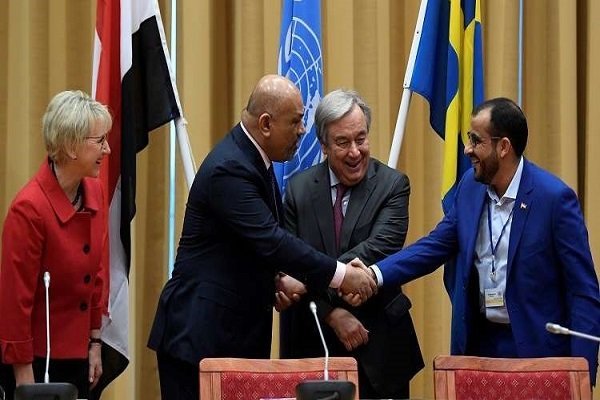
TEHRAN - The Yemen peace talks began with the attendance UN envoy Martin Griffiths on Dec. 13, 2018 in Stockholm and led to an agreement between the two sides, the Sana'a delegation and the Saudi-backed Hadi’s outgoing government representatives.
The agreement came about as Saudi Arabia stepped up its aggressive attacks in various parts of Yemen so that the current peace talks in Stockholm. The Saudis apparently wanted the talks to fail. However, the seriousness of the Sana'a delegation made it impossible for the other party to scuttle the talks and a bilateral agreement was the result.
In the course of the talks that began on Thursday last week, the Hadi aligned delegation often raised irrational, impossible conditions, but to no avail.
The warring parties in Yemen have agreed to a ceasefire in the strategic port city of Hudayda, Al Salif and Ras Issa. They are the main entry points for food and aid shipments to Yemen. The parties must abstain from dispatching any military reinforcements to the city and port of Hudaydah. The accord also calls for the creation of a joint committee, supervised by the UN, to oversee redeployment and de-mining, which will occur in three ports. The committee chair will report weekly to the UN Security Council.
The agreement places the Red Sea port city under the control of local forces recognized by the Yemeni government. Meanwhile, the UN will also play a “leading role” in supporting management and inspections at the ports.
The document also said that all revenues gathered from the port would be transferred to Yemen's central bank in Hudaydah which would then start paying the salaries of civil servants.
The security of Hodeidah city and the ports of Hudaydah, Salih and Ras Issa are the responsibility of the security forces, in accordance with Yemeni law. The legal tracks of the Authority must be respected and any obstacles or impediments to the functioning of local institutions, including Houthi supervisors, should be eliminated.
The agreements over the province of al-Hudaydah and its harbors seem to be the most important achievement of the Stockholm peace talks. It was the alertness of the Sana'a delegation that paved the way for the agreement on al-Hudaydah, which included the withdrawal of foreign forces from the province. Responsibility for the security of al-Hudaydah and the ports of al-Hudaydah, Saleef and Ras Isa is the job of the security forces of Yemen according to Yemeni law, which means that no foreign troops, no external forces, can be deployed in al-Hudaydah. And this means that no external force can be deployed in al-Hudaydah. Therefore, it may be said that with this clause in the agreement, the Saudi-UAE dream of occupying al-Hudaydah has been lost.
The head of the Houthi delegation, Mohammad Abdul Salam, said: “We made great concessions for the sake of the Yemeni people because Hudaydah is the last remaining corridor to save the country from famine”. “We proposed that civilian aircraft go to Jordan and Egypt before heading to Sanaa airport,” he added. “We called for UN surveillance on imports, but the opposition was opposed. But the agreement was positive and we hope that the exchange of prisoners will be done in full and on the basis of an agreed upon mechanism.”
Despite the agreement of the Yemeni parties in the Stockholm talks in Sweden and the official support of the United Nations Secretary-General Antonio Gutierrez of this agreement, Saudi Arabia has adopted a double standard policy with regard to what has happened in Sweden. “We hope that the Houthis accept a comprehensive political solution, in accordance with relevant UN resolutions, that serves the interests of Yemen and its people rather than working on behalf of the Iranian regime's interests,” the Saudi ambassador to the U.S., Khalid bin Salman, said.
These hostile statements by the Saudi ambassador indicate that Riyadh is still not committed to peace in Yemen and it is unlikely that, in light of the current agreement, the Saudis would cease its military aggression against the defenseless and innocent people of Yemen.
After the Yemeni side announced at the end of the talks the ceasefire in al-Hudayda, coalition bombers fled the city and targeted the al-Adha area. It’s clear that the Saudi aggression against the Yemeni people is still on their agenda even after the accords in Stockholm.
It’s important to mention two key points: first, the United Nations is committed its responsibility to protect the agreement. This marks less of a passive role for the UN. Secondly, after the talks the Saudi- backed Hadi’s outgoing government and its allies are in limbo. In any case, the failure of this agreement, if it should occur, cannot be condemned as a failure by the Sanaa government because the Yemenis have shown that they are struggling for peace.