Showing posts with label Hassan Rohani. Show all posts

Thursday, October 03, 2019

Iran’s Message of Hope

Editor
At a time when the world is in turmoil and rulers of predatory states repeatedly issue threats of war, the Islamic Republic of Iran has come up with a message of hope. Called the ‘Hormuz Peace Initiative’ (HOPE), Iranian President Hassan Rouhani announced the plan during his speech to the UN General Assembly on September 25. Preliminary details of the plan were revealed upon arrival in New York on September 23. Speaking to reporters before leaving Tehran, President Rouhani had said the Hormuz Peace Initiative (HOPE) was designed to include all countries of the region and its aim was to expand cooperation beyond regional security.
“This plan is about collective work within the Persian Gulf region and we want all countries of the region to partake in it,” the Iranian president said. The plan also includes political and economic cooperation between regional countries.
Instead of being a zone of peace, the Persian Gulf has been turned into a zone of conflict because of the presence of foreign military forces. The US has played a leading role in creating instability. It has military bases in almost all regional countries on the Western shores of the Persian Gulf and deliberately scares Arabian rulers into buying more weapons from it that only add to instability. The armies of these countries are incapable of using such weapons except against fellow Muslims—Yemen or Syria, for instance. By buying billions of dollars worth of weapons they have impoverished their own people increasing their suffering while American warmongers rake in tens of billions of dollars.
If regional countries were to come together and work for collective security, there would be no reason for outside predatory powers to intervene. This is what Iran’s plan proposes. “We believe the solution for the region comes from inside the region and those who come from the outside can never bring peace and security,” President Rouhani said on September 23. Referring to US military interventions in the Middle East, the Iranian president said since entering the region in 2001, the United States has failed to bring calm to any of the countries where it has deployed forces. The presence of US forces is in fact a source of instability and feeds into the resentment that exists because of its oppressive policies.
While Iran has not attacked any country in the last 2,500 years, it has been subjected to aggressions numerous times. Last month, the people of Iran commemorated 39 years of Saddam Husain’s aggression against the Islamic Republic. That war lasted for eight years (1980-1988). Iran singlehandedly defended its territory and people while Saddam was backed by all the Arabian regimes as well as the entire Western world. His army used chemical and biological weapons against Iran. The Western world—Germany, Britain, France and the US—supplied these banned weapons to Saddam. When the war ended in August 1988, Islamic Iran did not resort to seeking revenge from such neighboring countries as Kuwait or Saudi Arabia. Even Iraq was forgiven after Saddam Husain was overthrown and finally hanged in December 2006.
Despite suffering repeated aggression from its neighbors as well as countries far afield (the US, Britain et al), Iran has come forward with an olive branch at least toward its neighbors. It will serve these countries well if they were to grasp it and work with the Islamic Republic for the collective security of the region. Failing to grasp this opportunity will only bring more suffering and humiliation to these regimes and will ultimately lead to their demise.
The choice is theirs. One hopes they will make the right choice, for their own sake.

Friday, August 02, 2019

Trump Doesn’t Scare Iran

President’s “mentally-retarded” Twitter threats do not worry or impress the Iranian one bit

Kevin Barrett
Is Donald Trump “afflicted by mental disability”? That is what Iran’s President Hassan Rouhani said after Trump raged against Iran while supposedly calling off a planned military strike at the last minute on June 20. The alleged US strike plan would have killed an estimated 150 people and could have triggered a wider war. It was supposedly in retaliation for Iran’s shooting down a $240 million US drone that had violated Iranian airspace (as this article was being prepared on July 18, the US had just claimed it shot down an Iranian drone. Iran denied the claim and the Islamic Revolutionary Guard showed a video of the drone filming the US ship USS Maddox both before and after the time at which the US allegedly shot it down).
Trump’s erratic behavior, notably his habit of issuing wildly hyperbolic threats followed by apparent walk-backs, makes him a highly dubious prospective negotiating partner. The Iranian president has pointed out the obvious, “No sane person” would behave the way Trump does. In offering this diagnosis, President Rouhani is in good company. The book The Dangerous Case of Donald Trump: 27 Psychiatrists and Mental Health Experts Assess a President argues that Trump is pathologically narcissistic. One of the authors, Bandy Lee, an assistant clinical professor of psychiatry at the Yale School of Medicine, has briefed Democratic lawmakers on the president’s mental state. House Majority Leader Nancy Pelosi thinks the president is criminally insane, saying that Trump “needs intervention” and “should be in prison,” while 70,000 self-described mental health professionals have signed a Change.org petition entitled “Trump is mentally ill and must be removed.” And it isn’t just political opponents who say such things. According to Michael Wolfe’s book Fire and Fury, most of the people around Trump think the president is some combination of crazy and stupid.
Trump begs to differ. He has repeatedly bragged that he is a “very stable genius” — a self-diagnosis so insistently exaggerated that it sounds delusional. Arrogance is often a sign of insecurity, and Trump has good reason to be insecure about his own mental capacity and stability.
Though Trump’s Twitter threats suggest personal pathology, they also recall the theatrical “madman theory” of Richard Nixon and Henry Kissinger. In the late-1960s Nixon and Kissinger developed what they called a “secret plan to end the Vietnam War.” That secret plan was a key factor in Nixon’s 1968 election victory. What Nixon and Kissinger weren’t telling the public was that their secret plan was for Nixon to pretend to be a madman who might use nuclear weapons against North Vietnam (had Nixon told the public the truth — “my secret peace plan is to pose as a homicidal lunatic” — he probably would not have been elected!).
Trump — who gets advice from the mummified Kissinger through First son-in-law Jared Kushner — has taken the “madman theory” to new highs, or lows, with his maniacal behavior on Twitter. He has threatened Iran with “great and overwhelming force” adding that “In some areas, overwhelming will mean obliteration.” A year earlier, Trump had tweeted to President Rouhani, “NEVER, EVER THREATEN THE UNITED STATES AGAIN OR YOU WILL SUFFER CONSEQUENCES THE LIKES OF WHICH FEW THROUGHOUT HISTORY HAVE EVER SUFFERED BEFORE. WE ARE NO LONGER A COUNTRY THAT WILL STAND FOR YOUR DEMENTED WORDS OF VIOLENCE & DEATH. BE CAUTIOUS!” Other Trump statements suggest he doesn’t know the difference between the current Rahbar, Imam Sayyed Ali Khamenei, and the founder of the Islamic Republic, Imam Ruhollah Khomeini. Can such a delusional, ignorant buffoon really be leading the most powerful nation on Earth?
Trump’s Twitter lunacy has elicited little fear, and lots of unmitigated contempt, from Iran’s leadership. The Rahbar has pointedly refused to respond to Trump’s threats and walk-backs, saying that the American president “does not deserve a reply” and tweeting: “We do not believe at all that the US is seeking genuine negotiations with Iran; because genuine negotiations would never come from a person like Trump. Genuineness is very rare among US officials.”
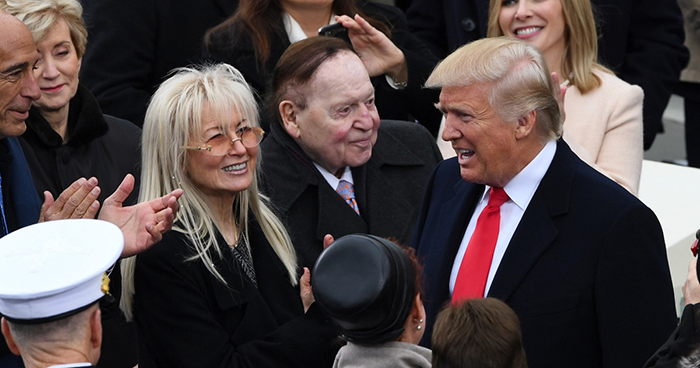
President-elect Donald Trump greets Zio-American casino magnate and organized crime boss Sheldon Adelson, and his wife Miriam, as he arrives on Capitol Hill in Washington, DC on 1-20-2017 for the inaugural ceremony to become the 45th president of the United States. Since taking office, Trump has helped to personally promote Adelson’s business interests abroad. When the US Embassy in Tel Aviv was moved to Jerusalem, the Adelsons were in the front row for the opening ceremony. Last year, President Trump raised a bid from Adelson to build a casino in Japan during a meeting with Japanese Prime Minister Shinzo Abe. Abe and his aides were “incredulous” that Trump “would be so brazen,” according to a source briefed on the conversation. The project is a top priority for Adelson because Japan only recently legalized casinos and the market is considered a “holy grail” in the industry. Adelson dined with Trump the night prior to the meeting. Adelson has already received a windfall from Trump’s new tax law, which particularly favored companies like his Las Vegas Sands. The company estimated the benefit of the law at $1.2 billion.
Meanwhile, a possibly somewhat genuine US politician, Rand Paul, may be trying to carry out an intervention against the insane Iran policy of Trump and his extremist advisors, John Bolton and Mike Pompeo. According to Politico, Rand Paul went golfing with Trump during the weekend of July 15 and 16 and “proposed sitting down with Iranian Foreign Minister Javad Zarif to extend a fresh olive branch on the president’s behalf, according to four US officials. The aim: to reduce tensions between the two countries. Trump signed off on the idea.” According to Politico, the neocon hawks are not pleased.
Trump’s floating Rand Paul as a possible new Iran emissary is a sign that the Bolton-and-Pompeo-driven “madman policy” has failed. If the administration’s “maximum pressure” policy was designed to coerce Iran into negotiating away its deterrent rockets and reducing support to its regional allies, it was doomed to failure from the beginning. Of all nations, Iran is the least susceptible to threats. It is one of the planet’s oldest and most venerable civilizations; Trump’s absurd threats to “obliterate” Iran will not cow a people with a 3,000 year-old history and an intense love for Imam Husayn (a), who stood up to tyranny regardless of the odds and became an inspiration for all who pursue difficult struggles for truth and justice.
Will Rand Paul help Trump ratchet down tension with Iran? Probably not. As long as the cruel and obnoxious US sanctions are in place, Iran’s leadership has no good reason to even talk to anyone who has anything to do with Trump. Why should Iran help Trump’s re-election campaign while Trump continues to try to strangle Iran’s economy?
If Trump really wanted to score a major diplomatic success, he would not only have to back off from his absurd claim that the JCPOA is too pro-Iran, but he would also have to reverse four decades of US policy aimed at containing and quarantining the Islamic Republic. Such a bold move would require breaking the Zionist stranglehold on US Mideast policy. If Trump is interested, there are several Republicans who could serve as better emissaries to Iran than Rand Paul: former senior security policy analyst in the Office of the Secretary of Defense Michael Maloof; former CIA Operations Officer Philip Giraldi; former US Army officer and State Department coordinator for counterterrorism contractor Scott Bennett; and former State Department official Michael Springmann. All four ex-US officials attended the May 2018 New Horizon conference in Mashhad and let it be known that they would like to see the US declare its independence from Israel and end its shameful 40 years of hostility to the Islamic Republic of Iran.
Does Donald Trump have the courage and vision to break with his predecessors’ failed policies and admit that the Islamic Republic is here to stay? Almost certainly not. Trump has been surrounded by Zionists throughout his career in the hotel-and-gambling business. His mentor was Kosher Nostra criminal Roy Cohn, and his enterprises have laundered enormous sums of money for the Meyer Lansky and Russian-Israeli mobs. He was inserted into the oval office by the Sheldon Adelson syndicate and its pro-Netanyahu associates. He has likely been compromised by the likes of Mossad pedophile pimp Jeffrey Epstein.
In the criminal underworld, to understand who someone is and what they are up to, the first question is: “Who sent him?” The people who “sent” Trump are relentlessly hostile to the Islamic Republic of Iran. The chances that Trump could break with those people, even if he wanted to, are remote. So Trump will in all likelihood continue to hurl lunatic threats followed by empty words of cajolery in the direction of Iran, tweet-storms of sound and fury signifying nothing, for as long as he remains president of the United States.

Monday, June 17, 2019

Pres. Rouhani: Iran-Russia ties exceptional in region

In meeting with Russian President

Pres. Rouhani: Iran-Russia ties exceptional in region
Iran's President described Tehran-Moscow relations exceptional in the region in all economic, political and international fields, emphasising, “Today, with foreign interference in regional affairs and the United States’ illegal sanctions, which have made problems for stability and cooperation, development of Tehran-Moscow relations is very important for both countries and stability and development of the region”. 
AhlulBayt News Agency (ABNA): Iran's President described Tehran-Moscow relations exceptional in the region in all economic, political and international fields, emphasising, “Today, with foreign interference in regional affairs and the United States’ illegal sanctions, which have made problems for stability and cooperation, development of Tehran-Moscow relations is very important for both countries and stability and development of the region”. 

Speaking in a meeting with President Vladimir Putin of Russia on Friday on the sidelines of the 19th Summit of Shanghai Cooperation Organisation in Bishkek, President Hassan Rouhani said that Tehran and Moscow are on the same side in regional and international communities. 

“Implementation of economic agreements between the two countries, particularly in the fields of energy and transportation, has got a good pace and the meeting of the joint commission for cooperation that is going to be held in Tehran next week will accelerate this process,” he said. 

Pointing out that supporting the cooperation of the two countries’ private sectors will accelerate the process of developing trade relations, the president said, "By adopting the law on trade with Eurasia in the parliament, we will provide the preparations as soon as possible, which will accelerate business cooperation”. 

Dr Rouhani also emphasised, "In addition to its illegal withdrawal from the Joint Comprehensive Plan of Action (JCPOA), the United States is imposing sanctions on companies and countries that want to comply with United Nations Security Council Resolution 2231”. 

"If the interests of the Iranian nation are met by the other parties, it is possible for us to return to the previous point," the president said, emphasising that Iran's actions are within the framework of its rights. 

Dr Rouhani described Russia's role in safeguarding the JCPOA and fulfilment of Europe’s commitments very important, and stated, “Iran has always supported the stability and security of the region and has proved its determination by fighting ISIS in the region as well as proposing a regional non-conflict agreement”. 

"In the case of Syria, we are also keen on continuing our good, effective bilateral cooperation on countering terrorism within the framework of the Astana Process with Turkey until we reach the final result," the president said. 

The Russian President said in the meeting that Moscow is determined to develop bilateral, regional and international cooperation with Iran, adding, “This cooperation will cover a wide range of economic and regional activities, particularly the joint fight against terrorism in the region”. 

Vladimir Putin emphasised, “The achievements we see today in Syria are the result of the positive role of Iran and the tripartite cooperation of Russia, Iran and Turkey in the Astana Process”. 

Putin continued, “Despite the existing problems, the two countries' trade relations are developing, and in the coming days, the Joint Commission on Cooperation between the two countries will be held in Tehran”. 

The Russian President added, “Moscow remains interested in being present and investing in the energy sector and is committed to cooperating in a wide range of areas of interest to the two countries, as well as promoting the implementation of agreements on the construction of new units in the Bushehr Power Plant and rail transport”. 

He went on to describe Iran's living up to the JCPOA, saying, “Moscow will continue its efforts for full implementation of the agreement by all parties”.
 

Thursday, June 06, 2019

The Other Silk Road

Pakistan to Turkey corridor could be an economic powerhouse
Yusuf Dhia-Allah

China’s Silk Road project connecting a vast swathe of the Eurasia landmass with Europe may have caught the world’s imagination but it is not the only game in town. Another less spectacular connectivity project between Iran, Iraq, and Syria may not pack quite the financial punch but its economic and geostrategic importance cannot be underestimated. Throw in Turkey into the mix and a very interesting scenario begins to emerge.
The three-country proposed railway link, portions of which are already in place, would connect the Persian Gulf to the Mediterranean Sea. It will also reconfirm Iran’s role as the dominant regional power. This comes at a time when both Iraq and Syria need massive investment for infrastructure development following the devastating wars the two countries were subjected to. Iran’s western neighbors were able to defeat the takfiri terrorists, thanks to significant support from Tehran with its military playing an important advisory role, as well as Hizbullah.
The potential of the Iran-Iraq-Syria railway link is immense. Turkey is sure to join this network once it sorts out its failed policy in Syria. The other factor would be Ankara coming out from under Washington’s shadow and quitting NATO. With growing deterioration in US-Turkish relations and Ankara strengthening ties with Russia, pulling out of NATO now seems a much more distinct possibility for Turkey than ever before.
If the regional bloc of four countries can be consolidated, it will help expand trade between them tremendously. Further, it will also potentially open an opportunity for Pakistan to join the group. Iran’s President Hassan Rouhani mentioned this in his joint press conference in Tehran with visiting Pakistani Prime Minister Imran Khan on April 22. President Rouhani said that Turkey and Iran already have a rail link; this can be extended to Pakistan as well.
The road and railway connectivity discussions between Iran, Iraq, and Syria have been underway for many months. Their aim is to boost trade by speeding up the transportation of goods. Time is money. Often, perishable goods are involved and if they can be transported to markets quickly, it will not only result in increased sales but also cut losses.
Iraqi Railways Company chief Salib al-Husayni said that a summit will be held between the countries to further discuss the matter, according to a report in the Arabic-language al-Sumeria news website on April 12. Al-Husayni made the comments on the sidelines of the joint Syrian-Iraqi committee meeting in Damascus.
As part of the project, Iran plans to build a railway linking Shalamcheh in Iran to the southern Iraqi city of al-Basrah. The link is estimated to cost 2.22 billion rials and will connect Iran to Syria via Iraq.
During his visit to Damascus in early April, Iran’s First Vice-President Eshaq Jahangiri had said, “We will connect the Persian Gulf from Iraq to Syria and the Mediterranean via railway and road.” His visit took place against the backdrop of a series of “historic” agreements signed earlier this year between Iran and Syria. These included a “long-term strategic economic cooperation” agreement described as a sign of changing realities in the Muslim East.
Syrian Prime Minister Imad Khamis said the “historic” agreements covered cooperation in the fields of industry, trade, and agriculture. He called the agreement “a message to the world on the reality of Syrian-Iranian cooperation.”
With the Western-Zionist-Saudi-backed terrorists defeated in Syria, the country is moving toward the phase of reconstruction. This is where Iran, which has been instrumental in defeating the terrorists, comes in to play a significant role in Syrian reconstruction as well.
Both Iraq and Syria are anxious to expand political and economic ties with Iran as they seek assistance in their post-war reconstruction efforts. The railway link is an important component of this initiative. Iran and Iraq signed five memorandums of understanding for the expansion of bilateral cooperation in various economic and healthcare sectors in March.
This also signaled Iraq’s intention to not become a “party to the system of [US-imposed] sanctions against Iran” as Prime Minister ‘Adil ‘Abd al-Mahdi said earlier in February. In addition to deep religious ties between the two countries with millions of pilgrims moving in both directions annually, Iraq is also heavily dependent on Iran for everything from food, fruits and vegetables, to machinery, electricity, and natural gas. In 2018, Iran’s exports to Iraq totaled $8.7 billion, surpassing Turkey’s $7.3 billion worth of exports in the same year. President Rouhani has said that Iran and Iraq have plans to expand bilateral trade volume to $20 billion in the near future.
Given that Iraq under Saddam Husayn had attacked Iran in September 1980 and caused massive devastation of the Islamic Republic for eight years, Iran’s magnanimity is remarkable. The war had the backing of all the Arabian regimes (except Syria), the Western world, as well as Russia. The confederacy of kufr joined hands to try and destroy the only Islamic state of modern times, but failed.
It also shows that Iran has always maintained good neighborly relations and has not attacked any country in 250 years. It has been the victim of repeated aggressions but valiantly defending its honor and territory. Iran’s exemplary conduct toward its neighbors has made them realize that it is a friend in need. After all, it was Iran’s help that enabled both Iraq and Syria to defeat the US-Zionist-Saudi-backed takfiri terrorists.
In addition to economic and trade relations, Iran, Iraq, and Syria have also moved toward strategic and military cooperation. While American forces are illegally occupying parts of Syria, in Iraq they are present with the consent of the Iraqi government.
During his visit to Tehran in early April, Iraqi Prime Minister ‘Adil ‘Abd al-Mahdi was accompanied by the Iraqi armed forces chief, Lieutenant General ‘Uthman al-Ghanimi. They also met Imam Seyyed Ali Khamenei. During the meeting, Imam Khamenei advised the visiting Iraqi delegation to get rid of the US forces from their soil as soon as possible. In Iraq, there is much resentment toward the presence of US forces.
It does not make sense for Iraq to allow US forces on its soil when they have caused so much mayhem in the country. Now that Iraq and Iran have entered into a strategic partnership agreement that will be mutually beneficial to both, there is no reason for US forces to train Iraqi troops. Iran can do a far better job of this, as has been demonstrated through its help in training al-Hashd al-Sha‘bi militia that was instrumental in defeating the US-backed takfiri terrorists.
During his visit to Tehran in early April the Iraqi Prime Minister acknowledged that Iran was key to brining peace and stability to his country. It is better to rely on a time-tested friend (Iran) than a greedy and destructive power (the US).