
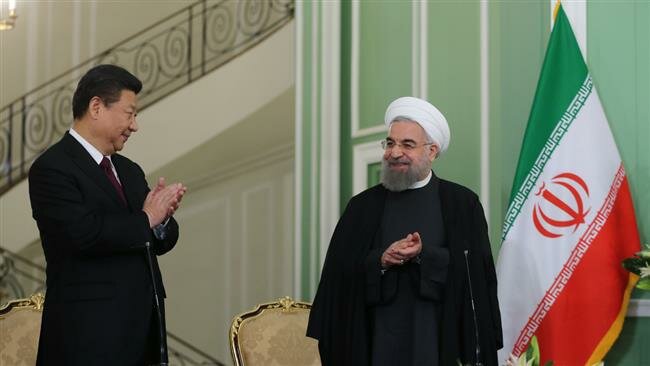
Xi Jinping and Hassan Rouhani
by Nicolai Due-Gundersen
Donald Trump’s withdrawal from the 2015 Iran nuclear deal (Joint Comprehensive Plan of Action or JCPOA in 2018 should come as no surprise. The abandonment of a framework years in the making fits Trump’s muddled modus operandi of winding down U.S. activity abroad (and then changing his mind). Several months later, he announced a U.S. withdrawal from Syria and implied that the Middle East was not an American problem. Using Twitter as his diplomatic channel, Trump rhetorically asked: “Does the USA want to be the Policeman of the Middle East, getting NOTHING [sic] but spending precious lives and trillions of dollars protecting others who, in almost all cases, do not appreciate what we are doing? Do we want to be there forever? Time for others to finally fight…”
Trump’s pattern of reversing traditional U.S. policies in the Middle East no doubt makes Iran question the wisdom of trusting the U.S. in the first place over an agreement that placed limits on Iran’s nuclear program in exchange for promises of economic recovery. Even conservative U.S. analysts are arguing that Trump’s hostility toward Iran means that traditional American allies should no longer place their faith in President Trump’s promises. For Iran, maintaining the JCPOA requires the deal’s other signatories to deepen their commitment. “Tehran is convinced that Europe could do more to boost trade, which has collapsed over the past year,” explains The Guardian’s Patrick Wintour. European Union members established a Europe-Iran payment mechanism (the Instrument in Support of Trade Exchanges or INSTEX) to circumvent U.S. penalties and allow trade. But being limited to humanitarian goods, INSTEX does little to deliver what Iran needs: to be a member of the world market and sell its oil freely.
In violating the JCPOA, Trump argued that Iran was destabilizing the region under the 2015 agreement. “The Iranian regime is the leading state sponsor of terror,” Trump insisted in his speech announcing his withdrawal from the deal. “It fuels conflict across the Middle East.” Trump continued that the U.S. was exiting the deal in order to start “working with our allies to find a real, comprehensive, and lasting solution to the nuclear threat.” Setting aside the terror fueled by the U.S. invasion of Iraq, U.S. arms deals for weapons used in Yemen, and the Brookings Institute asking if U.S. foreign policy is responsible for the Middle East’s instability, Trump seems to forget that America had already been working with Arab allies to facilitate a nuclear deal with Iran.
What became the Joint Comprehensive Plan of Action (JCPOA) began as an Omani initiative. “Although the JCPOA was formalized in 2015, much of the groundwork was laid in the years prior,” explains geopolitical analyst Edwin Tran. “[Oman] was on good terms with Iran in the years following the Iran-Iraq War (1980-1989) [and] in 2009, Sultan Qaboos was the first foreign leader to visit Iranian President Ahmadinejad following his reelection victory.” Oman’s excellent relations with Iran are counterbalanced by its relations with the U.S. , dating back to a treaty of friendship between Muscat and Washington in 1883. According to former U.S. Ambassador to Oman Richard Schmierer, Oman took initiative in 2009 and discreetly “began to explore the possibility of facilitating a dialogue between Iran and the West [on] the nuclear issue.” In 2012, Senator John Kerry was approached by Oman with the notion of “friendly relations between the United States and Iran” and throughout 2013 U.S. envoys met Iranian counterparts for secret meetings in Muscat. The result? Obama’s then-Secretary of State Kerry delivered an interim deal with Iran nine months into his new job.
Omani efforts successfully built trust between Iran and the U.S. With that trust shattered, Iran may look to a non-western JCPOA signatory that is also getting close to Oman: China. As Iran broke its uranium enrichment limit set by the 2015 deal, China (and Russia) condemned Trump’s withdrawal from JCPOA and subsequent sanctions threats. “The maximum pressure exerted by the U.S. on Iran is the root cause of the Iranian nuclear crisis,” explained Geng Shuang, spokesman for China’s foreign ministry. “The facts show that unilateral bullying has already become a worsening tumour [for Iran and the international community].” China has remained Iran’s biggest oil customer, receiving shipments of Iranian crude despite U.S. sanctions.
China has several advantages over EU signatories that allow it to bolster the Iran deal. China’s political and economic clout mean it is far less dependent on the U.S. than is the EU for trade and security. “[T]here are many ways in which Beijing could work around U.S. sanctions,” outlines Dr. Mahsa Rouhi, Nuclear Policy Research Fellow at the International Institute for Strategic Studies. Methods may include buying Iranian oil through Chinese businesses unconnected to U.S.-dominated financial networks and eroding “the dominance of the U.S. dollar” by expanding trade in the Gulf in its own currency, the Yuan. Such a long-term strategy would attack the petrodollar concept and slowly establish Chinese ‘petroyuan’ as a currency more and more linked to hydrocarbon sales.
China is expanding its investment not only in Iran’s ally Oman but across the entire Gulf. In the long run, Gulf states may welcome Chinese cash-flow as they attempt to diversify their oil economies. China’s Belt and Road Initiative (BRI) builds upon the fact that China represents the Gulf Cooperation Council’s (GCC) largest trading partner. Significantly, traditional U.S. allies are only too happy to trade with Beijing. “Saudi Arabia is investing billions in refineries and petrochemical facilities in China as well as taking a larger role in the China-Pakistan Economic Corridor, which is one of BRI’s most important components,” says analyst Sabahat Khan at the Institute for Near East and Gulf Military Analysis. “The United Arab Emirates is China’s most important regional trading partner; Dubai acts as a key gateway for Chinese goods heading across [the MENA region]. Officials predict China-UAE bilateral trade will reach 70 billion USD by next year.”
China’s political clout, deepening relations with Iran’s neutral neighbor, increasing investments across the Gulf, and its ability to undermine petrodollars may come together to see it replace the U.S. as a patron in the Gulf. Should this happen, Oman may still serve as a cultural and political mediator, but Beijing could become a strong guarantor of the nuclear deal, increasing its already prosperous relations with Iran to provide the Islamic Republic with the financial rewards Tehran craves. In addition, China and Iran share a common trait: they are non-Western actors that have historically faced U.S. wrath as their governments embraced non-Western systems—witness, for example, the current trade war between Beijing and Washington. Further, China and the U.S. don’t share the same image in the Middle East. China does not have the baggage of past interference that the U.S. has, including the 1953 coup against Iran’s elected Prime Minister Mohammad Mosaddegh.
Finally, it is no secret that China’s international influence is increasing. At a time when Trump has withdrawn the U.S. from UNESCO and the United Nations Human Rights Council while cutting UN budget contributions, can he complain when China fills that vacuum? By 2018, China’s financial contribution to the UN peacekeeping budget had shot up from 3% to 10.25%. China has promised to provide a further one billion USD to that budget over the next few years and has trained its troops to assist UN peacekeeping operations. “In part China is filling a space created by the withdrawal of the U.S. from [the UN],” concludes The Guardian’s Patrick Wintour. “In a sense China, through its resourcing of the UN, has earned a right to be heard.”
As Trump continues threatening Iran even after inspectors verified Tehran’s previous compliance with the nuclear deal, it will be very interesting to hear what China has to say to the Gulf and the world.
Nicolai Due-Gundersen is a political commentator at Kingston University, London and author of The Privatization of Warfare (Cambridge: Intersentia). He is former adviser to the Arab Institute for Security Studies in Jordan.

