
By Palestine Chronicle Staff
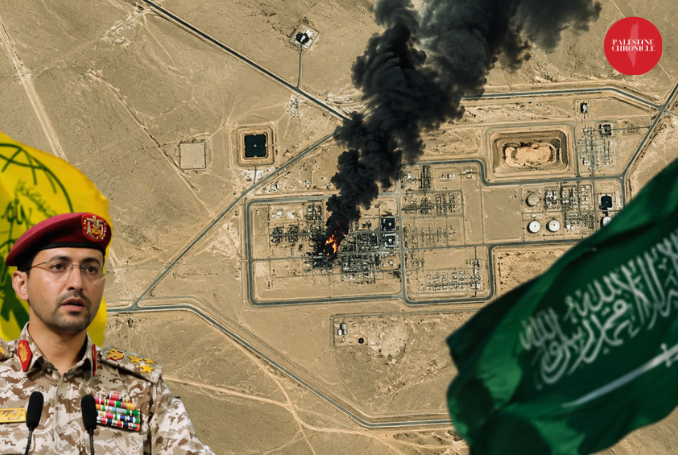 The disabling of Saudi Arabia’s strategic East-West Pipeline could have serious repercussions for the ongoing regional war and the global economy. (Design: PC)
Saudi Arabia’s East-West Pipeline has become increasingly important during the Iran war. Its shutdown now raises questions about the kingdom’s alternative oil export route.
Key Takeaways
- The 1,200-kilometer East-West Pipeline can carry up to seven million barrels of crude per day from eastern Saudi Arabia to the Red Sea.
- Its importance has increased sharply as the Iran war disrupted shipping through the Strait of Hormuz.
- Its Red Sea outlet now faces separate pressure as Ansarallah advances to Bab al-Mandeb and threatens Saudi shipping.
Saudi Arabia has temporarily shut one of the most strategically important pieces of oil infrastructure in the Middle East after drone attacks struck facilities along its East-West Pipeline.
The Saudi Energy Ministry said the attacks occurred Thursday morning in the Riyadh and Madinah regions. Emergency teams were deployed and pumping was suspended as a precaution while authorities assessed the condition of the system.
Saudi Arabia subsequently said several drones launched from Iraq were used in the attacks, which caused injuries and material damage. Authorities have not disclosed the full extent of the damage or said when operations will resume.
But the importance of the shutdown extends beyond the pipeline itself.
The East-West Pipeline has become Saudi Arabia’s principal means of moving large quantities of crude without using the Strait of Hormuz, where shipping has been severely disrupted during the US-Iran war.
And the pipeline ends at Yanbu on the Red Sea, meaning Saudi oil transported around Hormuz must ultimately enter another maritime corridor increasingly affected by the regional war.
Here is what to know.
What is the East-West Pipeline?
The East-West Pipeline, commonly known as Petroline, is a roughly 1,200-kilometer, or 745-mile, crude oil pipeline running entirely across Saudi Arabia.
Operated by Saudi Aramco, it begins at Abqaiq in the kingdom’s oil-producing Eastern Province and crosses the country to Yanbu on the Red Sea coast.
Its basic purpose is straightforward: Saudi crude produced and processed in the east can be transported overland to refineries, storage facilities and export terminals in the west.
From Yanbu, tankers can carry the oil into the Red Sea and onward toward international markets.
Most importantly, this allows Saudi Arabia to move oil without sending it through the Strait of Hormuz.
How Much Oil Can It Carry?
The pipeline’s maximum pumping capacity is approximately seven million barrels per day, according to the Saudi Energy Ministry.
Aramco said earlier this year that the system had been ramped up to that maximum capacity to support supplies and exports through Saudi Arabia’s western coast.
But seven million barrels per day should not be interpreted as seven million barrels of exports now disappearing from the global market.
Approximately two million barrels per day of the pipeline’s capacity is allocated to western Saudi refineries, theoretically leaving up to five million barrels per day available for other destinations, including exports.
Even that does not mean five million barrels were necessarily being exported through Yanbu immediately before the shutdown.
How Much Oil Was Actually Moving through Yanbu?
Available tanker-tracking figures show considerably lower volumes.
Vortexa estimated that crude and condensate loadings from Yanbu reached approximately 3.7 million barrels per day in early September, up from around 3.2 million in August.
Kpler produced a lower estimate of approximately 2.9 million barrels per day in September, compared with about 1.5 million in August.
The discrepancy reflects differences in the companies’ methodologies.
Both estimates nevertheless show the same thing: actual oil loadings from Saudi Arabia’s western coast were substantially below the pipeline’s theoretical seven-million-barrel capacity.
Why Has the Pipeline Become So Important?
Geography explains its strategic importance.
Historically, the Strait of Hormuz has been Saudi Arabia’s principal maritime outlet for crude exports.
The narrow waterway between Iran and Oman connects the Persian Gulf with the Gulf of Oman and the Arabian Sea and is one of the world’s most important energy chokepoints.
But shipping through Hormuz has fallen sharply during the US-Israeli war on Iran.
Saudi Arabia has consequently become increasingly dependent on transporting crude westward across its own territory and exporting it through Yanbu.
The US Energy Information Administration identifies the East-West Pipeline as one of the principal routes capable of bypassing Hormuz during a supply disruption.
In effect, the pipeline provides Saudi Arabia with an overland bridge between its eastern oil fields and the Red Sea.
What Does a ‘Precautionary Shutdown’ Mean?
Saudi Arabia has specifically described the suspension as “precautionary.” That distinction matters.
It does not necessarily mean the pipeline has been extensively damaged or will remain closed for a prolonged period.
Pumping was halted so authorities could secure the targeted sites and inspect the pipeline, pumping stations, power supplies, control systems and other infrastructure.
How quickly operations resume will depend on what those inspections find.
Following an earlier attack in April, Saudi authorities quantified the temporary loss at approximately 700,000 barrels per day and later announced that full capacity had been restored.
No comparable figure has yet been released following the September 10 attacks.
Does This Mean Saudi Arabia Has Lost Seven Million Barrels a Day?
No. Seven million barrels per day represents the pipeline’s maximum transportation capacity, rather than the amount of oil Saudi Arabia was exporting through Yanbu.
Actual western-coast loadings were estimated at between 2.9 million and 3.7 million barrels per day in September.
The effect on Saudi exports will depend on how long the shutdown lasts, how much of the system has been damaged, existing oil storage at Yanbu and what alternative transportation arrangements can be made.
Saudi authorities have not yet released enough information to calculate the actual loss of export capacity.
Why Does Bab al-Mandeb Matter?
Bypassing Hormuz solves only one geographical problem.
Once crude reaches Yanbu, tankers carrying it toward Europe and other markets must travel through the Red Sea.
At the southern entrance to that sea lies another major chokepoint: the Bab al-Mandeb Strait between Yemen and the Horn of Africa.
Recent developments in Yemen have therefore become directly relevant to Saudi Arabia’s oil-export calculations.
The Yemeni Armed Forces, affiliated with the Ansarallah movement, have advanced rapidly along Yemen’s western coast.
According to the reports supplied, Ansarallah seized Al-Mokha before advancing south toward Dhubab and Bab al-Mandeb. Its forces subsequently seized Mayyun Island, also known as Perim, inside the strait.
Ansarallah said Friday that its forces had captured six districts across Taiz and Hodeidah governorates covering approximately 5,400 square kilometers.
“The armed forces affirm that maritime navigation is safe for all companies, with the exception of Saudi ships,” military spokesperson Yahya Saree said.
He said operations would continue under an equation of “siege for siege” and “escalation for escalation” until Saudi attacks and the blockade were ended.
Is Saudi Arabia Facing Pressure on Both Oil Routes?
Saudi Arabia’s predicament now involves two different chokepoints.
To the east lies Hormuz, which the East-West Pipeline was designed to bypass.
To the west lies the Red Sea and Bab al-Mandeb, through which much of the crude reaching Yanbu must eventually travel.
The pipeline therefore does not eliminate Saudi Arabia’s dependence on vulnerable maritime routes. It shifts the point at which its crude reaches the sea.
The situation has become more consequential as Ansarallah’s advance has brought the movement directly to Bab al-Mandeb while it explicitly threatens Saudi, rather than general commercial, shipping.
What Is the US Doing?
Saudi Crown Prince Mohammed bin Salman reportedly called US President Donald Trump twice on Thursday requesting US strikes against Ansarallah as its forces advanced toward Bab al-Mandeb, according to two US officials cited by Axios.
Trump declined the requests, according to the report.
A senior US administration official said Washington was focused on maintaining “freedom of navigation in the Red Sea” while allowing regional partners to take the lead.
The US nevertheless remains involved in supporting Saudi military operations. More than 100 US military advisers are reportedly providing intelligence and targeting assistance through a newly established joint command, with one official estimating the number at closer to 200.
(PC, Drop Site, Anadolu, Al Mayadeen, Saudi Media)

No comments:
Post a Comment