
By Palestine Chronicle Editors
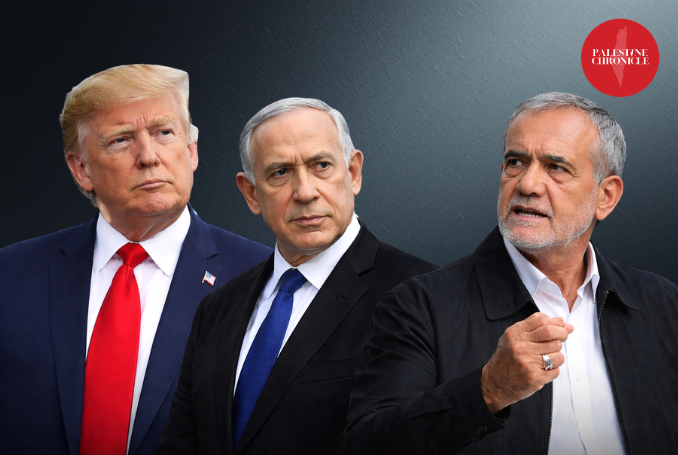 Competing endgame scenarios in the war on Iran, as Washington, Tel Aviv, and Tehran pursue sharply divergent outcomes. (Design: Palestine Chronicle)
Israel, Washington, and Tehran pursue conflicting endgames as escalation builds toward an inevitable political reckoning.
Key Takeaways
- Israel’s preferred outcome depends on sustained US military backing to weaken Iran strategically.
- Washington seeks a limited war it can frame as decisive without committing to long-term occupation.
- Iran is pursuing calibrated escalation to impose costs and preserve national cohesion.
- Arab states are unlikely to enter the war directly despite rhetorical escalation.
- Rising public and political pressure in the US could force Washington to declare victory and exit.
- Without the US, Israel cannot sustain a prolonged confrontation alone.
Israel’s Preferred Scenario
For Israel, this war was never about a single military objective. It was about reshaping the regional balance of power.
Israel’s preferred scenario is clear: a sustained US-backed campaign that permanently weakens Iran’s military infrastructure, missile capabilities, regional alliances, and economic resilience. The killing of top leadership was meant to trigger instability, fracture the state, and open space for long-term containment—or even transformation—of the Iranian political system.
From Tel Aviv’s perspective, the ideal outcome is not merely deterrence but strategic rollback: Iran weakened internally, isolated externally, and unable to project power through allies in Lebanon, Iraq, Syria, and Yemen.
But this scenario is entirely dependent on Washington’s endurance. Israel cannot alone sustain the scale of military pressure required to dismantle Iran’s infrastructure while simultaneously absorbing retaliation on multiple fronts. The Israeli calculus assumes continued US logistical, intelligence, and diplomatic shielding.
The question is not whether Israel prefers escalation. The question is whether it can sustain it without Washington.
Washington’s Scenario
The Trump administration’s preferred scenario is more restrained—but also more politically driven.
Washington does not seek occupation, nor does it seek open-ended war. It seeks a limited confrontation that can be framed as decisive. The messaging from the Pentagon has emphasized that “this is not Iraq” and not an “endless war.” The repetition itself reveals anxiety: the administration understands the domestic limits of military adventurism.
Privately, intelligence skepticism regarding rapid regime collapse further complicates the picture. The theory that “decapitation” would automatically destabilize Iran underestimated institutional resilience and succession mechanisms. The expectation of internal fragmentation has not materialized in any decisive way.
At the same time, public support inside the United States remains limited. Casualties, regional spillover, and operational friction—including incidents such as friendly-fire downings—have reinforced the perception that this war could spiral beyond initial expectations.
Washington’s ideal outcome now appears increasingly clear: escalate enough to claim strategic weakening of Iran, then declare victory, argue that “regime change” has effectively occurred through leadership decapitation, and exit under the banner of strength.
This would not be a military conclusion. It would be a political one.
Iran’s Scenario
Iran’s preferred scenario is survival with leverage.
Tehran is not attempting symmetrical escalation. It is pursuing calibrated pressure. Each response has widened the battlefield incrementally—targeting assets, signaling capabilities, and raising the cost for US and Israeli forces—without crossing thresholds that would justify overwhelming ground invasion.
This is strategic patience.
Iran understands that time works differently for each actor. For Washington, time erodes political capital. For Israel, time multiplies vulnerability. For Tehran, time consolidates national cohesion in the face of external aggression.
This war is existential for Iran in a way that it is not for the United States. In existential wars, societies tend to consolidate rather than fragment. Even internal critics of the system are unlikely to welcome externally imposed regime change.
Sun Tzu warned: do not surround your enemy. Leave them an exit, or they will fight with the desperation of survival. Washington’s decades-long strategy—sanctions, isolation, encirclement—has left Iran with few economic or diplomatic outlets. The result is not surrender. It is resistance.
Ironically, it is now Iran that appears to be reversing the encirclement—placing US bases, Israeli cities, and allied infrastructure under sustained psychological and strategic pressure.
This balancing of deterrence—what some may call a balancing of terror—does not necessarily produce decisive victory. It produces negotiation from parity.
The Arab Factor
Despite heightened rhetoric and regional tension, direct Arab military intervention remains unlikely.
Gulf states may issue strong statements. Some may quietly coordinate defense arrangements. But the risks of direct confrontation with Iran outweigh the perceived benefits. The performance of US bases as guarantors of security has already been tested under fire.
Major Arab states understand that entering this war would transform a contained confrontation into a regional conflagration with unpredictable economic and political consequences.
Thus, despite media dramatization, the probability of Arab armies entering the fray remains low.
This neutrality—or cautious distance—works in Iran’s favor.
The Palestine Chronicle
Based on current evidence, the most probable outcome follows a familiar historical pattern.
Escalation will continue. Iran will widen pressure incrementally. Israel will rely heavily on US backing. Casualties, operational friction, and economic consequences will mount.
Public opinion in the United States—already skeptical—will harden. Congressional scrutiny will increase. Media narratives questioning objectives and legality will expand. Political costs will accumulate.
At a certain threshold, Washington will pivot.
The Trump administration is likely to declare that Iran has been significantly weakened. It may claim that regime change has effectively been achieved through leadership restructuring. It will frame withdrawal not as retreat but as triumph—another demonstration of American strength.
Once the United States steps back, Israel faces a stark choice: escalate alone or follow suit.
Going alone is not sustainable. Israel lacks the strategic depth and economic insulation required for a prolonged regional war without American cover. Thus, Israel too would likely declare success—amid fanfare—and de-escalate.
In this scenario, Iran remains intact. National unity strengthens. The political system survives. Regional allies—particularly in Lebanon and Yemen—emerge emboldened, having weathered an existential confrontation tied directly to Tehran’s fate.
In both short and long terms, that outcome favors Iran and its allies.
This may be the last major war on Iran for some time.
If Iran withstands this confrontation, the illusion that it can be militarily dismantled from the air will fade. Washington may abandon the fantasy of defeating Iran on behalf of Israel. A longer-term arrangement—beyond mere ceasefire—could emerge, rooted in mutual deterrence rather than domination.
Such an agreement would not represent friendship. It would represent acknowledgment.
But one unresolved question remains: will Israel be satisfied?
Israel’s strategic doctrine has long favored proactive military solutions to perceived threats. If this war ends without a decisive Iranian collapse, Israeli leadership may seek new pathways to draw Washington back into confrontation in the future.
The dynamic is cyclical. The trigger may differ, but the pattern could repeat.
Therefore, the most likely outcome is not a decisive victory for any party but political recalibration.
- Israel seeks the permanent weakening of Iran, but cannot achieve it alone.
- Washington seeks a limited war it can market as a triumph.
- Iran seeks survival, consolidation, and cost imposition.
Time favors Tehran more than Washington. Political pressure favors Tehran more than Israel. Regional reluctance favors Tehran more than its adversaries.
This war may not end with surrender or collapse. It may end with narrative management in Washington and theatrical victory declarations in Tel Aviv.
But beneath the spectacle, the strategic balance will have shifted.
Iran’s survival in what it perceives as an existential war would strengthen its regional posture, validate its deterrence doctrine, and reshape calculations in Lebanon, Yemen, and beyond.
(Ramzy Baroud and The Palestine Chronicle Editorial Board)

No comments:
Post a Comment