
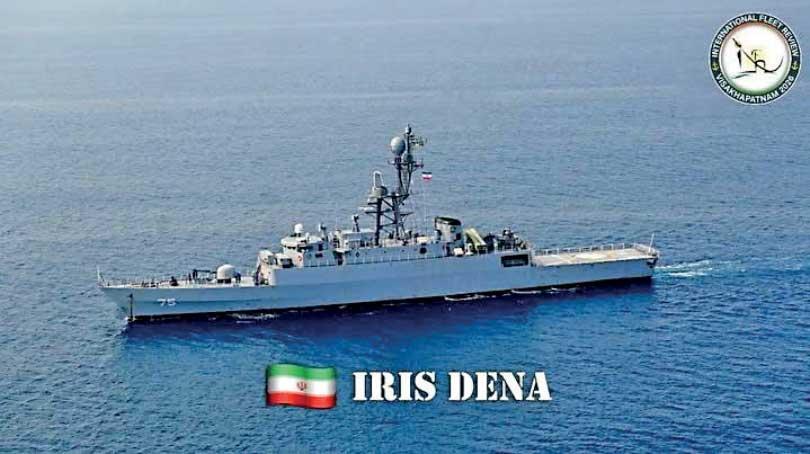
Iranian frigate IRIS Dena which was sunk
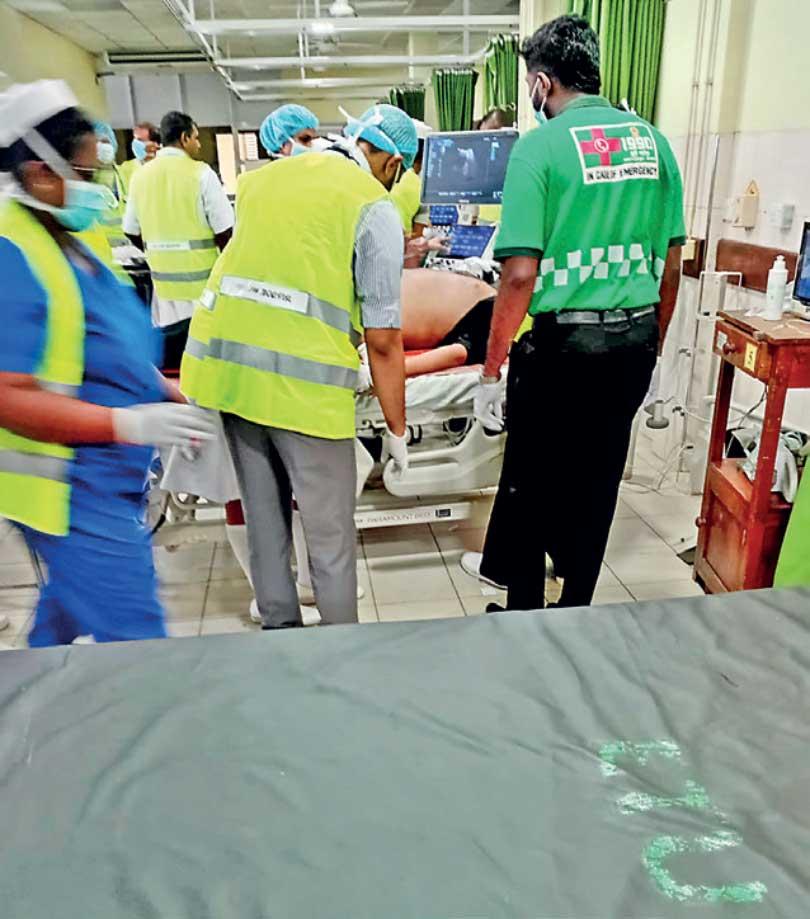
Sri Lankan health workers treating survivors
Dr. Nihal Jayawickrama
Dr. Dayan Jayatilleka |



Amidst the news that a second Iranian warship carrying almost 130 sailors said to have got stuck in international waters and it was heading towards Sri Lanka’s territorial waters, President Anura Kumara Dissanayake is in discussion with officials to respond the Iranian request to enter the safety of the island’s waters.
While Sri Lanka, an independent and sovereign country, now finds itself entangled in a war between two rival military powers including a superpower, the Daily Mirror spoke to two foreign policy experts as to the legality or justification of this attack in a region which has no connection to the ongoing war.
Unprecedented violation of International Law and conventions of war; Dr. Dayan Jayatilleka
Former ambassador and foreign policy expert Dr. Dayan Jayatilleka demanded that Sri Lanka should raise a strong diplomatic protest and as a member of South Asia should diplomatically rally the region against the unilateral extension of a unilaterally declared war by the US and Israel to the peaceful Indian Ocean region.
Dr. Jayatilleka was Sri Lanka’s Ambassador Extraordinary and Plenipotentiary to the Russian Federation (2018-2020). Earlier he served as Ambassador Extraordinary and Plenipotentiary of Sri Lanka to France, accredited to Spain and Portugal, and Permanent Delegate of Sri Lanka to UNESCO, Paris (2011- 2013) and Permanent Representative/ Ambassador of the Democratic Socialist Republic of Sri Lanka to the United Nations at Geneva and other International Organisations (2007-2009).
Q Could any country attack a vessel in a region/ international sea which is not part of the warring territory or region?
Dr Dayan Jayatilleka: It is an almost unprecedented violation of International Law and conventions of war for a country to attack a vessel of another country it has unilaterally declared war upon -- as the US and Israel have on Iran -- even if the vessel is a warship; but that warship has not been engaged in any war related activity, and is completely outside the theatre of conflict. In the present case, the Iranian warship was among a great many warships from different countries which participated by invitation in a naval event hosted by India in Visakhapatnam. That Iranian warship was peacefully headed back home when it was ambushed by a US submarine which torpedoed and sank it. This shows the unrestrained, unlimited and savage imperialist nature of US aggression in this war.
Q Is there any way to prevent such action being repeated?
Dr. Dayan Jayatilleka: We may be unable to prevent but we can certainly try to deter such action by increasing the political, moral and public opinion costs of such barbarism. Since the unprovoked attack took place in Sri Lanka’s Economic Zone, we can and should raise a strong diplomatic protest as Sri Lanka, but should, as a second step, also do so together with as many countries of the South Asian region as possible.
We can’t be silent when Iranians who have been our staunch friends and supporters throughout our own war of self-defence, whoever our leaders were, are ambushed, massacred and drowned off our shores.
Q As a sovereign country, have we acted correctly in the instance of rescuing the surviving Iranian crew members?
Dr Dayan Jayatilleka: We have done the very least we could do.
Q Could Iran sail a warship in sea of a neutral region? It could have a dangerous impact?
Dr Dayan Jayatilleka: It was there on an invitation from India to participate in a ceremony with over 70 other countries. It didn’t come there as part of the ongoing war.
Q As a region, how should we react to these developments?
Dr Dayan Jayatilleka: We should diplomatically rally the region against the unilateral extension of a unilaterally declared war by the US and Israel, to the peaceful Indian Ocean region, especially South Asia.
“Criminal act committed in violation of International law”- Dr. Nihal Jayawickrama
One of Sri Lanka’s prominent legal academics, constitutional expert, and former senior public servant, Dr. Nihal Jayawickrema is widely recognised for his expertise in human rights, international law and constitutional law. Former Professor of Law at the University of Hong Kong, Dr. Jayawickrema has worked with international organisations, including as co-author of a UNDP study on fighting corruption in post-conflict situations.
Q Could any country attack a vessel in a region/ international sea which is not part of a warring territory or region?
Dr. Nihal Jayawickrama: The sinking of an Iranian warship in international waters by a United States submarine was a criminal act committed in violation of international law. According to reports, the warship was on its way back to Iran after participating in the Indian International Fleet Review, an event at which a United States warship had also participated. The high seas are open to all States for peaceful purposes. The Iranian warship was not engaged in any hostile activity.
The sinking of the Iranian warship by a United States submarine appears to have been committed in furtherance of the military action which the United States has commenced against Iran in violation not only of international law, but also of the United States Constitution. Section 8 of the US Constitution states that only Congress has the power to declare war, and it is without the authority of Congress that President Trump ordered the military to assassinate the Head of State of Iran and destroy Iranian territory and to kill Iranian citizens including hundreds of female schoolchildren. Article 4 of the United Nations Charter requires Member States to refrain from the use of force against the territorial integrity of any State. That too has been violated by the United States.
Q Is there any way to prevent such action being repeated?
Dr. Nihal Jayawickrama; There does not appear to be any way in which such action can be prevented from being repeated. Under President Trump, the United States has become an international “outlaw”, acting in complete disregard of national and international norms, and utilising the enormous military weaponry it has at its disposal for that purpose.
Q As a sovereign country, have we acted correctly in the instance of rescuing the Iranian crew of the vessel?
Dr. Nihal Jayawickrama: The Sri Lankan Government acted, as it is required to under international humanitarian law, to utilise whatever resources it possessed to rescue the Iranian crew and provide them medical and other facilities. The Sri Lankan Navy should be proud of what it has achieved in very difficult conditions.
Q And how safe would it be for the region when Iran decided to sail a warship in the sea of a neutral region? It could have a more dangerous impact?
Dr. Nihal Jayawickrama: The Iranian warship was returning from a peaceful and legitimate mission, and had the right to sail through the Indian Ocean to reach its home base. It was not engaged in any military action. It was the United States submarine that surreptitiously entered a peaceful zone and brazenly and unlawfully violated the freedom of navigation.
Q As a region, how should we react to these developments?
Dr. Nihal Jayawickrama: There was a time when Sri Lanka was a leader of the Non-Aligned Movement of over a hundred States, and was able to utilise the moral strength it thereby possessed to influence the course of global events. That no longer exists. However, it is extremely important that we should not support or encourage in any way the illegal actions of any State, however powerful or influential that State might be.

No comments:
Post a Comment