
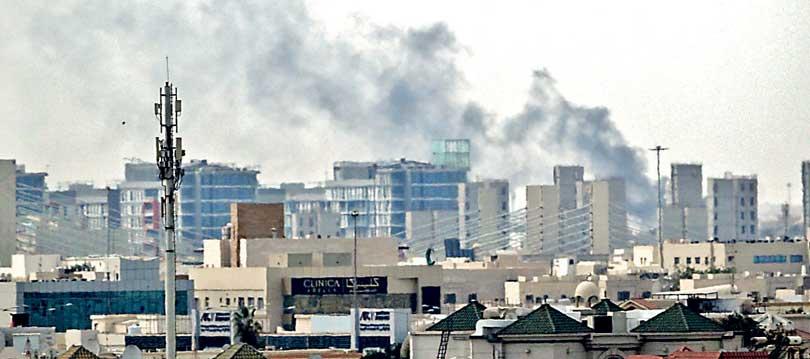
Multiple rounds of explosions echoed over Doha yesterday just hours after officials said they were evacuating residents living near the US embassy. AFP

Last Saturday, the United States and Israel without the sanction of the UN Security Council imposed an unlawful war on Iran — the only Middle Eastern nation that stands up to Western and Israeli hegemonic designs. This was not because of a breakdown in the treacherous Trump administration’s talks with Iran, but rather because of a breakthrough.
Iran had agreed to a total freeze of its nuclear programme and even consented to include a “never ever” clause regarding weaponisation. While the final draft was being prepared in Geneva for a ceremony likely to be held in Vienna, reports said the highly elated Omani mediators even purchased Mont Blanc pens at US$630 each for the parties to sign the document.
Yet, on the very day the pens were bought, bombs and missiles rained down on Iran — in what is seen as backstabbing befitting only a nation devoid of moral fabric. It is said that Israelis threatened Trump not to sign the deal by leveraging the Epstein file as kompromat.
Among those killed in the attacks was Iran’s Supreme Leader Ayatollah Khamenei, no lesser figure than the Catholic equivalent of a pope. He was not merely the spiritual leader of Shiite Muslims; he was also regarded as the representative of Imam Mahdi, whom Shiites believe will establish peace in the world.
Khamenei died a martyr — a Shaheed, one of the highest positions in Islam. He was prepared for his death. Unlike Israeli Prime Minister Benjamin Netanyahu — alias the International Criminal Court war crimes suspect — who hid in a bunker at the sight of the first incoming Iranian missile, Khamenei faced his fate with courage.
Iran, however, was prepared for the treachery. It entered talks first in Muscat and then in Geneva while simultaneously readying itself for an attack. All probabilities had been factored in.
The US appears to be following the same old strategy it adopted for the invasions of Afghanistan in 2001 and Iraq in 2003, believing that what worked in those theatres will also work in Iran. Yet the unfolding events show that the strategy is already falling apart. In both Afghanistan and Iraq, when the bombing began in preparation for the land invasion, there was little resistance. It was a cakewalk for the US-led coalition troops. But Iran is fighting back, striking hard at the enemy even while absorbing devastating blows that have so far killed more than 1,000 Iranians — mostly civilians, including more than 160 primary school children.
As the war enters its seventh day, analysts are beginning to discern Iran’s multi-layered strategy. If one approach fails, another comes into play. At present, the war appears to be tilting in Iran’s favour. It has closed the Strait of Hormuz, through which 20 per cent of the world’s oil supplies flow. Not only oil shipments but also other goods — such as food, fertiliser, electronics, and vehicles — pass through the strait. Stock markets have plunged, and world oil prices have risen from US$70 to between US$80 and US$90. Analysts predict they could soon reach US$100 or higher. If the war continues for a month, food prices will also soar, and governments will struggle to cope with rising inflation.
The biggest blow will be to developing countries. For Sri Lanka, which is painstakingly emerging from economic bankruptcy, the war is the horror of all horrors. Its oil import bill, which accounts for one-fourth of all imports, will soar. A ten‑dollar oil price hike as a result of the war has already added US$500 million to the country’s oil bill. More energy shocks are on the cards, with Saudi Arabia closing a refinery and Qatar halting gas supplies. Moreover, the country may have to rely more on thermal power generation to compensate for the Norachcholai power plant’s output loss following the use of low‑grade coal.
The blow does not come only in the form of oil price hikes. The Gulf region — especially Iran — is a top market for Sri Lanka’s tea. The country will be unable to export its tea and other products to the region.
The economy will suffer further if the Sri Lankan workforce in the Gulf returns home. Flight cancellations, rising air travel costs, and safety concerns will also curtail tourism inflows. In desperation, victim nations sing and dance before the US and Israel — as child sex predator and Mossad agent Epstein had advised them to do. The Sri Lankan government is no exception. It performs a cabaret, shedding its socialist garb. Under pressure, it condoled with the Iranian ambassador but, in its servility‑driven deference to the US‑Israeli axis, it would not condemn the war or the killing of Khamenei.
As nations sing and dance before the Nazis of our times, Spain stands out. It denied the United States permission to use NATO bases on Spanish soil. But poor Sri Lanka is not Spain. President Anura Kumara Dissanayake cannot afford to act like Spanish Prime Minister Pedro Sánchez, nor can the Janatha Vimukthi Peramuna, or Peoples Liberation Front, become the Spanish Socialist Workers Party (PSOE). Sri Lanka’s ruling party appears to see liberation not in socialism but in the embrace of right‑wing forces, however immoral they may be and whatever their ambitions to dominate the world. Since coming to power in November 2024, it has faced calamity after calamity. Following the economic crisis and Cyclone Ditwah, it is now forced to endure the adverse impacts of the illegal war on Iran.
Given this unenviable situation, the government cannot be entirely blamed; its stance resonates with political realism, especially when the survival of the state is at stake.
The belligerents know that the war cannot last forever. As Israel struggles to replenish its air defense system with ammunition, Iran will gain greater control over the politics of the war. Many options at its disposal have not yet been tried. One such option, according to geopolitical analyst Jiang Xueqin, is Iran’s ability to damage or destroy water desalination plants in the Gulf countries, most of which lack natural water sources. The chaos would be unimaginable if the Gulf states were to run out of water.
Asymmetrical warfare favours Iran. Aware of this possibility, the Gulf countries are pressuring the United States to end the war and to refrain from direct involvement — even though Iran has already struck US bases, radar facilities, and intelligence hubs in their territories. They face a dilemma: if they join the war, they risk being seen as Israeli proxies; if they do not, Iran has free rein over their territories.
By yesterday, the war was expanding, with Iran striking Kurdish military positions inside Iraq, while the US sought Kurdish support for a land invasion.
Things may go wrong for Americans and Israelis because they have misread Iran’s strategic culture. Jack Snyder defines it as “the sum total of ideals, conditional emotional responses, and patterns of habitual behaviour that members of the national strategic community have acquired through instruction and share with each other with regard to strategy.”
Iran’s strategic culture is rooted in Shiite Islam and the martyrdom of Imam Hussein, the grandson of the Prophet Muhammad. He was brutally massacred by the soldiers of a tyrant for standing up for justice. Martyrdom does not simply denote death; there is life in it. Like Khamenei, the faithful face it and do not run away from death.
The US strategic culture under Trump, in contrast, reflects white Western supremacism. It abandons the love‑thy‑neighbour Christianity of Jesus, and adopts the religion of hegemony‑hunting, greedy neocolonialists. This strategic culture does not respect Muslims’ holy month of Ramadan, as it wages a clash of civilisations instead of pursuing the dialogue between civilizations that former Iranian president Mohammed Khatami promoted.

No comments:
Post a Comment