Showing posts with label Saddam invades Kuwait. Show all posts

Tuesday, December 04, 2018

George H.W. Bush’s Complicity in the 1991 “Highway of Death” Massacre.

A “statesman” and “American hero”? What a lie!


A “statesman” and “American hero”? What a lie!
When George H.W. Bush was president he ordered the massacre of Iraqi soldiers after the ceasefire in 1991, and after he had promised them safe passage out of Kuwait. This article, which went viral after the war, exposed Bush as a mass murderer and war criminal, directly involved in the “Highway of Death.” He is a “hero” only to Big Oil and the Wall Street financial empire. This account was assembled by the author and presented by her at a tribunal examining U.S. war crimes. It is still cited around the world on anniversaries of this war.
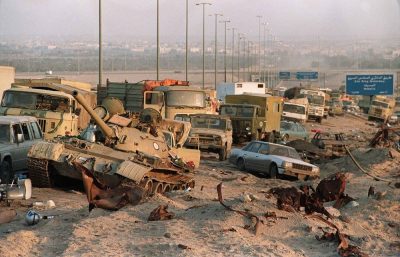
I want to give testimony on what are called the “highways of death.” These are the two Kuwaiti roadways, littered with remains of 2,000 mangled Iraqi military vehicles, and the charred and dismembered bodies of tens of thousands of Iraqi soldiers, who were withdrawing from Kuwait on February 26th and 27th 1991 in compliance with UN resolutions.
U.S. planes trapped the long convoys by disabling vehicles in the front, and at the rear, and then pounded the resulting traffic jams for hours. “It was like shooting fish in a barrel,” said one U.S. pilot. The horror is still there to see.

On the inland highway to Basra is mile after mile of burned, smashed, shattered vehicles of every description – tanks, armored cars, trucks, autos, fire trucks, according to the March 18, 1991, Time magazine. On the sixty miles of coastal highway, Iraqi military units sit in gruesome repose, scorched skeletons of vehicles and men alike, black and awful under the sun, says the Los Angeles Times of March 11, 1991. While 450 people survived the inland road bombing to surrender, this was not the case with the 60 miles of the coastal road. There for 60 miles every vehicle was strafed or bombed, every windshield is shattered, every tank is burned, every truck is riddled with shell fragments. No survivors are known or likely. The cabs of trucks were bombed so much that they were pushed into the ground, and it’s impossible to see if they contain drivers or not. Windshields were melted away, and huge tanks were reduced to shrapnel.
“Even in Vietnam I didn’t see anything like this. It’s pathetic,” said Major Bob Nugent, an Army intelligence officer. This one-sided carnage, this racist mass murder of Arab people, occurred while White House spokesman Marlin Fitzwater promised that the U.S. and its coalition partners would not attack Iraqi forces leaving Kuwait. This is surely one of the most heinous war crimes in contemporary history.
The Iraqi troops were not being driven out of Kuwait by U.S. troops as the Bush administration maintains. They were not retreating in order to regroup and fight again. In fact, they were withdrawing, they were going home, responding to orders issued by Baghdad, announcing that it was complying with Resolution 660 and leaving Kuwait. At 5:35 p.m. (Eastern standard Time) Baghdad radio announced that Iraq’s Foreign Minister had accepted the Soviet cease-fire proposal and had issued the order for all Iraqi troops to withdraw to positions held before August 2, 1990 in compliance with UN Resolution 660. President Bush responded immediately from the White House saying (through spokesman Marlin Fitzwater) that “there was no evidence to suggest the Iraqi army is withdrawing. In fact, Iraqi units are continuing to fight. . . We continue to prosecute the war.” On the next day, February 26, 1991, Saddam Hussein announced on Baghdad radio that Iraqi troops had, indeed, begun to withdraw from Kuwait and that the withdrawal would be complete that day. Again, Bush reacted, calling Hussein’s announcement “an outrage” and “a cruel hoax.”
Eyewitness Kuwaitis attest that the withdrawal began the afternoon of February 26, 1991 and Baghdad radio announced at 2:00 AM (local time) that morning that the government had ordered all troops to withdraw.
The massacre of withdrawing Iraqi soldiers violates the Geneva Conventions of 1949, Common Article III, which outlaws the killing of soldiers who are out of combat. The point of contention involves the Bush administration’s claim that the Iraqi troops were retreating to regroup and fight again. Such a claim is the only way that the massacre which occurred could be considered legal under international law. But in fact the claim is false and obviously so. The troops were withdrawing and removing themselves from combat under direct orders from Baghdad that the war was over and that Iraq had quit and would fully comply with UN resolutions. To attack the soldiers returning home under these circumstances is a war crime.
Iraq accepted UN Resolution 660 and offered to withdraw from Kuwait through Soviet mediation on February 21, 1991. A statement made by George Bush on February 27, 1991, that no quarter would be given to remaining Iraqi soldiers violates even the U.S. Field Manual of 1956. The 1907 Hague Convention governing land warfare also makes it illegal to declare that no quarter will be given to withdrawing soldiers. On February 26,199 I, the following dispatch was filed from the deck of the U.S.S. Ranger, under the by-line of Randall Richard of the Providence Journal:
“Air strikes against Iraqi troops retreating from Kuwait were being launched so feverishly from this carrier today that pilots said they took whatever bombs happened to be closest to the flight deck. The crews, working to the strains of the Lone Ranger theme, often passed up the projectile of choice . . . because it took too long to load.”
New York Times reporter Maureen Dowd wrote,
“With the Iraqi leader facing military defeat, Mr. Bush decided that he would rather gamble on a violent and potentially unpopular ground war than risk the alternative: an imperfect settlement hammered out by the Soviets and Iraqis that world opinion might accept as tolerable.”
In short, rather than accept the offer of Iraq to surrender and leave the field of battle, Bush and the U.S. military strategists decided simply to kill as many Iraqis as they possibly could while the chance lasted. A Newsweek article on Norman Schwarzkopt, titled “A Soldier of Conscience” (March 11,1991), remarked that before the ground war the general was only worried about “How long the world would stand by and watch the United States pound the living hell out of Iraq without saying, ‘Wait a minute – enough is enough.’ He [Schwarzkopf] itched to send ground troops to finish the job.” The pretext for massive extermination of Iraqi soldiers was the desire of the U.S. to destroy Iraqi equipment. But in reality the plan was to prevent Iraqi soldiers from retreating at all. Powell remarked even before the start of the war that Iraqi soldiers knew that they had been sent to Kuwait to die. Rick Atkinson of the Washington Post reasoned that “the noose has been tightened” around Iraqi forces so effectively that “escape is impossible” (February 27, 1991). What all of this amounts to is not a war but a massacre.
There are also indications that some of those bombed during the withdrawal were Palestinians and Iraqi civilians. According to Time magazine of March 18, 1991, not just military vehicles, but cars, buses and trucks were also hit. In many cases, cars were loaded with Palestinian families and all their possessions. U.S. press accounts tried to make the discovery of burned and bombed household goods appear as if Iraqi troops were even at this late moment looting Kuwait. Attacks on civilians are specifically prohibited by the Geneva Accords and the 1977 Conventions.
How did it really happen? On February 26, 1991 Iraq had announced it was complying with the Soviet proposal, and its troops would withdraw from Kuwait. According to Kuwaiti eyewitnesses, quoted in the March 11, 1991 Washington Post, the withdrawal began on the two highways, and was in full swing by evening. Near midnight, the first U.S. bombing started. Hundreds of Iraqis jumped from their cars and their trucks, looking for shelter. U.S. pilots took whatever bombs happened to be close to the flight deck, from cluster bombs to 500 pound bombs. Can you imagine that on a car or truck? U.S. forces continued to drop bombs on the convoys until all humans were killed. So many jets swarmed over the inland road that it created an aerial traffic jam, and combat air controllers feared midair collisions.
The victims were not offering resistance. They weren’t being driven back in fierce battle, or trying to regroup to join another battle. They were just sitting ducks, according to Commander Frank Swiggert, the Ranger Bomb Squadron leader. According to an article in the March 11, 1991 Washington Post, headlined “U.S. Scrambles to Shape View of Highway of Death,” the U.S. government then conspired and in fact did all it could to hide this war crime from the people of this country and the world. What the U.S. government did became the focus of the public relations campaign managed by the U.S. Central Command in Riyad, according to that same issue of the Washington Post. The typical line has been that the convoys were engaged in “classic tank battles,” as if to suggest that Iraqi troops tried to fight back or even had a chance of fighting back. The truth is that it was simply a one-sided massacre of tens of thousands of people who had no ability to fight back or defend themselves.
The Washington Post says that senior officers with the U.S. Central Command in Riyad became worried that what they saw was a growing public perception that Iraqi forces were leaving Kuwait voluntarily, and that the U.S. pilots were bombing them mercilessly, which was the truth. So the U.S. government, says the Post, played down the evidence that Iraqi troops were actually leaving Kuwait.
U.S. field commanders gave the media a carefully drawn and inaccurate picture of the fast-changing events. The idea was to portray Iraq’s claimed withdrawal as a fighting retreat made necessary by heavy allied military pressure. Remember when Bush came to the Rose Garden and said that he would not accept Saddam Hussein’s withdrawal? That was part of it, too, and Bush was involved in this cover up. Bush’s statement was followed quickly by a televised military briefing from Saudi Arabia to explain that Iraqi forces were not withdrawing but were being pushed from the battlefield. In fact, tens of thousands of Iraqi soldiers around Kuwait had begun to pull away more than thirty-six hours before allied forces reached the capital, Kuwait City. They did not move under any immediate pressure from allied tanks and infantry, which were still miles from Kuwait City.
This deliberate campaign of disinformation regarding this military action and the war crime that it really was, this manipulation of press briefings to deceive the public and keep the massacre from the world is also a violation of the First Amendment of the U.S. Constitution, the right of the people to know.
*Joyce Chediac presented her report  at the New York Commission hearing of the Commission of Inquiry for the International War Crimes Tribunal, May 11, 1991. It is reprinted from War Crimes: A Report on United States War Crimes Against Iraq, Maisonneuve Press, 1992.

Monday, December 03, 2018

“The Butcher of Iraq” George Bush Snr dies

By
 5Pillars
 

George HW Bush
Former American President George HW Bush – the architect of the First Gulf War which killed tens of thousands of Iraqis – has died aged 94.
Bush served as US President from 1988-1992 and will be best remembered in the Muslim world for the bloody war that he launched – with the assistance of several Arab nations, including Saudi Arabia and Egypt – against Saddam Hussein’s Iraq in 1990-1.
In 1990 Iraqi leader Saddam Hussein accused Kuwait of siphoning crude oil from the Ar-Rumaylah oil fields located along their common border. He also insisted that Kuwait and Saudi Arabia cancel out $30 billion of Iraq’s foreign debt, and accused them of conspiring to keep oil prices low in an effort to pander to Western oil-buying nations.
On August 2, 1990, he ordered the invasion of Kuwait after receiving what he thought was a green light from the US ambassador to Iraq. Hussein assumed that his fellow Arab states would stand by in the face of his invasion of Kuwait and not call in outside help to stop it, but this proved to be a miscalculation.
Two-thirds of the 21 members of the Arab League condemned “Iraq’s act of aggression,” and Saudi Arabia’s King Fahd, along with Kuwait’s government-in-exile, turned to the United States and other members of NATO for support.
On August 8, the day on which the Iraqi government formally annexed Kuwait, the first U.S. Air Force fighter planes began arriving in Saudi Arabia as part of a military build-up dubbed Operation Desert Shield. The planes were accompanied by troops sent by NATO allies as well as Egypt and several other Arab nations, designed to guard against a possible Iraqi attack on Saudi Arabia.
By January, the coalition forces prepared to face off against Iraq numbered some 750,000, including 540,000 U.S. personnel and smaller forces from Britain, France, Germany, the Soviet Union, Japan, Egypt and Saudi Arabia, among other nations. Iraq, for its part, had the support of Jordan (another vulnerable neighbor), Algeria, the Sudan, Yemen, Tunisia and the Palestinian Liberation Organisation (PLO).
Early on the morning of January 17, 1991, a massive U.S.-led air offensive hit Iraq’s air defenses, moving swiftly on to its communications networks, weapons plants, oil refineries and more. The Iraqi air force was either destroyed early on or opted out of combat under the relentless attack, the objective of which was to win the war in the air and minimise combat on the ground as much as possible.
Saddam Hussein was one of several Arab leaders toppled by the West
By mid-February, the coalition forces had shifted the focus of their air attacks toward Iraqi ground forces in Kuwait and southern Iraq. A massive allied ground offensive, Operation Desert Sabre, was launched on February 24, with troops heading from northeastern Saudi Arabia into Kuwait and southern Iraq.
Over the next four days, coalition forces encircled and defeated the Iraqis and “liberated” Kuwait. At the same time, U.S. forces stormed into Iraq some 120 miles west of Kuwait, attacking Iraq’s armored reserves from the rear. The elite Iraqi Republican Guard mounted a defense south of Al-Basrah in southeastern Iraq, but most were defeated by February 27.
In all, at least 10,000 Iraqi forces were killed, in comparison with only 300 coalition troops.
Though the Gulf War was recognised as a decisive victory for the coalition, Kuwait and Iraq suffered enormous damage, and Saddam Hussein was not forced from power. Intended by coalition leaders to be a “limited” war fought at minimum cost, it would have lingering effects for years to come, both in the Persian Gulf region and around the world.
In the immediate aftermath of the war, Hussein’s forces suppressed uprisings by Kurds in the north of Iraq and Shi’ites in the south. The United States-led coalition failed to support the uprisings, afraid that the Iraqi state would be dissolved if they succeeded.
Shortly before Christmas 1991, the Medical Educational Trust in London published a comprehensive study of casualties. It said up to a quarter of a million men, women and children were killed or died as a direct result of the American-led attack on Iraq and its immediate aftermath.
In evidence before the Parliamentary Foreign Affairs Select Committee, the major international relief agencies reported that 1.8 million people had been made homeless, and Iraq’s electricity, water, sewage, communications, health, agriculture and industrial infrastructure had been “substantially destroyed”, producing “conditions for famine and epidemics”.
In the years after the war, the deaths of half a million children as a result of an American and British-led economic embargo and the continuing bombing of populated areas in Iraq were not widely reported in the West.
In 2002, the United States (now led by President George W. Bush, son of the former president) sponsored a new U.N. resolution calling for the return of weapons inspectors to Iraq.
Amid differences between Security Council member states over how well Iraq had complied with those inspections, the United States and Britain began amassing forces on Iraq’s border.
Bush Jnr (without further U.N. approval) issued an ultimatum on March 17, 2003, demanding that Saddam Hussein step down from power and leave Iraq within 48 hours, under threat of war. Hussein refused, and the second Persian Gulf War began three days later. It would be much more bloody than its predecessor.

Friday, November 09, 2018

Who remember this guy?

Image may contain: one or more people

This is the late Iraqi dictator, Saddam. He murdered tens of thousands of innocent Shia Muslims in Iraq of which the most famous was Ayatollah Baqir al-Sadr and his honored Sister, Amina Bint ul-Huda.
Ayatollah al-Sadr was a born genius in knowledge. When Kuwait wanted to establish Islamic Banking they contacted him. People of knowledge in the West mourned his murder. Saddam killed him with his own hand according to Saddam's Physician.
After the glorious victory of the 1979 Islamic Revolution in Iran, the greedy West did everything to overthrow the Revolutionary government but failed. Their last resort was to push Saddam to invade Iran. They provided him with sophisticated weapons while Saudi Arabia, Kuwait and other Arab countries funded his war machine.
What was the end of Saddam?
He outlived his usefulness to the Americans so they tricked him to invade Kuwait. The idiot invaded Kuwait and they formed a coalition against him. Saudi Arabia funded the war. They killed more than one million Iraqis and caught Saddam like a rat from a rat hole. They hanged him after killing his two sons.
Who has ever profited in serving the greedy European savages? Who? Please give me an example!
Continue to Rest In Hell, the Cursed Saddam!
#ElbinawiTweets

Sunday, August 05, 2018

Where there is no lion, fox plays with its tail

By: Nabi Sonboli*


Saudi ambassador Khalid, posing with Zionist Henry Kissinger


Tehran, Aug 4, IRNA – Saudi Arabia is fabricating pretexts to coax the US to use its sources for confronting Iran, an analyst said warning Washington not to walk into a trap laid by an ally.


Saudi ambassador Prince Khalid posing with Bush Sr. and 
Bush Jr. who wrought havoc in Iraq. 


Prince Khalid bin Salman, the Saudi Ambassador to Washington, in an article published by Arab News on July 23rd, rightly quotes philosopher George Santayana as having said that “Those who cannot remember the past are condemned to repeat it.” In the article, he accused Iran of everything and compares Iran to Germany in 1938 under Hitler, arguing that Iran must be confronted, not appeased. 


Khalid, begins his article by mentioning his birthday three decades ago, but the history of Iran-US and Iran-Saudi relations did not begin with his birthday. When Mr. Ambassador was born, the war that Saudi Arabia and Iraq imposed on Iran for 8 years had just ended; a war that shaped Iranian strategic culture after the revolution and is imprinted on the minds of all Iranians. In the following, I will try to comment on some of his arguments briefly. Of course, the Saudi and UAE Ambassadors in Washington, and their lobbyists, are following Netanyahu line on Iran.

The Islamic Republic of Iran has not pursued an expansionist foreign policy during the past four decades. “Resistance” as the main pillar of Iran’s foreign policy is essentially a defensive posture. What others, including Saudis and Americans, expect from Iran is appeasement and retreat. Contrary to what Ambassador Khalid tries to argue, it’s the Saudis that have followed an aggressive foreign policy, supported by checkbook diplomacy and “free-riding”. The Iraqi war against Iran could not have happen and endured for eight years without Saudi support. The Saudi government paid more than 40 billion dollars to the Iraqi dictator to fight against Iran. That war imposed more than 200000 casualties, 600000 wounded, 2 million refugees and one trillion dollar in costs on Iranians. That experience shaped Iranian strategic culture and we will not let it happen ever again. 

Two years later, Saddam invaded Kuwait and attacked Saudi Arabia with the money and weapons provided by Saudi government during the Iraqi war against Iran. Saudi government invited the US to defend the Kingdom against Iraq and free Kuwait from Iraqi invasion in 1990 and asked the US to keep Saddam in power and let him kill Kurds, Shiites and Sunnis who were against him. The US-UK war against Iraq continued during 1990s. In 2003, the US had no option but to leave Saddam or get rid of him. Now, three decades later, the war trap that Saudi Arabia dragged US soldiers into in 1990s continues. It cost Iraq and the US more than 4 trillion dollars and thousands of casualties. This is the first result of America following the Saudi’s “wise” advice and expansionist policies in the Persian Gulf region. If Saudis had not supported Saddam, none of these wars and conflicts could have happened.

During the 1990s, Saudi Arabia created, supported and recognized the Taliban in Afghanistan. According to New York Times, “leading Saudi prince, Turki al-Faisal, hand a check for one billion Saudi riyals … to a top Taliban leader.” The Saudi lobby in Washington misled the US with the “Taliban project” to create “balance” against Iran and secure Afghanistan for oil transit, while even the European countries were against Taliban. In August 1998, Taliban killed Iranian diplomats and attacked Iranian cities on the border. They hosted the Al-Qaeda organization that would go on to kill 3000 innocent Americans on Sep. 11th. The Taliban is still the main threat to peace and security in Afghanistan 18 years after their removal from power by the US. The group, created and supported by Saudi Arabia and UAE, imposed billions of dollars and thousands of casualties on Afghanistan and the US. This is the second result of following expansionist Saudi policies and “wise” advice. 


In Syria, Saudi Arabia mobilized extremist elements to bring “democracy and freedom” to that country. Saudi Arabia's foreign minister Adel al-Jubeir said 'Bashar al-Assad will leave — have no doubt about it. He will either leave by a political process or he will be removed by force.' The Saudi effort to destabilize Syria and remove Assad from power led to destruction of Syria and expansion of ISIS influence. ISIS originally was created in Iraq, expanded to Syria and the rest of the world. Thousands of extremist from all around the world joined them, including Saudi citizens. They had a clear identity, ideology, money and training. Where did all these elements come from? According to a report published by Sofan Goup in 2015, 2,500 people from Saudi Arabia joined ISIS. In addition, according to Brooking Institutes, most of the people supporting ISIS on tweeter were Saudi Citizens. 

Saudi and UAE expansionist policies in Yemen, Bahrain, Qatar, Lebanon, Libya, Egypt, Turkey and other countries in recent years are clear enough. Military intervention in Bahrain, intervention in Libya, supporting military coup in other countries, blockades and coup attempt in Qatar, detaining Lebanon’s prime minister and so on, demonstrate the expansionist and aggressive nature of Saudi foreign policy. The only change that has been recently witnessed in Saudi foreign policy is a shift from covert expansionism to overt expansionism with more military muscle. What have Saudi Arabia and the UAE accomplished in these cases? 

Saudi Ambassador accuses Iran of “apocalyptic pursuit of nuclear weapons”. After the 1979 revolution, Iran stopped almost all nuclear activities and Iranian leader took positions against all nuclear weapons. In 1988, Saudi Arabia was the first country in the region that acquired nuclear-capable missiles. Like other weapons, Saudi nuclear policy has been to keep the option of buying a nuclear weapon open. Prince Turki Al Faisal announced 'I have suggested that the Gulf Cooperation Council members should carefully weigh all options, including acquiring a nuclear deterrent if the Iranian leadership succeed in building a nuclear weapon”. Iran has never reciprocated these threats. In fact, Iran was among the first countries that joined NPT and has implemented all of its commitments. According to the 2015 nuclear deal, Iran reaffirmed its NPT commitment never to pursue a nuclear weapon. The IAEA has published 12 reports since JCPOA implementation, all of which confirmed that Iran has kept its commitments according to the deal. Is Saudi Arabia ready to provide the same level of transparency as Iran has on all of its nuclear activities during the past 4 decades? 


Khalid claims that “Saudi Arabia’s vision is inclusive, guided by the rule of law and international order, and promoting peace, stability and economic prosperity for all.” The main problem with Saudi Arabia is its exclusionist mentality and approach. The Middle East has a mosaic social composition. Houthis in Yemen, Hezbollah in Lebanon, Shiites in Saudi Arabia and Bahrain, Kurds in Iraq and Syria and all ethnicities, sects and other minorities are parts of their societies and must be included. Only an inclusive system can survive in the Middle East. However, Saudi Arabia has always followed and supported exclusionist systems both at home and abroad. About 10% of Saudi population are Shiite and the same number of people are Sunnis in Iran. Compare the role of Shiites in Saudi Arabia with Sunnis in Iran. Twenty members of Parliament in Iran are Sunnis; they have their voices and positions at local levels. However, many believe their role in Iranian governance should be expanded. 

Khalid blames Iran for promoting sectarianism. In general, Shiites are in minority in the Islamic world and Iran suffer from sectarianism more than any other country. Iran good relations with Sunnis, Christians, Jews and different ethnicities like Arabs, Turks, Turkmens and Kurds in the region proves that Iran support more inclusive systems. Iran’s role in the Bonn conference and its role in supporting the inclusive system in Afghanistan and Iraq, Iran peace plans for Syria and Yemen, all demonstrate that contrary to the Saudi Ambassador claim, Iran supports more inclusive and democratic systems. The Saudi invasion of Bahrain and their support for military coups in the region show that they do not believe in democracy and inclusiveness. They do not have an inclusive system at home to promote it. Just last year, the Saudi military destroyed the historical area of Awamiya, a Shia-majority city inside Saudi Arabia. Mohammed bin Salman do not even tolerate his family.

Saudi Ambassador believes that Iran is responsible for regional instabilities. After 15 years of supporting instability in Iraq, Saudis just recently changed their position. Still many people hesitate to believe that it is a real change. Saudi Arabia invaded Bahrain and Yemen against the will and consent of their peoples. Saudi approach toward Qatar, Syria and Lebanon have endangered “order, peace, stability and prosperity” of these countries. Iranians, Iraqis, Syrians, Lebanese, Afghans and Yemenis all have severely suffered from local and regional conflicts.

Iran has legitimate interests and security concerns in the region. Tehran has repeatedly asked for inclusive regional mechanisms for security dialogue. Saudis have always rejected dialogue and peace initiatives. In the last case, Mohammed bin Salman rejected Kuwaiti initiative for regional dialogue and subsequently declared that “we will work so that the battle is on their side, inside Iran”. The Saudi System is based on submission, and Mohammed Bin Salman expects everyone in the Persian Gulf, the Middle East and even in Washington to submit to the King. Saudi efforts to prevent JCPOA and then its efforts to undermine it, demonstrate how threatening dialogue and intentional law are for them. 

According to the Khalid’s paper, “The Iranian constitution calls for spreading “the ideological mission of jihad throughout the world.” During the Iraqi war against Islamic Republic, before Khalid was born, Iranian authorities preferred to use the term “holly defense” not “Jihad”. After the 1979 revolution, the concept of “Jihad” was used in Iran more for peaceful and development purposes. Islamic revolutionaries established “construction Jihad” to support villagers and build roads; “Scientific Jihad” to support and encourage more research and education; and “Agricultural jihad” to modernize the agricultural infrastructures and trainings in rural areas. “Jihadists” ideology all around the world come from Saudi Arabia, not Iran. Contrary to Khalid argument, during the past decades, Iran has exported more experts, not extremists.

Khalid mentions, “We are aggressively fighting Daesh and Al-Qaeda, and the extremist ideologies that underpin them.” To differentiate Saudi and Iranian policies toward terrorism, he says “The difference is that in Saudi Arabia these terrorists are on the run, while in Iran they are running the country.” In 2001, that Iran president Mohammad Khatami asked the UN to call it the “Year of dialogue among civilizations”, Saudi and UAE terrorists killed 3,000 innocent women and men in the US. He claims that the terrorist “running Iran”, while it was a coalition of Iranian, Iraqi, Syrian and Lebanese forces that prevented ISIS from capturing Bagdad, Erbil, Damascus and Beirut while 3,000 Saudi citizens were among ISIS fighters. Since 2001, many Iranian officers and soldiers have lost their life in fighting against terrorists.

Saudi Ambassador tries to depict Iran as being against modernity and Saudi Arabia as supporting it. The Saudi Arabia just recently let the women to drive and opened cinemas, while Iranian women had benefited these and much more for decade. Iranian women got their voting power in 1962 while Saudi women still struggle for that. The first Iranian woman got her driver’s license 76 years ago while the women of Saudi Arabia got their licenses in 2018. 

According to the Saudi Ambassador “Iran’s official fiscal budgets show that between 2014 and 2017, “the defense budget grew by 71 percent, from $9.29 billion to $15.9 billion… and the budget rose even further last year to $19 billion.” Based on SIPRI report in 2017, Saudi Arabia with 69 Billion dollars, had the third military budget in the world after the US and China, while Iran military budget was less than 15 billion. The Saudis spend 10.3% of their GDP on defense while Iran spends only 3.1%. During the past 5 years (P)GCC countries has spent more than 500 billion dollars on military expenditure while Iran has spent less than 60 billion dollars. This is not the military budget of a regional and global threat, as Khalid compares Iran with Germany in 1938. Iran military budget proves Iranian peaceful intention and Saudi military expenditures confirm their aggressive and expansionist approach. 

Unfortunately, we live in a highly unstable region. We have the experiences of the Iraq war, USSR and US invasion of Afghanistan, the US invasion of Iraq, Syrian and Yemeni civil wars, military coups in neighboring countries and political instabilities all over the Middle East and beyond. We cannot allow our country to become vulnerable to any kind of threat and instability again. In any deal, Iran security is the main priority. Iran will keep all its defensive capabilities in any negotiation with any country. 

Saudi Ambassador refers to the Obama redline on Syria and by quoting the US officials including Trump, tries to encourage the US to confront Iran. He compares Iran with Germany in 1938 and ask the US and the world to “stand up against Iran”, “pressure Iran”, “contain Iran”, and “confront Iran with seriousness and intent”. It seems that he has got upset from paying checks and watching inaction and hearing that “something must be done.” He tries to encourage the American people to send their sons and daughters to fight and save King Salman from the troubles that he has made for himself and others in Persian Gulf and the Middle East. Saudi officials had taken this approach before when they asked the US to “cut the head of snake”, while September 11th demonstrated to the world, that “the head of snake” is inside Saudi Arabia and that when President Trump spoke against terrorism in Riyadh last year, the main audiences of his speech were in the room.

I have traveled to many countries, however my best trip was to Saudi Arabia. I don’t’ think that Khalid Bin Salman or Mohammed Bin Salman are properly representing the Saudi People. The system is not representative. Many wise men and women there look for a better life and more freedom, peace and stability for all. The root causes of problems in the Middle East, based on Arab Development Reports in recent years, include inefficient governments, exclusion, inequality, frustration, pervasive discrimination, expansion of urbanization, population growth, environmental problems, unemployment, among others. Military interventions, securitization of the region, dictatorships, militarization of systems and societies have exacerbated the situation. Iran certainly will benefit from modernization, development, moderation and an open-minded and inclusive system in Saudi Arabia. Although we have suffered greatly from malign Saudi behavior in the region and all around the world, especially in Washington, Tehran does not look for confrontation with neighboring countries.

In sum, Khalid seems to be worried, and he should be. Former Vice President Joe Biden was right when he said, “our biggest problem is our allies.” As an Iranian proverb says, “a wise enemy is better than a stupid friend”. Obama was smart to not go “walking into a trap—one laid both by allies and by adversaries” for him in Syria. I do not think that Trump is so naïve to walk into a trap prepared for him by Khalid and his brother MBS. The Saudi government wants the US to fight for them, and impose another 10 trillion dollars on American taxpayers. It seems that Khalid has not been able to understand “America First” yet. The US needs time and energy to revitalize its economy and make it more competitive to be able to compete with rising economies. As the proverb says, “While the cat is away, the mice will play”.


*Nabi Sonboli is an international affairs expert