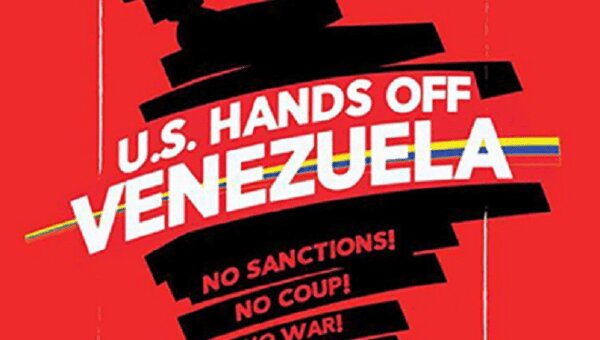
Americans have been trained by decades of Cold War propaganda to look for any confirmation that ‘socialism means poverty.’ But in the case of Venezuela and other states not governed by the free market, this cliche simply doesn’t ring true.
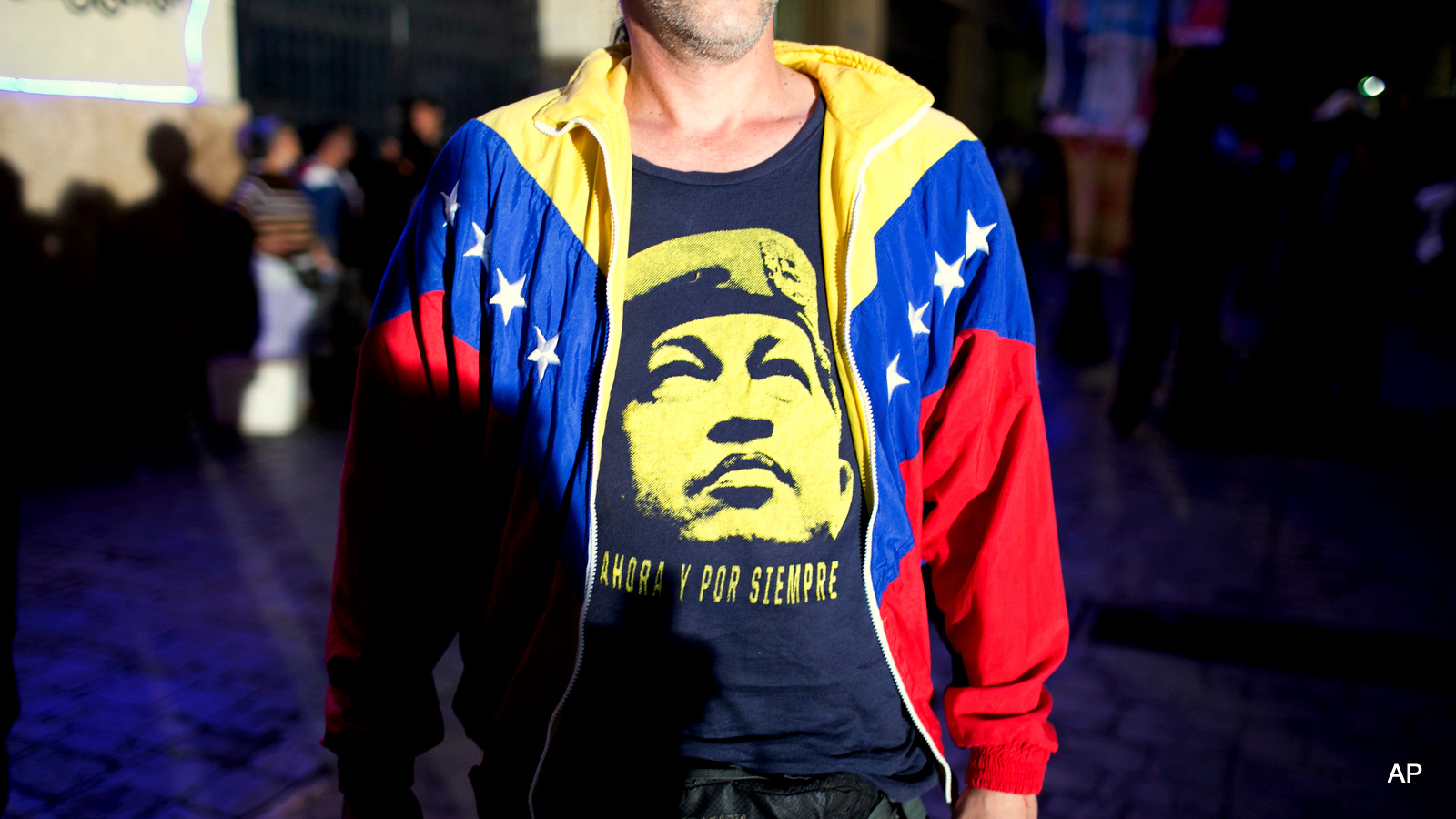
A pro-government supporter wears a T-Shirt with image of Venezuela’s late President Hugo Chavez, as he waits for results during congressional elections in Caracas, Venezuela, Sunday, Dec. 6, 2015.
WASHINGTON — (ANALYSIS) The political and economic crisis facing Venezuela is being endlessly pointed to as proof of the superiority of the free market.
Images and portrayals of Venezuelans rioting in the streets over high food costs, empty grocery stores, medicine shortages, and overflowing garbage bins are the headlines, and the reporting points to socialism as the cause.
Indeed, corporate-owned, mainstream media advises Americans to look at the inflation and food lines in Venezuela, and then repeat to themselves clichés they heard in elementary school about how “Communism just doesn’t work.”
In reality, millions of Venezuelans have seen their living conditions vastly improved through the Bolivarian process. The problems plaguing the Venezuelan economy are not due to some inherent fault in socialism, but to artificially low oil prices and sabotage by forces hostile to the revolution.
Starting in 2014, the Kingdom of Saudi Arabia flooded the market with cheap oil. This is not a mere business decision, but a calculated move coordinated with U.S. and Israeli foreign policy goals. Despite not just losing money, but even falling deep into debt, the Saudi monarchy continues to expand its oil production apparatus. The result has been driving the price of oil down from $110 per barrel, to $28 in the early months of this year. The goal is to weaken these opponents of Wall Street, London, and Tel Aviv, whose economies are centered around oil and natural gas exports.
And Venezuela is one of those countries. Saudi efforts to drive down oil prices have drastically reduced Venezuela’s state budget and led to enormous consequences for the Venezuelan economy.
At the same time, private food processing and importing corporations have launched a coordinated campaign of sabotage. This, coupled with the weakening of a vitally important state sector of the economy, has resulted in inflation and food shortages. The artificially low oil prices have left the Venezuelan state cash-starved, prompting a crisis in the funding of the social programs that were key to strengthening the United Socialist Party.
Corruption is a big problem in Venezuela and many third-world countries. This was true prior to the Bolivarian process, as well as after Hugo Chavez launched his massive economic reforms. In situations of extreme poverty, people learn to take care of each other. People who work in government are almost expected to use their position to take care of their friends and family. Corruption is a big problem under any system, but it is much easier to tolerate in conditions of greater abundance. The problem has been magnified in Venezuela due to the drop in state revenue caused by the low oil prices and sabotage from food importers.
The Bolivarian experience in Venezuela
Americans have been trained by decades of Cold War propaganda to look for any confirmation that “socialism means poverty.” A quick, simplistic portrait of the problems currently facing Venezuela, coupled with the fact that President Nicolas Maduro describes himself as a Marxist, can certainly give them such a confirmation. However, the actual, undisputed history of socialist construction around the world, including recent decades in Venezuela, tells a completely different story.
Hugo Chavez was elected president of Venezuela in 1999. His election was viewed as a referendum on the extreme free market policies enacted in Venezuela during the 1990s. In December, when I walked through the neighborhoods of central Caracas, Venezuelans spoke of these times with horror.
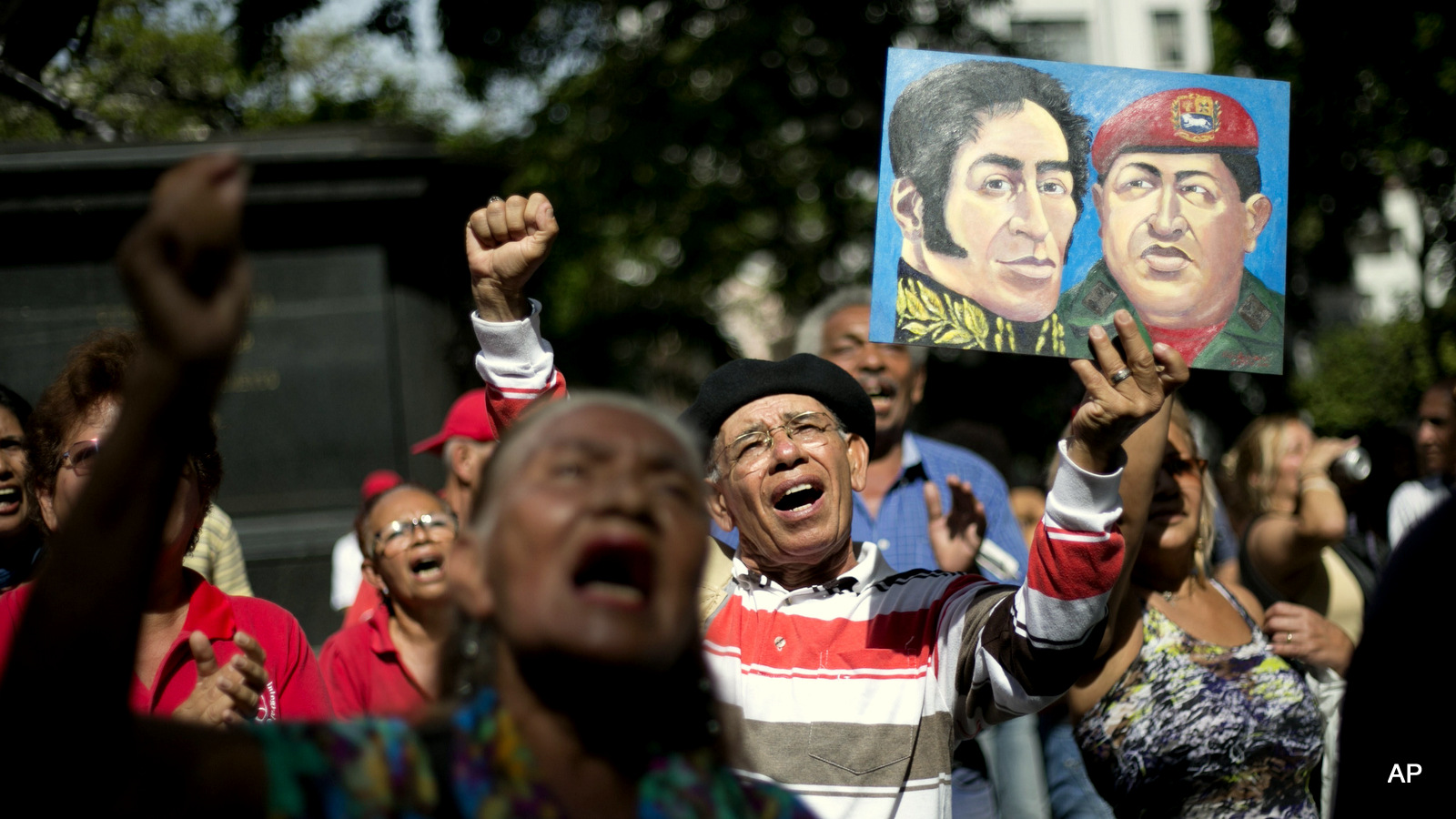
Demonstrators gather in Bolivar Square to show their support of Venezuela’s President Nicolas Maduro, in Caracas, Venezuela. The demonstrators gathered as the Organization of American States is meeting to discuss a report from Secretary General Luis Almagro denouncing violations of the Venezuela’s constitution.
Venezuelans told of how the privatizations mandated by the International Monetary Fund made life in Venezuela almost unlivable during the 1990s. Garbage wouldn’t be collected. Electricity would go off for weeks. Haido Ortega, a member of a local governing body in Venezuela, said: “Under previous governments we had to burn tires and go on strike just to get electricity, have the streets fixed, or get any investment.”
Chavez took office on a platform advocating a path between capitalism and socialism. He restructured the government-owned oil company so that the profits would go into the Venezuelan state, not the pockets of Wall Street corporations. With the proceeds of Venezuela’s oil exports, Chavez funded a huge apparatus of social programs.
After defeating an attempted coup against him in 2002, Chavez announced the goal of bringing Venezuela toward “21st Century Socialism.” Chavez quoted Marx and Lenin in his many TV addresses to the country, and mobilized the country around the goal of creating a prosperous, non-capitalist society.
In 1998, Venezuela had only 12 public universities, today it has 32. Cuban doctors were brought to Venezuela to provide free health care in community clinics. The government provides cooking and heating gas to low-income neighborhoods, and it’s launched a literacy campaign for uneducated adults.
During the George W. Bush administration, oil prices were the highest they had ever been. The destruction of Iraq, sanctions on Iran and Russia, strikes and turmoil in Nigeria — these events created a shortage on the international markets, driving prices up.
After the death of Chavez, Nicolas Maduro has continued the Bolivarian program. “Housing Missions” have been built across the country, providing low-income families in Venezuela with places to live. The Venezuelan government reports that over 1 million modern apartment buildings had been constructed by the end of 2015.
The problems currently facing Venezuela started in 2014. The already growing abundance of oil due to hydraulic fracturing, or fracking, was compounded by Saudi Arabia flooding the markets with cheap oil. The result: massive price drops. Despite facing a domestic fiscal crisis, Saudi Arabia continues to expand its oil production apparatus.
The price of oil remains low, as negotiations among OPEC states are taking place in the hopes that prices can be driven back up. While American media insists the low oil prices are just the natural cycle of the market at work, it’s rather convenient for U.S. foreign policy. Russia, Venezuela, Ecuador, and the Islamic Republic of Iran all have economies centered around state-owned oil companies and oil exports, and each of these countries has suffered the sting of low oil prices.
The leftist president of Brazil, Dilma Rousseff, has already been deposed due to scandal surrounding Petrobras, the state-owned oil company which is experiencing economic problems due to the falling price of oil. Although much of Brazil’s oil is for domestic consumption, it has been revealed that those who deposed her coordinated with the CIA and other forces in Washington and Wall Street, utilizing the economic fallout of low oil prices to bring down the Brazilian president.
The son of President Ronald Reagan has argued that Obama is intentionally driving down oil prices not just to weaken the Venezuelan economy, but also to tamper the influence of Russia and Iran. Writing for Townhall in 2014, Michael Reagan bragged that his father did the same thing to hurt the Soviet Union during the 1980s:
“Since selling oil was the source of the Kremlin’s wealth, my father got the Saudis to flood the market with cheap oil.
Lower oil prices devalued the ruble, causing the USSR to go bankrupt, which led to perestroika and Mikhail Gorbachev and the collapse of the Soviet Empire.”
The history of socialist construction
Prior to the 1917 revolution, Russia was a primitive, agrarian country. By 1936, after the completion of the Five-Year Plan, it was a world industrial power, surpassing every other country on the globe in terms of steel and tractor production. The barren Soviet countryside was lit up with electricity. The children of illiterate peasants across the Soviet Union grew up to be the scientists and engineers who first conquered outer space. The planned economy of the Soviet Union drastically improved the living standards of millions of people, bringing them running water, modern housing, guaranteed employment, and free education.
There is no contradiction between central planning and economic growth. In 1949, China had no steel industry. Today, more than half of all the world’s steel is produced in China’s government-controlled steel industry.
Cuba has wiped out illiteracy, and Cubans enjoy one of the highest life expectancies in Latin America.
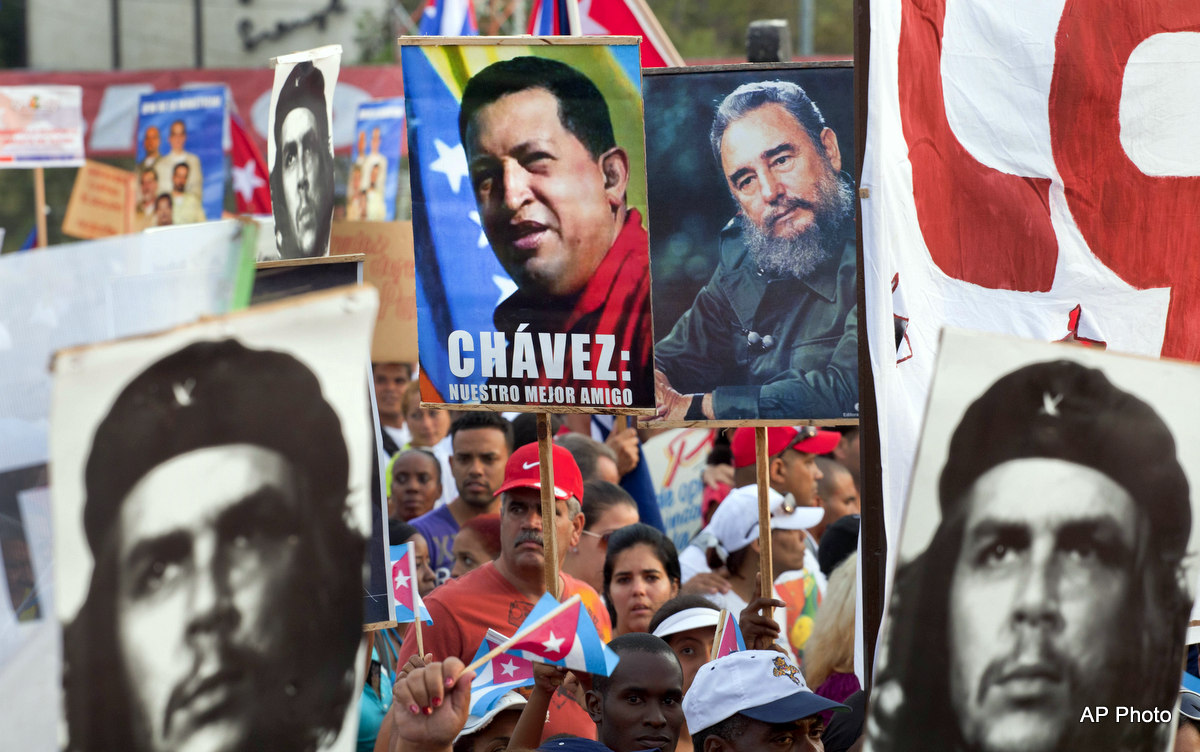
People hold up images showing Fidel Castro, second from right, Venezuela’s late President Hugo Chavez, center, and Cuba’s revolutionary hero Ernesto ‘Che’ Guevara, bottom left and right, during a May Day march in Revolution Square in Havana, Cuba, Wednesday, May 1, 2013. The image of Chavez carries the words in Spanish “Chavez : Our best friend.” (AP Photo/Ramon Espinosa)
When the Marxist-Leninist governments of Eastern Europe collapsed in the early 1990s, economists like Jeffrey Sachs of Columbia University, who can be counted among capitalism’s “true believers,” predicted rapid economic growth. Since the 1990s, conditions in what George W. Bush called the “New Europe” have become far worse than under socialism. The life expectancy has decreased and infant mortality has risen. Human and drug traffickers have set up shop. In endless polls, the people of Eastern Europe repeatedly say life was better before the defeat of Communism.
Russia’s recovery from the disaster of the 1990s has come about with the reorientation of the economy to one centered around public control of its oil and natural gas resources — much like Venezuela. The Putin government has also waged a crackdown on the small number of “oligarchs” who became wealthy after the demise of the Soviet Union. Once strong state to control the economy was re-established, Russia’s gross domestic product increased by 70 percent during the first eight years of Putin’s administration. From 2000 to 2008, poverty was cut in half, and incomes doubled.
Neoliberal capitalism has failed
It is only because these facts are simply off-limits in the American media and its discussions of socialism and capitalism that the distorted narrative about Venezuela’s current hardships are believed.
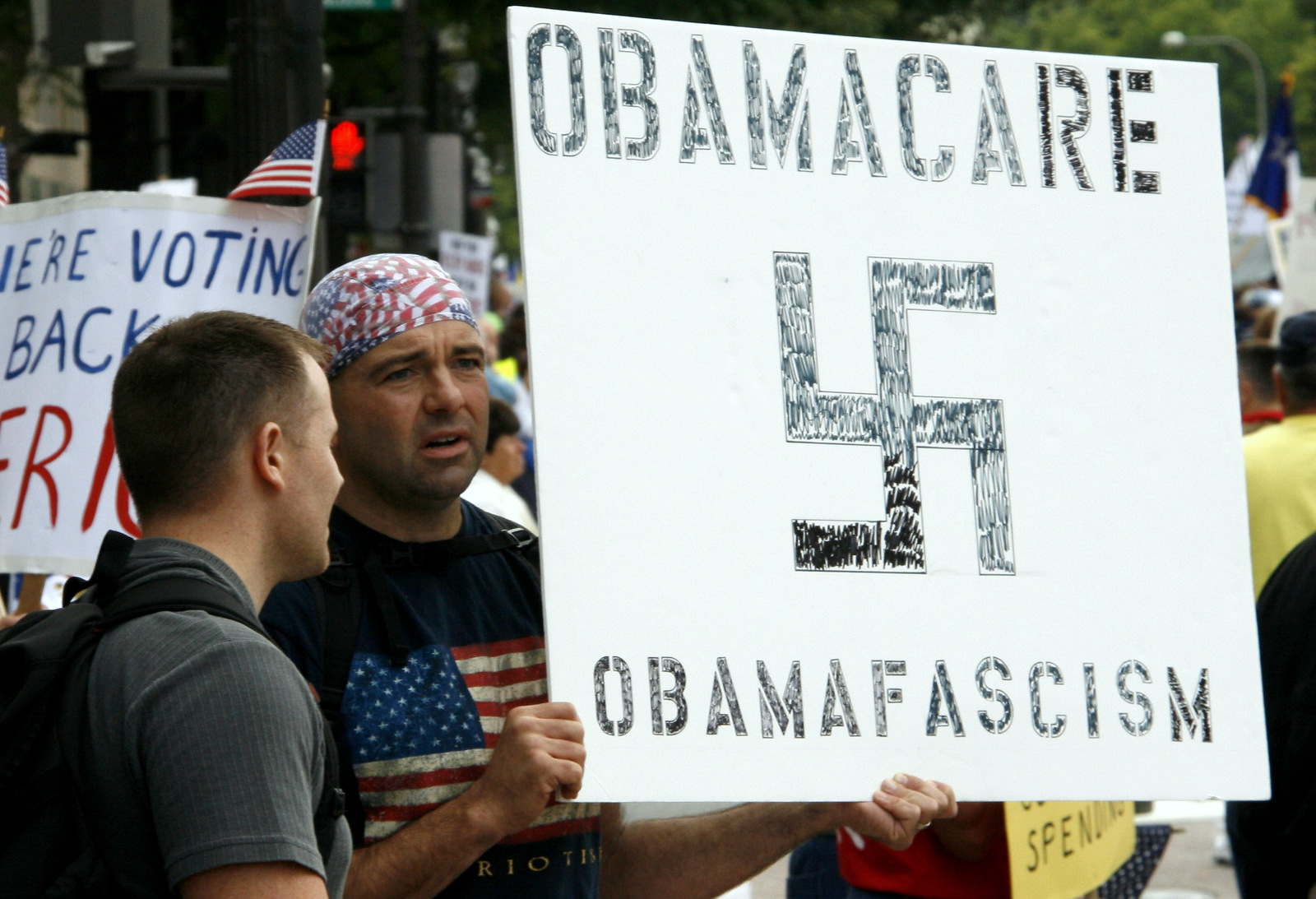
American media has perpetuated a cold-war induced false narrative on the nature of socialism.
When discussing the merits of capitalism and socialism, American media usually restricts the conversation to pointing out that socialist countries in the third world have lower living standards than the United States, a country widely identified with capitalism. Without any context or fair comparison, this alone is supposed to prove the inherent superiority of U.S.-style capitalism.
If the kind of neoliberal “free trade” advocated by U.S. corporations was the solution to global poverty, Mexico, a country long ago penetrated with the North American Free Trade Agreement, would be a shining example of development, not a mess of drug cartels and poverty. The same can be said for oil-rich countries like Nigeria, where exports are massive but the population remains in dire conditions.
The governments of Bangladesh, Honduras, Guatemala, Indonesia, and the Philippines have done everything they can to deregulate the market and accommodate Western ”investment.” Despite the promises of neoliberal theoreticians, their populations have not seen their lives substantially improve.
If one compares the more market-oriented economy of the U.S., not to countries in the global south attempting to develop with a planned economy, but to other Western countries with more social-democratic governments, the inferiority of the “free market” can also be revealed.
Even as the social-democratic welfare states of Europe drift closer to the U.S. economic model with “austerity cuts,” the U.S. still lags behind them in terms of basic societal health. Western European countries with powerful unions, strong socialist and labor parties, and less punitive criminal justice systems tend to have healthier societies.
The American perception that socialism or government intervention automatically create poverty, while a laissez faire approach unleashes limitless prosperity, is simply incorrect. Despite the current hardships, this reality is reflected in the last two decades of Venezuela’s history.
A punishment vote, not a vote for capitalism
The artificially low oil prices have left the Venezuelan state cash-starved, prompting a crisis in the funding of the social programs that were key to strengthening the United Socialist Party.
It is odd that the mainstream press blames “socialism” for the food problems in Venezuela, when the food distributors remain in the hands of private corporations. As Venezuelan political analyst Jesus Silva told me recently: “Most food in Venezuela is imported by private companies, they ask for dollars subsidized by the government oil sales to do that; they rarely produce anything or invest their own money.”
According to Silva, the economic sanctions imposed on Venezuela by the U.S., in addition to the oil crisis, have made it more difficult for the Venezuelan government to pay the private food importing companies in U.S. dollars. In response, the food companies are “running general sabotage.”
“Venezuela’s economy depends on oil sales. Now that oil prices are dropping down, the challenge is to get other sources of economic income,” he explained. “Meanwhile, the opposition is garnering electoral support due to the current economic crisis.”
When the United Socialist Party and its aligned Patriotic Pole lost control of Parliament in December, many predicted the imminent collapse of the Bolivarian government. However, months have passed and this clearly has not taken place.
While a clear majority cast a voto castigo (“punishment vote”) in December, punishing the government for mismanaging the crisis, the Maduro administration has a solid core of socialist activists who remain loyal to the Bolivarian project. Across Venezuela, communes have been established. Leftist activists live together and work in cooperatives. Many of them are armed and organized in “Bolivarian Militias” to defend the revolution.
Even some of the loudest critics of the Venezuelan government admit that it has greatly improved the situation in the country, despite the current hardships.
In December, I spoke to Glen Martinez, a radio host in Caracas who voted for the opposition. He dismissed the notion that free market capitalism would ever return to Venezuela. As he explained, most of the people who voted against the United Socialist Party — himself included — are frustrated with the way the current crisis is being handled, but do not want a return to the neoliberal economic model of the 1999s.
He said the economic reforms established during the Chavez administration would never be reversed. “We are not the same people we were before 1999,” Martinez insisted.
The United Socialist Party is currently engaging in a massive re-orientation, hoping to sharpen its response to economic sabotage and strengthen the socialist direction of the revolution. There is also talk of massive reform in the way the government operates, in order to prevent the extreme examples of corruption and mismanagement that are causing frustration among the population.
The climate is being intensified by a number of recent political assassinations. Tensions continue to exist on Venezuela’s border with the U.S.-aligned government of Colombia. The solid base of socialist activists is not going to let revolution be overturned, and tensions continue to rise. The Maduro and the United Socialist Party’s main task is to hold Venezuela together, and not let the country escalate into a state of civil war.