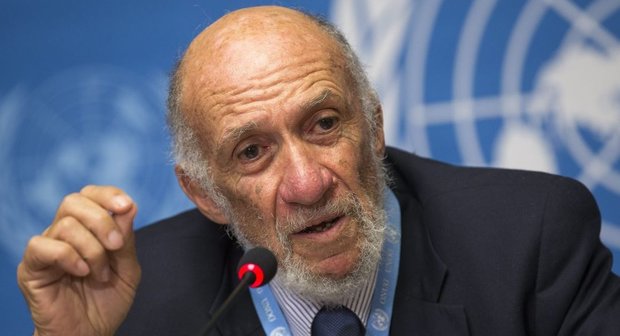
TEHRAN, Sep. 01 (MNA) – Richard Anderson Falk, professor emeritus of international law at Princeton University, says “Both Iran and the United States have rather firm positions.”
Former United Nations High Commissioner for Human Rights says “It is difficult to expect Iran to renew its commitments, much less strengthen them, under JCPOA, unless the US agrees to roll back present sanctions on Iran in a convincing manner.”
He says “In contrast, it is difficult to imagine Trump reducing sanctions unless he can point to some sort of victory that places new restrictions on the international regulatory regime governing.”
He says “In contrast, it is difficult to imagine Trump reducing sanctions unless he can point to some sort of victory that places new restrictions on the international regulatory regime governing.”
Following is the full text of the interview:
US President Donald Trump has driven up the pressure against Iran while at the same time suggested he might be willing to talk to Iranian leaders. How serious he is in this offer? Does he really want to engage Iran diplomatically?
Trump is impulsive, acts inconsistently, and is almost impossible to interpret accurately in advance of his actions. He seems to view foreign policy choices as transactions with a gain/loss transactional connection as measured by his sense of impacts on domestic American politics.
On balance, it would seem sensible for Iranian leaders to test whether Trump is sincere about a willingness to negotiate a way out of present confrontational diplomacy, but without investing their own credibility or political composure by doing so. A show of receptivity, perhaps with a condition asserted that hostile actions be suspended with respect to Gulf tanker navigation, might be an appropriate way to see whether there exists a potential opening for restorative diplomacy aimed at crisis resolution.
As the 2020 election gesture, it is important for Trump to talk on the phone or in-person with Iranian officials. In this regard, some experts believe that he should give special concessions such as oil waivers to Iran so that they come to the negotiation table. Do you think that Trump is ready to make any kind of concessions?
As I have indicated, it is difficult to assess what Trump might be prepared to do if he believes there would be a positive payoff in his 2020 electoral prospects by talking peace directly with Iranian leaders. On the one side, is Trump’s pledge back in 2016 to avoid further American involvement in Middle East wars, and presenting himself as someone who has avoided costly and failed international adventures. On the other side is the appointment of war-mongering and Islamophobic individuals as his principal foreign policy advisors, Bolton and Pomeo. Also, Trump’s belligerent political personality always seeks to project a tough guy, bullying image in dealing with foreign governments with which there are active conflictual relations.
It seems as if Trump administration wants Iran to withdraw from JCPOA. Will be the US-Israeli interests better provided In case of Iran’s withdrawal?
It seems that the Trump objective is to reach a new agreement on Iran’s nuclear agreement that he can claim gives Israel and Saudi Arabia more assurance that Iran will not have the means to cross the nuclear threshold covertly or in a short period of time. These supposed concerns were his main argument relied upon in repudiating and withdrawing the US from the JCPOA, and reimposing and extending harsh sanctions. These concerns hide to some extent the real motivations that were to please Israel and repudiate a major achievement of the Obama presidency.
Of course, it seems unlikely that Iran would give Trump such a victory in the context of either revalidating JCPOA or reaching a new agreement. In that event, the further unraveling of JCPOA confronts Trump with a dilemma, either acknowledging the failure of his approach or escalating the tensions by further escalating tensions with Iran, and risking the outbreak of war.
We are witnessing French President Emmanuel Macron efforts to convince Trump to rejoin JCPOA. How serious should we take these efforts? Shall we think of them as a US coordinated plan?
There is no firm evidence to support the view that US diplomacy with respect to Iran would cooperate with France in overcoming the present impasse. As my prior responses suggest, Trump would have to be willing to back down if there is a renewal of the US commitment to JCPOA, or deepen the already dangerous crisis. I suspect that it is possible that the Macron role might give the parties more time to figure out whether they can find a mutually acceptable face-saving compromise. Both Iran and the United States have rather firm positions. It is difficult to expect Iran to renew its commitments, much less strengthen them, under JCPOA, unless the US agrees to roll back present sanctions on Iran in a convincing manner. In contrast, it is difficult to imagine Trump reducing sanctions unless he can point to some sort of victory that places new restrictions on the international regulatory regime governing Iran’s nuclear program as a result of the earlier agreement.
Interview by Javad Heirannia