Showing posts with label Middle East Strategic Alliance (MESA). Show all posts

Wednesday, February 20, 2019

“Arab NATO” Explodes On Takeoff

by Martin Berger
It hasn’t gone unnoticed by the majority of geopolitical analysts that the Trump administration has been promoting the idea of a Middle Eastern military alliance rather aggressively. The so-called Middle East Strategic Alliance (MESA) that is being more commonly referred to as the “Arab NATO” was first mentioned in public back in 2017, when Donald Trump was paying an official visit to Riyadh. Back then the Saudi royal family announced that it would love a form of a “security pact” to be signed by all of the US-aligned states in the region. Next year, it was Washington that would be advancing this idea during its talks with regional forces, arguing that “joined Arab forces” should intervene in the Syrian conflict and pursue the agenda of countering Iran and radical terrorism (as if those two had something in common).
However, no matter how great this idea looked on paper for Washington, it’s a given that over the years, the absolute majority of the Persian Gulf states, the potential members of MESA, have tainted their reputation with various terrorism sponsoring ventures, while the most powerful of those states – Saudi Arabia is reported to have spent some 100 billion on the promotion of Wahhabism. Moreover, Riyadh and Abu Dhabi are known for their destabilization attempts in Yemen, Libya, Syria and Lebanon. Therefore, the slogan that Washington would use to promote MESA – that it is an Arab coalition aimed at countering terrorism, extremism and aggression in all shapes and forms would really hilarious to any sane person.
Moreover, Riyadh and Abu Dhabi are known for their destabilization attempts in Yemen, Libya, Syria and Lebanon.
So it’s clear that MESA has nothing in common with countering terrorism, so why would Washington need it in the first place? Well, it wants to draw the US-friendly regimes of the Middle East into a military bloc that would resemble NATO. Yet, this block would still have unique Arab characteristics, cementing various players in a Sunni stronghold that would try to prevent Iran’s regional expansion.
Washington expects that Jordan, Egypt and six Gulf states (Bahrain, Qatar, Kuwait, the United Arab Emirates, Oman and Saudi Arabia) will become the founding nations of the “Arab NATO”. However, it’s more of an example of wishful thinking than anything else , since there is a number of visible obstacles standing in the way of such a development, namely, the conflict between Saudi Arabia and the United Arab Emirates on the one hand, and Saudi Arabia and Qatar on the other. Even though Doha hosts the largest US military base in the region, it is still treated like an outcast by its immediate neighbors, which resulted in Qatar making numerous steps towards improving its standing with Iran.
In turn, Oman would traditionally adhere to its neutral status, while Kuwait and Bahrain together would have a hard time committing more than two hundred servicemen to MESA together.
As a result, Saudi Arabia, the United Arab Emirates and the United States are the only beneficiaries of such an alliance and main players within it at the same time.
Last November, the largest international military games across the Middle East, the so-called Shield of the Arabs 1, were held in Egypt. These exercises brought together soldiers and observers from a total of eight Arab countries, with regional media sources describing those as a preparatory stage for the creation of the “Arab NATO”.
However, in spite of the loud protests voiced in Washington, both Kuwait, Oman and Qatar maintain close ties with Tehran, and should those states be drawn into MESA, its members will end up fighting each other.
It curious that more than four years ago, Saudi Arabia would announce the creation of the largest anti-terrorism Islamic alliance in existence that had the exact same countries listed as its members, but then nothing happened, and Riyadh enjoyed far better relations with regional powers back then.
It has recently been reported that Anthony Zinni, a retired Marine Corps general and former head of US central command who has been working as an envoy for the Trump administration to resolve Washington’s disputes with Qatar, has resigned from his position with the US state department. He is the latest four-star general to exit the administration, which is a clear indicator that the concept of MESA is not really advancing. Before calling it quits, Zinni would try to sweet talk Doha in supporting Washington’s agenda, while it still remains besieged by American allies in the region. But then he realized that those attempts were fruitless because of the unwillingness, as he put it, of the regional leaders to agree to a viable mediation effort that Washington offered to conduct or assist in implementing.
Anthony Zinni
But it’s goes much further than that. Among the factors that influenced Zinni’s decision to leave was Trump’s impulsive decision to announced an emergency withdraw of American troops from Syria, since this old veteran would tend to believe that strength is in numbers, so he would advocate the continuous increase in American boots on the ground all across the Middle East. It’s said that Anthony Zinni was particularly close to the former US state secretary Rex Tillerson, and once the latter decided that he had enough, Zinni tried to approach Michael Pompeo, but to no avail. Additionally, negotiations with Egypt, Jordan, Iraq and Turkey on their involvement in MESA would all but fail too.
The American media was quick to point out that the general suffered a defeat on his mission to resolve the Qatari crisis. Zinni himself admitted that his mission to smooth out the contradictions between Qatar and its immediate neighbors was close to impossible for anyone to pull out.
The US State Department is trying to downplay the importance of his resignation, arguing that he was supposed to lay the grounwork for MESA, while Pompeo, Bolton and Kushner are said to be able to take it from there.
On the contrary, independent analysts would all point out that there’s no replacing the general, who was respected all across the Persian Gulf and had trusted contacts in the majority of Arab capitals. Some of them would also point out that two years into Trump’s term in office resulted in a significant shift in the leading figures playing lead roles in Washington’s designs, with more than 20 high-ranking officials abandoning their posts. According to the Brookings Institution, some 65% of senior advisors in Washington would call it quits over Trump’s presidency.
It’s clear that Washington’s agenda in the Middle East has suffered a huge blow when Anthony Zinni chose to resign, as this will literally kill the prospects of a MESA-related summit being held in the foreseeable future, putting a stake in the hear of Washington’s plans to draw together an anti-Iranian coalition.

Thursday, November 01, 2018

MESA: the Arabian NATO?

Arabian military alliance to bring more petro-capital to imperial purveyors of war

By Tahir Mustafa


Uncle Sam and nephew Moshe are always scheming new ways to squeeze more money out of Arabian rulers. Playing on their fears borne of insecurity, hundreds of billions of dollars have been squeezed out of them over the last two decades by selling them weapons. The ill-trained and ill-motivated Arabian armies cannot use most of these weapons. But more sales are in the pipeline.
There is little evidence that these regimes feel any more secure by acquiring vast quantities of weapons than they did without them. If massive purchases of weapons cannot buy them security, what else can they do?
Uncle Sam has come up with another idea: the Middle East Strategic Alliance (MESA). There is nothing strategic about the new alliance that would comprise the six members of the Gulf Cooperation Council (GCC) plus Egypt and Jordan. The US would act as godfather and supervise the quarrelling potentates to prevent them from coming to blows with each other.
The idea of creating MESA is not entirely new. It is a modified version of the “Arab NATO” that had been talked about even before Donald Trump’s visit to Saudi Arabia in May 2017. As is customary with many of his hare-brained ideas that he periodically throws up, Saudi Crown Prince Muhammad bin Salman had proposed the establishment of an Islamic army to “fight terrorism.” He even recruited the former Pakistani army chief General Raheel Sharif to head this army. Various reports say he is paid a six-digit salary in US dollars; not a bad deal for doing virtually nothing!
The problem with the “Islamic army” is that there is no army despite Bin Salman proposing an alliance of 34 countries. The alliance pointedly excluded Islamic Iran, Iraq, and Syria — three countries most severely affected by terrorism. Since the election of Mahathir Muhammad as prime minister, Malaysia has also pulled out of the so-called alliance. Indonesia had already said it would not send troops for the proposed “Islamic army.”
There is a simple solution to fighting terrorism: Saudi Arabia, Zionist Israel, and imperialist America should stop supporting and arming terrorists masquerading as rebels, insurgents, or freedom fighters. In mid-September, there were reports that Abu Bakr al Baghdadi, the self-styled khalifah of the terrorist outfit Da‘ish or ISIS (or whatever other four-letter-word it is known by) had relocated to Afghanistan. Fleeing Syria would not have been possible without direct US help. Both the Russians and Afghans (former president Hamid Karzai, for instance) have publicly stated that Da‘ish terrorists have been airlifted to Afghanistan in “unmarked” helicopters. This was a broad hint that the Americans did it.
But back to the idea of MESA or “Arab NATO” or whatever other fancy label is attached to it. Taking advantage of the presence of so many Arabian rulers or foreign ministers in New York for the 73rd session of the United Nations General Assembly in September, US Secretary of State Mike Pompeo gathered them to deliver a stern lecture about “working together.” This was the first time that all six members of the Gulf Cooperation Council (GCC) sat under one roof after the Saudi-led blockade of Qatar was launched in June 2017. The blockade had US blessing. Others at the September 28 meeting in New York were representatives of Egypt and Jordan — both basket cases looking for financial handouts.
But here is the rub. On his Saudi visit last year, Trump had announced arms deals worth some $350 billion. Soon thereafter, the US also sold $12 billion worth of helicopters to Qatar. On September 29, Trump even announced that he had told the Saudi king that since they have “trillions of dollars” — yes trillions with a “T” — they must give this money to the US. The Najdi Bedouins, it seems, would soon be heading back to the desert!
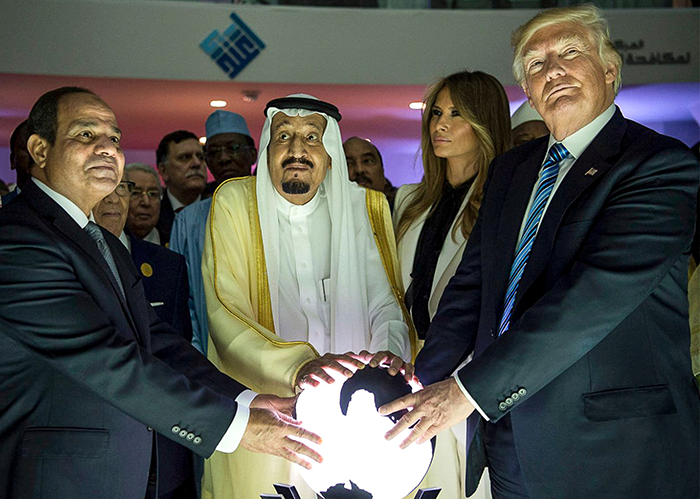
Egyptian President ‘Abd al-Fattah al-Sisi, Saudi King Salman, and US President Donald Trump visit the Global Center for Combating Extremist Ideology, in Riyadh, Saudi Arabia, 5-20-2017, the occasion where the US chief executive announced his plans for an “Arab NATO.” Any serious security alliance involving the United States in the Muslim East will not happen without Israeli oversight, full participation, and approval. This means that for all the other “Sunni” regimes to tag along as cannon fodder, Bani Saud will have to deal openly with Israel — the only credible, if unofficial, military presence in MESA — if the alliance is to have any real credibility, to wit all the not-so-secret overtures from Arabia to Israel that have been taking place under pressure from the Trump administration and the rising principled influence of Iran.
The Saudi-Qatari spat, entirely artificial, shows how the US operates: first create a crisis and then milk both sides of the dispute. The only exception is Zionist Israel whose implantation in the heart of the Muslim East is the source of all instability. While the US rakes in tens of billions of dollars annually from Arabian potentates, Zionist Israel gets billions in free arms and other handouts.
The imperialist-Zionist duo is talking up the alleged threat from Islamic Iran. For the record, Iran has not attacked any country in 250 years. It desires peace and good neighborliness with all regional countries. The only exception is Zionist Israel, that usurper entity illegally squatting on Palestinian land.
The Arabian potentates backed by the US, Israel, and Europe even tried to destroy the Islamic Republic through the eight-year war that was launched in September 1980 but they failed. Islamic Iran valiantly defended its land, integrity and honor.
The imperialists and Zionists have sold the diabolical plot to the Arabian potentates that Islamic Iran is a greater threat to them than Zionist Israel. In what would make sense only in an upside-down world, this is true. Israel would not survive without the presence of the illegitimate Arabian regimes. David Ben Gurion, Israel’s first prime minister, had admitted in a moment of candor that the Arabian regimes are Israel’s first line of defence!
In pursuit of the MESA idea, the US is planning a high-level meeting with Arabian dictators in January. The aim, according to a senior US official, is to speed up forging an alliance whose principal aim would be to confront Islamic Iran.
Tim Lenderking, US Deputy Assistant Secretary of State for Arabian (sic) Gulf Affairs, toured the region in August and September to drum up support for MESA — a concept not dissimilar to the Arabian NATO. “The more we have coordinated efforts, the more effective in enhancing stability,” Lenderking told Emirati website The National on September 26, calling Iran the “number one threat” on the MESA list. Cyber attacks, conflict management, and Syria and Yemen were also thrown in for good measure. In both Syria and Yemen, the aggressors have failed and their policies are falling apart. It is, however, internal conflicts among these potentates that are most problematic. They behave like children, friends one moment and mortal enemies the next and at each other’s throats. The acquisitiveness of the material rather than the aspiration for the moral is endemic to this kind of fratricidal infighting.
With its militaristic policies in the region falling apart, Washington seems to be in a hurry to establish MESA as another mischief-making tool. “We [US] would like to agree on the concept of MESA by the January [2019] summit,” Lenderking said, adding that the US was “flexible” on the date given the talks were still in the early stages. “Flexibility” is also necessary because of the fickleness of Arabian rulers. Lenderking acknowledged the ongoing rift between Saudi Arabia, Bahrain, the UAE and Egypt on the one hand and Qatar on the other. Pompeo’s September 28 meeting in New York failed to resolve these differences.
“In the long term, with the MESA that we envision, it would be hard to have two or three countries in this alliance in this kind of confrontation,” Lenderking admitted. “We can continue to develop the concept and work on some of the pillars but ultimately you have to see the rift de-escalated.”
The bottom line of all these manouvres is to protect Zionist Israel. Along the way, the US wants to make tons of money by selling useless weapons to the incompetent Arabian armies that train their weapons only on hapless people, whether in Yemen or in their own oppressed societies.

Tuesday, July 31, 2018

American or Arab NATO?

By Farzad Farhadi


TEHRAN - The Trump administration is quietly pushing ahead with a bid to create a new security and political alliance with six Persian Gulf Arab states, Egypt and Jordan, in part to counter Iran’s expansion in the region, according to U.S. and Arab officials.


The White House wants to see deeper cooperation between the countries on missile defense, military training, counter-terrorism and other issues such as strengthening regional economic and diplomatic ties.
The plan to forge what officials in the White House and Middle East have called an “Arab NATO”. The administration’s hope is that the effort, tentatively known as the Middle East Strategic Alliance (MESA), might be discussed at a summit provisionally scheduled for Washington on Oct. 12-13. Saudi officials raised the idea of a security pact ahead of a Trump visit last year to Saudi Arabia where he announced a massive arms deal, but the alliance proposal did not get off the ground, a U.S. source said.
“MESA will serve as a bulwark against Iranian aggression, terrorism, extremism, and will bring stability to the Middle East,” a spokesperson for the White House’s National Security Council said.
Similar initiatives by previous U.S. administrations to develop a more formal alliance with Persian Gulf and Arab allies have failed in the past. It is unclear how the alliance could immediately counter Tehran but the Trump administration and its allies have joint interests in the conflicts in Yemen and Syria as well as defending Persian Gulf shipping lanes through which much of the world’s oil supplies are shipped.
Arab NATO and its impact
Saudi Arabia and the UAE are the key player in the formation of the so-called “Arab NATO”. Potentially a big obstacle to the planned alliance is a 13-month-old rift pitting Saudi Arabia and the UAE against Qatar, home to the largest U.S. airbase in the region. The U.S. administration is concerned the quarrel could be an obstacle to the initiative, he and an Arab official both said Riyadh and Abu Dhabi had assured Washington the rift would not pose a problem to the alliance.
 The sultanate of Oman is also an obstacle in this direction. This country has good relations with Tehran, a relationship that does not match the coalition with the United States and against Iran. Although the Sultanate has a good relationship with the United States, it is unclear what will the courageous Oman still have to deal with this coalition?
The role of Tel Aviv in Arab NATO
In fact, the Trump administration began to complete what had been launched a year ago in Riyadh and announced the establishment of the Middle East Strategic Alliance.
Undoubtedly, the Zionist regime alongside the United States and what moderate Arabs will play an effective role in the coalition. In the other words, this alliance called the Arab NATO to favor the Zionist regime.
 
Why did not the treaty establish a joint Arab defense against the Zionist regime?
All these years, why did not you hear about a joint Arab defense treaty against Tel Aviv?
The Israeli’s attack on al-Aqsa mosque is increasing in large numbers and Jewish settlements have expanded. Why does not this provoke any reaction? The new generation of Arabs is faced with a lot of dangerous dilemma illustrated in fake phrases such as counteracting terrorism and preventing the spread of Iranian influence. But it cannot conceal the fact that occupation, settlement, blockade and racism constitute a major threat to Palestine, the interests of Jordan and Arab security.
America, the West and Zionists exploit sectarian and tribal issues to spark conflict in the region. The U.S. uses the Arab NATO in the first place to serve the Zionist regime and then pursue its interests and with its Western allies.
The U.S. seeks to keep the Arab states under the auspices of Washington, and in turn, they always need the U.S. and its military support.
By creating an unrealistic enemy of Iran, the United States is seeking to boost its military and arms industries.
What caused the Arab NATO to be addressed is Yemen and Syria's crises. When in the Yemeni war, the Saudi coalition could not get any achievement, and when in Syria, the United States saw itself against strong rivals, the whispers of the creation of the Arab NATO got stronger.
The U.S.'s goal of the Arab NATO formation is in the first step in stabilizing the U.S. presence in the region and the protection of U.S. economic and investment interests and the creation of job opportunities within the United States through the sale of weapons to the region. The United States seeks to maintain balance and domination of the region's economy.
Abdel Bari Atwan, the famous analyst of the Arab world, wrote: “At the same time of Trump's war of words with Rouhani, Trump is looking to form a new security-military coalition with the Persian Gulf countries alongside Egypt and Jordan.”
He added: “The Saudi propaganda against Yemeni Ansarallah about the attack on oil tankers is likely to help establish a new pact with U.S. oversight. But there are a lot of questions here, including will Egypt and Jordan join the new coalition and participate in the upcoming Washington Summit in October? What is the Israeli relationship with this new treaty, and whether it is a member, and how is the nature of this membership, secret or public? What is the problem with the Doha crisis with the four Arab countries that are blocking this coalition?
Will Qatar cut ties with Iran upon the demands of the U.S.-Saudi-Emirati? Is it worth $ 1.5 billion to develop the U.S. military base in Qatar, Al Udeid, targeting it as one of the main centers of the new Arab-American treaty and outlining its main role in any future anti-Iran war?”
Atwan highlighted: “It may be too early to give an answer to all these questions given the unclear details of the American plan. But it is unlikely to know that America's anti-Iran threats are intended to terrorize Arab nations, and in particular the Persian Gulf, to justify signing the new treaty and to fully honor membership fees.”
He continued: “This new tribal treaty is a new tool for taking over hundreds of billions of dollars from the Persian Gulf States on the pretext of strengthening the defense capability but in reality to prepare for the war against Iran. These countries can not oppose Trump’s request and may be left out of the future summit of Washington, or face heavy debts owing to the large military spending that the United States seeks to pay.”
In any case, it is undeniable that Arab NATO is more than the Arab desire.
The United States confronts Arabs by Arabs, and through the imaginary subjects. The U.S. will challenge states that do not move on the path of the Zionist regime and the United States. Washington aims to sell weapons and maintain tension between Saudi Arabia and its allies with Iran. And by scaring Saudi Arabia and other Persian Gulf states from dangerous illusion about Iran, U.S. has already signed wealthy weapons deals.
The goal of Arab NATO formation is to serve Israel, marginalize Palestine, sell more weapons, make more money, and show more hostility towards the Islamic Republic of Iran.
Experts and observers believe that good prospect for Arab NATO could not be imagined. The goal of the Arab Nation is to destabilize the Middle East and to spur the regional issues by Americans.