Showing posts with label Judaism. Show all posts

Sunday, December 01, 2019

Distinction between Judaism and Zionism

Editor

Those struggling against the racist ideology of Zionism must be clear: Judaism and Zionism are not the same. Judaism is a revealed religion. Zionism is a political ideology. Its adherents include Jews, Christians, Hindus, atheists and yes, even Muslims! In the US, Christian Zionists are a well-heeled group that wields immense influence over decision-making in Washington. In the Muslim East, most Arabian rulers are Zionists. They have openly embraced the oppressors of Palestinian people. Pro-Israeli propagandists deliberately attempt to link Zionism with Judaism. It is through such linkage that they try to silence criticism of Israeli crimes by branding it as “anti-Semitism.”
Like Islamophobia, anti-Semitism is real but criticism of Israeli crimes in not anti-Semitism. At the same time, it is essential for Muslims to be clear that they do not accuse all Jewish people of being supporters of Israel, much as the Zionists would like to link the two. There are many Jewish academics, scientists, and social and political activists that openly reject Zionism and are vocal critics of Israeli policies. Some have even suffered in their academic careers. Professor Norman Finkelstein is a prime example. The distinguished law professor, Richard Falk is another prominent critic of Israeli crimes against the Palestinian people.
Muslims struggling against Israeli injustices ought to make alliances with anti-Zionist Jewish groups and individuals as well as other human rights activists to seek justice for the long-suffering Palestinian people.

Monday, November 19, 2018

The Matrix of Terrorism: from the Talmud to Wahhabism

As attacks hit Europe on a increasingly regular basis – very much resembling the daily situation in Syria and Irak; which, by the way, provokes neither indignation nor agitation among the international community and its media – it is worth considering the ideological matrix of terrorism, a weapon used by Atlantist, Zionist and Wahhabi powers alike.

Cromwellian Revolution, Revolution of 1789, Bolshevik Revolution
A parallel can be drawn between the methods of political terror deployed in England by Cromwell during the 17th century, those deployed by the Wahhabi Saud tribe in the Arabian Peninsula during the 18th century and those of the French Revolution (1789), which foreshadowed the anarcho-socialist revolutions of the 19th and 20th centuries. These revolutions, many of which were accompanied by territorial expansion, all have one point in common: ideological domination by means of mass extermination. The aim was to build modern institutions on the remains of traditional ones.
The modern era and its murderous revolutions began with Protestantism which, in essence, is a revolutionary religion based on the veterotestamentary model.
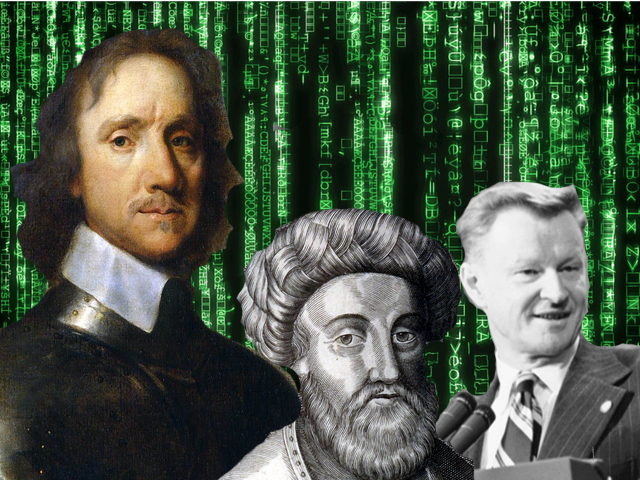
In 1641, the “English Revolution” began. It was led by the Puritan, sectarian and fanatical Oliver Cromwell (1599-1658), who belonged to those who went by the name of “Old Testament Christians”. He banned the celebration of Christmas, burnt churches and murdered priests. This revolution ended in 1649 with the execution of King Charles I (just as, a century later, the French Revolution culminated with the execution of King Louis XVI). The modus operandi of the French revolutionaries was clearly identical to that of their English predecessors.
The French revolutionaries massacred some 260 000 Vendean Catholics, who fought against the anticlerical Revolution. Cromwell, who had set out to conquer Scotland and Ireland, had foreshadowed the French revolutionaries and their methods. La Terreur clearly came to serve as a model for the majority of terrorist extermination wars of the 20th century: the Armenian genocide, led by the Sabbatean Young Turks (the Donmëh), and the messianic Judeo-Bolshevik revolution. The Vendean genocide came to be used as reference for Lenin’s crushing of the Tambov peasant revolt by means of chemical weapons (June to December 1921). The death toll of this new Vendean massacre is estimated to be 240 000.

The Talmud and Frankism: the source of revolutionary anarchism ?
The origin of this modern nihilism, driving force of the 19th and 20th century socialist revolutions, is found in the Sabbatean-Frankist interpretation of  Kabblah and, going back further in history, is also found in the Talmud itself.
Following the antinomian Kabbalists Sabbatai Zevi (1626-1676) and Jacob Frank (1726-1791), both Kabbalah and messianism in its Sabbatean-Frankist form paved the way for atheist messianism (atheist in appearance, at any rate).
As the Jewish Marxist philosopher Michael Lowry explains very clearly, the structure of socialism is that of Jewish messianism.
Of all the movements within socialism, it was the anarchic movement (the historical manifestation of which was the Bolshevik Revolution) that remained the most faithful to the cataclysmic messianism of the Frankist interpretation of Kabbalah. This Sabbatean-Frankist aspect of anarchism can be very clearly seen in the work of Mikhail Bakunin (1814-1876). Indeed, one would think he was paraphrasing Jacob Frank when he wrote:
“The destructive passion is also a creative passion”
“I believe in neither constitutions nor laws…it is something else we need: passion and life, a new world without laws and therefore free.” (1)
A century before Bakunin, Jacob Frank declared :
I have come to Poland solely to eradicate all laws and all religions, and my desire is to bring life to the world. (2)
The roots of this Frankist messianism are found in the Talmud and, specifically, in this Midrash (Talmudic commentary of the Bible) Tehilim (of Psalm 45.3):
Israel asks God: when will you send us redemption? He replies: when you have descended to the lowest level, then I will bring redemption.
This is the Talmudic prophecy which Jacob Frank attempted to fulfill by spreading depravity and general chaos. He thus declared:
I have not come to elevate, I have come to destroy and lower all things until everything has sunk, that it can descend no more…There is no ascension without prior descent… (3)
Catastrophe and widespread depravity is, in traditional Jewish eschatology, the prerequisite for the coming of the messianic age and redemption. As the leading expert of Kabblah and Jewish messianism Gershom Scholem explains, there are certain interpretations which give a new meaning to Psalm 146:7. As opposed to the traditional version, according to which during the messianic age “The Lord sets prisoners free” (matir assirum), we should read “The Lord removes prohibitions” (matir issurim) (4)
Following Jacob Frank, Bakunin echoes this idea perfectly.
It is not all surprising, therefore, to find Jewish messiansim in its Frankist form at the heart of socialist thought, once we know that it was precisely in Central Europe (where Frankism was born and took root) that socialist movements were formed.
As Michaël Lowy explains, for the majority of socialist thinkers,
There were only two ways out (within the framework of neo-romanticism): either a return to one’s own historical roots, one’s own culture, nationality or ancestral religion; or adherence to a revolutionary utopia of a universal nature. Unsurprisingly a number of Jewish thinkers from the German culture, who were close to anti-capitalist romanticism, simultaneously chose both these paths through a rediscovery of the Jewish religion (in particular the restorative Utopian interpretation of messianism) and an affinity for or identification with profoundly nostalgic (and notably libertarian) revolutionary utopias – two paths which were structurally homologous.
This dual approach characterizes several Central European Jewish thinkers who formed an extremely diverse group but who, nonetheless, were unified by this central problem. Among them we find the greatest minds of the 20th century…Franz Rosenzweig, Martin Buber, Gershom Scholem, Gustav Landauer, Walter Benjamin, Franz Kafka, Ernst Toller, Ernst Bloch, Georg Lukacs (5)
Ernst Toller, Ernst Bloch and Georg Lukacs were, as Lowy highlights, “assimilated anarcho-Bolshevik Jews” as opposed to the others who had “abandoned their Jewish identity while keeping a vague connection with Judaism.”  This is not inherently contradictory, bearing in mind the close relationship between European Jewish assimilationism and Frankism (6).
Lowy explains that “the references of their religious atheism (a term invented by Lukacs) are both Jewish and Christian” and their political evolution led them to a point where they faced the problem of reconciling the two (7).
Several contemporary accounts of Georg Lukacs reveal his fervent and apocalyptic messianism. Marianne Weber, his wife, described Lukacs as being an intellectual who was “stirred by eschatological hopes that a new messiah would come” and for whom “a socialist regime based on fraternity is the prerequisite for redemption.”
Lukacs himself terms this materialist form of messianism “atheist religiosity.” During a conference held in 1918, he paid homage to the Anabaptists (an evangelical Christian movement) and advocates their categorical imperative:  “Bring forth the Kingdom of God to this earth.” (8)
During the same period, that of the 1918-19 German Revolution, the German Jewish socialist Gustav Landauer was, like Lukacs, seized by messianic fervor and compared the “spirit of the Revolution” to the action of the “ancient prophets.” In the preface to the second edition of the Call to Socialism, he wrote:
“Chaos is here. Minds are awakening…May the revolution bring rebirth…May the revolution produce religion, a religion of action, life, love, that makes men happy, redeems them and overcomes impossible situations.” (9)
Revolutionary terror, deployed by Cromwell in England and by the revolutionaries in France, was the model for the Bolsheviks. It was also the model for the Jewish homeland (1920) with the creation of the Yishuv terrorist organisations the Haganah and the Irgun (the foundation of the Israeli Defence Forces) whose role was to support colonial expansion in Palestine.
We shouldn’t forget the famous Nakam terrorist group. In 1945, Israel’s first president, Chaim Weizmann, former chemist and leader of the World Zionist Organisation, supplied the Nakam Group* with chemical formulas to poison the water supply in Munich, Nuremberg and Hamburg. Abba Kovner was arrested on his return from Israel where he had obtained the poison, and his commando of mass murderers were stopped from executing their plan. In 1946, however, they succeeded in poisoning the bread for the prisoners held at Langwasser. Abba Kovener is today celebrated in Israel as a hero…
Terrorism on a national scale, however, is but one version of revolutionary terror. The International Brigades (Spain 1936-1938) ushered in the age of international terrorism. Wahhabi “jihadism” continues in this vein.

From Revolutionary Terror to Wahhabi Terrorism
The French Revolution of 1789 was, from the outset, a project to establish a “Universal Republic” (10) by violent means. Gustave Le Bon, anthropologist and sociologist, had understood this perfectly:
The violence of the Revolution, its massacres, its need for propaganda, its declarations of war against all kings can be explained only if we consider that it was the establishment of a new religious belief in the soul of the masses. (11)
Wahhabi terrorism, as is known, has been used by the US ever since the late 1970s (12). Zbigniew Brzezinski (1928-2017), who was national security adviser to president Carter at the time, supervised the coordination between the CIA and the Pakistani and Saudi intelligence services with the objective of financing future terrorists, including Bin Laden. The idea was to lure the Soviet Union into the Afghan graveyard. This strategy was again used in the late 1990s in Chechnya, in order to trigger the disintegration of the Russian Federation. It was then later deployed in Iraq, following the 2003 war. Since 2011, it has been applied to Libya, Syria, Yemen and elsewhere…
Indeed, in an interview with the Nouvel Observateur (15 January 1998), Brzezinski explained why and how he had financed Bin Laden in Afghanistan. In response to the question “Do you not regret having promoted Islamic fundamentalism, having given weapons and advice to future terrorists?” he answered:
What is most important for world history? The Taliban or the fall of the Soviet Empire? Some Islamic hotheads or the liberation of Central Europe and the end of the cold war?
And when the journalist remarked:
“Some hotheads?” But it has been said time and time again: today Islamic fundamentalism represents a world-wide threat…
Brzezinski replied:
Rubbish! It’s said that the West has a global policy regarding Islam. That’s hogwash: there is no global Islam. Let’s look at Islam in a rational and not a demagogic or emotional way. It is the first world religion with 1.5 billion adherents. But what is there in common between fundamentalist Saudi Arabia, moderate Morocco, militaristic Pakistan, pro-Western Egypt and secularized Central Asia? Nothing more than that which connects the Christian countries… (13)
What Brzezinski is explaining here is that Wahhabi terrorism is an artificial creation and that the extent to which it spreads across the globe depends on Western policy. And history testifies to this. Indeed, Saudi Arabia would not have been established without British support during and after the First World War. In 1945, Ibn Saud and Franklin Roosevelt made a pact aboard the USS Quincy: in exchange for Saudi oil, the kingdom of Saudi Arabia would from now on be protected by the Americans, who took this opportunity to drive out the British.
With the American dollar linked to Saudi oil, the Wahabbi doctrine, funded by petrodollars, expanded beyond Saudi Arabia. Wahhabism has since sought to conquer Islam via various institutions, such as the World Islamic Congress (1949-1952), the Islamic Congress of Jerusalem (1953), Organisation of Islamic Cooperation (1969), the Supreme Council for Islamic Affairs (1969), the Muslim World League, (1962) andthe World Assembly of Muslim Youth (1972).
The Saudi Wahhabists also finance university chairs at Harvard, California, Santa Barbara, London and Moscow. In addition, Saudi Arabia holds 30 per cent of the total Arab satellite budget, controls fifty TV channels and almost as many newspapers and magazines (14).
All this is done with the support of the Anglo-Saxon powers which lead the “free” world. This support was recently renewed by president Trump who, with his Riyadh speech and the very large arms contract which he signed with Saudi Arabia, has tacitly approved the continuation of Wahhabi military aggression in the Middle East.
* Known in English as “The Avengers”, from the Hebrew Nakam, meaning revenge, this group belonged to the Bricha movement, and was led by the Zionist Abba Kovner.
*
Youssef Hindi is a writer and historian of messianic eschatology. Born in Morocco, he emigrated to France at a very young age, and followed a path that led him to develop a reflection on the necessary reconciliation of the North and the South shores of the Mediterranean. Two worlds whose destinies have always been intimately intertwined. Here’s his Twitter account: https://twitter.com/youssef_hindi?lang=en
Translation reposted from https://geostrategieblog.wordpress.com/2017/08/16/the-matrix-of-terrorism/(typos were edited out by Transnotitia)
Notes:
[1] Quoted in Michaël Lowy, Messianisme juif et utopie libertaires en Europe centrale, Archives de sciences sociales des religions. N. 51/1, Persée, 1981, pp. 6-7.
[2] In Gershom Scholem, Aux origines religieuses du judaïsme laïque, de la mystique aux Lumières, Calmann-Levy, 2000, p. 212.
[3] Charles Novak, Jacob Frank, le faux messie, 2012, l’Harmattan, p. 56.
[4] Cité par Michaël Lowy, op. cit., p. 8.
[5] Michaël Lowy, op. cit., p. 11.
[6] See : Youssef Hindi, La mystique de la laïcité, chapter IV, 2017, Sigest.
[7] Michaël Lowy, op. cit., p. 12.
[8] Michaël Lowy, op. cit., p. 36.
[9] Michaël Lowy, op. cit., p. 22.
[10] See Anacharsis Cloots, La République universelle, 1792.
[11] Gustave Le Bon, Psychologie des foules, 1895, Presses Universitaires de France, 1981.
[12] Regarding Wahhabism, see : Jean-Michel Vernochet, Les Égarés, le wahhabisme est-il un contre islam ?, 2013, Sigest.
[14] See the list in Al-Farsy, Custodian of the Two Holy Mosques : King Fahd ben Adbul Aziz, Chanel Islands : Knight Communication, 2001, pp. 220-228.

Wednesday, October 17, 2018

Let’s talk Palestine! (Part 1)

By Afreen Rizvi

In the following month, Zionists and their sympathisers are celebrating 100 years since the Balfour Declaration was signed – a declaration that legitimised the oppression of the Palestinians. A declaration that essentially allowed the Zionist state of Israel to emerge on a land already belonging to Palestinians. A mere 67 words within a letter that eliminated the culture, history, and freedom belonging to the indigenous people of Palestine. There is not a single day that goes by where a Palestinian is left to live freely – children are followed by Israeli soldiers on their journeys to school, targeted, snatched from their parents and imprisoned. This is the stark reality – a reality purposely distorted by Zionist funded media outlets and international bodies.
What was the Balfour Declaration? 
In simple terms, the Balfour Declaration was a statement issued by the British government during World War 1 that gave support to the Jewish community to essentially steal the land belonging to the Palestinians and call it “home.” The declaration was within a letter dated 2nd November 1917 from the foreign secretary of UK, Arthur Balfour to Lord Walter Rothschild – Rothschild was known to be a favoured leader of the Zionist Federation of Great Britain and Ireland.
The declaration read:
“His Majesty’s government view with favour the establishment in Palestine of a national home for the Jewish people, and will use their best endeavours to facilitate the achievement of this object, it being clearly understood that nothing shall be done which may prejudice the civil and religious rights of existing non-Jewish communities in Palestine, or the rights and political status enjoyed by Jews in any other country.
 
Retrospectively, the ghastly declaration led to heinous consequences that exist till present day. Balfour gave a green light to Israeli terrorism. Balfour authorised the murder of innocent civilians. The British government played a key role in perpetuating the atrocities against innocent Palestinians.
Earlier this year over 14,000 people signed a petition calling on the British goverment to apologise to the Palestinians and this was the response…
“The Balfour Declaration is an historic statement for which Her Majesty’s Government does not intend to apologize. We are proud of our role in creating the State of Israel.” [1]
So, 100 years have passed and the British Government is proud of having indigenous people ethnically cleansed from their own land. When you hear of Palestinian children being brutally attacked on their way to school, or Palestinian women being raped in the presence of their family members, or of Palestinian fathers being incarcerated or when you see images of dead Palestinian babies attacked by Israeli rockets – this is what Great Britain is “proud” of.
Theresa May, the British PM, has stated she wants Britain to celebrate the centenary of the Balfour declaration, but any human with a conscience should not only condemn May, but vow to stand in solidarity with the Palestinians until their rights and freedom are returned. This month especially, activists – regardless of faith and ideology, have a responsibility to be the voices for the voiceless, and under no circumstances should we feel the need to crack under pressure and ignore the struggle of the Palestinians to appease others. We can never forget the struggle. 
100 years on…
100 years have passed and the vast majority of the global population have stood by silently allowing the Zionists to incarcerate, terrorise, target and murder the owners of the promised land. Although the declaration was signed by Britain, why did the entire world fail to condemn this? Bodies such as the UN have given Israel a platform, and media outlets and politicians ave strengthened their ties with Israeli politicians and personalities despite the violence and terror inflicted on Palestinians. Further to this, whilst Israel labels itself as the “only democracy in the Middle East” – let’s not be afraid to state the facts – that over 4.5 million Palestinians in the West Bank have no say in deciding which political party will come into power and control every single aspect of their lives – thus Israel is far from democratic.
Upon reflection, the global community did not question Arthur Balfour, and till today – 100 years on – how many countries are effectively assisting the people of Palestine? In fact, how many Muslim nations, other than the Islamic Republic of Iran, are working to free the people of Palestine? or providing some form of aid to the Palestinians?
The Supreme Leader of Iran, Ayatollah Sayed Ali Khamenei, has eloquently stated “Our standpoint is that Palestine belongs to the Palestinians and that continuing its occupation is a great and intolerable injustice and a major threat to global peace and security.” [2]
100 years may have passed and Israel may consider itself to be a powerful force, but the power of resistance is unimaginable and no force is greater than God.
(Part two of this series shall look at the roots of Zionism)
Author: Afreen Rizvi

Friday, July 13, 2018

Migration in the name of Faith

Safeguarding one’s faith, being good ambassadors for Islam and working for the betterment of wider society are critical features in the Islamic perspective on migration says Ali Jawad Migration has a special place in the historiography of the world’s great religions. The early histories of Judaism, Christianity and Islam are replete with tales of persecution against the early believers. Oppressive powers spared no means to exact their deadly vengeance on those who subscribed to the ‘new faith’ in order to pre-emptively deter others, and to ultimately quash the nascent religion. In the face of such torment, devout followers were left with little option but to hide their faith, face torture and worse, or to emigrate to distant lands in the hope that they could practise their faith more freely. In the religious context therefore, the concept of migration emerges as a drastic step compelled by circumstance. It is the exercise of a desperate option whereby one chooses to forsake his/her homeland, people and belongings for the sake of something deemed superior, namely one’s faith. It represents the reaffirmation of one’s inherent freedom, dignity and identity within a social context that openly stands against these values. According to the late scholar Murtadha Mutahhari, the concept of hijrah (migration) signifies ‘leaving one’s home, people and homeland for a new place of abode, with a view to saving one’s faith’. In the view of other scholars, the applicability of this concept is timeless and can have a wider context than simply saving one’s faith. Perhaps it can be applied to any migrant who leaves his residence for God’s sake. In numerous verses of the Holy Qur’an, there is mention of hijrah and promise of great reward for those who migrate for the sake of God. Such is the significance and status of ‘migrants’ in Islam that even though migration is contingent upon circumstance, a Muslim is duty-bound to maintain a true and sincere intention to embark on such a duty should circumstances change. Migration thus takes on an ethical dimension denoting a constant state of preparedness motivated by strong belief and faith. Indeed, one of the definitions of migration put forward by the scholars of Islamic ethics and spirituality entails abandoning one’s sins, or migrating from one’s lower carnal and animalistic self to the higher human self. In addition to this classical definition of migration under circumstances of duress, Islam also encourages its followers to explore the signs of God in the universe. Numerous verses of the Qur’an invite readers to reflect and ponder over the wonders of nature such as the alternation of night and day, the ocean tides, the stars and planetary objects in the heavens and so on. In addition, the Qur’an also makes mention of past nations and historic civilisations in several verses, and invites readers to ‘travel across the Earth’ in order to learn and take heed from the lessons of history. The inclusive paradigm by which Islam views peoples of different cultures and nations further encouraged Muslims to travel outwards and interact with those of other cultures and civilisations. One of the beautiful pieces of advice is by Ali Ibn Abi-Talib(a) to his son Al-Hasan(a), in which he counsels: “My dear son! Though the span of my life is not as that of some other people who have passed away before me, yet I took great care to study their lives; assiduously I went through their activities, I contemplated over their deliberations and deeds, I studied their remains, relics and ruins. I pondered over their lives so deeply that I felt as if I have lived and worked with them from early ages of history down to our times, and I know what did them good and what brought harm to them.” This approach, which is distinctly influenced by the teachings of the Qur’an, encourages human beings to be inquisitive and indeed scientific. Arguably one of the more renowned Prophetic sayings also refers to this attribute. The Final Messenger is famously known to have said: ‘Go in search of knowledge even if you have to journey to China’. The inclusive paradigm by which Islam views peoples of different cultures and nations further encouraged Muslims to travel outwards and interact with other cultures and civilisations. The Holy Qur’an stresses the ethical precept: ‘so that you know one another’, when pointing to the secret of the diversity that exists between human beings. (49:13) Finally, the concept of da’wah (calling to the way of God) features strongly in the Islamic faith. Islam renders it both an individual and collective obligation to spread its teachings. Muslims are urged to invite others to follow the Godly path through wisdom and good conduct. All these elements can be viewed as ‘push’ factors for Muslims to embark on migration from a purely religious point of view. Obviously, the traditional socio-economic factors such as war, persecution, natural disasters, economic hardship and the like are examples of situations in which migration from one’s homeland takes on a more urgent and compulsive character. In the Islamic tradition, there are historically two significant migrations that coincide with the early beginnings of the Prophetic mission. Approximately five years after the Proclamation of the Divine message by the Holy Prophet Muhammad(s), the first wave of Muslim migrants secretly fled to Abyssinia. Renowned companions such as Bilal, the Abyssinian slave, and Ammar ibn Yaser derive some of their iconic status due to their integrity, steadfastness and sacrifices during this period of history. During the thirteenth year after the Proclamation, the Holy Prophet(s) and the Muslims of Makkah emigrated to Madina, which consequently became the cradle of the Islamic civilisation. According to exegetes, the following verse from the Holy Qur’an was revealed as an instruction to the believers to embark upon this migration: ‘Those who migrate for the sake of God after they have been wronged, We will surely settle them in a good place in the world, and the reward of the Hereafter is surely greater, had they known. Those who are patient and put their trust in their Lord’. (16:41-42) The above verse sets out the basis for migration according to Islam. Like similar verses that highlight this concept, this verse specifies the criterion of migrating for the sake of God. This condition not only outlines the objective of migration but contains within it the ethical cornerstones and values that should be part and parcel of this process. Due to this association, there is a deep-rooted precept in Islamic jurisprudence referred to as al-ta’arrub ba’d al-hijrah, which broadly refers to ‘losing or weakening of one’s faith after migration’. In several narrations it is regarded as among the major sins for a Muslim, thus serving as a clear warning about the priorities that one should have when migrating to a foreign land. This precept underscores the invaluable status of faith above other considerations, whilst also stressing the need for Muslims to preserve their Islamic values and identity at all times and in all places. In modern times, migration has taken on an altogether staggering magnitude on the global stage. Muslims are confronted with unique challenges relating to how they experience, practise and project their faith in the modern era. These are challenges that emerge as a result of the natural progression of individuals and communities when introduced to alternate social contexts. According to the United Nations, ‘more people than ever are living abroad’ with a phenomenal 232 million international migrants in 2013; a sizeable increase from 175 million in 2000. Muslims are not an exception to this general trend. Today, there are close to 2.7million Muslims living in the UK with the majority being born into second or third generation migrant families. Faceless statistics such as the above admittedly overlook the broad diversity that exists. The human face of migration can only be seen in the unique story, experience and culture of each individual. Likewise, the Muslim community is far from monolithic, coming from all the four corners of the globe and contributing to the wider diversity of modern day Britain. Naturally, questions surrounding culture, identity, integration, cohesion and assimilation have arisen. The more sensationalist news stories, principally driven by the political climate and narrative of the last decade, have expectedly waned with the passage of time. These negative discourses largely contributed to an unsavoury climate and exaggerated the ‘identity-crisis’. As with all faith denominations that have a multicultural followership, Muslims are confronted with unique challenges relating to how they experience, practise and project their faith in the modern era. These are challenges that emerge as a result of the natural progression of individuals and communities when introduced to alternate social contexts. From an Islamic perspective however, the foremost obligations remain safeguarding one’s faith, becoming good ambassadors for its lofty teachings and principles, and working for the betterment of wider society. The Prophetic example, which best illustrates the ethics of migration according to Islam, provides an important reference for modern Muslim communities to tackle some of their contemporary challenges in this regard. • All information were correct at the time of publication…. January 2014 Ali Jawad is a human rights activist and political analyst with a keen interest in international diplomacy.