
Showing posts with label jihadism. Show all posts

Thursday, May 02, 2019

Want to curb violent attacks? Curb civilisationalism

Decades of Saudi global funding of Sunni Muslim ultra-conservatism is perceived to have created breeding grounds for radicalism in Muslim communities even if it was largely not directly responsible for the rise of jihadism.
The same is true for civilisationalism of which jihadism is just one expression as are intolerant, supremacist expressions of Evangelism, Hinduism and Buddhism.
Civilisationalism, wittingly or unwittingly, plays with the fire of processes of radicalization that may or may not lead to political violence, a fixture of human history.
Given that societies’ moral and ethical backbone invariably is rooted in values promoted by religion, religion often provides a convenient civilizationalist framework for the justification of violence. Religion, however, is seldom, if ever, the driver.
Recent attacks on mosques in New Zealand, churches and luxury hotels in Sri Lanka, synagogues in the United States and numerous other incidents across the globe demonstrate that civilizationalist ideologies that promote supremacy and exclusivism and dehumanize the other resonate with the most vulnerable groups in society.
Perpetrators of violence, irrespective of social background or economic class, tend to be people who are on the lookout. More often than not they are susceptible to charismatic figures, struggle to deal with personal problems or seek to fill a void in their lives.
They can be loners or products of a group that increasingly isolates them from society and/or convinces them of an imaginary threat posed by one segment of society.
What acts of political violence, recent and longer ago, demonstrate is that the fire civilisationalists play with more often than not erupts at home rather than on the other side of the globe.
The fire fuels the politics of fear on which civilisationalists thrive, distorts inter-communal relations, hijacks public debate, and disrupts development of inclusive policies that would significantly reduce the risk of violence.
A recent study of Saudi foreign fighters, the second largest contingent to join the Islamic State in Syria, showed that civilisationalism was their main driver. Products of an education system that long promoted a Sunni Muslim ultra-conservative brand of Islam that was exclusivist and supremacist, particularly towards Shiites, many of them were driven by sectarian concerns.
Those concerns stemmed from the decision of Syrian president Bashar al-Assad, a member of a sect deemed heretical by ultra-conservatives to project his brutal suppression of anti-government protests as a struggle against Sunni militants and the support he enjoyed from predominantly Shiite Iran and Hezbollah, the Iranian-backed Lebanese Shiite militia.
Anthropologist Scott Atran and journalist Jason Burke note that the phenomenon of foreign fighters joining struggles far from home does not contradict the fact that most recent and less recent acts of political violence were carried out either by homegrown loners or militants.
Some were instigated by recruiters who were nonetheless dependent on locals susceptible to their civilizationalist ideology.
Civilisationalism’s witting or unwitting appeal to vulnerable individuals is mirrored in the perpetrators of non-political incidents such as mass shootings who often are troubled males groping with personal problems and/or demons.
The fact that civilizational and political violence draw from the same pool that produces troubled mass shooters calls into question efforts to prevent incidents that almost exclusively focus either on civilizationalist notions that marginalize groups through stereotyping and other techniques, or criminalization and security measures.
What the communality of the pool highlights is that violence, political or not, is as much a security and law enforcement issue as it is one of public health and social service. It calls for mechanisms that provide early warnings, stop individuals from going off the deep end, and offer them the assistance they need to deal with their personal problems, grievances and voids.
Two separate incidents in October 2014 prove the point.
On first glance, Jaylen Fryberg, a popular freshman, who opened fire on classmates during lunch at a high school near Seattle, appeared to be a happy student. He was a well-liked athlete who shortly before he went on his shooting spree had been named his school’s freshman homecoming prince.
Mr. Fryberg, who shot himself during the incident, no longer is able to explain what prompted him to shoot fellow students and put an end to his own life. But the subsequent police investigation suggested that he was angry at being rebuffed by a girl that chose his cousin rather than him.
By contrast, Michael Zehaf-Bibeau, a 32-year old convert to Islam, who killed a guard at Ottawa’s National Monument and then stormed the Canadian parliament, had all the trappings of a troubled down-and-out individual.
Canadian media reported that Mr. Zehaf-Bibeau had a history of mental illness and a criminal record that included drug possession, theft, and issuing threats. He was addicted to crack cocaine and spent the last weeks of his life in a homeless shelter.
The Globe and Mail quoted a friend of his, Dave Bathurst, as being told by Mr. Zehaf-Bibeau that the devil was after him. “I think he must have been mentally ill,” Mr. Bathurst said.
The cases of Messrs. Fryberg and Zehaf-Bibeau raise the question of what the difference is between a school shooting and a politically motivated terrorist attack in terms of how societies can pre-empt violence.
The cases suggest that community engagement as well as social psychological and psychiatric services may be as important as security and law enforcement. Both Mr. Fryberg and Mr. Zehaf-Bibeau had issued cries for help in their own ways.
Writing on Twitter, Mr. Fryberg warned the woman who had rejected him that “your gonna piss me off… And then some (expletive) gonna go down and I don’t think you’ll like it.” Several days later, he tweeted “It breaks me… It actually does… I know it seems like I’m sweating it off… But I’m not… And I never will be able to.”
Mr. Bathurst, like Mr. Zehaf-Bibeau, a convert to Islam, was perhaps the one person Mr. Zehaf-Bibeau appeared to confide in. He described how he felt being persecuted by the devil.
Mr. Zehaf-Bibeau’s sense of alienation was deepened when the mosque that he and Mr. Bathurst attended asked him to no longer come to prayer because of his erratic behaviour.
Messrs. Fryberg and Zehaf-Bibeau’s communalities point, on the one hand, to a need for policies and tools that allow society to step in before individuals like them resort to violence.
On the other hand, they highlight the threat posed by civilizationalist ideology, irrespective of its religious, national or civilizational packaging.
Both cases, together with the attacks in New Zealand, Sri Lanka and the United States suggest that the rise of civilisationalists, be it to the highest office in the land or as increasingly acceptable social and political groups, raise the spectre of a world in which violence becomes the new normal.
Dr. James M. Dorsey is a senior fellow at Nanyang Technological University’s S. Rajaratnam School of International Studies, an adjunct senior research fellow at the National University of Singapore’s Middle East Institute and co-director of the University of Wuerzburg’s Institute of Fan Culture.

Monday, November 19, 2018

The Matrix of Terrorism: from the Talmud to Wahhabism

As attacks hit Europe on a increasingly regular basis – very much resembling the daily situation in Syria and Irak; which, by the way, provokes neither indignation nor agitation among the international community and its media – it is worth considering the ideological matrix of terrorism, a weapon used by Atlantist, Zionist and Wahhabi powers alike.

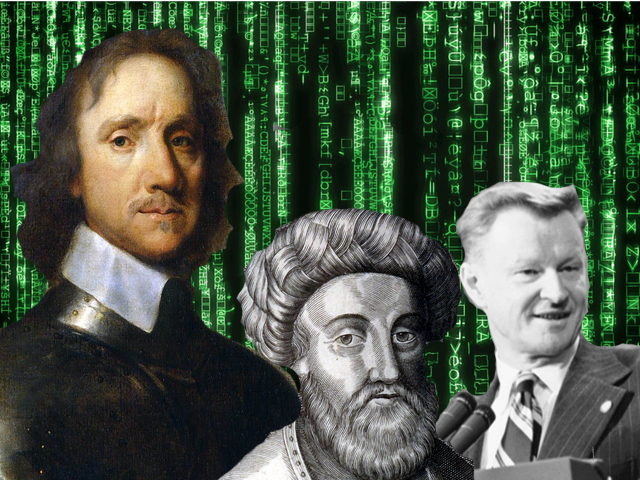
Cromwellian Revolution, Revolution of 1789, Bolshevik Revolution
A parallel can be drawn between the methods of political terror deployed in England by Cromwell during the 17th century, those deployed by the Wahhabi Saud tribe in the Arabian Peninsula during the 18th century and those of the French Revolution (1789), which foreshadowed the anarcho-socialist revolutions of the 19th and 20th centuries. These revolutions, many of which were accompanied by territorial expansion, all have one point in common: ideological domination by means of mass extermination. The aim was to build modern institutions on the remains of traditional ones.
The modern era and its murderous revolutions began with Protestantism which, in essence, is a revolutionary religion based on the veterotestamentary model.
In 1641, the “English Revolution” began. It was led by the Puritan, sectarian and fanatical Oliver Cromwell (1599-1658), who belonged to those who went by the name of “Old Testament Christians”. He banned the celebration of Christmas, burnt churches and murdered priests. This revolution ended in 1649 with the execution of King Charles I (just as, a century later, the French Revolution culminated with the execution of King Louis XVI). The modus operandi of the French revolutionaries was clearly identical to that of their English predecessors.
The French revolutionaries massacred some 260 000 Vendean Catholics, who fought against the anticlerical Revolution. Cromwell, who had set out to conquer Scotland and Ireland, had foreshadowed the French revolutionaries and their methods. La Terreur clearly came to serve as a model for the majority of terrorist extermination wars of the 20th century: the Armenian genocide, led by the Sabbatean Young Turks (the Donmëh), and the messianic Judeo-Bolshevik revolution. The Vendean genocide came to be used as reference for Lenin’s crushing of the Tambov peasant revolt by means of chemical weapons (June to December 1921). The death toll of this new Vendean massacre is estimated to be 240 000.

The Talmud and Frankism: the source of revolutionary anarchism ?
The origin of this modern nihilism, driving force of the 19th and 20th century socialist revolutions, is found in the Sabbatean-Frankist interpretation of  Kabblah and, going back further in history, is also found in the Talmud itself.
Following the antinomian Kabbalists Sabbatai Zevi (1626-1676) and Jacob Frank (1726-1791), both Kabbalah and messianism in its Sabbatean-Frankist form paved the way for atheist messianism (atheist in appearance, at any rate).
As the Jewish Marxist philosopher Michael Lowry explains very clearly, the structure of socialism is that of Jewish messianism.
Of all the movements within socialism, it was the anarchic movement (the historical manifestation of which was the Bolshevik Revolution) that remained the most faithful to the cataclysmic messianism of the Frankist interpretation of Kabbalah. This Sabbatean-Frankist aspect of anarchism can be very clearly seen in the work of Mikhail Bakunin (1814-1876). Indeed, one would think he was paraphrasing Jacob Frank when he wrote:
“The destructive passion is also a creative passion”
“I believe in neither constitutions nor laws…it is something else we need: passion and life, a new world without laws and therefore free.” (1)
A century before Bakunin, Jacob Frank declared :
I have come to Poland solely to eradicate all laws and all religions, and my desire is to bring life to the world. (2)
The roots of this Frankist messianism are found in the Talmud and, specifically, in this Midrash (Talmudic commentary of the Bible) Tehilim (of Psalm 45.3):
Israel asks God: when will you send us redemption? He replies: when you have descended to the lowest level, then I will bring redemption.
This is the Talmudic prophecy which Jacob Frank attempted to fulfill by spreading depravity and general chaos. He thus declared:
I have not come to elevate, I have come to destroy and lower all things until everything has sunk, that it can descend no more…There is no ascension without prior descent… (3)
Catastrophe and widespread depravity is, in traditional Jewish eschatology, the prerequisite for the coming of the messianic age and redemption. As the leading expert of Kabblah and Jewish messianism Gershom Scholem explains, there are certain interpretations which give a new meaning to Psalm 146:7. As opposed to the traditional version, according to which during the messianic age “The Lord sets prisoners free” (matir assirum), we should read “The Lord removes prohibitions” (matir issurim) (4)
Following Jacob Frank, Bakunin echoes this idea perfectly.
It is not all surprising, therefore, to find Jewish messiansim in its Frankist form at the heart of socialist thought, once we know that it was precisely in Central Europe (where Frankism was born and took root) that socialist movements were formed.
As Michaël Lowy explains, for the majority of socialist thinkers,
There were only two ways out (within the framework of neo-romanticism): either a return to one’s own historical roots, one’s own culture, nationality or ancestral religion; or adherence to a revolutionary utopia of a universal nature. Unsurprisingly a number of Jewish thinkers from the German culture, who were close to anti-capitalist romanticism, simultaneously chose both these paths through a rediscovery of the Jewish religion (in particular the restorative Utopian interpretation of messianism) and an affinity for or identification with profoundly nostalgic (and notably libertarian) revolutionary utopias – two paths which were structurally homologous.
This dual approach characterizes several Central European Jewish thinkers who formed an extremely diverse group but who, nonetheless, were unified by this central problem. Among them we find the greatest minds of the 20th century…Franz Rosenzweig, Martin Buber, Gershom Scholem, Gustav Landauer, Walter Benjamin, Franz Kafka, Ernst Toller, Ernst Bloch, Georg Lukacs (5)
Ernst Toller, Ernst Bloch and Georg Lukacs were, as Lowy highlights, “assimilated anarcho-Bolshevik Jews” as opposed to the others who had “abandoned their Jewish identity while keeping a vague connection with Judaism.”  This is not inherently contradictory, bearing in mind the close relationship between European Jewish assimilationism and Frankism (6).
Lowy explains that “the references of their religious atheism (a term invented by Lukacs) are both Jewish and Christian” and their political evolution led them to a point where they faced the problem of reconciling the two (7).
Several contemporary accounts of Georg Lukacs reveal his fervent and apocalyptic messianism. Marianne Weber, his wife, described Lukacs as being an intellectual who was “stirred by eschatological hopes that a new messiah would come” and for whom “a socialist regime based on fraternity is the prerequisite for redemption.”
Lukacs himself terms this materialist form of messianism “atheist religiosity.” During a conference held in 1918, he paid homage to the Anabaptists (an evangelical Christian movement) and advocates their categorical imperative:  “Bring forth the Kingdom of God to this earth.” (8)
During the same period, that of the 1918-19 German Revolution, the German Jewish socialist Gustav Landauer was, like Lukacs, seized by messianic fervor and compared the “spirit of the Revolution” to the action of the “ancient prophets.” In the preface to the second edition of the Call to Socialism, he wrote:
“Chaos is here. Minds are awakening…May the revolution bring rebirth…May the revolution produce religion, a religion of action, life, love, that makes men happy, redeems them and overcomes impossible situations.” (9)
Revolutionary terror, deployed by Cromwell in England and by the revolutionaries in France, was the model for the Bolsheviks. It was also the model for the Jewish homeland (1920) with the creation of the Yishuv terrorist organisations the Haganah and the Irgun (the foundation of the Israeli Defence Forces) whose role was to support colonial expansion in Palestine.
We shouldn’t forget the famous Nakam terrorist group. In 1945, Israel’s first president, Chaim Weizmann, former chemist and leader of the World Zionist Organisation, supplied the Nakam Group* with chemical formulas to poison the water supply in Munich, Nuremberg and Hamburg. Abba Kovner was arrested on his return from Israel where he had obtained the poison, and his commando of mass murderers were stopped from executing their plan. In 1946, however, they succeeded in poisoning the bread for the prisoners held at Langwasser. Abba Kovener is today celebrated in Israel as a hero…
Terrorism on a national scale, however, is but one version of revolutionary terror. The International Brigades (Spain 1936-1938) ushered in the age of international terrorism. Wahhabi “jihadism” continues in this vein.

From Revolutionary Terror to Wahhabi Terrorism
The French Revolution of 1789 was, from the outset, a project to establish a “Universal Republic” (10) by violent means. Gustave Le Bon, anthropologist and sociologist, had understood this perfectly:
The violence of the Revolution, its massacres, its need for propaganda, its declarations of war against all kings can be explained only if we consider that it was the establishment of a new religious belief in the soul of the masses. (11)
Wahhabi terrorism, as is known, has been used by the US ever since the late 1970s (12). Zbigniew Brzezinski (1928-2017), who was national security adviser to president Carter at the time, supervised the coordination between the CIA and the Pakistani and Saudi intelligence services with the objective of financing future terrorists, including Bin Laden. The idea was to lure the Soviet Union into the Afghan graveyard. This strategy was again used in the late 1990s in Chechnya, in order to trigger the disintegration of the Russian Federation. It was then later deployed in Iraq, following the 2003 war. Since 2011, it has been applied to Libya, Syria, Yemen and elsewhere…
Indeed, in an interview with the Nouvel Observateur (15 January 1998), Brzezinski explained why and how he had financed Bin Laden in Afghanistan. In response to the question “Do you not regret having promoted Islamic fundamentalism, having given weapons and advice to future terrorists?” he answered:
What is most important for world history? The Taliban or the fall of the Soviet Empire? Some Islamic hotheads or the liberation of Central Europe and the end of the cold war?
And when the journalist remarked:
“Some hotheads?” But it has been said time and time again: today Islamic fundamentalism represents a world-wide threat…
Brzezinski replied:
Rubbish! It’s said that the West has a global policy regarding Islam. That’s hogwash: there is no global Islam. Let’s look at Islam in a rational and not a demagogic or emotional way. It is the first world religion with 1.5 billion adherents. But what is there in common between fundamentalist Saudi Arabia, moderate Morocco, militaristic Pakistan, pro-Western Egypt and secularized Central Asia? Nothing more than that which connects the Christian countries… (13)
What Brzezinski is explaining here is that Wahhabi terrorism is an artificial creation and that the extent to which it spreads across the globe depends on Western policy. And history testifies to this. Indeed, Saudi Arabia would not have been established without British support during and after the First World War. In 1945, Ibn Saud and Franklin Roosevelt made a pact aboard the USS Quincy: in exchange for Saudi oil, the kingdom of Saudi Arabia would from now on be protected by the Americans, who took this opportunity to drive out the British.
With the American dollar linked to Saudi oil, the Wahabbi doctrine, funded by petrodollars, expanded beyond Saudi Arabia. Wahhabism has since sought to conquer Islam via various institutions, such as the World Islamic Congress (1949-1952), the Islamic Congress of Jerusalem (1953), Organisation of Islamic Cooperation (1969), the Supreme Council for Islamic Affairs (1969), the Muslim World League, (1962) andthe World Assembly of Muslim Youth (1972).
The Saudi Wahhabists also finance university chairs at Harvard, California, Santa Barbara, London and Moscow. In addition, Saudi Arabia holds 30 per cent of the total Arab satellite budget, controls fifty TV channels and almost as many newspapers and magazines (14).
All this is done with the support of the Anglo-Saxon powers which lead the “free” world. This support was recently renewed by president Trump who, with his Riyadh speech and the very large arms contract which he signed with Saudi Arabia, has tacitly approved the continuation of Wahhabi military aggression in the Middle East.
* Known in English as “The Avengers”, from the Hebrew Nakam, meaning revenge, this group belonged to the Bricha movement, and was led by the Zionist Abba Kovner.
*
Youssef Hindi is a writer and historian of messianic eschatology. Born in Morocco, he emigrated to France at a very young age, and followed a path that led him to develop a reflection on the necessary reconciliation of the North and the South shores of the Mediterranean. Two worlds whose destinies have always been intimately intertwined. Here’s his Twitter account: https://twitter.com/youssef_hindi?lang=en
Translation reposted from https://geostrategieblog.wordpress.com/2017/08/16/the-matrix-of-terrorism/(typos were edited out by Transnotitia)
Notes:
[1] Quoted in Michaël Lowy, Messianisme juif et utopie libertaires en Europe centrale, Archives de sciences sociales des religions. N. 51/1, Persée, 1981, pp. 6-7.
[2] In Gershom Scholem, Aux origines religieuses du judaïsme laïque, de la mystique aux Lumières, Calmann-Levy, 2000, p. 212.
[3] Charles Novak, Jacob Frank, le faux messie, 2012, l’Harmattan, p. 56.
[4] Cité par Michaël Lowy, op. cit., p. 8.
[5] Michaël Lowy, op. cit., p. 11.
[6] See : Youssef Hindi, La mystique de la laïcité, chapter IV, 2017, Sigest.
[7] Michaël Lowy, op. cit., p. 12.
[8] Michaël Lowy, op. cit., p. 36.
[9] Michaël Lowy, op. cit., p. 22.
[10] See Anacharsis Cloots, La République universelle, 1792.
[11] Gustave Le Bon, Psychologie des foules, 1895, Presses Universitaires de France, 1981.
[12] Regarding Wahhabism, see : Jean-Michel Vernochet, Les Égarés, le wahhabisme est-il un contre islam ?, 2013, Sigest.
[14] See the list in Al-Farsy, Custodian of the Two Holy Mosques : King Fahd ben Adbul Aziz, Chanel Islands : Knight Communication, 2001, pp. 220-228.