Showing posts with label Islamophobes. Show all posts

Friday, August 02, 2019

Financiers of the Islamophobia Industry

All money trails lead to Israel

Hayy Yaqzan
It has been a great start to the summer as Islamophobes in Europe and North America continue to get dragged through the mud. On June 13, a US judge ruled that the publisher of The Daily Stormer, a neo-Nazi fake news site, must pay a Muslim comedian $4.1 million for falsely portraying him as a terrorist. Two days later, a UK judge declared that The Daily Mail, a notoriously Islamophobic site, owes an apology and £120,000 to the Palestinian charity Interpal for claiming that it was a terrorist organization.
However, as discussed in the previous article in this series on Islamophobia, these moments of success only scratch the surface of a complex global industry.
A prominent but sometimes forgotten stakeholder in the Islamophobia industry is Israel, both through its own policies and through the powerful Zionist lobby in the US. Israel’s influence on the spread of anti-Muslim bigotry is joined at the hip with its efforts to suppress pro-Palestinian scholarship and advocacy. A 2015 report by the International Jewish anti-Zionist Network (IJAN) found that Israel and its supporters had pumped over $300 million into Islamophobic, anti-Arab, and anti-Palestinian efforts at the time. Hatem Bazian, a lecturer at UC Berkeley and a prominent researcher on Islamophobia, has estimated that about 70% of Islamophobia funding in the US comes from Zionist sources.
Exploring and exposing the way this process works is very difficult, as the entire scheme relies on secrecy from the general public. One Canadian professor at the University of Lethbridge learned this the hard way in 2018. In 2016, Anthony Hall — a tenured professor who had taught Native American studies, liberal education, and globalization for 26 years — found himself suspended without pay for suggesting that there was a Zionist connection to 9/11 and that it is important to think critically about the narrative of the Holocaust. B’nai Brith Canada had jumped on the case and pressured the university to remove Hall, but he was reinstated in 2017. In June 2018, he apparently went too far: he said that the Zionists were funding Islamophobia. B’nai Brith again raised the alarm, and this time Hall was seemingly pressured into retirement by August.
It is precisely these extraordinary efforts to silence anyone who tries to trace Islamophobia to the Zionist lobby that should raise eyebrows about just how deep of a relationship this is. And this is why the contents of IJAN’s report are so important.
The main offenders identified in the report, titled The Business of Backlash: The Attack on the Palestinian Movement and Other Movements for Justice, were 11 donors whose foundations (not including their private wealth) are collectively worth over $10 billion. Many of them fund Islamophobia through the donor-advised funds discussed in previous Crescent articles, as an effort to make it difficult to trace their contributions back to them. And most of them could clearly benefit from stirring up negative views of Muslims, and they have invested heavily in oil and weapons technology.
One of the Zionist contributors are the Koch Brothers. Fred C. Koch was a US chemical engineer and entrepreneur who, in 1927, found an efficient way to refine oil into gasoline. This led to him setting up his own oil refinery. However, in 1929, it became known that Fred and his partner, a former employee of Universal Oil Products, had only made minor tweaks to Universal’s existing process and claimed it as their own.
Embarrassed in the US, Koch entered a market that his competitors in the US were reluctant to support: Soviet Russia under Stalin’s brutal regime. This kept Koch afloat as he built up his business in the US, ready to sacrifice anything for money. His eldest son, Frederick, was all but ostracized from the family for his interest in studying theatre, and his sons have said that their mother lived in fear of their father.
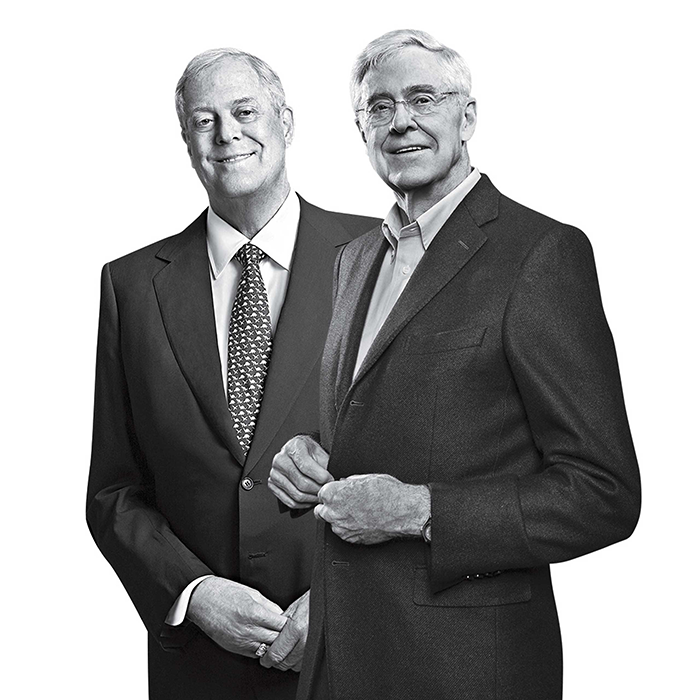
Charles and David Koch: not as erudite as they look in their carefully choreographed images. Among the wealthiest billionaires in the US, they too acquired their fortune through fraud, trickery, and extortion. They shield their contributions to the Islamophobia network by providing the seed capital for donor-advised funds.
After Koch’s death in 1967, his sons fought bitter legal battles to control the business, and eventually two of them, Charles and David, succeeded (their brother Bill Koch has called them “the biggest crooks in the oil industry”). They expanded into other ventures, and today they own $115 billion in assets and Koch Industries is the second-largest privately-held company in the US (as of 2015). Koch Industries controls at least four oil refineries, six ethanol plants, a natural-gas-fired power plant, and 4,000 miles of pipeline. At one point, it was producing 5% of all oil burned in the US and also producing billions of pounds of petrochemicals, inserting itself into the production of everything from fertilizers and the plywood sold at Home Depot to Angel Soft toilet paper and Apple’s iPhones.
In addition to being one of the top 30 polluters in the US and repeatedly showing no concern for the health of residents in the areas they work in, Koch Industries is a major contributor to the Donors Capital Fund (discussed in the previous article), which they know funnels their money to Islamophobic and anti-Palestinian projects. These include the Clarion Project, the David Horowitz Freedom Center, Stand With Us, the Israel Law Centre (which defends illegal Israeli squatters and war criminals), and more.
The Kochs must certainly be aware of where their donations are going, though publicly they put on the mask of progressive views and criticism of Israel. In May 2016, for example, they invited notoriously anti-Israel pundits to the Charles Koch Institute’s conference, even as they were funneling money to Zionist enablers and likely exploring the options for their first major ($150 million) investment in Israel, which came just a year later. It is important to note that the Koch family are not of Jewish or Israeli background; they are Christian Zionists of Dutch descent.
Another of the 11 major Zionist funders of the Islamophobic and anti-Palestinian machine is the Sheldon Adelson Family Foundation. In May of 2017, Sheldon Adelson owned $36.7 billion in assets. He owns Las Vegas Sands, the largest casino company in the world. The Adelsons’ contributions are focused mostly on pro-Israel efforts, particularly sending young American Jews on fully-paid “birthright” trips to Israel. However, they also support more general Islamophobic organizations, including the American Islamic Congress, the Endowment for Middle East Truth, and the Middle East Media Research Institute (MEMRI).
Adelson has also given as much as $250,000 to the Counterterrorism and Security Education and Research Foundation (CTSERF), which is yet another Islamophobic think tank. And in case this does not make it clear enough, he has also openly said that “all Muslims are terrorists.” He has also supported current presidential candidate Tulsi Gabbard, a supporter of Indian PM Narendra Modi and his virulently Islamophobic rhetoric. She has also spoken about “radical Islamic ideology” and countries with “Islamic extremist” populations, and Adelson has stood by her despite — or perhaps, because of — all this.
There is much more to discuss on this topic, so this will continue in upcoming articles. It is important to point out here that the many links between Islamophobic and anti-Palestinian efforts is one more reason why the Palestinian struggle for justice should be a pressing concern for all Muslims. Those who enable and maintain the illegal colonization of Palestine are often the same people who are sending harassment and even violent right-wing extremists to our doorsteps, such as recent shootings in masjids in Quebec and New Zealand.

Saturday, December 01, 2018

Muslims Win, Islamophobia Loses…

Kevin Barrett


Did Muslims just defeat Islamophobia in the American midterm elections of 2018?
The US electorate refused to follow pied piper Donald Trump down the path of Islamophobic extremism. Overall, of the 83 notably Islamophobic candidates, only 20 won their races, while 63 lost, according to Muslim Advocates. Those results may discourage future candidates from thinking they can score cheap political points and easy victories by joining the Muslim-bashing bandwagon.
Victories by the first two Muslim women ever elected to Congress, Rashida Tlaib of Michigan and Ilhan Omar of Minnesota, made mainstream media headlines — generally with a neutral to positive spin. Tlaib's support for a one-state solution in Palestine alienated Zionists of all stripes, causing the Zionist wolf-in-sheep’s-clothing “peace” group J Street to refuse to endorse her… but that didn’t stop Tlaib from getting positive coverage in the Zionist-dominated mainstream media.
In the past, any Palestinian who ran for Congress on a one-state solution platform would have been relentlessly smeared. In fact, any congressional candidate who displays any sympathy for Palestine usually gets quickly annihilated by the Zionist lobby and its lapdog media. Former six-term Congresswoman Cynthia McKinney has described how every incoming member of Congress is bullied into signing a pledge of loyalty to Israel. Those who don’t sign are put on the Zionists’ enemies list, and soon face monstrous obstacles in their path to reelection — including media collusion in setups and smears.
So how could an anti-Zionist Palestinian like Tlaib draw positive media coverage? What’s different about 2018?
It seems that many Jewish Zionists in American media are increasingly liberal, educated, and appalled by Donald Trump. More and more of these liberal Zionists, especially the younger more left-leaning ones, are beginning to awaken to the justice of the Palestinian cause. To them, a young female Palestinian supporter of Bernie Sanders who endorses the one-state solution looks a lot less scary than Trump himself does. And even the older liberal-centrist Zionists may prefer Rashida Tlaib to Donald Trump, who is perceived as a threat to the liberal order in which Jews have thrived. Though they may be uneasy with Tlaib's support for the one-state solution, those moderately liberal Jews who care for America as much as for Israel still viewed Tlaib’s victory as a welcome slap in the face to Donald Trump.
Perhaps they also understand that one Rashida Tlaib in Congress poses no immediate threat to Israel’s stranglehold on US Mideast policy. The vast majority of Congressional representatives are still taking mountains of money from AIPAC and other hardline Zionist organizations, signing the loyalty pledge to Israel, obeying Israeli orders concerning which bills to vote for and against, giving enthusiastic standing ovations to the likes of Netanyahu, and otherwise demonstrating their abject and obsequious fealty to the State of Israel.
Another reason Rashida Tlaib’s victory doesn’t bother most American Jews all that much is that Muslims are still grossly underrepresented in the US government, while Jews are increasingly overrepresented. As I noted in my satirical online article “Kavanagh converts to Judaism to save Supreme Court nomination,” Jews represent less than 2% of the US population yet have three seats on the Supreme Court (representing 33% of available seats). Prior to the midterms there were 30 Jews (versus only two Muslims) in the US Congress, despite the fact that Jews and Muslims make up roughly equal percentages of the US population. And Jewish political money dominates federal elections, making up close to half of the bribes, euphemistically known as “campaign contributions,” that buy and sell American politicians like cattle.
The 2018 midterms reinforced the already strong Jewish position in Congress. According to the Jewish Telegraph Agency (JTA) Jewish Congress members are “poised to take key leadership roles”: “Five Jewish Democrats are set to chair key House committees, including three representatives from New York: Jerrold Nadler, the Judiciary Committee; Eliot Engel, Foreign Affairs; and Nita Lowey, Appropriations. Adam Schiff of California will head the Intelligence Committee and John Yarmuth of Kentucky will lead the Budget Committee.” The JTA rundown on “races of significance to Jewish voters” offered lots more good news for Jews, including more than a dozen victories to celebrate, along with only two bits of bad news: Rashida Tlaib's victory in Michigan and pro-Palestinian Alexandria Ocasio-Cortez’s win in New York.
So despite hopeful signs, the gradual erosion of support for Likudnik Israel in the American Jewish community has not yet reached the tipping point. Barring unexpected developments (such as a 9/11 truth “black swan”) it will be years before the US frees itself from Israeli occupation.
But how many years? What is worrisome to the Zionists is that “criticism of Israel is part of a package among young progressives along with healthcare for all and jobs for all,” as Democratic strategist Brad Bannon puts it. And that young progressive wave, which Bernie Sanders almost surfed into the White House in 2016, could become a tidal wave, driven by the tectonic shock of revulsion against Trump, in 2020.
Should Muslims join the “young progressive wave”? Islam shares many core values with American progressivism including concern for social and economic justice, opposition to tyranny and usurious piling up of wealth, and an egalitarian ethos that emphasizes morality and ethics. Add the young progressives’ opposition to Islamophobia and support for Palestine, and the movement seems to resonate well with Islam.
But the young progressives also tend to support identity politics: the tendency to think and vote “as a woman,” “as a black,” “as a Hispanic,” or even “as an L or G or B or T or Q.” This unhealthy and narcissistic approach has undermined the concern for social justice that once was the hallmark of the Left. It has allowed billionaires and bankers to divide and conquer working people. And certain perverse manifestations of identity politics have contributed to the erosion of the traditional family values that most Muslims share with other socially conservative Americans.
So if Muslims choose to support the young progressives, they ought to try to steer the movement toward social justice for all, rather than petty obsessions with this or that form of identity politics. And fortunately the young progressives are relatively open to that message. After all, the major difference between the Bernie Sanders and Hillary Clinton campaigns was that Sanders was proposing concrete solutions to problems of economic inequality and injustice, whereas Clinton’s message was “make me the first woman president.” Sanders’ triumph over Clinton, which was undone by rigged voting machines, illustrated what Democrats could achieve when they campaigned for economic justice rather than identity politics.
But isn’t a concern with economic justice for Americans rather petty in light of the fact that US economic policies and military actions are causing the ruination and death of millions of Muslims and non-Muslims all over the world? This was a common critique of Bernie Sanders, who rarely spoke about US foreign policy during his campaign for president. It might also be a valid critique of whoever picks up the torch from Sanders and runs with it in 2020.
But opposing US or Zionist empire too radically or effectively is a recipe for political or even actual suicide, as the Kennedy brothers, Malcolm X, Martin Luther King Jr., Paul Wellstone, and others learned the hard way. So Sanders’ approach — enthusiastic support for expensive social justice programs that could only be paid for by rolling back the US empire, without explicitly saying “I am going to roll back the empire” — makes political sense. Likewise, if Sanders intended to challenge the Likudniks, which seems likely, he was politically wise to avoid announcing those intentions too loudly and clearly.
All things considered, the 2018 midterms showed that Muslims should be guardedly optimistic about their chances of joining young progressives and helping ensure that (insha’allah) the inevitable decline of US empire occurs with a minimum of violence and injustice, and that Palestinians finally achieve a modicum of justice, perhaps even outright victory. And as the US empire declines and finally collapses, and Americans seek new ways of understanding their place in the universe, the next generation of Muslims could find itself in a position to convey the timeless message of Islam to those who had previously rejected it.
 

Kevin Barrett

Thursday, November 08, 2018

Daniel Haqiqatjou: Authentic Islam is facing extinction in the United States


By 5Pillars


Daniel Haqiqatjou
5Pillars editor Roshan Muhammed Salih spoke with American Muslim writer and lecturer Daniel Haqiqatjou about Islam in America. Haqiqatjou warned that Islam is under attack by Islamophobes but is also being undermined by mainstream Muslim organisations.
Roshan Muhammed Salih: You believe that orthodox Islam is under threat in America. Why?
Daniel Haqiqatjou: Yes, Islam is definitely under attack from different quarters. There are non-Muslim Islamophobes who tend to be Conservatives, but there are also some liberals such as Bill Maher and Sam Harris for example. These are people who are supposed to be on the political Left but they regularly target Islam and Muslims.

Linda Sarsour speaking at the ‘Women’s March’ in Washington on 21 January 2017.

But unfortunately there are also a lot of Muslims who fall into this second camp (the liberals) and they have gained a lot of popularity. They say they are defending Muslims against the more obvious, overt attack by the Conservatives but a lot of the political content of the Left is also anti-Islam. And ignorance or naivety about this reality is very dangerous. I think you should be more concerned about the enemy that you don’t see than the one that is more obvious.
For instance, there is this activist called Linda Sarsour who is very popular amongst the average Muslim as well as amongst the national Muslim institutions. At least several times a month she is featured by some of these institutions for a fundraising event or a conference or a convention. And she also has direct endorsements from a number of scholars and this is despite the fact that she has gone on record with many statements that are fundamentally anti-Islamic. Yet she presents herself as if she is an orthodox mainstream Muslimah and this is very problematic. I don’t want to pick on Linda Sarsour in particular but she is seen as a role model and this is problematic in my view.
RMS: Do you think that if we were not so vocal about some of our views, such as Islam’s prohibition on homosexuality, that we would be better placed to form alliances with left-wing groups which could be useful in the overall fight against Islamophobia?
DH: What is the point of fighting Islamophobia if you’re distorting Islam and especially if you’re distorting Islam in the eyes of the next generation? What sort of Islam will be left if we do that? I hear this argument all the time: let’s not be so vocal about same-sex marriage or LGBT issues. We know that there are lots of bad things that Muslims and non-Muslims do in society so why are we focusing on things like LGBT and being so vocal about it?

American Muslims now fear an islamophobic backlash

But these arguments are nonsense for a number of reasons. Yes, as Muslims we should not support all the other Fahisha (lewdness), things like gambling or the consumption of alcohol or drug use. In the US there is a huge drug epidermic; it’s wiping out entire suburbs and we shouldn’t be any less vocal on these issues and only raise the flag when it comes to LGBT. We should be consistent across the board.
But what makes LGBT a more pressing issue is that this is what is being debated now in society, so where is the Muslim voice? Are we going to be absent and not have a view on this issue? Are we not going to teach our children in the masjids about Islam’s position on homosexuality? In Canada they’re trying to make it illegal to say that engaging in homosexuality is sinful or wrong. So no matter how quiet you are on this issue, that’s not enough because now they’re trying to dictate what you can and cannot say about it in the masaajid.
RMS: There seem to be some fundamental differences between British and American Muslims. American Muslims are more affluent, more liberal and more patriotic. American Muslims have also watered down their religion to a certain extent. Would this be a fair reflection?
DH: Yes I agree with that. I can’t make a direct comparison with the UK because I haven’t been to the UK. But in the United States there is a high premium placed on the notion of being a “Muslim American” or “American Islam.” And these are concepts that are promoted in mainstream gatherings and in mainstream discourse.

Nearly a quarter of those who were raised as Muslims in America end up leaving the religion

As far as I can tell this is not something that is happening in the UK; there are people out there who are promoting “British Islam,” but they’re on the fringes, they’re not in the mainstream. But here in the US you have keynote speakers at mainstream conventions with thousands of people attending and they will say “yes, I am an unapologetic Muslim” and then they will say “we love this country.”
And then you have somebody like Khizr Khan who is the father of the soldier Humayun Khan who died in the Iraq war. He will be a star speaker at these conventions and he is being promoted like this is what it means to be an American Muslim – a proud father who sends his son to fight in an American war and the contradictions of that are not even apparent. And Muslims have become accustomed to dealing in this kind of politics reflexively.
RMS: Don’t you think it’s hyperbolic to talk about the possible extinction of Islam in the United States if you go down this route of appeasement?
DH: No, I don’t think it’s hyperbolic to be concerned about the future of Islam in this country. I think the statistic is that a quarter of Muslims born in America with Muslim parentage end up leaving Islam. So we have 25% who are dropping off and when we go to the masjid we are not seeing youths who are active in the masjid.
But there is a lot of immigration which is filling up the masjid so our community is not aware of this demographic downfall. So when you go for prayers on Friday you have a parking problem and the masjid is full and because of that people say we’re doing great and our numbers are better than ever.
But the reality is that the problem is masked by immigration and if the immigration was cut off completely then we would have to ask ourselves can the community regenerate itself? Well if we’re losing 25% every generation that means extinction in three generations. And leaving aside people who are leaving Islam, there is the distortion of Islam that is happening and we are not teaching or children authentic Islam. So what kind of Islam is the next generation going to be practising? Is it going to be the kind of Islam where homosexuality is okay? Where the hijab is about choice and your personal preference? Where a female can lead daily prayers in the masjid because it seems “sexist” that only a man can lead prayers?
So if that’s the kind of Islam that we’re okay with, then yes that kind of Islam can exist in the next few generations. But I don’t think that’s a success.
Daniel Haqiqatjou was born in Houston, Texas and comes from a liberal secular Muslim background. He studied physics as an undergraduate at Harvard University and completed graduate studies in philosophy, studying with some of the top physicists and philosophers in the world, including multiple Nobel Prize winners. He has also studied Islam traditionally with respected ulama. He has written and lectured on contemporary issues surrounding Muslims and Modernity over the past ten years, and has spoken at universities and mosques around the world. His work has been featured in outlets such as The Washington Post, The Atlantic, CNN, Aljazeera, Public Discourse, Mashable, and First Things. He lives with his wife and four children in the US.

Thursday, October 13, 2016

Who Was Hussein and Why Does His Sacrifice Matter in 2016?

By Walaa Chahine 


An arrow through the eyes. Three spears in the center of an infant’s chest. Women in chains. A final, lone solider beheaded for his stand against injustice.

This is the story of Karbala, the story you were never taught, the story your children will never learn.

History books will never teach you of a man named Hussein or a land named Karbala. You have never learned of the day 72 stood against an army of 30,000 and won. No one has ever told you the story that the great British historian Edward Gibbons said will “awaken the sympathy of the coldest reader.”


You have never truly heard of Hussein, Karbala, or Ashura, and you probably didn’t need to. No, this time in Islamic and global history never meant anything, until now.

More than 1300 years ago, Hussein (as), the grandson of the Prophet Muhammad (as), rode with his family and army to Kufa, Iraq after the people of the city pleaded with him to save them from the oppression of their caliph, Yazid I. During the journey, his caravan was intercepted and diverted to Karbala, Iraq. There, he and his family were denied access to water (in the scorching hot desert) for three days. After a long stalemate, orders from Yazid arrived to kill Hussein and his people. Yazid’s army did just that, murdering 72 of them and taking the women and children they hadn’t killed as prisoners.

No, this isn’t a history lesson, a parable, or a cruel bedtime story. Yes, there have been battles throughout all of history that have been just as evil and dark. No, none of them have been as overlooked and ignored, as this battle.
Currently, in 2016, the story of Karbala means more to Islam and the world than anyone can imagine.
This is why you need to know about the Battle of Karbala - 

1) Oppression In The Name of Islam

If you think ISIS has only been around for the past couple of years, it’s because you were never taught about the story of Karbala. Hussein was fighting the same ideology almost 1400 years ago. He refused to pledge allegiance to Yazid and his father, who murdered, tortured, raped, and oppressed people in the name of Islam. In reality, they didn’t follow any of the pillars of Islam, nor did they care about the fundamental institutions of society that held people together no matter their culture, race, or religion. Sound familiar?

Was it not for Hussein’s stand, Islam would have been a dead religion long ago (sorry, bigots and Islamophobes). For a long time, this stand against injustice kept Muslims safe and well. Unfortunately, ISIS, AL-Qaeda, Saudi Arabia, whatever you want to call them, had enough and decided to tarnish that image.

Their first victims? The followers of Hussein - Shia Muslims. In Yemen, Iraq, Bahrain, Kuwait, and other countries with Shia populations, the followers of Yazid’s ideologies launched full on attacks. They eventually upgraded to not only Shias, but Sunnis, Druze, Ahmadies, Christians, and any person who stands in their way of tyrannical rule and widespread oppression.

This week alone, Saudi Arabia massacred hundreds of innocent Yemenis at a funeral, for no apparent reason but power and money. Is that not what Hussein died fighting?

2) Unity

Karbala and the day of Ashura (the day the massacre occurred) can teach us a lot about unity. This story is not about Good Islam versus Bad Islam. It’s not about Hussein versus Yazid. It’s not even about Right versus Wrong.
It’s truly, and utterly, about Good versus Evil. That is what united people to fight for and alongside Hussein on that battlefield, the simple story of Good versus Evil.

There is the story of a man named Hur (Arabic word for ‘free man’), who was the leader of the army of Yazid, and who decided to break free from his army and fight alongside Hussein when he realized the corrupt ways of Yazid. He was the first to be martyred.


There was John bin Huwai, an Ethiopian Christian who fought alongside Hussein in the name of good and not evil. Despite being an old man, and Hussein urging him to stay away from the battlefield, John gave his life for the stand against oppression.

Hussein, his family, and friends, all of different races, cultures, and religions, stood hand in hand against an army of cruelty. If we, today, in 2016, can put aside our differences and hunger for power and domination, we can easily defeat anyone who stands in the way of keeping humanity safe and inherently good.

To continue carrying Hussein’s message of unity, many of his followers use Ashura and his story to bring all kinds of people together for charity, tolerance, and goodwill.

In Iraq (where his shrine and his companions’ shrines are located) each year, thousands of Iraqi people, including orphans and those in poverty, open their homes to the visitors of Hussein, no matter their religion or ethnicity.

Who is Hussain, a non-profit organization promoting his message conducts food-drives, blood-drives, and drives for the homeless in his honor. It was started in London in 2012 and has since become a global movement.
3) Resistance and Sacrifice

Perhaps, the most important of lessons we can learn from Hussein and his army is that of resistance and sacrifice. Mahamat Ghandi once said, “If I had an army like the 72 soldiers of Hussein, I would have won freedom for India in 24 hours.”

Each and every story of the martyrs of Karbala can bring tears to your eyes.

The sacrifices range from grown men, to the 6-month old son of Hussein who did not know of good versus evil but only of thirst and hunger. When Hussein held him up and begged that they be allowed access to water, Yazid’s army shot three spears into his heart.

But, the saddest of sacrifices comes from Hussein’s brother, Abbas, who crossed the battle field to the Euphrates River to bring water back to the infants and children. There, he filled a water skin in hopes of quenching their thirst. The soldiers fired an arrow through his eye and cut off his arms, but that did not halt him. He carried the skin of water in his mouth, crawling towards the tents filled with children, until the army approached him and finally killed him.

Eventually, drenched in Abbas’s blood, the blood of his martyred teenage son, companions, and infant child, Hussein stood alone on the battlefield, with women, children, and the ill waiting in tents. He bid them farewell and shouted to an empty desert behind him “Is there anyone to help me?”, When silence was the only response, he marched to fight the army of Yazid, where he was beheaded (much like ISIS does today), stomped on, and his head attached to a pole. The army then tied up the women and children, and marched them from city to city behind the severed head of Hussein, all the way back to their commander, Yazid.

All over the world, people today are resisting to injustice, and they use Hussein as an example.

In Egypt three years ago, a Shia sheikh by the name of Hassan Shehata, well known for standing up against extremist groups and radical ideologies, was murdered. His death spun Egyptian Sunnis, Shia, and Christians into standing up, and changing the discourse locally, and nationally.

On January 2nd of this year, Sheikh Nimr al-Nimr was executed by Saudi Arabia for doing exactly what Sheikh Shehata did. His murder caused international outrage, especially in Bahrain, where persecution of minority groups like those of Sheikh Nimr’s, is just as common.

Nigerian cleric, Sheikh Zakzaky , has been detained since last December for his stand against injustice. His followers were burned alive for their loyalty.

Black Lives Matter, the Arab Spring, Occupy Wall Street, NOW, and so many other groups standing against injustice in the world have Hussein as an example.

Once you truly understand the stories of Karbala, listening to each one in specific detail, you will understand why millions of Shia every year mourn during Muharram. It’s why they cry and wear black and why Christians and Sunnis alike join them in paying respects to Hussein and his brother Abbas at their shrines in Karbala, Iraq. Not because it’s merely a sad story, but because sacrifices like this didn’t just keep true Islam alive, but kept good alive throughout the Eastern world.

Your history books never taught you that. Your history books will never teach you of the powerful women, like Zainab, the sister of Hussein, who embodied true feminism and stood up to the tyrant Yazid in his castle, even as they were handcuffed and promised to be raped and sold.

Your books never taught you about the high regard with which so many great men and women (authors, historians, presidents, Nobel Prize winners, artists, etc) held Hussein.

Charles Dickens is quoted as saying, “If Hussein had fought to quench his worldly desires...then I do not understand why his sister, wife, and children accompanied him.”

The first President of India, Dr. Ragendra Pasad, said, “The sacrifice of Imam Hussein is not limited to one country, or nation, but it is the hereditary state of the brotherhood of all mankind.”

Although victor in resistance and the stand against in justice, Hussein did not live to speak of his victory. The survivors did, the people who witnessed his head being marched through their cities did, and the families of those martyred did.

Still, your children will probably never read a famous history book about Islam that included the Battle of Karbala. It won’t be a story you think of when you remember the greatest battles of mankind. You won’t remember it when you read about ISIS or watch a new CNN documentary about Islam in 2016.

However, you should know it, our children need to learn about it. It teaches us more than how to combat ISIS and stand up to any injustice. We can learn from it feminism, ethics, morality, and unity. Even if we don’t want to teach our kids and our students about Islam and Hussein, we can remove the religious factor of the equation and what remains is a story that has brought people to tears for centuries.

The Lebanese writer Antoine Bara once wrote, “No battle in the modern and past history of mankind has earned more sympathy and admiration as well as provided more lessons than the martyrdom of Hussein in the battle of Karbala.”

Hussein and Karbala are not just a story for Shia Muslims, they are a story for humanity.

Ask yourself, if the Battle of Karbala can teach us so much about standing against the image of Islam that the world and media hold today, then why don’t we ever learn about it?