Showing posts with label Gibraltar releases Iranian oil tanker Adrian Darya-1. Show all posts

Wednesday, August 21, 2019

Why the World Is Watching the Fate of an Iranian Tanker in the Mediterranean

Greece, unlike the U.S., has taken the position that Iran has "the right to develop nuclear technology for peaceful purposes alone."


by
The British seized the Iranian tanker at the urging of the United States. (Photo: Jorge Guerrero/AFP/Getty Images)
At 11:30 p.m. on August 18, the Iranian tanker Adrian Darya 1 left the shores of Gibraltar at the mouth of the Mediterranean Sea. This ship had been detained 46 days ago by British Royal Marines and Gibraltar’s officials. The British claimed that the ship—then named Grace 1—was taking its cargo of 2.1 million barrels of oil to Syria. There are European Union sanctions against trade with the Syrian government. It is based on these sanctions that the British seized the Iranian vessel.

Last Thursday, on August 15, Gibraltar’s Chief Minister Fabian Picardo ordered the release of the ship after the Iranian authorities said it would not be going to Syria. The immediate destination for Adrian Darya 1 is the Greek port of Kalamata.

Sanctions on Iran

The British, it is clear, seized the Iranian tanker at the urging of the United States. There was no previous British warning that it might enter in such a muscular way into the U.S. attempt to suffocate Iran. Even the location of the seizure unnecessarily raised tensions for the United Kingdom. The waters around Gibraltar are contested between Britain and Spain, with the latter making noises about a formal complaint about the British action.

Gibraltar’s government has been trying to find a middle course between the claims of Britain and Spain. It seeks some form of independence, although with close ties with both its large neighbor and its formal occupant. When the UK asked Gibraltar’s authorities to get involved in the seizure of the Iranian tanker, Gibraltar’s government complied because the request was in line with European Union sanctions against trade with the Syrian government.

In Gibraltar’s courts, the British were largely silent. The case against the Iranian vessel was made by the United States, which changed the basis for the seizure. The U.S. argued that the vessel had to remain impounded as part of its new and harsh sanctions regime against Iran. When Gibraltar was preparing to release the ship, the U.S. District Court in Washington, D.C., issued a warrant for the ship. This emergency warrant alleged that the ship was owned by the Iranian Revolutionary Guards and therefore must not be allowed to sail.

Gibraltar did not agree. The U.S. tried to use its 1977 International Emergency Economic Powers Act, and the new sanctions regime by the Trump administration. None of this appealed to the judiciary in Gibraltar. The government of Gibraltar said that it did not accept the new U.S. sanctions regime on Iran. It had held the vessel based on the European Union sanctions on Syria, not on any EU sanctions on Iran. Therefore, it has allowed Adrian Darya 1 to sail.

Iran’s Reaction

New statistics show that Iran’s economy has been decelerating at a rapid pace. The numbers from the Statistical Center of Iran show that Iran’s GDP shrank by 4.9 percent in 2018-19. Economic growth is slipping backwards, as the sectors of oil, industry, and agriculture post negative numbers. Inflation continues, with the inflation rate now at the highest it has been in a quarter of a century. Iranian traders have been moving their goods to Iraq, which results in the rise of prices within Iran. Most stunningly, the prices of non-trade goods and services—such as health and housing—are rising. All this has put enormous pressure on the government of Hassan Rouhani, although his spokesman Ali Rabiei said on Monday that Iran’s economy is experiencing “positive signs.”

Confidence from the Iranian government is remarkable. Officials in Tehran refuse to be cowed by the pressure from Washington, D.C. When the Adrian Darya 1 left Gibraltar, senior Iranian parliamentarian Alaeddin Boroujerdi said that its release was a result of “the revolutionary diplomacy of resistance.” He pointed to the seizure by Iran of the British ship Stena Impero, which continues to be detained in Iran. The British ship, Boroujerdi said, was being held for its violation of basic maritime rules in the Strait of Hormuz. The seizure of the Iranian ship—he pointed out—“was an act of piracy by England.”

Based on this assessment that the UK had indulged in piracy at the urging of the United States, Iran’s chief judge Ebrahim Raeisi said that the release of Adrian Darya 1 is not sufficient. Compensation must be paid to Iran. What compensation will be demanded from the UK is not clear, and it is further unclear where Iran will formally raise the issue of compensation. Iranian diplomats say that they might approach the United Nations based on the 1982 UN Convention on the Law of the Sea.

Will Greece Hold the Tanker?

Within the Trump administration there is appetite to further block the passage of Adrian Darya 1, and make it a flashpoint toward war. That is what Trump’s adviser John Bolton indicated when Gibraltar held the ship. Make your move, he seemed to suggest to Tehran. Iran told the U.S.—through the Swiss authorities—that it must allow the ship free passage. If the Adrian Darya 1 is blocked, it would set a terrible precedent for international shipping.

When the tanker enters Kalamata, it will likely take on a new crew and then set its next destination. There is no indication as to what the ship will do with its 2.1 million barrels of crude oil. It is likely that it will unload its cargo onto another ship in international waters.

Last week, the U.S. government asked Greece to contribute to its naval force in the Persian Gulf. Greece, with its new conservative prime minister, declined—as did France and Germany—to this new U.S. initiative. The Greek government, led by Kyriakos Mitsotakis, is eager for a close relationship with Washington, but it is not willing to enter a frontal clash with Iran. Greece is already in a heated situation with Turkey. To rattle Iran would only further complicate Greece’s fragile dance in the eastern Mediterranean.

Greece, unlike the U.S., has taken the position that Iran has “the right to develop nuclear technology for peaceful purposes alone.” This is Iran’s position. The United States, as Professor Seyed Mohammad Marandi told Tricontinental: Institute for Social Research, opposes even a peaceful nuclear project for Iran. This is why Trump walked out of the 2015 nuclear deal. This is precisely why the U.S. has been putting immense pressure on Iranian shipping. And this is what led us to the story of the Adrian Darya 1.

Tuesday, August 20, 2019

Will The Release Of The Adrian Darya-1 Affect U.S.-UK Relations?

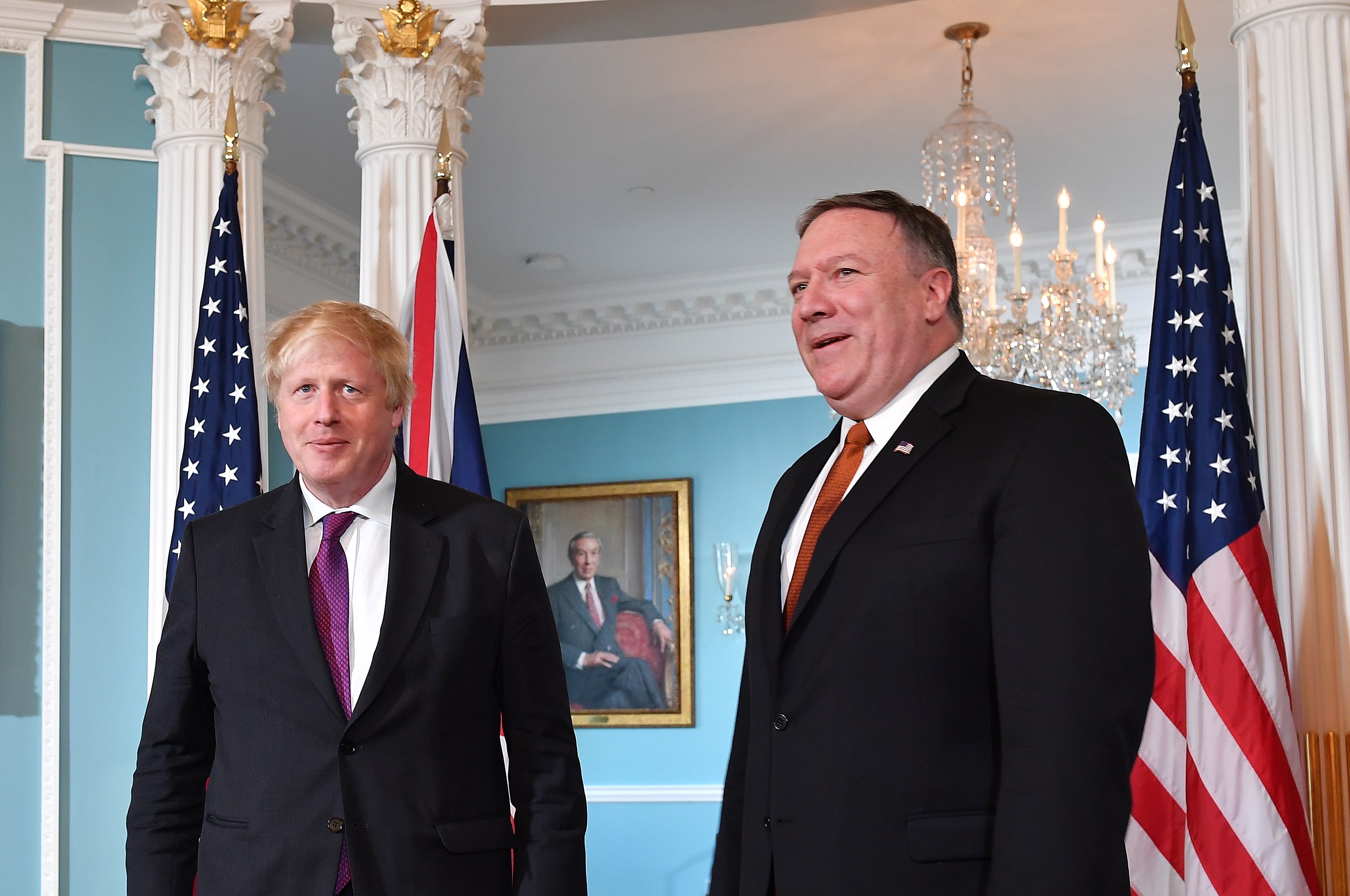
Boris Johnson and Mike Pompeo in 2018 (U.S. Department of State via Wikimedia Commons)
Authorities in Gibraltar decided on Thursday to release the Iranian oil tanker Adrian Darya-1, which they was seized last month. The vessel was detained for allegedly breaching European Union sanctions by shipping oil to Syria. Tehran has denied that charge. After Gibraltar courts rejected a new U.S. legal effort to retain the vessel, now renamed the Adrian Darya-1, the ship got underway on Sunday.
Arguably, the seizure of the Adrian Darya-1 marked the moment when the UK became directly involved in the ongoing U.S.-Iran conflict. It was clear that Tehran would not remain silent. So when Gibraltar extended the tanker’s detention last month, the Iranians responded and seized the British-flagged tanker Stena Impero, putting the UK government under pressure to respond.
Then-UK Foreign Secretary Jeremy Hunt suggested that there should be a European-led mission to protect shipping in the Persian Gulf region. However, that proposal has since been ruled out by the government of new UK Prime Minister Boris Johnson. Instead, the UK has decided to join a U.S.-led mission in responding to Iranian threats, part of Johnson’s overall rebalancing of UK foreign policy in Washington’s direction.
The decision to release Adrian Darya-1 should de-escalate tensions between the UK and Iran slightly. It could prompt the Iranians, because their main disagreement is with the U.S. and not the UK, to release Stena Impero. Tehran must be taking into account the fact that London still supports the 2015 nuclear deal (the Joint Comprehensive Plan of Action or JCPOA), which the U.S. rejected in 2018.
The UK has made it clear that its primary concern regarding Adrian Darya-1 is the transfer of oil to Syria. “We note the Government of Gibraltar has received assurances from Iran that the Grace 1 will not proceed to Syria. Iran must abide by the assurances they have provided. We will not stand by and allow Iran—or anyone—to bypass vital EU sanctions on a regime that has deployed chemical weapons against its own people,” a British foreign office spokesman said in a statement.
“There is no comparison or linkage between Iran’s unacceptable and illegal seizure of, and attacks on, commercial shipping vessels in the Strait of Hormuz and the enforcement of EU Syria sanctions by the Government of Gibraltar. Freedom of navigation for commercial shipping must be respected and international law upheld,” the official continued.
It seems clear that the White House was not delighted by the decision to release the tanker, which came only hours after White House National Security Advisor John Bolton’s visit to London. The State Department issued a statement that said the U.S. “assesses that the M/T Grace I was assisting the Islamic Revolutionary Guard Corps (IRGC) by transporting oil from Iran to Syria. This could result in serious consequences for any individuals associated with the Grace I.” The statement added that “in the case of the M/T Grace I, we will continue to act consistent with our existing policies concerning those who provide material support to the IRGC.”
That statement was followed by reports that a U.S. federal court had issued a warrant to detain the ship pursuant to the State Department’s decision in April to designate Iran’s Islamic Revolutionary Guard Corps as a “Foreign Terrorist Organization.” The U.S. Justice Department argued that the tanker was linked to the IRGC and therefore subject to seizure, but officials in Gibraltar determined that under EU law they had no grounds upon which to hold it.
It’s no surprise that the Trump administration opposed releasing Adrian Darya-1. But its opposition increases pressure on London. At a time when Johnson is about to lead the UK out of the EU on Oct. 31, Britain in increasingly dependent on support from the U.S. A UK-U.S. trade deal is key to the UK’s post-Brexit plans, and Johnson would want to minimize tensions between Downing Street and the White House. However, he also does not want to risk the UK becoming embroiled in an unwanted U.S.-Iran conflict.
“Despite her determination to deliver Brexit, Theresa May felt able to disagree with the US on the Iran deal and climate change. Trump was often critical of her. Trump is full of praise for her successor. There is a real danger that Boris will deliver whatever Trump asks, because if Brexit happens the UK will be isolated and desperate for a trade deal with the U.S.,” Clare Short, a former International Development Secretary in the Labour government led by Tony Blair, told LobeLog. “It is very interesting that the Gibraltar courts have made a decision independent of UK influence. This has clearly annoyed the US.”
The fact that the U.S. Justice Department fought to have Adrian Darya-1’s seizure extended indicates that it was Washington that was behind the decision to detain it in the first place. The hardliners in Trump’s administration, seemingly, are attempting to increase international pressure on Tehran. That is probably why Bolton described the seizure of the vessel as “excellent news” on Twitter last month.
This is a big test for a new prime minister who, although he supports the nuclear deal, needs to walk a tight line between alienating the U.S. and provoking Iran. What is important to watch now is the extent to which Gibraltar’s decision will have an impact on the “Special Relationship.” “I am not aware of the arguments the U.S. will put to the Gibraltar court to achieve a further detention of the Grace 1, but I would expect them to be rejected by the UK government since they can only be based on a policy the UK rejects; namely, preventing Iran from selling oil at all. So this could well turn into a disagreement between Britain and the U.S.,” former British ambassador to Tehran Sir Richard Dalton told LobeLog on Friday, before authorities in Gibraltar did reject the U.S. warrant.
“But the big things in U.S. and UK diplomacy are NATO, the EU, intelligence sharing and mutual trade and investment. Such matters are not directly connected to Iran policy, which is of secondary importance in the relationship,” Dalton added. “The U.S./UK relationship is so multi-faceted, that one further disagreement can be absorbed and dealt with without much or any harm being done. It will be touched on by Johnson and Trump at the G7 meeting in Biarritz but I suspect only in passing.”
One thing that further complicates the UK government’s mission is that Britain is dealing with a U.S. administration that does not seem to have an internal political consensus on Iran. While Trump does not appear to be in favor of war, others such as Bolton do appear to favor it. Johnson’s government has, therefore, to take a firm position in not letting U.S. pressure drag London into any unnecessary conflicts. That is the only way it can continue maintaining a balanced policy with both Europe and the U.S. in the post-Brexit period.
Abdulaziz Kilani is a British-Arab writer. He is also the editor-in-chief of Sharq Wa Gharb Arabic electronic newspaper.