Showing posts with label Abdulaziz Kilani. Show all posts

Sunday, September 01, 2019

Netanyahu is risking war to boost his electoral prospects

Israeli Prime Minister Benjamin Netanyahu seen during a meeting with Russia's Putin in Moscow, Russia on April 4, 2019 [kremlin.ru]
In an effort to boost his electoral prospects, Israeli Prime Minister Benjamin Netanyahu is risking the outbreak of a war no one wants.
Over the course of a few days, Israel launched attacks in Iraq, Syria and Lebanon. Commenting on the attack in Syria, the Israeli military said that on 25 August its aircraft struck “Iranian Quds Force operatives and Shiite militias which were preparing to advance attack plans targeting sites in Israel from within Syria over the last number of days”. This unprecedented escalation will almost certainly increase tensions.
The US State Department issued a statement regarding the Syria attack, pointing out that Secretary of State Mike Pompeo spoke with Netanyahu on the phone. “The Secretary expressed support for Israel’s right to defend itself from threats posed by the Iranian Revolutionary Guard Corps and to take action to prevent imminent attacks against Israeli assets in the region,” the statement said.
Of course, President Donald Trump’s administration – unlike the Barack Obama administration – has been committed to supporting far right-wing Israeli policies and in particular Netanyahu’s agenda. President Trump’s public recognition of Israel’s sovereignty over the Syrian Golan Heights in the lead up to the Israeli election back in April was seen as helpful to the Israeli prime minister. There is no way to imagine that this backing will decrease.
The recent steps in which Trump supported the ban of Congresswomen Rashida Tlaib and Ilhan Omar from entering Israel and the State Department’s move to drop the Palestinian territories listing from its website also suggests this fact. These steps could be seen as fresh examples of the unconditional US support for Netanyahu, in order to help him win next month’s do-over election.
Arguably, during the Obama administration it would have been far more difficult for Netanyahu to have this flexibility in pursuing his plans in the occupied West Bank. However, since the US Ambassador to Israel, David Friedman, said that Israel has the right to annex parts of the West Bank, that could be seen as the green light for Netanyahu’s plans.
Such a major announcement, which reverses decades of US commitments towards the Palestinian-Israeli conflict, would indeed boost Netanyahu’s popularity and indicates that, under his leadership, Israel is stronger and can do what it wants without anyone standing in its way.
Earlier this month, the Times of Israel reported that a poll for the Walla news site found that a majority of the Israeli public opposes a unity government led by Netanyahu, which would bring together the ruling Likud party and its centrist competitor Blue and White (Kahol Lavan). Therefore, Netanyahu, seemingly, is desperate to not let this poll be the case when it comes to counting the votes in the upcoming Israeli elections in September.
After his past failures to contain Iran in Syria, Netanyahu will likely look for something to help him win the election. If he can appear to be containing Tehran now, and not just in Syria but across the whole region, he will be able to portray himself as a strongman whose leadership can ensure Israel’s security. Such a portrayal will likely help in gaining extra votes, but the tactic may backfire.
It is believed that the attack Israel launched in southern Lebanon in the early hours of 25 August is of key significance, as it was the first of its kind since 2006, according to Hezbollah’s General Secretary Hassan Nasrallah, who made a rare appearance on the same day issuing a strong warning to Tel Aviv.
“I say to the Israeli army along the border, from tonight be ready and wait for us,” Nasrallah said. “What happened yesterday will not pass,” Nasrallah warned.
Thus, if Nasrallah responds militarily, the region could find itself on the brink of an unwanted war, although it is clear that neither side is in favour of conflict.
“What happened was similar to a declaration of war which allows us to resort to our right to defending our sovereignty,” the Lebanese president’s office quoted Michel Aoun, a political ally of Hezbollah, as saying on Twitter on Monday, Reuters reported. This raises a significant question: Does Aoun’s statement confirm and authorise an act of revenge?
Netanyahu is aware that the majority of Israeli citizens are not in favour of war. “An overwhelming majority of the population, 73%, believe that Israel is an established fact, as opposed to only 18% who think that the existence of the state is in real danger,” the Jerusalem Post reported in April.
“But alongside the sense of security that Israelis express regarding the existence of the state, 52% of the public fear that a war could break out in the near future, seemingly in light of the increasing tensions in the north and the Iranian threat to retaliate against Israel,” the report continued.
The Israeli daily added: “12% of the public are very fearful that a war could erupt in the near future, and 40% moderately fearful. In contrast, 31% are not so fearful and 7% are not fearful at all at the prospect of a war in the near term.”
Despite the fact that Netanyahu seems to be aware of Israeli citizens’ concerns, his actions show that he is willing to use any means necessary to win the elections, regardless of the consequences for the region and Israel itself.
Although Israel attacked Iranian-backed targets in Syria previously, it has never escalated to a degree that entails attacks on four targets in three countries within just a few days. The tensions have now reached their peak and what will be important to observe is when and how Hezbollah responds.

Tuesday, August 20, 2019

Will The Release Of The Adrian Darya-1 Affect U.S.-UK Relations?

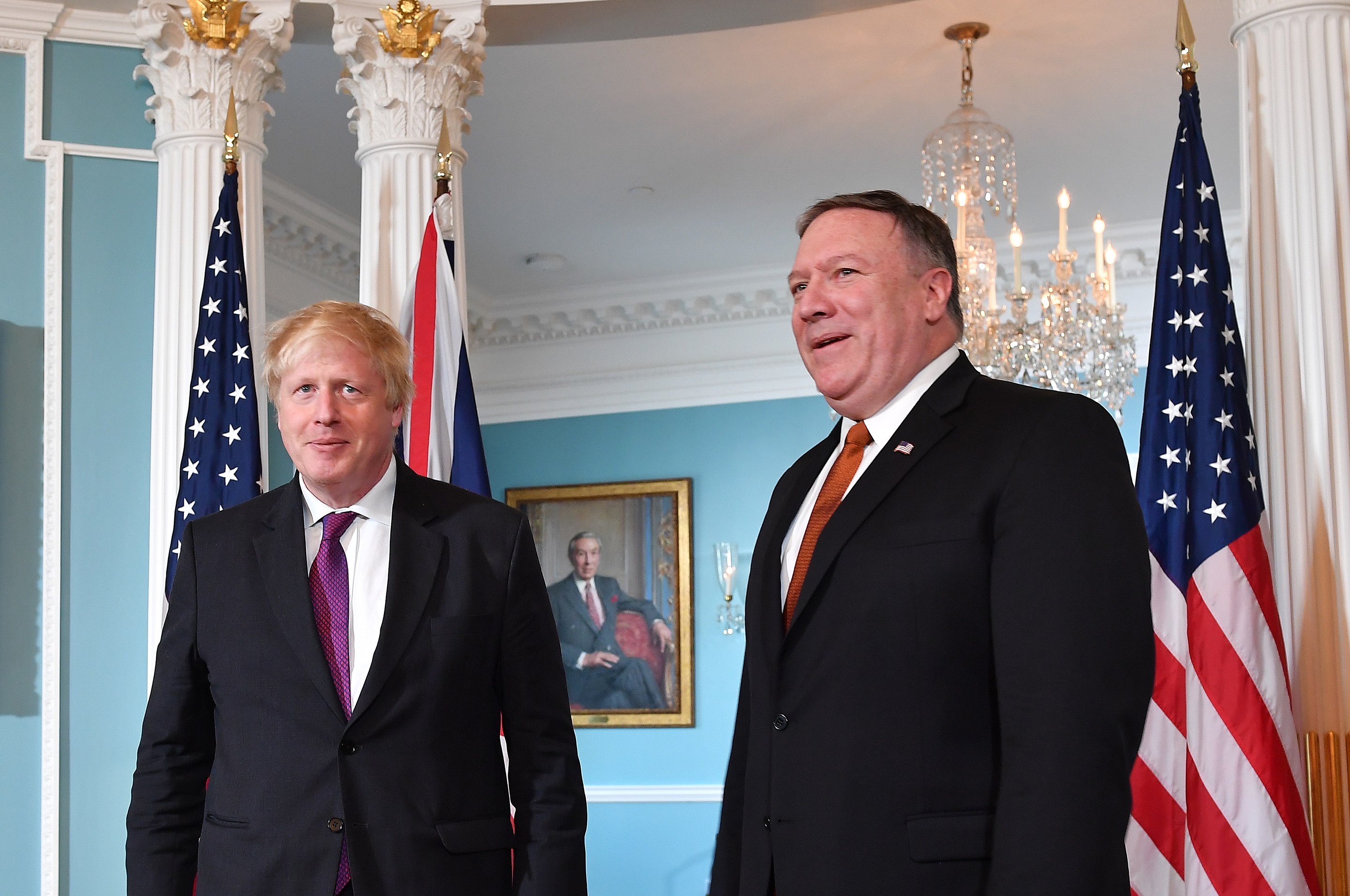
Boris Johnson and Mike Pompeo in 2018 (U.S. Department of State via Wikimedia Commons)
Authorities in Gibraltar decided on Thursday to release the Iranian oil tanker Adrian Darya-1, which they was seized last month. The vessel was detained for allegedly breaching European Union sanctions by shipping oil to Syria. Tehran has denied that charge. After Gibraltar courts rejected a new U.S. legal effort to retain the vessel, now renamed the Adrian Darya-1, the ship got underway on Sunday.
Arguably, the seizure of the Adrian Darya-1 marked the moment when the UK became directly involved in the ongoing U.S.-Iran conflict. It was clear that Tehran would not remain silent. So when Gibraltar extended the tanker’s detention last month, the Iranians responded and seized the British-flagged tanker Stena Impero, putting the UK government under pressure to respond.
Then-UK Foreign Secretary Jeremy Hunt suggested that there should be a European-led mission to protect shipping in the Persian Gulf region. However, that proposal has since been ruled out by the government of new UK Prime Minister Boris Johnson. Instead, the UK has decided to join a U.S.-led mission in responding to Iranian threats, part of Johnson’s overall rebalancing of UK foreign policy in Washington’s direction.
The decision to release Adrian Darya-1 should de-escalate tensions between the UK and Iran slightly. It could prompt the Iranians, because their main disagreement is with the U.S. and not the UK, to release Stena Impero. Tehran must be taking into account the fact that London still supports the 2015 nuclear deal (the Joint Comprehensive Plan of Action or JCPOA), which the U.S. rejected in 2018.
The UK has made it clear that its primary concern regarding Adrian Darya-1 is the transfer of oil to Syria. “We note the Government of Gibraltar has received assurances from Iran that the Grace 1 will not proceed to Syria. Iran must abide by the assurances they have provided. We will not stand by and allow Iran—or anyone—to bypass vital EU sanctions on a regime that has deployed chemical weapons against its own people,” a British foreign office spokesman said in a statement.
“There is no comparison or linkage between Iran’s unacceptable and illegal seizure of, and attacks on, commercial shipping vessels in the Strait of Hormuz and the enforcement of EU Syria sanctions by the Government of Gibraltar. Freedom of navigation for commercial shipping must be respected and international law upheld,” the official continued.
It seems clear that the White House was not delighted by the decision to release the tanker, which came only hours after White House National Security Advisor John Bolton’s visit to London. The State Department issued a statement that said the U.S. “assesses that the M/T Grace I was assisting the Islamic Revolutionary Guard Corps (IRGC) by transporting oil from Iran to Syria. This could result in serious consequences for any individuals associated with the Grace I.” The statement added that “in the case of the M/T Grace I, we will continue to act consistent with our existing policies concerning those who provide material support to the IRGC.”
That statement was followed by reports that a U.S. federal court had issued a warrant to detain the ship pursuant to the State Department’s decision in April to designate Iran’s Islamic Revolutionary Guard Corps as a “Foreign Terrorist Organization.” The U.S. Justice Department argued that the tanker was linked to the IRGC and therefore subject to seizure, but officials in Gibraltar determined that under EU law they had no grounds upon which to hold it.
It’s no surprise that the Trump administration opposed releasing Adrian Darya-1. But its opposition increases pressure on London. At a time when Johnson is about to lead the UK out of the EU on Oct. 31, Britain in increasingly dependent on support from the U.S. A UK-U.S. trade deal is key to the UK’s post-Brexit plans, and Johnson would want to minimize tensions between Downing Street and the White House. However, he also does not want to risk the UK becoming embroiled in an unwanted U.S.-Iran conflict.
“Despite her determination to deliver Brexit, Theresa May felt able to disagree with the US on the Iran deal and climate change. Trump was often critical of her. Trump is full of praise for her successor. There is a real danger that Boris will deliver whatever Trump asks, because if Brexit happens the UK will be isolated and desperate for a trade deal with the U.S.,” Clare Short, a former International Development Secretary in the Labour government led by Tony Blair, told LobeLog. “It is very interesting that the Gibraltar courts have made a decision independent of UK influence. This has clearly annoyed the US.”
The fact that the U.S. Justice Department fought to have Adrian Darya-1’s seizure extended indicates that it was Washington that was behind the decision to detain it in the first place. The hardliners in Trump’s administration, seemingly, are attempting to increase international pressure on Tehran. That is probably why Bolton described the seizure of the vessel as “excellent news” on Twitter last month.
This is a big test for a new prime minister who, although he supports the nuclear deal, needs to walk a tight line between alienating the U.S. and provoking Iran. What is important to watch now is the extent to which Gibraltar’s decision will have an impact on the “Special Relationship.” “I am not aware of the arguments the U.S. will put to the Gibraltar court to achieve a further detention of the Grace 1, but I would expect them to be rejected by the UK government since they can only be based on a policy the UK rejects; namely, preventing Iran from selling oil at all. So this could well turn into a disagreement between Britain and the U.S.,” former British ambassador to Tehran Sir Richard Dalton told LobeLog on Friday, before authorities in Gibraltar did reject the U.S. warrant.
“But the big things in U.S. and UK diplomacy are NATO, the EU, intelligence sharing and mutual trade and investment. Such matters are not directly connected to Iran policy, which is of secondary importance in the relationship,” Dalton added. “The U.S./UK relationship is so multi-faceted, that one further disagreement can be absorbed and dealt with without much or any harm being done. It will be touched on by Johnson and Trump at the G7 meeting in Biarritz but I suspect only in passing.”
One thing that further complicates the UK government’s mission is that Britain is dealing with a U.S. administration that does not seem to have an internal political consensus on Iran. While Trump does not appear to be in favor of war, others such as Bolton do appear to favor it. Johnson’s government has, therefore, to take a firm position in not letting U.S. pressure drag London into any unnecessary conflicts. That is the only way it can continue maintaining a balanced policy with both Europe and the U.S. in the post-Brexit period.
Abdulaziz Kilani is a British-Arab writer. He is also the editor-in-chief of Sharq Wa Gharb Arabic electronic newspaper.