Showing posts with label German Chancellor Angela Merkel. Show all posts

Sunday, July 07, 2019

Trump is the perverse personification of American exceptionalism

Sasha Abramsky
With an unprecedented hubris, the United States of America thinks that it is the exceptional country in the world and that it is the absolute role model for mankind and thus should be obeyed and followed in every aspect of human life.
This has become more evident with coming to office of Donald Trump as he is excessively overwhelmed with the illusion that he is the best US president and he can save America from its imminent fate of total extermination. Sasha Abramsky, a freelance journalist and a part-time lecturer at the University of California at Davis, has addressed the issue in his piece titled, "Trump is the perverse personification of American exceptionalism".
As with so many of Donald Trump’s interactions, in his dealings with other countries, the U.S. president is a bull in a china shop, smashing through everything in his path. It is, to say the least, discombobulating.
When the president of the United States doesn’t hesitate to wade into the domestic politics of allied nations, and goes into attack-dog mode against political figures in those countries, it sends a strong signal both that traditional alliances are breaking down, and also that in this new entertainment-as-politics era, anything goes and etiquette be damned. The U.K., the U.S.’s closest ally over the past century, has borne much of this stunning breach of protocol.
Trump has, in his verbal dealings with the U.K., repeatedly treated the country as a suzerainty, a fiefdom for which he assumes the right to “suggest” fundamental decisions, rather than as a sovereign state.
Even by the utterly debased truth-standards of Trumplandia, there is a peculiar absurdity to Donald Trump lecturing anybody on how to counter violent crime outbreaks. After all, this is a man who does not even consider gun control legislation in the wake of one mass shooting after another. Moreover, Trump frequently aligns himself with the most violent elements of society — from calling the neo-Nazis in Charlottesville “very fine people” to flirting with paramilitary violence.
This should lead us to question Trump’s bashing of international leaders all the more. When Trump says banal, cruel, inflammatory things about a U.S. political figure, as he so frequently does, one can, I suppose, just about make the argument that it’s all part of the rough-and-tumble of a fiercely partisan domestic politics. It’s still jaw-dropping how much venom one man can inject into the system, but at least it’s about chasing votes within the country of which Trump is leader.
However, when he does the same thing regarding other countries, we witness an extraordinary exercise in hubris: Assuming his role as a bull in a china shop, Trump butts heads with anyone and anything that he so chooses. He seems to think he has the right to do so because he is American, which means he is powerful — very powerful; and in Trump’s worldview, the powerful do not have to respect lesser mortals. Indeed, in his zero-sum understanding of human life and interactions, to respect others is to show a sign of unforgivable political and personal weakness: more respect going to others means less respect coming back to you.
Time and again, Trump has picked puerile fights with local and national leaders in allied countries. On the one hand, this is just bloviating; the tweets are the ugly rantings of a crotchety old man who uses the internet and his smartphone as extensions of his id.
He has said that “Paris is no longer Paris” in the shadow of terrorist attacks. He has critiqued German Chancellor Angela Merkel for her handling of the influx of refugees, mainly Syrian, in the 2015-16 period. He has called Canadian Prime Minister Justin Trudeau dishonest and a liar; and, after the vituperative G7 summit in Canada last June, Trump’s then-economics adviser Larry Kudlow, presumably with the president’s blessing, accused Trudeau of stabbing the U.S. administration in the back. Trump has mocked the accent of the Indian prime minister, and accused the Japanese and the South Koreans of freeloading in their decades-long embrace of U.S. security guarantees.
Back in the U.K., Trump, a U.S. president with no sovereign authority over British politics, openly embraced the idea of a Boris Johnson premiership even before the hapless Prime Minister Theresa May announced her intention to step down. Johnson, a one-time mayor of London and then a foreign secretary, played a crucial role in the Brexit vote outcome by coming out strongly against EU membership during the referendum campaign. He has also achieved domestic notoriety over the years, as he has ratcheted up his nationalist rhetoric through talking about “piccaninnies” and making a slew of other racist comments. Many commentators compare Johnson’s rise in the U.K. to the real estate mogul’s in the U.S.
Trump has also argued that Nigel Farage, the extremist who helped set the conditions for the Brexit referendum victory, ought to be made the U.K.’s ambassador to the U.S. — an argument that was ridiculed when he made it, but which I’m sure will be resurrected if Johnson becomes prime minster in late July.
Like so many innately incurious and self-absorbed people, the 45th U.S. president thinks that he knows everything about everything, and that his most unfiltered of thoughts are thus worthy of broadcasting in their entirety. Read a few poorly written pieces of conservative commentary, and Trump is suddenly an expert on British crime rates. Read a few tweets on Brexit, and he knows the secret of how to untie the Gordian knot that the British political system has twisted itself into in attempting to implement an essentially impossible disengagement from Europe.
The real danger here is not that these comments betray Trump’s essential lack of wisdom and grace. There have, after all, been all-too-many boorish leaders dotted throughout human history. No, the deeper danger is that, seeking to sidestep the avalanche of inanity that now emanates from D.C. and heads in their direction, the U.S.’s global networks of allies simply start to tune the country out, essentially leaving a post-Trump United States as a heavily armed pariah — a nuclear behemoth with an otherwise shrunken global footprint. Last year, in response to Trump’s increasingly erratic behavior, German Chancellor Merkel said that Europe could no longer rely on the U.S. for protection and succor.
Trump’s re-election campaign slogan is Keep America Great, KAG — which, a cursory glance at the Urban Dictionary will show, probably isn’t exactly the best acronym to run for high office on. But dodgy definitions aside, there’s a vertigo-inducing historical short-sightedness to the idea. One doesn’t keep anything or anyone great by gratuitously throwing insults and threats left and right at any and all in your line of vision.

Thursday, November 22, 2018

Trump seems to have no concept of a multipolar world: Jahanpour

By Javad Heirannia
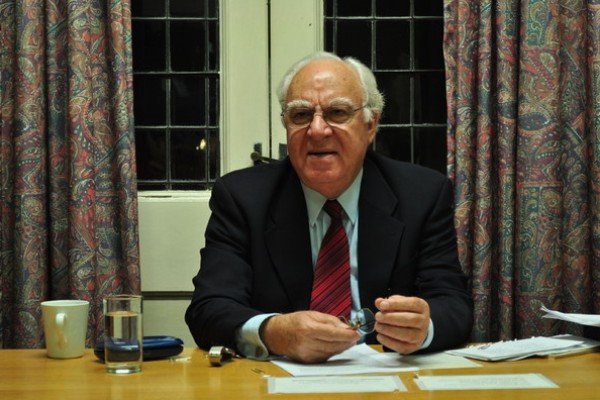
TEHRAN - Professor Farhang Jahanpour, part-time tutor on Middle Eastern affairs in the Department of Continuing Education, University of Oxford, and a member of Kellogg College says that The main reason for the idea of forming a joint European army “has been President Trump’s unilateral and ultra-nationalist approach that puts America first and, by implication, ignores the interests of other countries and tries to impose his views on them.”
Former Senior Research Scholar at Harvard adds that “He seems to have no concept of a multipolar world and he wishes to rule other countries like a global hegemon, in the same way, that he is trying to establish an imperial presidency at home.”
Following is the full text of the interview:
Q: The idea of forming a joint European army is not a new idea, but in recent days, with the comments of French President Emmanuel Macron and German Chancellor Angela Merkel and the reaction of Trump, it has assumed a new dimension. What are the reasons for the progress of this project by countries such as France and Germany?
A: The main reason for the European unease about the latest developments has been President Trump’s unilateral and ultra-nationalist approach that puts America first and, by implication, ignores the interests of other countries and tries to impose his views on them. He seems to have no concept of a multipolar world and he wishes to rule other countries like a global hegemon, in the same way, that he is trying to establish an imperial presidency at home. However, most countries of the world are reacting to that arrogant attitude and want to move towards a multipolar world based on the rule of law and respect for international treaties. 
Trump has withdrawn the United States from the landmark Paris Climate Accord that, in view of the rapid pace of global warming, many countries take very seriously. He withdrew the United States from the nuclear agreement with Iran, despite the fact that it was the result of two years of intense negotiations between seven countries, and was unanimously approved by the EU and the Security Council Resolution 2231. In defiance of UN resolutions, Trump moved the U.S. Embassy in Israel to Jerusalem, despite the fact that various international agreements have seen Jerusalem either as an international city or as the capital of a future Palestinian state. 
Trump has withdrawn America from a number of other important international agreements and organizations, including UNESCO, the Trans-Pacific Partnership, the UN Human Rights Council, etc. However, his latest withdrawal from the Intermediate-Range Nuclear Forces Treaty (INF), which prohibited the United States and Russia from possessing, producing or deploying medium-range ground-based cruise missiles, has particularly alarmed the European countries that see it as a very dangerous and provocative move. 
Trump withdrew from that treaty without any consultation either with the NATO allies or with Russia. “We’re going to terminate the agreement and we’re going to pull out,” Trump told reporters on October 20 during a campaign stop in Nevada. This is not the way that a law-abiding country should deal with international treaties or with its allies. Gorbachev who signed that agreement jointly with President Reagan told Russia’s Interfax News Agency: "Getting rid of the treaty is a mistake… All the agreements aimed at nuclear disarmament and limitation of nuclear arms must be preserved to save life on Earth."
Meanwhile, German Foreign Minister Heiko Maas said Washington should consider the consequences of pulling out of that international treaty, which he described as “an important pillar of our European security architecture."
Europe has been America’s loyal ally since the Second World War, but many Europeans have come to the conclusion that America, especially under Trump, is not treating them as allies, but as vassals. They also don’t like the unnecessary conflicts that Trump is inciting against Iran, Russia, China and others, and his unilateral sanctions on a number of countries, as well as putting pressure on U.S. allies to obey U.S. diktats and do the same.
Recently, reacting to some of the arrogant and interfering stances of the U.S. ambassador to Germany, the former German Chancellor Gerhard Schroeder told Die Welt: “When I look at the actions of the U.S. ambassador in Germany, I get the impression that he sees himself more as an occupation officer than as an ambassador of the United States in a sovereign state.” He also criticized U.S. trade policy, saying that Germany “cannot put up with being treated like an occupied country”.
Trump may be unhappy with the decision of the European countries to form a European Army but, above all, he should blame himself for this state of affairs. 
Q: Speaking to the "Europe 1" radio, French President Emmanuel Macron called for the formation of a real European military to counter Russia's threats and also independence from the USA. In the interview, the French president said: "We have to defend ourselves against Russia, China, and the even USA." Why does France now name the United States alongside China and Russia as a threat?
A: Because the United States is making excessive demands on its allies, without taking into account their long-term interests. During the Cold War, the United States formed a number of military alliances in different parts of the world to contain the former Soviet Union. They included NATO in Europe, CENTO in the Middle East and SEATO in South East Asia. 
 Those alliances boosted the status of the United States as the so-called “leader of the free world” and as the leading country in the capitalist camp. The members of those alliances were required to contribute to the cost of running those organizations allegedly to guarantee their collective security, but also to bolster the position of the United States as one of the two superpowers. 
With the collapse of the Soviet Union and the dismantlement of the Warsaw Pact, NATO should have been dismantled. In fact, Gorbachev was promised by President George H. W. Bush and his Secretary of State James Baker that if he dismantled the Soviet Union and agreed with the unification of Germany, NATO would not encroach upon former Soviet territory. However, contrary to those promises, America has brought most of the former Soviet Republics into NATO and has pushed its forces right up to the borders of Russia.
Not content with that, American governments have called on NATO members to spend 2% of their GDPs on NATO, and of course, purchase American weapons in order to maintain the compatibility of all their weapons. President Trump does not realize that NATO’s main function has been to bolster the US’s superpower status, and has complained that NATO members do not pull their weight and has demanded that all NATO members increase their contribution to 3% of their GDP. This has forced many Europeans to question the role of NATO in their security. This is why as the German Chancellor Angela Merkel, speaking to MEPs in Strasbourg on 13 November, said: “The time when we can rely on others has passed. We have to take our fate into our own hands if we want to defend our community.”
Q: Ursula von der Leyen, the German defense minister, recently said that the founding of the European Army and its future activities could not only increase the security of European countries but also solve international crises. If the joint European army carried out missions outside Europe in addition to missions inside Europe, Is this not a parallel with NATO?
A: I don’t believe that most European countries would like to dismantle NATO for the time being, but they simply wish to have more say about their own defense and to be able to act more independently. So, while they wish to strengthen their defense forces and also act more in harmony with the rest of the EU members, they will stay within NATO. But it can be said that in time a European force would act in parallel with NATO. 
Q: Trump has opposed the plan and in response to French President Macron's remarks called the formation of this army offensive. Due to Trump’s reaction and his renewed appeal to Europeans to give more money to NATO, can these disputes threaten NATO's future?
A: As I said earlier, I believe that with the collapse of the Warsaw Pact and the Soviet Union, NATO is obsolete. Instead of spending these insane amounts of money on warfare, the time has come to look for more peaceful means to ensure global security. 
A recent study has shown that since 2001, the United States alone has spent $5.9 trillion on wars and that it has been in a state of constant wars, sometimes waged through contractors. So, President Eisenhower's prediction about a military-industrial complex has been almost completely fulfilled. The continuation of the present insane course will not only create a great deal of devastation and loss of life, it may even lead to a global conflagration, which might spell the end of human civilization. 
Therefore, instead of forming a new military force, the greatest contribution that the Europeans can make is to wage a determined campaign to establish world peace through dialog and negotiation. The ideals of the United Nations were certainly very noble, but sadly many of them have remained unfulfilled. What we need now is a re-invigorated United Nations, an end to militarism and a new Human Rights Charter for all the people of the world, not the privileged few. 
The conflict between Europe and Russia has been artificially intensified in order to sell more arms. Many Europeans see Russia as a member of the European family of nations, and China and India as the two rising powers are also more interested in trade and economic development than in war and conflict. Europe can play a historic role by dismantling NATO, putting an end to militarism and starting a new world order.

Thursday, September 13, 2018

Europe's hollow threats

Europe's hollow threats
TEHRAN, Sep. 12 (MNA) – Although there has recently been lots of controversies on issues such as developing an "independent payment system" Europe and a "pseudo-swift structure" to maintain the nuclear deal with Iran, many analysts and experts in economic affairs believe that there's no real intention to actualize this idea among the EU authorities.
In the meantime, there are deterrent factors that have hampered European independence from the United States, and it seems that these factors are now highlighted under the presidency of Donald Trump.
The fact is that European politicians, and especially the current generation of European rulers act as the main barrier in this way. While some left-wing and Social-Democrats are about to put the idea into practice, some politicians such as the  German Chancellor Angela Merkel, French President Emmanuel Macron and the British Prime Minister Theresa May are opposed to this idea.
They were committed to maintaining Europe's economic and security dependence on Washington. However, the key question is whether the European countries will succeed on this path or not? Is there really a will to develop an independent payment system from the United States in Europe? The answer to this question is negative!
One of the most important prerequisites for the formation of an "independent payment system in Europe" is the consensus of the right-wing and left-wing parties on this issue. However, the European officials don't seem to have such intention. On the contrary, they have become major obstacles to realizing this goal themselves.
It's interesting that such a fact has been taken into consideration by many Western sources. For example, Foreign Policy writes in this regard:
“What’s different today is that the US is imposing sanctions contrary to the foreign policies not just of Russia and China, which have long chafed against the sanctions tool, but against the fundamental foreign policy of our closest allies in Europe and elsewhere,” Smith said. “That is what has brought us to this situation.”
It continues; "with their access to the US financial system hanging in the balance, European banks know that, in the end, the EU must satisfy Trump’s demands to fix the deal or be prepared to fully comply when US sanctions return."
Recently, the Chancellor of Germany has announced her opposition to the creation of an independent payment system in Europe (to save the Joint Comprehensive Plan of Action). Angela Merkel believes that the US-EU security relationship is a priority and this should be considered in all the EU calculations! In other words, the German Chancellor has actually preferred "to play on the US ground", and this she considers above all other options including "Europe's financial independence from the United States."
Theresa May, the British prime minister, has exactly the same opinion. She believes that, instead of confronting Trump's financial and economic policies, and even its illegal measures such as the White House's withdrawal from then nuclear deal, Europe should think about holding negotiations and interactions with Washington!
As for the French President Emmanuel Macron, his policies suggest that he has a strong desire to interact with United States under any conditions! In 2017 and during the joint-American-European Project on changing the JCPOA, he played an extremely important and highlighted role, though Trump had eventually pulled out of the nuclear deal.
Finally, it should be noted that the main obstacle to "Europe's independence from the United States" are the European authorities. As long as the current generation of European politicians are in office, such independence (in terms of security and finance) won't be actualized. When it comes to Iran sanctions, the EU seeks to satisfy Trump’s demands, and this a rule which is not going to change.