
By Dr. M. Reza Behnam
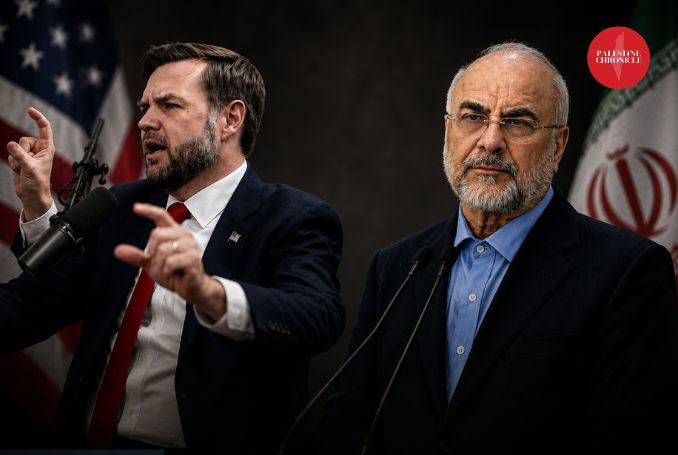 US Vice President JD Vance (L) and Iranian Parliament Speaker Mohammad Bagher Ghalibaf. (Photos: Video grab, X. Design: PC)
Fundamentally, America’s frustration with Iran is not about its nuclear potential; it is about its independence.
Strip away the diplomatic briefings, Congressional hearings and the endless cable news loops about centrifuges, regional proxies and cyber attacks, and you hit a raw unvarnished nerve.
What truly disturbs the United States about the Islamic Republic is not its policies, its rhetoric or even its nuclear ambitions. It is Iran’s audacity to exist completely outside the American orbit and make it work.
When diplomatic pretenses are scrapped, we see that a major power does not spend billions of dollars, conduct regional wars and upend global markets out of pure legalistic devotion to global rules or nonproliferation treaties.
The conflict with the United States is not about what Iran has in its centrifuges. Rather, it is about what Tehran represents to a hegemon that refuses to accept “no” and cannot tolerate a world not under its control.
If the mere possession of enriched uranium or atomic warheads were the ultimate red line, the outline of America’s animosities would look entirely different.
The “crossing the nuclear threshold” explanation collapses under the weight of obvious global contradictions. Washington, for example, has found ways to coexist, cooperate or outright partner with other nuclear-armed nations; from historical accommodations with Pakistan and India, to winking at Israel’s undeclared arsenal, and managing a pragmatic, albeit tense, approach to China and North Korea.
In the vocabulary of global superpowers, compliance is currency. Washington tolerates fierce enemies if they eventually capitulate; and it accommodates brutal allies if they submit to American domination. What empire dreads most is an uncooperative self-reliant country that refuses to bend the knee, yet stubbornly survives after decades of total economic siege.
The real reason Iran gets under the skin of the American foreign policy establishment, and why it has become its main target, has little to do with atoms, and everything to do with sovereignty, geography and the architecture of US hegemony.
For decades, the unwritten rule of the post-Cold War order was simple: align with the US-led global order, or be excluded and isolated. Most nations that initially balked had little choice but to integrate, bound by the weight of a dollar-dominated global economy. Difficult states were either absorbed, brought into client-state relationships, or heavily monitored.
In 1979, Iran did the unforgivable. It rebelled and institutionalized a successful, unapologetic ideological revolution that expressly rejected US-Israeli hegemony, and built an enduring political structure explicitly rooted in anti-imperialism and anti-Zionism. It proudly declared that a Middle Eastern state could chart its own destiny outside the Western framework.
Since then, generations of US policymakers have convinced themselves that crushing economic sanctions, diplomatic excommunication, assassinations and covert sabotage would inevitably lead to a popular implosion or “regime” collapse.
Washington’s frustration has only deepened because its strategy has not worked.
Instead, Iran adapted. It cultivated a culture of domestic self-sufficiency and pivoted Eastward, proving that a nation could survive outside the Western financial template. Washington has viewed Iran’s resilience not simply as a policy challenge, but as a dangerous ideological precedent.
One has only to look at a map to understand Washington’s obsession with Iran.
Geography is destiny, and Iran’s geographical location is the US empire’s worst headache.
Perched directly above the Strait of Hormuz, Iran sits at one of the most vital maritime crossroads on earth—the liquid throat through which massive amounts of the world’s energy pass daily.
For the better part of a century, “Pax Americana” in the region has rested on a chauvinist premise: the US military will police the global commons, control energy chokepoints and dictate the terms of regional and global trade.
The Islamic Republic has defied this assumption and refuses to allow the US to be the landlord of its backyard. To ensure its sovereignty and regional preeminence, Tehran has developed a robust asymmetrical military capability.
To a superpower accustomed to uncontested dominance across every ocean and airspace, an “unmanaged” armed power sitting astride the global energy supply is an itch that cannot be scratched.
Washington has anchored its regional hegemony through security alliances with Israel and Arab janissaries. In response, Iran engineered its own security architecture and counterweight to US-Israel dominance through a network of non-state actors and regional alliances—the “Axis of Resistance” (Lebanon, Iraq, Yemen and Syria, before President Bashar al-Assad was overthrown in 2024).
However one defines the “Axis of Resistance,” it has been a masterclass in strategic statecraft that has fundamentally checked Washington and Tel Aviv’s ambitions at almost every turn.
Iran and the US approach regional politics through fundamentally irreconcilable worldviews.
Washington acts like an indispensable global manager and boss. It makes the rules for the world and expects every other country to obey them without question. Iran, on the other hand, operates from a fiercely nationalistic, civilizational mindset that views foreign oversight as an existential insult.
Iran refuses to play the role of the chastised regional outcast, waiting for Western permission to participate. For the United States, witnessing Iran successfully institutionalize its defiance and cement its regional power would signal the end of its control over the Middle East.
Fundamentally, America’s frustration with Iran is not about its nuclear potential; it is about its independence. Iran is an enduring testament that despite all the aircraft carriers, economic blockades and diplomatic muscle of a global superpower, there are still places on earth that will look the empire in the eye and say, NO.

– Dr. M. Reza Behnam is a political scientist specializing in the history, politics and governments of the Middle East. He contributed this article to The Palestine Chronicle.

No comments:
Post a Comment